My Parents Called Me a Failure at My Sister’s Army Promotion Party—Then a Four-Star General Asked Who Had Authorized Her Promotion
PART 1: THE DAUGHTER NOBODY WANTED TO NOTICE
My younger sister’s promotion to Major was supposed to be the proudest evening of my parents’ lives.
They rented an extravagant ballroom, invited more than a hundred influential guests, and spent the night celebrating Emily as the only daughter who had ever accomplished anything worthwhile.
Meanwhile, my mother ordered me to stay near the service corridor.
She didn’t want anyone asking about my supposedly insignificant office job.
I obeyed without argument.
For almost forty minutes, I watched my family praise Emily while treating me like an embarrassing relative who had wandered into the wrong party.
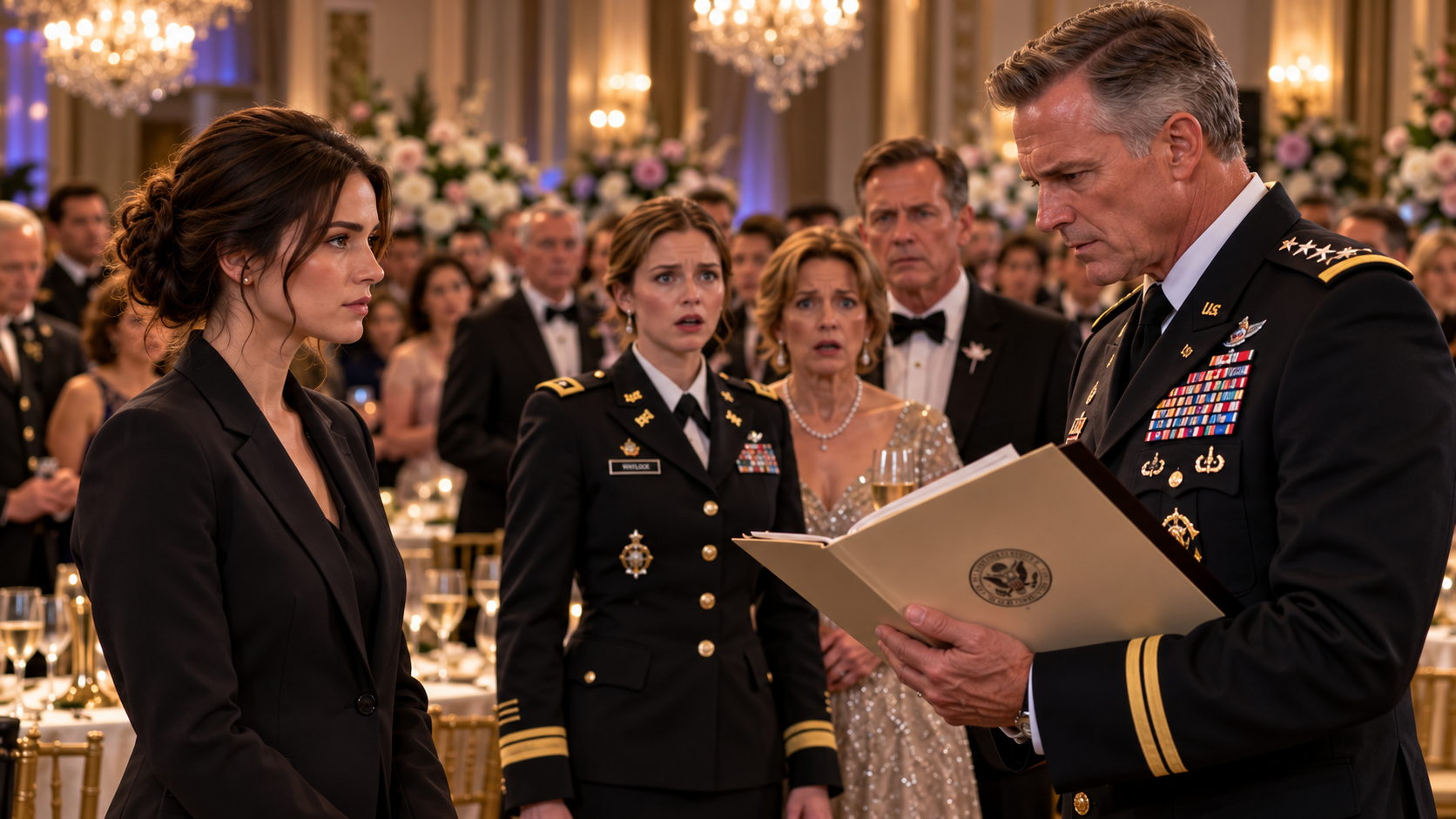
Then a four-star general entered the ballroom.
He accepted a folder containing Emily’s promotion paperwork.
After studying the documents, his expression changed.
“Who authorized this file earlier this morning?”
Nobody answered.
The general looked across the crowded room.
Past the politicians.
Past the senior officers.
Past my parents.
Then his eyes stopped directly on me.
My mother raised her champagne glass before the string quartet had even finished its opening piece.
“To Major Emily Whitlock!”
Her voice carried across the ballroom.
“The pride of our family!”
More than a hundred guests applauded.
Crystal chandeliers glittered above the tables at the Sea Pines Grand Club in Hilton Head.
The entire ballroom had been decorated for the occasion.
White linen covered the tables.
Elaborate arrangements of orchids and lilies filled the room.
Cameras flashed as guests turned toward my younger sister.
Among the attendees were state senators, defense contractors, judges, retired military officers, and wealthy families whose names frequently appeared on exclusive guest lists.
My parents had spared no expense.
After all, Emily was celebrating her promotion to Major.
And according to my mother, no achievement in our family’s history had ever deserved a grander celebration.
Emily stood beside the stage in her Army dress uniform.
She looked immaculate.
The golden oak leaves on her shoulders reflected the chandelier light.
Every ribbon sat perfectly in place.
Her hair had been arranged into a flawless twist.
And her smile never seemed to weaken, no matter how many people approached to congratulate her.
She looked entirely comfortable at the center of attention.
That wasn’t surprising.
My sister had spent most of her life there.
A retired colonel stepped forward to shake her hand.
“Making Major before thirty,” he remarked. “That’s impressive.”
Another guest nodded approvingly.
“I expect we’ll be hearing plenty about you in Washington.”
Emily gave a small, carefully practiced laugh.
She placed one hand against her chest.
“I’ve simply been lucky enough to learn from some remarkable mentors.”
I nearly choked on my water.
But I swallowed, lowered the glass, and kept my expression neutral.
There was no reason to create a scene.
Not tonight.
My name is Megan Whitlock.
I had arrived wearing a dark blazer, black trousers, and simple heels.
Nothing flashy.
Nothing intended to draw attention.
I’d deliberately chosen clothes that would allow me to blend into the crowd.
I stood near the ballroom entrance, watching my sister receive one compliment after another.
Every few moments, another influential guest approached her.
Some wanted to discuss her career.
Others wanted photographs.
My father moved between groups of visitors, proudly introducing Emily whenever an opportunity appeared.
My mother looked as though she might burst with happiness.
Then she noticed me.
Her smile tightened immediately.
She excused herself from the conversation she’d been having and hurried across the ballroom.
“Megan.”
Her eyes traveled over my clothes.
“Thank goodness you managed to dress appropriately.”
I looked down at my blazer.
“It’s just a jacket, Mom.”
She gave an impatient nod.
“Yes, darling, I can see that.”
Then she caught my forearm and leaned closer.
“I need you to pay attention to something.”
Her voice became quieter.
She glanced toward a nearby group of defense executives.
“There are some very important guests here tonight.”
I waited.
She tightened her grip slightly.
“Please don’t start discussing that little office job of yours.”
I turned toward her.
“My little office job?”
Mom sighed as though I were being deliberately difficult.
“You know what I mean.”
I didn’t.
Or rather, I knew exactly what she meant, but I wanted to hear her say it.
She glanced around to make sure nobody important was listening.
“When people hear you handle military paperwork, they assume you’re doing clerical work.”
She lowered her voice further.
“I don’t want anyone confusing whatever you do with Emily’s actual accomplishments.”
For a moment, I simply looked at her.
There it was.
The familiar dismissal.
The same attitude I’d heard throughout my adult life.
In our family, Emily was the real soldier.
Emily was ambitious.
Emily was going places.
Every new assignment, every professional milestone, and every compliment she received became another reason for my parents to celebrate.
My own work never seemed to qualify.
According to them, I worked somewhere in defense.
I dealt with documents.
I spent my days in an office.
And because I rarely discussed the details of my responsibilities, they assumed there was nothing particularly important to discuss.
I wasn’t the daughter my mother could proudly introduce at expensive dinner parties.
I didn’t return home with dramatic stories that my father could repeat to his friends.
So they had decided my career was insignificant.
And apparently, that meant I needed to remain invisible during Emily’s celebration.
Mom leaned closer again.
“I’d prefer it if you stayed near the tables at the back.”
She paused.
“Perhaps by the service corridor.”
I stared at her.
She continued before I could answer.
“Of course, be courteous if anyone speaks to you. But remember, tonight is about your sister.”
The scent of orchids and lilies surrounded us.
It was almost excessively sweet.
My mother had always loved expensive arrangements.
Perfect flowers.
Perfect lighting.
Perfectly polished appearances.
She believed a beautiful room could make any gathering look successful.
And sometimes I wondered whether she preferred beautiful appearances because they kept people from noticing what was happening underneath.
I glanced toward Emily.
She was laughing with another group of guests.
Then I looked back at Mom.
“If that’s what you want.”
Her answer was immediate.
“It is.”
She patted my arm.
It was the same gesture she’d used when I was ten years old and being told to behave in front of company.
Then she hurried away.
Within seconds, she was back beside Emily, smiling proudly.
I remained where she’d told me to stay.
Nearly forty minutes passed.
I watched guests approach the stage to congratulate my sister.
My father seemed determined to make sure everyone knew how proud he was.
My mother moved through the ballroom with her champagne glass, repeating Emily’s achievements whenever another conversation began.
Occasionally, someone asked about me.
My parents acknowledged my presence only when avoiding the question became impossible.
Then their attention returned to Emily.
I didn’t approach the stage.
I didn’t interrupt the speeches.
And I certainly didn’t try to compete for attention.
I stood near the back, exactly where Mom wanted me.
From there, I could see almost the entire ballroom.
The politicians clustered together in small groups.
The retired officers exchanging stories.
The defense executives speaking quietly over their drinks.
And Emily, radiant beneath the chandeliers, enjoying every moment.
Then the ballroom doors opened.
The change in the room was immediate.
Several senior military officers standing near the stage straightened almost instinctively.
Conversations slowed.
Heads turned toward the entrance.
A four-star general walked into the ballroom.
His presence drew attention even among guests accustomed to meeting powerful people.
Emily noticed him immediately.
Her smile grew wider.
My mother looked so delighted that she nearly spilled her champagne.
The general greeted several people as he entered.
He shook hands.
Exchanged a few quiet words.
Acknowledged the officers who approached him.
For a moment, it appeared that he had come simply to join the celebration.
Then one of his aides handed him a folder.
The general accepted it.
Opened the cover.
And began reading.
He examined the first page carefully.
His expression changed.
It wasn’t a dramatic reaction.
He didn’t raise his voice or announce that something was wrong.
But the warmth disappeared from his face.
He turned toward my sister.
“Major Whitlock.”
Emily straightened.
“Sir?”
He held up the folder slightly.
“This promotion authorization came across my desk earlier today.”
A few nearby conversations stopped.
The silence spread gradually through the ballroom.
The general turned a page.
Read another section.
Then flipped to the next sheet.
Nobody interrupted him.
Emily continued smiling, but her expression had become noticeably less certain.
The general paused.
“Interesting.”
One word.
Quietly spoken.
Yet it seemed to change the atmosphere in the entire room.
I watched my mother’s face.
Only moments earlier, she had been glowing with pride.
Now she was studying the general, trying to understand why he was examining Emily’s paperwork so closely.
My father stopped speaking to the guest beside him.
Emily stood beside the stage, waiting.
The general looked up from the folder.
“Who authorized her file this morning?”
Nobody responded.
The ballroom grew still.
More than a hundred guests had gathered to celebrate my sister’s promotion.
Yet suddenly, no one seemed willing to say a word.
The general held the folder in one hand.
His eyes moved slowly across the room.
He looked beyond the senior officers standing near the stage.
Past the politicians and defense contractors.
Past the wealthy guests seated beneath the chandeliers.
My mother’s champagne glass remained suspended near her chest.
Emily’s confident smile had begun to disappear.
Then the general looked beyond my parents.
Toward the back of the ballroom.
Toward the tables beside the service corridor.
Toward me.
I hadn’t moved from the place my mother had chosen.
My dark blazer was still buttoned.
My glass of water remained in my hand.
And I had spent the entire evening doing exactly what my family expected.
Staying quiet.
Avoiding attention.
Making sure Emily enjoyed her moment.
But now the general’s gaze rested directly on me.
He had asked who approved the authorization earlier that morning.
No one had answered.
And he was looking at the daughter my parents had spent the evening describing as someone with an insignificant office job.
I met his eyes.
Across the ballroom, the silence deepened.
For forty minutes, my mother had wanted me hidden near the service corridor so nobody would mistake my work for something important.
Now a four-star general was looking straight at me while holding the most important document of my sister’s evening.
And everyone in the room was waiting to learn why.
PART 2: THE SIGNATURE THAT CHANGED EVERYTHING
General Alexander Mercer had commanded soldiers through three wars, served at the Pentagon under two administrations, and earned a reputation for asking questions that made powerful people uncomfortable.
He was not a man who enjoyed embarrassing junior officers.
Which made his next words especially unsettling.
“Ms. Whitlock, would you come forward, please?”
My mother turned toward me so abruptly that champagne spilled over the rim of her glass.
For one extraordinary second, she seemed unable to comprehend that the general had addressed me.
Then she smiled nervously.
“General, I’m terribly sorry. That’s my other daughter, Megan. She works in administration. I’m sure you meant—”
“I know exactly who she is, Mrs. Whitlock.”
The interruption was courteous.
It was also absolute.
I set my water glass on the nearest table.
As I crossed the ballroom, people moved aside.
I recognized several faces.
A senator who had testified before our oversight committee.
A defense contractor whose company had recently undergone a compliance review.
Two retired generals who had attended briefings I had chaired.
None of them had recognized me in civilian clothes, or perhaps they had simply been too polite to interrupt a family celebration.
Mercer waited until I reached him.
“Good evening, Director Whitlock.”
My father blinked.
“Director?”
I offered the general a restrained smile.
“Good evening, sir.”
He extended the folder.
“Your signature appears on the final administrative release at 0842 this morning.”
“Yes, sir.”
“And the conditional approval?”
“Mine as well.”
Mercer studied me for a moment.
“Would you explain why you attached a personnel integrity hold to an otherwise favorable promotion recommendation?”
A murmur traveled through the room.
Emily’s face drained of color.
I looked at the folder.
There were several reasons I did not want this conversation taking place in front of a hundred people.
The first was professional.
The second was personal.
The third stood six feet away wearing the rank of major.
“Sir,” I said, “I would prefer to discuss the matter privately.”
Mercer nodded once.
“Under ordinary circumstances, so would I.”
He turned toward his aide.
“Captain Brooks, please secure the documents.”
Then he faced the guests.
“Ladies and gentlemen, I apologize for interrupting your evening. There appears to be an administrative question concerning the paperwork associated with this celebration. It would be inappropriate to discuss personnel matters in a public setting.”
My mother exhaled.
For a moment, she appeared relieved.
Then Mercer continued.
“However, I would like to clarify one thing before we proceed.”
He looked at me.
“Director Whitlock serves as the civilian executive responsible for personnel integrity reviews within the Defense Leadership Assessment Office. Her office provides independent oversight of sensitive promotion and command-selection processes.”
The ballroom became utterly silent.
“She is not a clerk,” Mercer added. “And she does not merely handle paperwork.”
My father stared at me.
My mother opened her mouth.
Nothing came out.
The general continued, his voice measured.
“Her recommendations have informed decisions affecting senior officers across multiple commands. I have personally relied upon her judgment.”
I wished he had stopped there.
But Mercer glanced toward the service corridor.
“And I must say, Megan, I was surprised to find you standing at the back of the room.”
My mother looked as though she had been struck.
I held Mercer’s gaze.
“Family arrangements, sir.”
Something moved behind his eyes.
Understanding, perhaps.
Or disappointment.
He did not ask another question.
Instead, he turned toward Emily.
“Major Whitlock, I need you and your immediate commanding officer to join us in the private conference suite.”
Emily swallowed.
“Yes, sir.”
My father stepped forward.
“General, is there some sort of mistake?”
“We intend to determine that, Mr. Whitlock.”
My mother recovered enough to speak.
“Surely this can wait until tomorrow. Emily has worked so hard, and we’ve invited so many—”
“Mrs. Whitlock.”
Mercer’s voice remained calm.
“Your daughter’s career deserves accuracy more than ceremony.”
He gestured toward the adjoining hallway.
Emily followed him without another word.
I started after them.
Then my father caught my arm.
“Megan.”
I stopped.
He leaned close enough that only I could hear him.
“What have you done?”
For thirty-three years, I had waited for my father to ask me about my work.
Not once had he shown genuine curiosity.
Now he wanted answers.
And the first thing he assumed was that I had harmed his favorite daughter.
“I did my job,” I said.
His grip tightened.
“Don’t play games. This is Emily’s night.”
I looked down at his hand.
“Then perhaps you should let me help determine whether she can still enjoy it.”
He released me.
I walked away before he could answer.
The conference suite was on the second floor.
Its windows overlooked the dark Atlantic, where distant lights from fishing vessels moved against the horizon.
General Mercer took the seat at the head of the table.
His aide placed the folder before him.
Emily sat opposite me.
Beside her was Colonel Thomas Reed, a compact man with silver hair and the exhausted expression of someone who had spent the afternoon answering uncomfortable questions.
I knew Reed.
More importantly, I knew his signature.
Mercer folded his hands.
“Let’s establish the facts.”
He looked at me.
“Director?”
I opened my leather portfolio.
“The Army’s official promotion process was completed through the appropriate personnel channels. My office did not grant Major Whitlock her rank, and we have no authority to do so.”
Emily shifted.
“Then why are we here?”
“Because,” I said, “your promotion was accompanied by a recommendation for assignment to the Strategic Defense Integration Program.”
Colonel Reed lowered his eyes.
The program was a highly selective initiative coordinating military logistics, procurement oversight, and classified operational planning.
Its members handled sensitive information involving enormous contracts and national security priorities.
Selection required more than an impressive service record.
It required integrity reviews.
Background assessments.
And confirmation that no unresolved conflicts of interest could compromise a candidate.
Emily had been nominated three months earlier.
Her file had arrived at my office six weeks before the party.
At first glance, it was exemplary.
Outstanding evaluations.
Exceptional leadership assessments.
Strong endorsements from senior officers.
But two weeks into the review, an analyst noticed something strange.
Several performance statements appeared to have been copied from reports submitted by another officer.
Not merely similar.
Identical.
The original officer was Captain Daniel Foster, a logistics specialist who had served under Emily during an overseas assignment.
His name appeared repeatedly in internal project records.
Yet in the nomination package, nearly all references to his contributions had disappeared.
Mercer opened the folder.
“Major Whitlock, do you know Captain Foster?”
Emily stared at the tabletop.
“Yes, sir.”
“Did he work on the logistics modernization initiative referenced in your nomination?”
“Yes.”
“Was he the principal architect of the supply-chain redesign?”
A pause.
“He contributed.”
I placed a document on the table.
“His original performance report identifies him as project lead.”
Emily glanced at it.
“Reports can be misleading.”
“Certainly,” I replied. “That’s why we requested supporting records.”
I slid forward another page.
“Captain Foster submitted the initial proposal, supervised the testing phase, and authored the implementation plan.”
Colonel Reed cleared his throat.
“Director, these matters were addressed at the unit level.”
I looked at him.
“Then perhaps you can explain why the unit-level investigation was closed without interviewing Captain Foster.”
Reed went still.
Mercer turned toward him.
“Colonel?”
Reed adjusted his glasses.
“The inquiry found insufficient evidence of misconduct.”
“Who conducted it?”
“An internal review officer.”
“Selected by whom?”
Reed hesitated.
“By my office.”
The general leaned back.
“Interesting.”
It was the same word he had spoken in the ballroom.
This time, nobody misunderstood it.
Emily looked at me with an expression I had seen throughout childhood.
Anger mixed with disbelief.
“You knew about this?”
“Yes.”
“And you didn’t tell me?”
“I wasn’t permitted to discuss an active review.”
“I’m your sister!”
“And I was responsible for an independent assessment.”
Her cheeks reddened.
“You could have warned me.”
I felt something cold settle inside my chest.
“Warned you about what, Emily?”
She opened her mouth.
Then closed it.
I waited.
Finally, she looked away.
Mercer noticed.
“Major, is there something you wish to disclose?”
“No, sir.”
I removed the final document from my portfolio.
“This morning, our office received an amended certification from Colonel Reed’s command. It stated that the integrity concerns had been fully resolved.”
Reed nodded quickly.
“Correct.”
“Unfortunately,” I continued, “the certification included an electronic reference number associated with a review that never occurred.”
Mercer looked at Reed.
The colonel’s expression changed.
Not dramatically.
But enough.
The general extended his hand.
“Let me see that.”
I passed him the document.
He studied it.
Then looked up.
“Colonel Reed, who prepared this certification?”
Reed swallowed.
“My personnel staff.”
“Who instructed them to prepare it?”
Silence.
Mercer repeated the question.
This time, Reed answered.
“I did.”
Emily closed her eyes.
I felt no satisfaction.
Only a familiar, exhausting sadness.
Mercer placed the document on the table.
“Director Whitlock, what action did you take?”
“I authorized release of the routine administrative acknowledgment so the official promotion process would not be improperly disrupted. I separately placed the special-assignment nomination under review and referred the certification discrepancy to the appropriate investigative authorities.”
Mercer nodded.
“So Major Whitlock’s rank remains valid.”
“Yes, sir. Unless a separate lawful process determines otherwise.”
“And her proposed assignment?”
“Suspended pending review.”
The general turned toward Emily.
“Do you understand the distinction, Major?”
“Yes, sir.”
“Good. Because tonight’s celebration does not change either fact.”
Emily’s eyes glistened.
For the first time that evening, she looked less like the polished officer beneath the chandeliers and more like the little girl who used to hide broken things beneath her bed rather than admit she had damaged them.
Mercer stood.
“We will continue this through official channels. Nobody in this room is to interfere with witnesses or records.”
He looked at Reed.
“Colonel, you will remain available.”
Then he turned toward me.
“Director Whitlock, a word.”
We stepped into the hallway.
The door closed behind us.
Mercer looked tired.
“Your sister didn’t know you were involved?”
“No, sir.”
“Your parents?”
“They believe I process routine documents.”
He regarded me for several seconds.
“Why haven’t you corrected them?”
I looked toward the staircase.
From below came faint music.
My mother had apparently instructed the quartet to resume.
“Because I tried, once.”
Mercer waited.
“When I received my first major appointment, I invited them to the ceremony. My father said he had already promised to attend Emily’s training graduation.”
“And your mother?”
“She asked whether the ceremony would be worth traveling for.”
Mercer’s expression hardened.
“I see.”
I gave a small shrug.
“Eventually, I stopped explaining.”
He looked toward the conference room.
“Your sister may be facing a difficult investigation.”
“I know.”
“And you cannot protect her from the consequences.”
“I know that too.”
Mercer nodded.
“Then I suggest you prepare for the possibility that your family will blame you.”
I almost laughed.
“They already do.”
But I had no idea how much worse it was about to become.
Because when I returned downstairs, my mother was waiting at the foot of the staircase.
And standing beside her was a man I had hoped never to see again.
Richard Vale.
Chief executive of Vale Strategic Systems.
One of the largest defense contractors in the region.
And the man whose company had paid for my sister’s entire promotion party.
PART 3: THE SECRET BEHIND THE PERFECT PROMOTION
Richard Vale smiled when he saw me.
It was a polished, practiced smile.
The kind that belonged on magazine covers and corporate annual reports.
“Megan Whitlock,” he said warmly. “What an unexpected pleasure.”
I stopped three steps above him.
“Mr. Vale.”
My mother glanced between us.
“You know Richard?”
“We’ve met professionally.”
Vale chuckled.
“More than met. Director Whitlock’s office has been rather interested in our compliance procedures.”
My mother looked confused.
“Director?”
He raised an eyebrow.
“Your daughter hasn’t told you?”
Before she could answer, I stepped off the staircase.
“Mr. Vale, this isn’t an appropriate setting for business.”
“Of course.”
His smile remained.
“But I do hope we can clear up any misunderstandings.”
I looked at him carefully.
“Misunderstandings?”
“Administrative ones.”
The word sounded harmless.
His tone did not.
Vale Strategic Systems had been seeking a major logistics technology contract.
The company supplied tracking systems, military communications equipment, and software used to coordinate sensitive transportation networks.
Its proposed platform promised to reduce supply delays across multiple commands.
On paper, it was impressive.
In practice, our preliminary review had uncovered irregularities in subcontractor disclosures and possible conflicts involving former military personnel.
Nothing had been proven.
But the questions were serious enough to require additional scrutiny.
I had recommended that the review continue before any favorable compliance determination.
Vale had not been pleased.
Now he stood in front of me at my sister’s party.
Wearing a tuxedo.
Smiling beside my mother.
And behaving as though our professional disagreement were a minor social inconvenience.
My father approached.
“Richard, there you are.”
He placed a hand on Vale’s shoulder.
“Have you met Megan?”
Vale’s smile widened.
“Indeed.”
Dad turned toward me.
“Richard has been incredibly generous. He helped arrange the venue and introduced Emily to several important people.”
I felt my stomach tighten.
“Helped arrange?”
My mother waved a dismissive hand.
“He insisted on contributing. Such a thoughtful gesture.”
I looked at Vale.
“How thoughtful.”
He tilted his head.
“Your sister has a remarkable future.”
“I’m sure she does.”
“And talented young officers deserve support.”
“Support should never come with expectations.”
His smile faded slightly.
My father frowned.
“Megan, there’s no need to be rude.”
I ignored him.
“Mr. Vale, did your company directly fund this event?”
My mother laughed nervously.
“Good heavens, Megan. Must you interrogate everyone?”
Vale adjusted his cuff.
“It was a private contribution through an events foundation.”
“Which foundation?”
His eyes narrowed.
“Why?”
“Because I’d like to know.”
My father stepped between us.
“That’s enough.”
I looked at him.
“Dad, this matters.”
“What matters,” he snapped, “is that your sister has earned something extraordinary, and you seem determined to ruin it.”
There it was again.
The familiar accusation.
I was the difficult daughter.
The jealous daughter.
The daughter who could never simply be happy for Emily.
I had spent years hearing variations of the same speech.
But now the circumstances were different.
“Did Emily know who funded tonight?” I asked.
My mother stiffened.
“Of course she did.”
My father nodded.
“Richard’s generosity is hardly a secret.”
“Then did she disclose it through the appropriate ethics channels?”
My father stared at me.
“What are you talking about?”
Vale spoke before I could answer.
“Director Whitlock, perhaps we should discuss this privately.”
I turned toward him.
“That’s the first sensible suggestion you’ve made.”
He gestured toward the garden terrace.
I did not follow immediately.
Instead, I took out my phone and sent a brief message to Captain Brooks.
Then I stepped through the glass doors.
The night air was cool.
Beyond the terrace, palm trees shifted in the ocean breeze.
The distant sound of waves carried across the grounds.
Vale waited until the doors closed.
“You’re making this unnecessarily complicated,” he said.
I looked at him.
“Am I?”
“Your sister is talented. She has powerful supporters. Her career could be exceptional.”
“Her career belongs to her.”
“Of course.”
He paused.
“But opportunities require relationships.”
I folded my arms.
“What do you want, Richard?”
For the first time, his smile disappeared completely.
“I want your office to stop delaying the compliance review.”
I said nothing.
He continued.
“Our company has invested hundreds of millions of dollars developing technology that will save lives. Every month of delay costs taxpayers money.”
“If your disclosures are complete, the review will establish that.”
“You know how these things work.”
“Yes,” I replied. “I do.”
His jaw tightened.
“You could resolve the remaining questions with a phone call.”
“No.”
He stared at me.
“Just like that?”
“Just like that.”
Vale stepped closer.
“You should consider what happens if your sister’s career becomes collateral damage.”
I felt my pulse quicken.
“Are you threatening her?”
“I’m explaining reality.”
“No,” I said. “You’re explaining leverage.”
His expression hardened.
“You’re not as untouchable as you think.”
I looked directly at him.
“I’ve never considered myself untouchable.”
He lowered his voice.
“Your father has business relationships. Your sister has ambitions. Your mother has friends who would be very disappointed to hear certain things.”
“Such as?”
Vale studied me.
Then smiled again.
“Perhaps we should leave it there.”
I took a step back.
“That’s probably wise.”
He turned toward the ballroom.
But before he reached the doors, I spoke.
“Richard.”
He stopped.
“Did you know Captain Daniel Foster?”
For the first time, he seemed genuinely surprised.
“Who?”
“Captain Foster.”
Vale’s expression recovered.
“I meet hundreds of officers.”
“Then perhaps you’ll remember him when the investigators ask.”
He stood motionless for a moment.
Then opened the door and went inside.
I remained on the terrace.
My hands were cold.
Not from the wind.
From the realization that the problem was larger than Emily’s nomination.
Much larger.
Ten minutes later, Captain Brooks joined me.
“Director.”
I turned.
“Did you hear enough?”
He nodded.
“General Mercer has been informed. Your contemporaneous account is being preserved, and the appropriate investigators will be notified.”
“Thank you.”
Brooks hesitated.
“There’s something else.”
He handed me a sealed envelope.
“This arrived through the hotel concierge. It was addressed to you.”
I looked at the handwriting.
My name had been written in block capitals.
Inside was a single sheet of paper.
And one photograph.
The photograph showed Emily standing beside Richard Vale outside a conference center.
Beside them was Colonel Reed.
And a fourth person.
A young man in civilian clothes.
Daniel Foster.
I turned the photograph over.
On the back, someone had written:
Ask your sister what happened in Germany. Ask her why Daniel stopped answering his phone.
My throat tightened.
Beneath the photograph was a printed message.
They didn’t just steal his work.
They destroyed his career when he tried to report it.
I read the words twice.
Then I looked at Brooks.
“Who delivered this?”
“The concierge said a woman left it approximately twenty minutes ago.”
“Did she give a name?”
“No, ma’am.”
I stared at the photograph.
Something about Daniel’s expression disturbed me.
He wasn’t smiling.
He looked exhausted.
And Emily’s hand rested on his shoulder in a way that appeared almost possessive.
I had reviewed dozens of documents bearing his name.
But I had never seen his face.
Until now.
“Captain,” I said, “I need to know whether Foster is safe.”
Brooks nodded.
“I’ll make the appropriate inquiries.”
I returned to the ballroom.
The music had stopped again.
My mother stood beside Emily near the stage.
Both looked furious.
My father approached before I could reach them.
“We need to talk.”
“Not now.”
“Yes, now.”
He pointed toward an empty alcove.
I followed him.
My mother and Emily joined us.
The moment we were out of earshot, my mother turned on me.
“What did you say to the general?”
I stared at her.
“Mom—”
“Don’t pretend you don’t understand. Emily is humiliated.”
Emily folded her arms.
“You’ve been investigating me.”
“I reviewed an assignment nomination.”
“You knew it was mine.”
“Not when the review began.”
“But you continued.”
“Yes.”
She gave a bitter laugh.
“Of course you did.”
My father leaned toward me.
“Couldn’t you have passed the file to someone else?”
“I disclosed the relationship and was screened from decisions requiring recusal. The review was handled under independent controls.”
“Then why was your name on the authorization?”
“Because I signed the administrative release in my official capacity after legal review. That didn’t make me the investigator.”
My mother shook her head.
“Listen to yourself. You sound like you’re trying to justify betraying your own sister.”
I felt something inside me begin to fracture.
Not because the accusation was new.
But because, for once, the consequences were real.
“Emily,” I said quietly, “did you take credit for Captain Foster’s work?”
She stared at me.
“Excuse me?”
“Did you?”
Her face reddened.
“You have no idea what happened over there.”
“Then tell me.”
My mother interrupted.
“Megan, stop this immediately.”
I kept my eyes on Emily.
“Did you know Vale was funding this party?”
Emily looked away.
That was answer enough.
My father stepped forward.
“You’re not going to stand here and accuse your sister of wrongdoing based on some bureaucratic technicality.”
“Dad, this isn’t about a technicality.”
“Then what is it about?”
I took a breath.
“It’s about whether Emily’s career has been influenced by people who expect favors in return.”
My mother’s face twisted.
“How dare you?”
Her voice rose.
Several guests turned.
“You have spent your entire life resenting your sister because she’s accomplished more than you!”
The words struck harder than I expected.
My father did not intervene.
Emily said nothing.
My mother continued.
“She worked for everything she has. She wore the uniform. She served her country. And you sat behind a desk pushing papers!”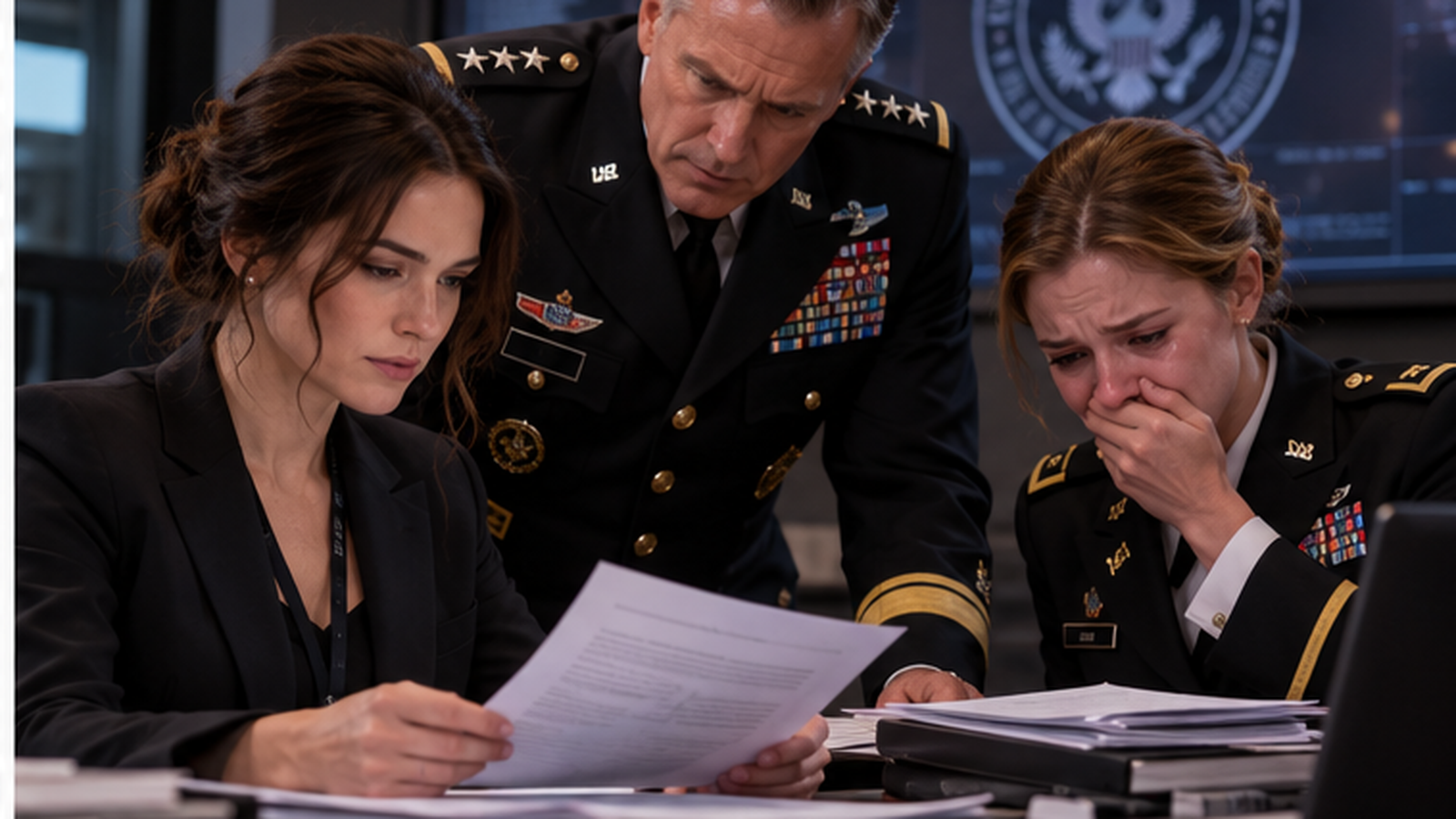
I looked at her.
For a moment, I was seventeen again.
Standing in our kitchen with a scholarship letter in my hand.
Trying to tell my parents that I had been accepted into a prestigious university program.
Only to have my mother interrupt because Emily had won a regional athletic competition.
I remembered my father promising to attend my graduation.
Then failing to appear.
I remembered birthdays.
Missed calls.
Forgotten accomplishments.
Years of being told that I was too sensitive.
Too serious.
Too difficult.
And now, in a ballroom filled with strangers, my mother was using my sister’s uniform as a weapon against me.
I felt my eyes burn.
But my voice remained steady.
“Mom, you don’t know what I’ve done for this country.”
She laughed.
“Oh, please.”
“No,” I said. “You really don’t.”
My father shook his head.
“Enough. You’re embarrassing us.”
I looked at each of them.
Then I said something I had never said before.
“I’m done trying to make you proud.”
My mother blinked.
Emily’s expression changed.
Dad frowned.
“What does that mean?”
“It means I’m going to finish my work. And whatever happens next, you will not make me responsible for choices I didn’t make.”
I turned away.
My mother called after me.
“Megan, don’t you walk away while I’m speaking!”
I kept walking.
I had nearly reached the ballroom entrance when Emily caught up with me.
Her voice was low.
“Megan.”
I stopped.
She looked over her shoulder.
Then leaned closer.
“You need to stop asking about Germany.”
A cold sensation moved through my chest.
“Why?”
Her eyes filled with tears.
“Because if you keep digging, you’re going to find something that will destroy all of us.”
Before I could answer, she walked away.
And for the first time that night, I realized my sister wasn’t simply angry.
She was terrified.
PART 4: THE TRUTH EMILY HAD BEEN HIDING
At 6:17 the following morning, my phone rang.
I had barely slept.
After leaving the party, I had driven to a small hotel several miles away rather than remain in the suite my parents had reserved.
I had spent most of the night staring at the ceiling.
Thinking about Emily.
About Daniel Foster.
About Richard Vale.
And about the strange photograph delivered to me on the terrace.
The caller was General Mercer.
“Megan.”
I sat upright.
“Sir.”
“Investigators have located Captain Foster.”
My heart quickened.
“Is he safe?”
“He’s alive.”
The pause that followed frightened me.
“But?”
“He’s been living under considerable pressure. He has agreed to provide a formal statement.”
I closed my eyes.
“Where is he?”
“I can’t discuss his location. But there’s something you need to know.”
I waited.
“His original complaint wasn’t limited to the misappropriation of his work.”
I gripped the phone.
“What else?”
“He alleged that test results were altered before a major equipment demonstration.”
I stared at the wall.
“Altered how?”
“Failures were removed from the summary reports.”
My stomach dropped.
The logistics technology involved in the demonstration was a precursor to the system Vale Strategic Systems now wanted the government to purchase.
If the allegations were true, the implications could extend far beyond Emily’s career.
“Who authorized the changes?” I asked.
“That’s under investigation.”
Mercer paused.
“Your sister’s name appears in the correspondence.”
I closed my eyes.
For several seconds, I could hear nothing but my own breathing.
Then Mercer spoke again.
“Megan, because of your family relationship and your professional involvement, I’ve asked that you be separated from the substantive investigation going forward.”
“I understand.”
“You’ll provide records through counsel and cooperate as a witness where appropriate.”
“Yes, sir.”
“Your office’s integrity review will continue under an independent official.”
“Of course.”
His voice softened.
“I know this is difficult.”
I looked toward the window.
Outside, the sun was rising over a quiet parking lot.
“Sir, I don’t think I’ve ever been more disappointed in someone.”
Mercer was silent for a moment.
“Disappointment is not a verdict. Let the evidence establish what happened.”
He was right.
But that didn’t make the pain disappear.
By noon, the first rumors had begun circulating.
A local political columnist reported that Emily’s special assignment had been suspended.
An anonymous source claimed there were questions about her professional evaluations.
By late afternoon, someone had posted photographs from the party.
One showed General Mercer holding the folder.
Another showed me standing beside him.
The caption read:
Prominent Army Officer’s Promotion Party Interrupted by Pentagon Official—Family Rivalry Suspected.
I stared at the headline.
Family rivalry.
As though years of work, legal responsibilities, and possible misconduct could be reduced to jealousy between two sisters.
My mother called seventeen times.
I didn’t answer.
My father sent a message.
You need to fix this before the press destroys Emily.
I read it.
Then put the phone away.
That evening, someone knocked on my hotel door.
I checked the peephole.
Emily stood in the hallway.
She was wearing jeans and a gray sweatshirt.
No uniform.
No perfect hair.
No practiced smile.
For the first time in years, she looked like my little sister.
I opened the door.
“What are you doing here?”
Her eyes were red.
“Can we talk?”
I hesitated.
Then stepped aside.
She entered and sat on the edge of the bed.
For several moments, neither of us spoke.
Finally, Emily looked up.
“Do you remember when we were kids and Dad used to take us fishing?”
I frowned.
“Yes.”
“He always let me hold the rod.”
I said nothing.
“You’d bait the hooks. Untangle the line. Carry the tackle box.”
I remembered.
“Then if we caught anything, he’d take a picture of me holding the fish.”
Emily gave a miserable little laugh.
“And everyone would congratulate me.”
I leaned against the desk.
“Why are you telling me this?”
She stared at her hands.
“Because I think that’s where it started.”
I waited.
“I got used to people giving me credit for things you helped with.”
Her voice trembled.
“At first, I didn’t even notice.”
I felt something tighten in my throat.
Emily wiped her face.
“Then I joined the Army. And for the first time, I was surrounded by people who didn’t care who Dad knew.”
She looked at me.
“They cared whether I could lead.”
“And could you?”
She nodded.
“At first.”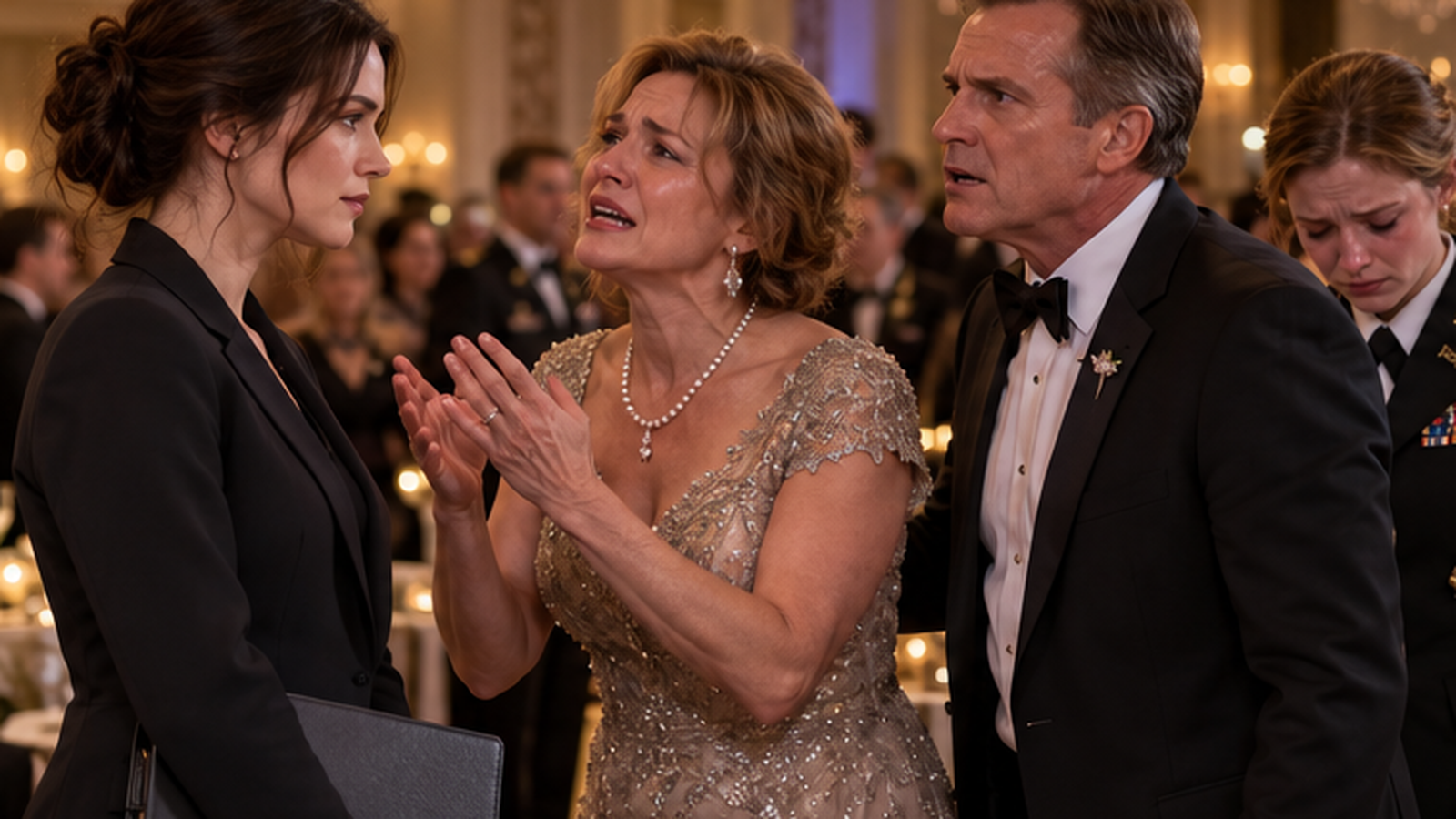
I said nothing.
“I worked hard, Megan. I really did. I was good at my job.”
“I believe you.”
Her face crumpled slightly.
“But eventually I started believing I had to be exceptional at everything.”
She took a shaky breath.
“Every evaluation. Every assignment. Every promotion. I couldn’t just be good.”
I pulled out the desk chair.
“Tell me about Daniel.”
She lowered her head.
For a long time, she said nothing.
Then she began.
Daniel Foster had arrived at her unit in Germany with a reputation for solving problems.
He was brilliant with logistics systems.
Quiet.
Methodical.
The sort of officer who noticed flaws others overlooked.
Emily had been assigned to supervise the modernization project.
At first, they worked well together.
Daniel developed the technical solutions.
Emily coordinated personnel, schedules, and command briefings.
Their early success attracted attention from senior leadership.
Then Richard Vale’s company became involved.
Vale representatives offered technical support.
They attended demonstrations.
They proposed expanding the project into a much larger program.
Colonel Reed began speaking about national recognition.
About career-making opportunities.
About officers who knew how to deliver results.
Emily’s voice grew quieter.
“One of the early demonstrations failed.”
I watched her.
“The tracking software lost contact with several simulated shipments. Daniel said the system wasn’t ready.”
“What happened?”
“Reed wanted the report revised.”
“Revised?”
Emily nodded.
“He said the failures were environmental anomalies. He wanted them listed separately instead of in the executive summary.”
“And Daniel?”
“He refused.”
She began crying.
“He said the whole point of the test was to identify failures before soldiers depended on the system.”
I felt a painful mixture of pride and dread for a man I had never met.
“What did you do?”
Emily covered her face.
“I signed the revised summary.”
The room became silent.
I waited until she lowered her hands.
“Did you know the summary was misleading?”
She nodded.
“Yes.”
The admission seemed to drain the strength from her body.
“Daniel confronted me. He said we were putting careers ahead of safety.”
“What happened next?”
“He filed a complaint.”
“And?”
“Reed told me Daniel was unstable. He said Daniel had become obsessed with the project and was trying to sabotage it because he wasn’t receiving enough recognition.”
Emily looked at me desperately.
“I wanted to believe him.”
“But you knew Daniel had raised legitimate concerns.”
“Yes.”
I took a slow breath.
“Did you retaliate against him?”
She began shaking her head.
Then stopped.
“I gave Reed an unfavorable leadership assessment.”
My stomach tightened.
“Was it accurate?”
“No.”
The word was barely audible.
I looked away.
Outside, a car passed through the parking lot.
Its headlights swept across the curtains.
For several moments, I couldn’t speak.
Then I asked the question I had been afraid to ask.
“Did you know your nomination used Daniel’s work?”
Emily nodded.
“I knew some of the language came from the project reports.”
“Did you correct it?”
“No.”
“Why?”
“Because by then everyone was calling it my achievement.”
She looked at me with naked shame.
“And I was afraid that if I corrected them, they’d realize I wasn’t the person they thought I was.”
I stared at her.
For years, Emily had been the perfect daughter.
The perfect officer.
The person my parents used as proof that ambition always led to success.
And beneath all that praise, she had become terrified of being ordinary.
I wanted to comfort her.
I also wanted to scream.
Instead, I asked, “Why are you telling me now?”
Emily wiped her eyes.
“Because Richard called me this morning.”
I sat straighter.
“What did he say?”
“He told me to keep quiet.”
“About what?”
“Everything.”
She swallowed.
“He said the investigation would disappear if I stayed loyal. He said Reed would take care of it.”
“And if you didn’t?”
Her face went pale.
“He said he’d make sure everyone knew I was responsible.”
I closed my eyes.
“Emily, you are responsible for what you signed.”
“I know.”
“But that doesn’t mean you should accept responsibility for things other people did.”
She nodded miserably.
“I don’t know how to fix this.”
I studied her.
Then I said the hardest thing I had ever said to my sister.
“You might not be able to fix your career.”
She began crying again.
I continued.
“But you can stop making the damage worse.”
She looked up.
“How?”
“Tell the truth. All of it. To the investigators. With legal counsel. Without trying to protect Reed or Vale.”
Her hands trembled.
“What if I lose everything?”
I looked at her for a long moment.
“Then you’ll have to learn who you are without everyone applauding.”
She stared at me.
I moved to sit beside her.
“And Emily?”
“Yes?”
“You won’t lose me because you tell the truth.”
She broke.
Not elegantly.
Not quietly.
She bent forward and sobbed with the kind of grief that seemed to come from years of pretending.
I put my arm around her.
For a moment, she was ten years old again.
The little girl who used to crawl into my bed during thunderstorms.
But I knew comfort wasn’t enough.
Not anymore.
When she finally stopped crying, I handed her a tissue.
“You need a lawyer.”
She nodded.
“And you need to preserve every message, every document, every communication involving Vale and Reed.”
“I will.”
“You must not coordinate your account with anyone.”
“I understand.”
I looked at her.
“Do you?”
She met my eyes.
“Yes.”
Then she reached into her bag.
“I brought something.”
She removed a small external drive.
My stomach tightened.
“What is that?”
“Copies of project correspondence. Daniel sent me the original testing records before he filed his complaint.”
I stared at the drive.
“You kept them?”
“Yes.”
“Why?”
Her voice cracked.
“Because some part of me knew he was right.”
I did not touch it.
Instead, I reached for my phone.
“We’re going to arrange for this to be transferred properly through your attorney.”
Emily nodded.
For the first time that evening, I saw something in her expression that had been missing for years.
Not confidence.
Not pride.
Honesty.
Three weeks later, the investigation took a dramatic turn.
Federal investigators obtained records showing that Vale Strategic Systems had routed payments through a consulting foundation connected to Colonel Reed’s family.
Several transactions coincided with key project milestones.
The evidence did not establish every allegation.
But it was sufficient to broaden the inquiry.
Then investigators discovered something worse.
An engineer at Vale Strategic Systems had warned management that the software’s failure rates were significantly higher than reported.
The warning had been removed from the final executive presentation.
The engineer’s name was Laura Chen.
And according to the recovered correspondence, she had been instructed to destroy her original test notes.
She hadn’t.
She had preserved them.
When investigators interviewed her, she provided a complete set of records.
The case changed overnight.
It was no longer merely about a promotion package.
It was about whether powerful people had concealed technical failures to secure a lucrative government contract.
And whether military officers had helped them do it.
Emily cooperated.
She acknowledged signing the misleading summary.
She admitted giving Daniel an unfair assessment.
She identified meetings where Reed had pressured her to support the revised findings.
Her testimony was painful.
At times, humiliating.
But she continued.
Meanwhile, my parents refused to accept what was happening.
My mother insisted Emily was being used as a scapegoat.
My father claimed the investigation was politically motivated.
Then they began telling friends that I had orchestrated the entire affair because I had always been jealous of Emily.
I learned about it when a colleague forwarded me a message.
My father had written:
Our older daughter has used her government position to pursue a personal vendetta against her sister.
I stared at the words.
Something inside me went very quiet.
I had endured their disappointment.
Their neglect.
Their insults.
But accusing me of abusing public office was different.
It could damage my professional reputation.
And it was false.
I forwarded the message to my ethics counsel.
Then I called my father.
He answered immediately.
“Megan, finally.”
“Dad, you need to stop telling people I manipulated the investigation.”
He scoffed.
“I’m entitled to defend my daughter.”
“I’m your daughter too.”
Silence.
Then he said, “You know what I mean.”
I closed my eyes.
“Yes,” I replied. “I do.”
He sighed impatiently.
“Emily’s entire future is at stake.”
“And mine isn’t?”
“You’ve got your comfortable government job. You’ll be fine.”
I looked out my office window.
Washington stretched beneath a gray afternoon sky.
“Dad, you have no idea what my job involves.”
“Then perhaps you should have explained it.”
I almost laughed.
“I tried.”
He said nothing.
“When I was promoted, I invited you.”
“We were busy.”
“When I received my national service award, I sent you the announcement.”
“I don’t remember that.”
“When I was appointed director, I called Mom.”
“She said you were moving into management.”
I swallowed.
“Did either of you ever ask what that meant?”
Silence.
Then he said, “This isn’t about you.”
I felt tears rise.
But I refused to let them change my voice.
“That’s the problem, Dad. It never is.”
I ended the call.
For the first time in my life, I did not wait for him to call back.
Four months passed.
The investigation continued.
Colonel Reed was relieved of his leadership duties pending further proceedings.
Vale Strategic Systems faced contract suspensions and additional scrutiny.
Richard Vale resigned as chief executive after the company’s board announced an independent review.
The authorities pursued the allegations through the appropriate legal and military processes.
Not every accusation resulted in a charge.
Not every suspect was guilty of every rumored offense.
But the central facts became increasingly difficult to dispute.
The test summaries had been misleading.
Daniel Foster had been punished for raising concerns.
And several influential people had tried to bury the truth.
Emily faced formal disciplinary proceedings.
She was removed from the special-assignment selection process and reassigned while her case was resolved.
Her promotion to major was not automatically erased.
But the future she had imagined was gone.
At least for the moment.
Then, one rainy Thursday afternoon, General Mercer called me into his office.
I assumed he wanted an update on the integrity reforms.
Instead, he handed me a letter.
“Read this.”
It was from Daniel Foster.
I recognized his name immediately.
The letter was brief.
He thanked the investigators who had reopened his complaint.
He described the years of professional isolation that followed his original report.
He wrote about the humiliation of being labeled unreliable.
About losing assignments.
About wondering whether speaking up had destroyed the career he loved.
Then came the final paragraph.
I don’t know whether I’ll ever fully recover what I lost. But I hope the people reviewing this case understand that the truth matters even when the person telling it has no influence, no powerful friends, and no one willing to listen.
I read the paragraph twice.
Mercer watched me.
“There’s more.”
He placed another document on the desk.
It was a memorandum recommending corrective action concerning Foster’s personnel records.
The recommendation had been approved for further processing.
I looked up.
“His record?”
“We’re working to correct the damage that can be documented.”
My throat tightened.
Mercer leaned back.
“And I’ve recommended him for a new assignment consistent with his expertise, subject to his wishes and the usual review.”
I looked down at the letter.
For months, I had thought about Emily’s shame.
My parents’ anger.
My own disappointment.
But Daniel had lost something too.
Years of his life.
Opportunities that might never return.
A reputation he had spent his career building.
And unlike Emily, he hadn’t chosen the circumstances that destroyed it.
Mercer studied me.
“You’ve done good work, Megan.”
I shook my head.
“My office did its job.”
“Sometimes that’s exactly what good work looks like.”
I looked at the letter again.
Then I asked, “Does he know?”
“Not yet.”
I nodded.
For the first time in months, I felt something resembling hope.
But the most difficult conversation was still waiting.
Because two days later, my mother appeared outside my apartment.
And she was carrying a cardboard box filled with photographs.
PART 5: THE FAMILY WE CHOOSE TO BECOME
I hadn’t seen my mother in nearly five months.
When I opened the door, she looked smaller than I remembered.
Her hair was neatly styled.
Her coat was expensive.
Her makeup was flawless.
But her eyes were tired.
For once, she didn’t begin by criticizing my clothes.
“Megan,” she said quietly.
I stood in the doorway.
“Mom.”
She looked down at the box.
“May I come in?”
I hesitated.
Then stepped aside.
She entered my apartment and looked around.
It was a modest two-bedroom place with large windows, bookshelves, and a small dining table.
I had lived there for six years.
My mother had never visited.
She studied the framed certificates on the wall.
The photographs of colleagues.
The commendations.
The picture of me standing beside General Mercer at a formal ceremony.
Then she stopped in front of a framed photograph.
It showed me at thirty years old, receiving an award for distinguished civilian service.
I was smiling.
Beside me stood three colleagues.
No family members.
My mother stared at it.
“When was this?”
“Three years ago.”
She stepped closer.
“You never told us.”
I looked at her.
“I did.”
Her face changed.
I continued.
“I sent you an invitation.”
She said nothing.
“You told me Emily had an important event that weekend.”
Mom lowered her eyes.
“I don’t remember.”
“I know.”
She turned away from the photograph.
For several moments, the only sound was the hum of the refrigerator.
Then she placed the box on my dining table.
“I found these while cleaning the attic.”
I looked inside.
Old photographs.
School certificates.
Newspaper clippings.
A faded blue ribbon.
My first debate trophy.
My high school graduation program.
A photograph of me holding a science competition award.
Another showed me standing outside my university dormitory on move-in day.
I picked it up.
My smile in the picture was enormous.
I remembered that day.
I had been terrified.
Excited.
Proud.
And desperately hoping my parents would tell me they were proud too.
My mother sat down.
“I didn’t realize how much I’d missed.”
I remained standing.
She took a breath.
“Your father and I always thought you were independent.”
I looked at her.
“Independent?”
“You never seemed to need us the way Emily did.”
The words hurt more than I expected.
“Mom, I was a child.”
She closed her eyes.
“I know.”
“No,” I said. “I don’t think you do.”
My voice trembled.
“I needed you at my graduation. I needed you when I got my first job. I needed you when I moved across the country and didn’t know anyone.”
She began crying.
I continued.
“I needed you when I worked eighty-hour weeks and wondered whether I was good enough. I needed you when I was promoted. When I failed. When I succeeded.”
I swallowed.
“And every time I called, you asked about Emily.”
My mother covered her mouth.
I had imagined this conversation for years.
In some versions, I shouted.
In others, I walked away.
But now that she was sitting in front of me, crying, I felt mostly tired.
She looked up.
“I thought you were strong.”
“I was strong because I had to be.”
The sentence hung between us.
My mother lowered her head.
For a long time, she said nothing.
Then she whispered, “I’m sorry.”
I stared at her.
It was the first apology I could remember hearing from her that wasn’t followed immediately by an excuse.
She reached into the box.
At the bottom was a folded letter.
The paper had yellowed with age.
She handed it to me.
I recognized my own handwriting.
I had written it when I was seventeen.
The night before leaving for college.
Dear Mom and Dad,
I know Emily is the one who’s good at sports and making friends, but I hope someday you’ll be proud of me too.
I stopped reading.
My eyes filled.
I remembered writing those words.
I had hidden the letter inside a drawer because I was too embarrassed to give it to them.
Somehow, it had ended up in the attic.
My mother watched me.
“I found that last week.”
I looked at her.
She began crying again.
“I sat on the floor and read it over and over.”
I couldn’t speak.
She wiped her cheeks.
“I kept thinking about all the times you tried to tell us something important, and I wasn’t listening.”
I folded the letter carefully.
“Why now, Mom?”
She looked confused.
“Why are you here now? Because the investigation became public? Because you discovered what my job actually is? Because General Mercer knows my name?”
She shook her head.
“No.”
I waited.
She looked down at her hands.
“Because Emily asked me a question I couldn’t answer.”
“What question?”
My mother’s voice broke.
“She asked whether we would still love her if she wasn’t a major.”
I felt my chest tighten.
Mom continued.
“She said she’d spent her whole life being afraid of disappointing us. And then she asked whether we’d ever loved either of you for who you were.”
A tear slid down her cheek.
“I didn’t know what to say.”
I sat opposite her.
For a long moment, neither of us spoke.
Then I said, “I don’t know whether we can go back to being the family you remember.”
She nodded.
“I understand.”
“But maybe we can build something different.”
Her eyes lifted.
I continued.
“That means no more comparisons. No more pretending Emily is perfect. No more dismissing my work because you don’t understand it.”
She nodded again.
“And no more asking me to hide who I am so someone else can feel important.”
My mother began crying harder.
“I promise.”
I held her gaze.
“Don’t promise because you’re upset today. Show me over time.”
She wiped her face.
“I will try.”
It wasn’t a perfect reconciliation.
It wasn’t a dramatic embrace that erased decades of hurt.
But it was the first honest conversation we’d had in years.
And that mattered.
My father took longer.
Much longer.
For weeks, he refused to acknowledge that anything had been wrong.
He insisted he had treated both daughters equally.
He claimed I had misunderstood his intentions.
He said families shouldn’t keep score.
Then my mother stopped defending him.
For the first time in their marriage, she challenged him when he dismissed me.
She told him about the letter.
About the photographs.
About the award ceremonies they’d missed.
And about Emily’s question.
One evening, she called me.
“Your father wants to speak with you.”
I stared at the phone.
“Does he?”
“Yes.”
“Is he ready to listen?”
A pause.
“I think he’s beginning to understand that he has to.”
We met at a small restaurant in Washington.
No chandeliers.
No influential guests.
No cameras.
Just three people sitting at a table.
My father looked uncomfortable.
He spent the first ten minutes discussing traffic and the weather.
Then he cleared his throat.
“Megan.”
I looked up.
“I owe you an apology.”
I waited.
He stared at his coffee.
“I’ve been proud of Emily because I understood her accomplishments. The Army, the uniform, the promotions. Those were things I could explain to my friends.”
He paused.
“Your work was different.”
I said nothing.
“And instead of asking about it, I assumed it wasn’t important.”
His voice grew rough.
“That was wrong.”
I felt tears rising.
He continued.
“When the general recognized you at the party, I was shocked.”
He looked at me.
“And I realized I didn’t know my own daughter.”
I swallowed.
“Dad, I never needed you to be impressed by my title.”
He nodded.
“I know.”
“I needed you to care enough to ask.”
His eyes filled.
“I know that now.”
He reached across the table.
I looked at his hand.
For a moment, I remembered every missed ceremony.
Every forgotten milestone.
Every time he’d made me feel invisible.
Then I placed my hand in his.
Not because everything was forgiven.
But because I wanted to believe people could change.
And because I had finally learned that forgiveness didn’t require pretending the past had never happened.
It required acknowledging what had happened and deciding what came next.
The months that followed were difficult.
Emily’s disciplinary case concluded after a lengthy review.
She accepted responsibility for her actions.
She received a formal reprimand, lost eligibility for the prestigious assignment, and was removed from leadership duties.
After considering her future, she chose to separate from active service through the applicable process rather than continue pursuing a command career.
It was devastating.
For years, she had built her identity around the Army.
Without it, she felt lost.
She moved into a small apartment in North Carolina.
She began counseling.
She took classes in organizational ethics and project management.
For the first time in her adult life, she had no rank to announce at family gatherings.
No distinguished uniform.
No impressive title.
And no one applauding when she entered a room.
But something unexpected happened.
She began to change.
At first, the changes were small.
She stopped exaggerating her accomplishments.
She learned to admit when she didn’t know something.
She began asking other people about their lives.
And slowly, she developed friendships that had nothing to do with status.
One afternoon, she called me.
“I got a job.”
I smiled.
“Really?”
“An operations position at a nonprofit.”
“That sounds promising.”
She laughed nervously.
“It’s not glamorous.”
“Does it matter?”
A pause.
“No,” she said. “I don’t think it does.”
“What will you be doing?”
“Helping coordinate emergency supplies for communities after natural disasters.”
I leaned back in my chair.
“Emily, that’s important work.”
She was quiet.
Then she said, “I think I finally understand why you never needed to tell everyone how important your job was.”
I smiled.
“Why?”
“Because the work matters whether anyone applauds or not.”
I closed my eyes.
For the first time in years, I felt proud of my sister without any bitterness.
Not because she had achieved something extraordinary.
But because she was learning to become someone honest.
Meanwhile, Daniel Foster’s career began to recover.
The corrections to his personnel record were completed after review.
His prior unfavorable assessment was formally addressed.
He received an opportunity to return to meaningful work in logistics modernization.
The government did not magically restore every lost year.
No institution could.
But his professional reputation was no longer defined by a false narrative.
He eventually accepted a position advising on systems reliability and procurement safeguards.
His work helped establish stronger procedures for documenting failed tests and protecting personnel who raised legitimate concerns.
I never became personally involved in his case beyond my authorized responsibilities.
But months later, I received a copy of a public speech he delivered at a professional conference.
One passage stayed with me.
He said that integrity was rarely dramatic.
It was not always a heroic moment beneath bright lights.
Sometimes it was simply refusing to change a number in a report.
Refusing to sign a statement you knew was misleading.
Or speaking up when silence would make life easier.
I printed those words and placed them in my office.
They reminded me why I had chosen my career.
Not for recognition.
Not for influence.
But because decisions made behind closed doors could affect people who would never know our names.
Richard Vale’s company underwent extensive restructuring.
Several executives were removed.
The government imposed contractual remedies and additional oversight where supported by the findings.
Colonel Reed faced military proceedings concerning his role in the false certifications and retaliatory actions.
The outcomes were reported through official channels.
The process was neither quick nor simple.
But the records that had once been buried were finally examined.
And the people who had tried to silence Daniel could no longer pretend his warnings had never existed.
A year after the promotion party, General Mercer invited me to attend a ceremony honoring civilian and military personnel who had contributed to reforms in defense oversight.
I initially declined.
Public recognition had never been something I sought.
But Mercer called me personally.
“Megan, you need to attend.”
“Sir, there are plenty of people who deserve recognition more than I do.”
“Then come for them.”
I laughed.
“That sounds suspiciously like an order.”
“It is a strongly worded invitation.”
I agreed.
The ceremony took place in Washington.
It was smaller than Emily’s party.
No extravagant flowers.
No wealthy donors.
No photographers crowding the entrance.
Just a room filled with public servants, officers, analysts, and families.
My mother and father arrived early.
I had invited them without knowing whether they would come.
When I entered the room, my father stood.
He was wearing a dark suit.
My mother held a small bouquet of white flowers.
For a moment, I stopped walking.
It was such a simple sight.
My parents waiting for me.
Not Emily.
Not a senator.
Not someone whose name appeared on a guest list.
Me.
My father smiled.
“We wouldn’t miss this.”
I felt my throat tighten.
Mom stepped forward.
“You look beautiful.”
I glanced down at my navy suit.
“It’s just a jacket, Mom.”
She laughed through tears.
“I know.”
Then she hugged me.
And this time, there was no warning to stay quiet.
No request to stand at the back.
No reminder that someone else was more important.
Emily arrived a few minutes later.
She wore a simple green dress.
Her hair was loose around her shoulders.
She looked nervous.
“Hey,” she said.
I smiled.
“Hey.”
She handed me a small envelope.
“Don’t open it until later.”
“What is it?”
“Just something I wanted you to have.”
I slipped it into my bag.
Then she hugged me.
“I love you, Megan.”
I held her tightly.
“I love you too.”
General Mercer approached shortly before the ceremony began.
He greeted my parents politely.
Then he turned toward me.
“Director Whitlock.”
“General.”
“Ready?”
I smiled.
“As I’ll ever be.”
He looked toward my family.
“It’s good to see everyone here.”
My father nodded.
“General, I owe you thanks.”
Mercer raised an eyebrow.
“For what?”
“For helping us understand what our daughter does.”
The general studied him.
Then said something I would never forget.
“Mr. Whitlock, your daughter’s work was important long before I recognized her in a ballroom.”
My father lowered his eyes.
“Yes, sir.”
Mercer continued.
“I’m glad you’re here to recognize it now.”
The ceremony began.
When my name was called, I walked toward the stage.
The room applauded.
General Mercer presented me with a commendation recognizing my contributions to integrity and accountability in defense personnel systems.
I shook his hand.
Cameras flashed.
But this time, I wasn’t looking toward the cameras.
I was looking toward the front row.
My mother was crying.
My father was applauding.
And Emily was smiling.
Not the polished smile she’d worn beneath the chandeliers a year earlier.
A real one.
Proud.
Uncomplicated.
Happy for someone else.
I accepted the commendation.
Then returned to my seat.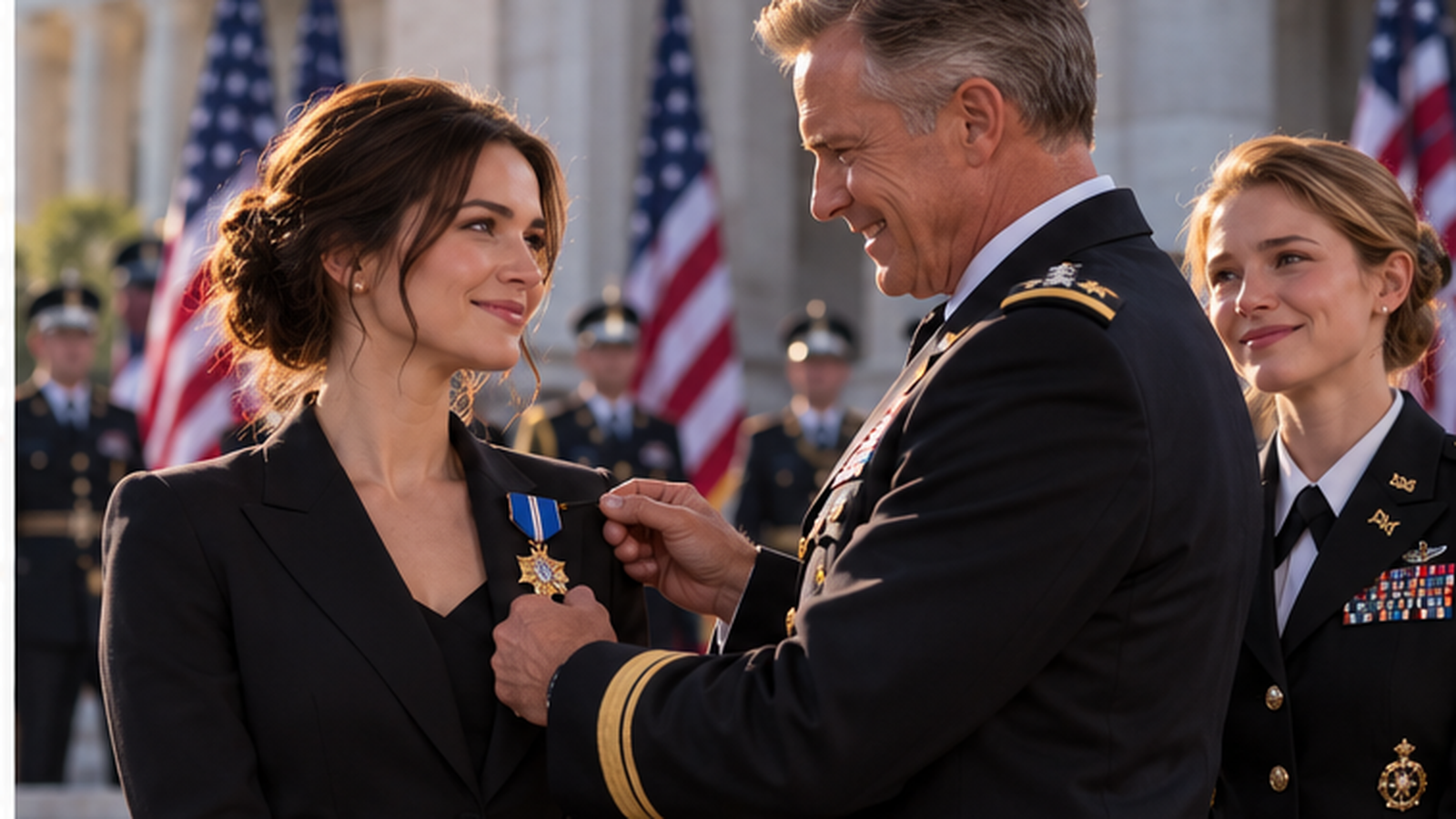
Afterward, my father asked whether we could take a family photograph.
I almost laughed.
For years, our family photographs had revolved around Emily.
Her graduations.
Her promotions.
Her awards.
Now my father wanted a picture of all four of us.
Together.
We stood beneath the American flag near the front of the room.
My mother took my hand.
Emily stood beside me.
My father placed an arm around both of us.
The photographer raised the camera.
“Everyone ready?”
I looked at my sister.
She smiled.
I smiled back.
“Yes,” I said.
“We’re ready.”
That evening, after my family left, I returned to my apartment.
I placed the commendation on my desk.
Then remembered Emily’s envelope.
Inside was a photograph.
An old one.
It showed the two of us as children.
I was perhaps twelve.
Emily was eight.
We were sitting on the front steps of our childhood home.
She had fallen off her bicycle and scraped her knee.
I had wrapped a bandage around it.
In the photograph, she was leaning against me.
I was holding her hand.
On the back, Emily had written:
You were always the person who helped me stand up.
I’m sorry I spent so many years making you feel small.
I used to think being successful meant everyone had to look at me.
Now I know it means being able to look at myself without shame.
Thank you for refusing to lie for me.
And thank you for loving me enough to tell me the truth.
Your little sister, Emily.
I sat at my desk for a long time.
Then I cried.
Not the bitter tears I had shed after the promotion party.
Not the exhausted tears that came after years of disappointment.
These were different.
They came from realizing that something I had believed was permanently broken had begun, slowly and imperfectly, to heal.
A few weeks later, my mother called.
She wanted to know whether I would come home for Thanksgiving.
I hesitated.
Family holidays had always been difficult.
But she surprised me.
“Emily is bringing a friend from work,” she said. “Your father is cooking, and I’ve promised not to interfere.”
I laughed.
“That sounds dangerous.”
She laughed too.
Then she became quiet.
“Megan?”
“Yes?”
“I wanted to ask you something.”
“What?”
“How is your work going?”
I stared at the phone.
Such a simple question.
Five words.
But for most of my life, they had been the words I wanted to hear.
I sat down.
“Actually, Mom, there’s a new project I think you’d find interesting.”
“I’d love to hear about it.”
And she listened.
She asked questions.
She didn’t interrupt.
She didn’t turn the conversation toward Emily.
For twenty minutes, we talked about my work.
Not classified details.
Not impressive titles.
Just the things I could share.
The challenges.
The people.
The reasons the work mattered.
When we finally hung up, I sat quietly for a moment.
Then I smiled.
I had spent so many years believing that my family’s approval would make me feel complete.
But the truth was, I had become complete long before they noticed.
Their recognition was meaningful.
Their apologies mattered.
Their willingness to change gave me hope.
But my worth had never depended on their understanding.
That was the lesson I had needed most.
Not that I was secretly more important than my sister.
Not that a four-star general could humiliate my parents into respecting me.
Not that professional success made me superior to anyone.
The lesson was simpler.
A person’s value does not increase when someone powerful recognizes it.
And it does not disappear when the people closest to them fail to see it.
I thought about the ballroom in Hilton Head.
The chandeliers.
The expensive flowers.
The applause.
My mother’s hand gripping my arm as she ordered me to remain near the service corridor.
I remembered standing alone with my glass of water.
Watching everyone celebrate Emily.
Feeling invisible.
Then I remembered General Mercer’s voice.
“Who authorized this file earlier this morning?”
For one extraordinary moment, the entire room had turned toward me.
My parents had finally seen that I was someone they didn’t understand.
But that wasn’t the moment everything changed.
The real change came later.
When Emily chose honesty over admiration.
When my mother learned to listen.
When my father acknowledged the damage he’d caused.
When Daniel Foster’s voice was finally heard.
And when I realized I no longer needed to prove that I deserved a place at my own family’s table.
The following Thanksgiving, I arrived at my parents’ house carrying a pumpkin pie.
Emily opened the door.
She was wearing an old sweater and an apron dusted with flour.
“Thank God you’re here,” she said.
I laughed.
“What’s wrong?”
“Dad is attempting to make gravy.”
From the kitchen came a loud clatter.
Then my father’s voice.
“Everything is under control!”
Emily rolled her eyes.
“Nothing is under control.”
I stepped inside.
The house smelled of roasted turkey and cinnamon.
My mother appeared from the dining room.
“Megan!”
She hugged me.
Then took the pie.
“Perfect timing.”
I looked toward the dining table.
Four places had been set.
Simple plates.
Cloth napkins.
A small arrangement of autumn flowers.
Nothing extravagant.
Nothing designed to impress anyone.
Just a family dinner.
My father emerged from the kitchen carrying a gravy boat.
He looked relieved to see me.
“Can you help me with something?”
I raised an eyebrow.
“Depends. Is it classified?”
He laughed.
“No. It’s the gravy.”
Emily burst out laughing.
My mother shook her head.
And I found myself laughing with them.
Really laughing.
Without caution.
Without waiting for someone to make a cutting remark.
Without feeling as though I needed to earn the right to be there.
Later, after dinner, my father raised his glass.
I felt an old instinctive tension.
For years, his toasts had always been about Emily.
Her achievements.
Her future.
Her extraordinary promise.
But this time, he looked around the table.
“I’d like to say something.”
Emily and I exchanged glances.
Dad cleared his throat.
“I spent a long time thinking a successful family was one that looked impressive to other people.”
He glanced at my mother.
“I cared too much about what people thought.”
Then he looked at Emily.
“And I put pressure on you to be perfect.”
Emily lowered her eyes.
He turned toward me.
“And I failed to see the daughter who was quietly doing extraordinary things without asking for applause.”
My throat tightened.
Dad took a breath.
“I can’t change the years I missed.”
His voice cracked.
“But I can promise to stop missing the ones ahead.”
My mother reached for his hand.
Emily wiped her eyes.
I stared at my father.
Then raised my glass.
“To the years ahead.”
Everyone repeated it.
“To the years ahead.”
And as our glasses touched, I realized something beautiful.
We were not the family we had pretended to be at Emily’s promotion party.
We were not perfect.
We still had difficult conversations.
Old wounds still hurt sometimes.
Trust still required patience.
But we were finally becoming a family that could tell the truth.
And that was worth more than any title.
More than any promotion.
More than any glittering ballroom filled with people who barely knew us.
That night, before I left, Emily walked me to my car.
The air was cold.
Leaves rustled along the driveway.
She stood beside me for a moment.
Then said, “Can I ask you something?”
“Of course.”
“Do you ever wish you hadn’t gone to my party?”
I considered the question.
I remembered my mother’s humiliation.
My father’s anger.
The investigation.
The painful months that followed.
The damage to Emily’s career.
The truth about Daniel.
All of it.
Then I shook my head.
“No.”
She looked surprised.
“Really?”
“Really.”
“Why?”
I smiled gently.
“Because if I hadn’t gone, I might still be standing at the back of the room, waiting for someone to notice me.”
Emily looked down.
Then back at me.
“And now?”
I glanced toward the house.
Through the window, I could see our parents clearing the table together.
I looked at my sister.
“Now I know I never belonged back there in the first place.”
She smiled through tears.
Then hugged me.
And this time, neither of us needed to be the more successful sister.
Neither of us needed to win.
We were simply Megan and Emily.
Two imperfect women.
Two daughters learning to understand their parents.
Two sisters learning to understand each other.
And for the first time in our lives, that was enough.
THE END.