Jim Carrey Signaled That He Was Drowning During The Truman Show—The Crew Thought He Was Still Acting
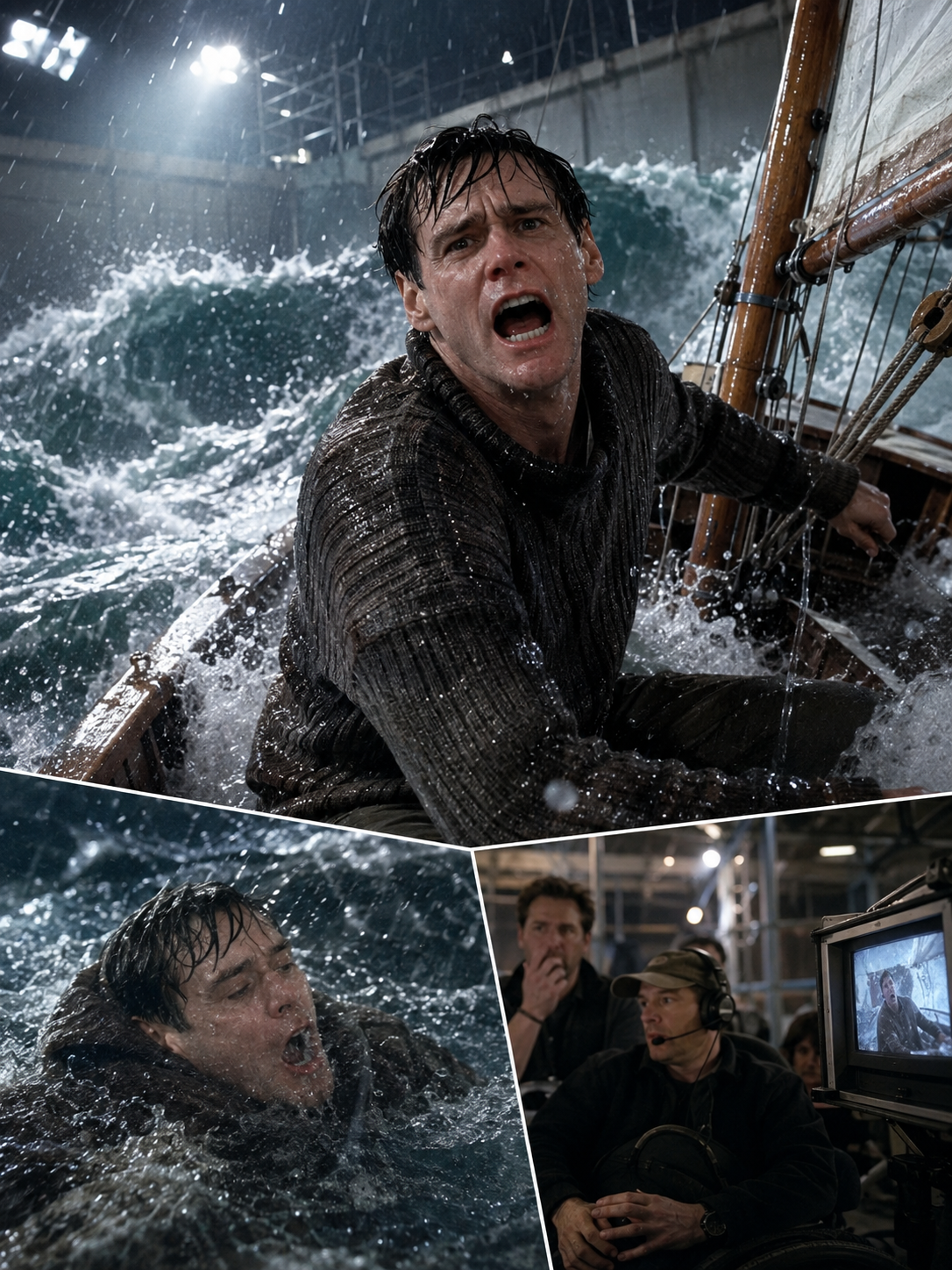
Truman Burbank clings to a sailboat as the artificial sky above him turns black.
Rain lashes his face. Waves crash across the deck. The man who has unknowingly spent his entire life inside a television studio refuses to turn back, even as the show’s creator transforms the manufactured ocean into a violent storm.
Jim Carrey’s panic in the climax of The Truman Show is convincing because part of it was no longer performance.
While filming the sequence inside a large water tank, Carrey became exhausted beneath heavy, waterlogged clothing. Powerful machinery continued driving wind and waves toward him. He used a prearranged distress signal to tell the crew that he was in trouble.
They mistook the signal for acting.
Carrey later said he sank to the bottom of the tank with almost no air remaining and escaped the most violent section of the water using what little strength he had left. Director Peter Weir confirmed that the incident occurred and said the production changed its safety procedures afterward.
The scene was written as a terrifying piece of fiction about a man nearly being killed for an audience’s entertainment. On the set, it came dangerously close to becoming real.
Truman’s Final Test
Released in 1998, The Truman Show follows Truman Burbank, an ordinary insurance salesman who does not know that his hometown is an enormous television set.
His marriage, friendships and career have all been constructed for a program broadcast continuously around the world. Hidden cameras record his every movement, while actors pose as the people closest to him.
The show’s creator, Christof, played by Ed Harris, controls Truman’s environment from a production room built into the artificial world surrounding him.
To prevent Truman from leaving Seahaven, the program has conditioned him to fear water. As a child, he was made to believe that his father drowned during a boating accident—an event secretly staged to discourage him from ever attempting to escape by sea.
By the final act, however, Truman has recognized that his world is false.
He disappears from the cameras and boards a sailboat, choosing to confront the fear that has controlled him for most of his life. When Christof’s staff discovers him, the producer orders the studio’s weather system to create a storm.
The wind intensifies. The boat is nearly overturned. Truman falls into the water and struggles to survive as millions of fictional viewers watch.
The sequence needed to look dangerous. According to Carrey, it became much more dangerous than expected.
A Storm Created Inside a Tank
The ocean sequence was filmed in a tank at Universal Studios rather than in an uncontrolled open sea.
The production used large wave machines to agitate the water. Carrey recalled jet engines or similarly powerful equipment directing air and spray toward him, creating the impression of gale-force conditions.
Safety measures were in place. Divers were positioned underwater, and the production had established a signal Carrey could use if he needed help.
The signal was a clenched fist.
But the costume added a danger that became increasingly serious as the filming continued. Carrey was wearing wool clothing, including a large sweater and pants, along with shoes.
Once saturated, those garments became considerably heavier. Every attempt to remain above the surface required more energy, while the waves repeatedly pushed him backward and beneath the water.
A performer can imitate exhaustion only up to a point. Carrey eventually stopped portraying a man reaching his physical limit and actually reached it.
He raised his clenched fist.
No one stopped the storm.
The Signal Nobody Understood
Because the scene required Truman to appear desperate, Carrey’s distress did not immediately look unusual.
The crew saw him struggling, but struggling was what the character was supposed to be doing. They saw the fist, but interpreted it as another dramatic movement within an intense performance.
Carrey later described going beneath the surface without enough breath to continue. He reached the bottom of the tank and felt himself losing consciousness.
With his remaining strength, he turned away from the center of the simulated storm and made several powerful strokes toward calmer water.
He finally surfaced outside the area being directly struck by the effects. Gasping and almost completely depleted, he reached the edge of the set and held on.
The machinery continued operating for a time because the crew still did not know where he had gone.
Only after the storm began shutting down did people locate him.
Carrey said he believed he had come extremely close to dying.
Weir later supported the essential details of the actor’s account. The director said the production had divers and other safety protocols, but acknowledged that filming a drowning scene created a dangerous ambiguity: the emergency looked like the performance they were trying to capture.
The crew did not fully understand what had happened until after the take ended.
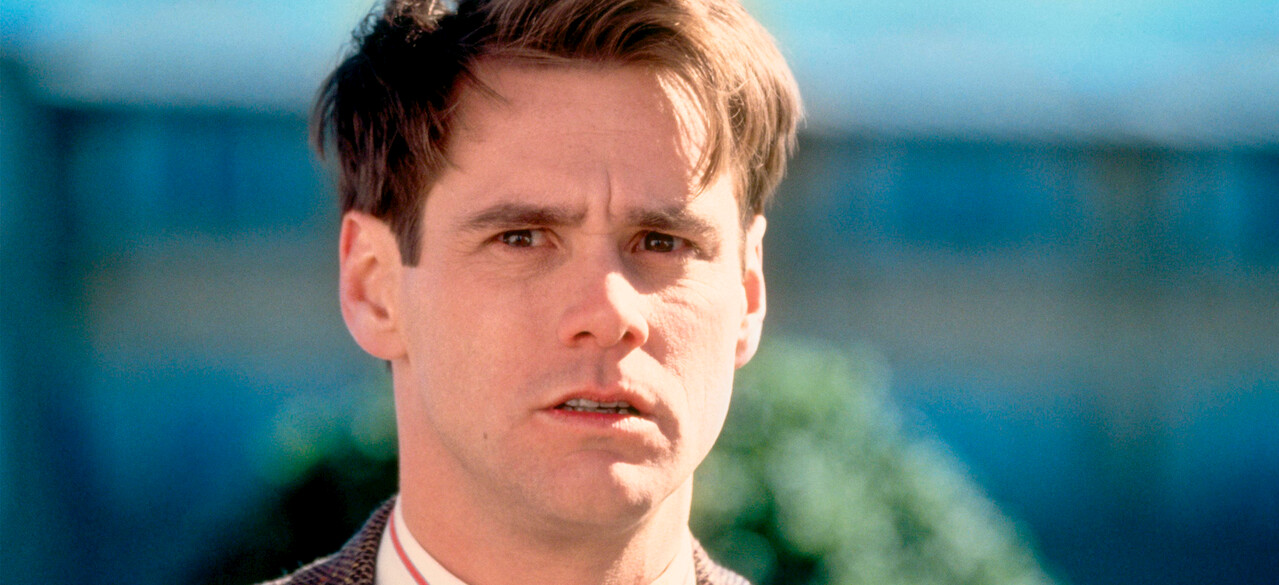
Anger After the Near Accident
Carrey was furious.
The problem was not simply that the sequence had been physically difficult. He believed the production had failed to recognize that his life was in danger despite an agreed-upon warning signal.
Weir remembered the incident as sobering and said safety procedures were revised following the near accident.
The director also recalled that Carrey was willing to perform additional takes despite what had happened. That decision did not mean the actor considered the incident acceptable. Carrey later spoke about becoming intensely angry when he believed people were being endangered.
Continuing may also have reflected the professional pressures surrounding a major studio production. The storm was essential to the film’s conclusion, and Carrey was carrying a project designed to prove that he could do more than the broad physical comedy that had made him famous.
By the late 1990s, he was one of Hollywood’s biggest stars, known for Ace Ventura: Pet Detective, The Mask, Dumb and Dumber and Liar Liar. The Truman Show offered something different: a restrained, dramatic performance inside a story about fame, surveillance and the cost of entertaining an audience.
Carrey’s personal experience during the storm made those themes disturbingly literal.
The Scene’s Unsettling Parallel
Inside the movie, Christof watches Truman being battered by the storm from the safety of his control room.
Members of the fictional production staff become alarmed. One warns that they cannot allow Truman to die while the entire world is watching.
Christof continues.
He views Truman as both his creation and his property. The possibility of death becomes secondary to preserving control over the show.
On the real set, Carrey was also being watched by cameras and crew members as he fought to remain above water. When he signaled for help, the observers believed the struggle was part of the entertainment.
The parallel is difficult to ignore.
The Truman Show asks whether an audience can become so absorbed in an image that it stops recognizing the humanity of the person inside it. Carrey’s near drowning exposed a similar danger in filmmaking: when an actor is expected to portray terror convincingly, genuine terror may be mistaken for professional excellence.
The moment also reflected Carrey’s complicated relationship with fame.
Like Truman, he had become the center of an enormous entertainment machine. Audiences expected energy, vulnerability and constant performance from him, while the private person behind those expectations was easier to overlook.
Carrey later connected Truman’s departure from the artificial world with his own growing desire to stop living solely as the crowd-pleasing figure others wanted him to be.
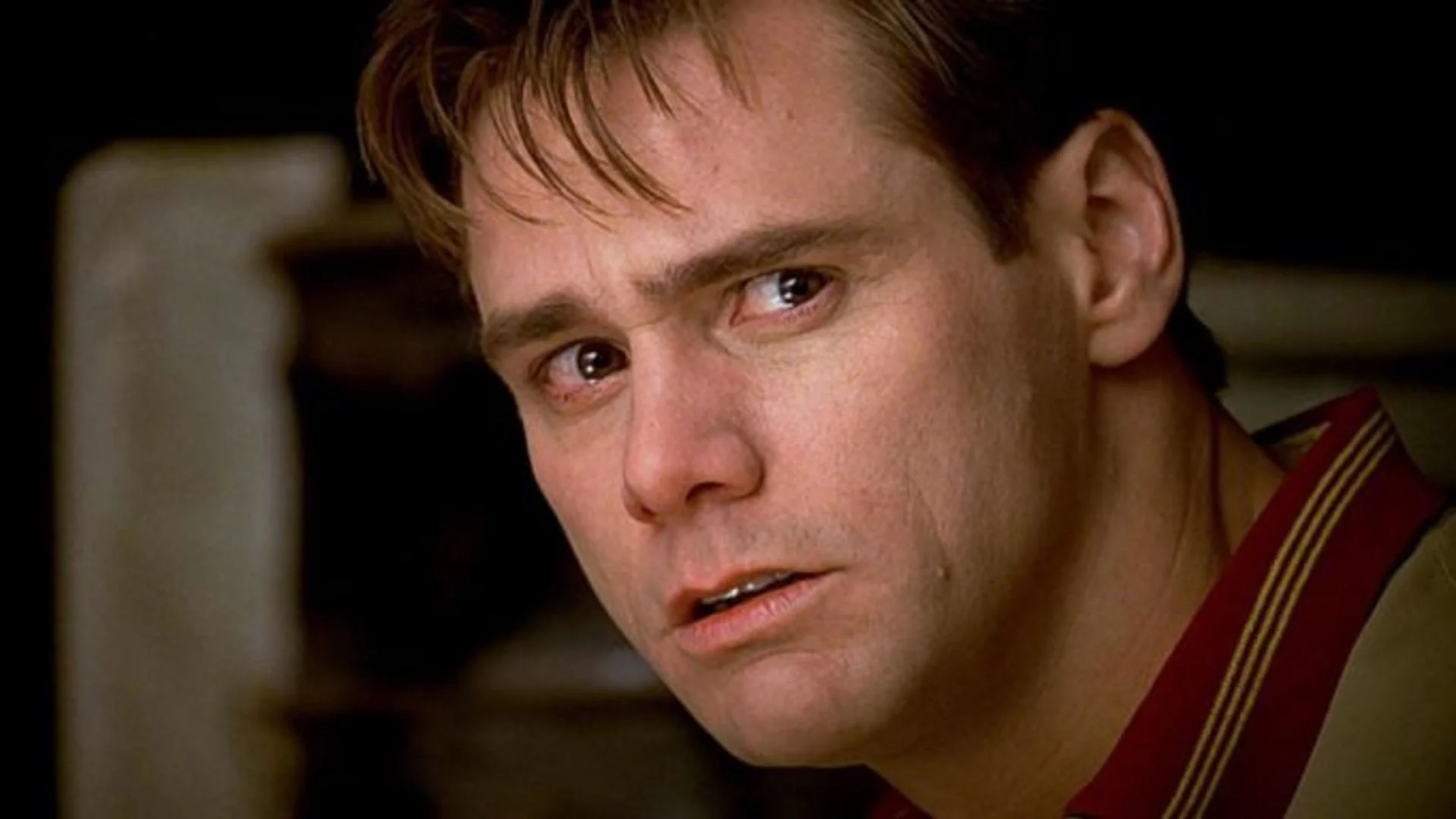
Why the Sequence Still Feels So Real
The storm remains one of the film’s most powerful sequences because Truman’s determination survives after physical strength has nearly disappeared.
He ties himself to the boat. He challenges Christof to do his worst. After the storm finally stops, Truman continues sailing until the bow strikes the painted wall at the edge of his world.
He climbs a staircase, reaches an exit and chooses the uncertainty of real life over the comfort of a prison designed around him.
Carrey’s performance throughout the sequence combines Truman’s emotional awakening with the actor’s genuine physical strain. That does not mean every frightened expression came from the accident, nor should the near drowning be treated as an acceptable shortcut to realism.
The scene works because of Carrey’s acting. The danger reveals what the production risked while trying to capture it.
The Truman Show became one of the defining films of Carrey’s career and an increasingly prophetic examination of reality television, manufactured identity and life under constant observation.
Its climax was supposed to show a fictional audience watching a man nearly die without understanding the full reality of what it was seeing.
During filming, the same thing almost happened behind the camera.
Carrey survived because he found enough strength to leave the center of the storm himself. The safety signal failed, the machines kept running and the performance continued past the point where acting had ended.
The finished scene shows Truman fighting for freedom.
Hidden inside it is the moment Jim Carrey was fighting simply to reach the surface.