Michelle Yeoh and Jackie Chan Turned Supercop Into a Stunt Rivalry — and Neither Wanted to Back Down

When Michelle Yeoh rode a motorcycle up a ramp and onto a moving train in Supercop, she was not simply trying to create another impressive action sequence.
She was working opposite Jackie Chan — a performer whose career had already been built around doing things on camera that most movie stars would never attempt.
That combination produced something unusually combustible.
Years later, Yeoh revealed that Chan had actually asked her to stop taking such extreme risks. Her response was essentially that he had little room to complain, considering his own reputation. Chan then explained the problem: when she performed a spectacular stunt, he felt he had to “go one better.”
The result was a friendly competition that helped turn 1992’s Police Story 3: Super Cop, commonly known simply as Supercop, into one of the most memorable stunt showcases of their careers.
And for Yeoh, it marked an extraordinary way to return to action cinema.
Yeoh Was Coming Back After Years Away
By the time director Stanley Tong brought Yeoh and Chan together for Supercop, Yeoh already understood the unforgiving culture of Hong Kong action filmmaking.
A trained dancer and highly competitive athlete, she had entered the movie business in the 1980s and quickly established herself as far more than a former beauty queen. She trained intensely and performed demanding action in films such as Yes, Madam!.
Then she stepped away.
After marrying businessman and producer Dickson Poon in 1988, Yeoh took a break from acting. She later explained that she had wanted to commit herself fully to her marriage. When the relationship ended, she returned to movies in 1992.
Her comeback project was Supercop.
It was difficult to imagine a quieter way of returning to work.
Chan played Hong Kong police inspector Chan Ka-Kui, while Yeoh played a mainland Chinese security officer who joins him during an undercover operation against a drug-trafficking organization.
But the plot was only part of what audiences remembered.
The real spectacle was watching two performers with unusually high thresholds for physical risk occupy the same movie.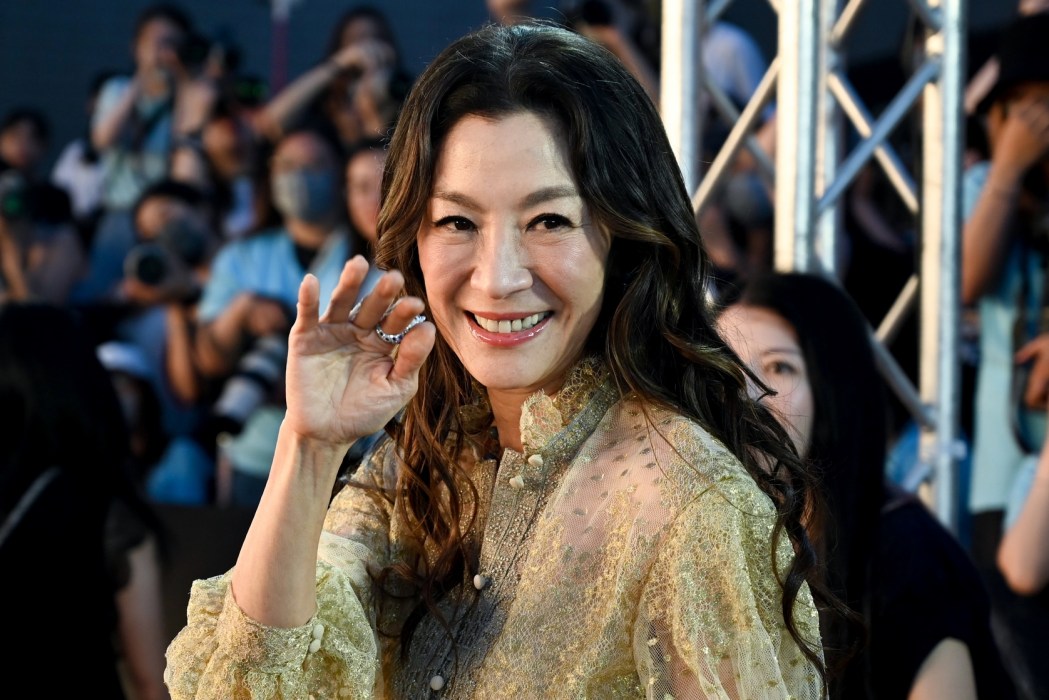
Every Big Stunt Seemed to Create a New Challenge
Yeoh and Chan had known each other before Supercop. In fact, Yeoh has said Chan was the first person she worked with after arriving in Hong Kong, when they appeared together in a commercial early in her career.
By Supercop, however, they were meeting as established action stars.
And their competitive instincts began feeding each other.
The Academy of Motion Picture Arts and Sciences later described their relationship on the film as one in which their mutual competitiveness led them toward increasingly outrageous stunt ideas.
Yeoh’s motorcycle sequence became the defining example.
Rather than relying on the kind of digital effects that would become commonplace decades later, she rode a real motorcycle toward a moving train, launched up a ramp and landed on top of it.
Looking back, Yeoh wondered what she had been thinking. She remembered hanging from vehicles, riding the motorcycle onto the train and performing what she called the “most insane stunts.”
Chan, meanwhile, had his own spectacular sequences, including one involving a helicopter and a rope ladder as the action raced through Kuala Lumpur.
The dynamic was almost absurd: one star would do something extraordinary, and instead of providing relief, it created pressure for the other.
One Stunt Came Terrifyingly Close to Disaster
The rivalry may have been playful, but the danger was not.
One of Yeoh’s most frightening moments came during a sequence in which she had to leap from the roof of one moving vehicle onto a convertible driven by Chan.
Standing beside stationary vehicles, Yeoh later recalled, the distance did not appear overwhelming.
Movement changed everything.
With both vehicles traveling at speed, timing, wind and momentum transformed the jump into something far more unpredictable. On one attempt, Yeoh landed on the car but could not secure herself. A windshield that was supposed to break did not shatter as planned, leaving her without the expected surface to help stop her fall.
She slid off and hit the road as other vehicles approached from behind.
Chan immediately wanted the stunt stopped for the day.
Yeoh did not.
She and Tong decided to try again, and the next attempt succeeded.
The story captures both the astonishing discipline and the troubling level of risk that defined a particular era of Hong Kong action filmmaking. Yeoh has explained that productions at the time often did not have the long rehearsal periods associated with major Western action movies. Performers could learn choreography on set and move quickly into filming.
That environment rewarded nerve.
Yeoh had plenty of it.
After Supercop, Their Careers Took Different Roads
The film strengthened Yeoh’s status as one of the rare performers who could stand beside Chan in an action movie without becoming merely a supporting presence.
But their careers soon expanded in different directions.
Chan continued refining the mixture of martial arts, comedy and elaborate stunt work that had made him a superstar in Asia. His international profile grew dramatically, eventually leading to major Hollywood successes including the Rush Hour films. In 2016, the Academy honored him with an Honorary Award recognizing his extraordinary contributions to film.
Yeoh moved from Hong Kong action films into increasingly varied international roles.
She played Chinese intelligence agent Wai Lin opposite Pierce Brosnan in 1997’s Tomorrow Never Dies, then demonstrated an entirely different kind of dramatic and physical power in Ang Lee’s Crouching Tiger, Hidden Dragon. Later came roles in Crazy Rich Asians, Star Trek and numerous major franchises.
Then, more than 30 years after Supercop, her journey reached another historic point.
At the 95th Academy Awards on March 12, 2023, Yeoh won Best Actress for Everything Everywhere All at Once.
The woman once proving that she could keep up with Jackie Chan had become an Oscar-winning leading actress whose career could no longer be contained by the label “action star.”
The Competition Never Erased the Friendship
What makes the Supercop story especially enduring is that the rivalry appears to have been rooted in affection rather than hostility.
Yeoh has continued to describe Chan as a close friend. In a later interview, she joked about his habits and described him as great fun to be around.
Perhaps the clearest expression came in 2016, when Yeoh helped honor Chan as he received his Academy Honorary Award.
Standing decades removed from the days when the two of them were challenging each other to ever more improbable action sequences, Yeoh looked back at the man she had first met near the beginning of her career.
She said he remained essentially the same person she remembered from those early days: “honest, funny, kind” — and, in her eyes, forever young.
That may be the most fitting legacy of their Supercop partnership.
The train jump, speeding vehicles and helicopter sequences made movie history because they looked dangerous.
They looked dangerous because they were.
But beneath all that risk was something simpler: two fiercely competitive performers who respected each other enough to keep raising the bar — and who, decades after the cameras stopped rolling, still remembered the person standing beside them when they did it.