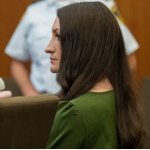
“SHE WANTS HER FREEDOM” — MUM WHO WAS CONVICTED IN HAIRDRYER BABY CASE LAUNCHES BID TO OVERTURN CONVICTION AND 6-YEAR SENTENCE

“SHE WANTS HER FREEDOM” — MUM WHO WAS CONVICTED IN HAIRDRYER BABY CASE LAUNCHES BID TO OVERTURN CONVICTION AND 6-YEAR SENTENCE
SCOTLAND — Courtney Gartshore has launched a legal bid to overturn both her conviction and her six-year prison sentence over the death of her three-month-old daughter, Dahlia-Rose.
The 28-year-old mother was convicted of culpable homicide following a trial at the High Court in Aberdeen in July.
She was sentenced to six years in prison at the High Court in Edinburgh on August 14.
Now, court officials have confirmed that an intimation of appeal against both conviction and sentence has been lodged on her behalf, formally beginning the appeal process.
The development comes only weeks after a judge described the case as “uniquely disturbing and distressing.”
 A BABY EXPOSED TO PROLONGED HEAT
Dahlia-Rose died at a property on King Street in Peterhead, Aberdeenshire, on September 30, 2023.
According to the evidence accepted by the jury, Gartshore had been drinking the night before and was alone caring for her infant daughter.
Sometime between approximately 4 a.m. and 9 a.m., Dahlia-Rose was exposed to significant and sustained heat from a hairdryer.
The appliance was later found plugged in beside Gartshore’s bed.
The judge said the hairdryer may have been positioned close to the infant for at least 20 minutes and possibly up to an hour.
The resulting injuries affected around 18% of Dahlia-Rose’s body, including her head, face, neck, upper body and right arm.
Experts told the court that the burns themselves were survivable.
The prosecution’s expert evidence was that the likely cause of death was hyperthermia and heatstroke.
The jury ultimately rejected the defence position that Dahlia-Rose may already have died from another unexplained cause before being exposed to the heat.
 SHE SAID SHE COULD NOT REMEMBER WHAT HAPPENED
One of the central mysteries throughout the case was why Gartshore used the hairdryer.
She maintained that she had no memory of doing so.
Her defence did not argue that she intentionally set out to harm her daughter.
Instead, the defence suggested that Gartshore may have been attempting to warm the baby, although exactly what happened remained unclear.
The judge stressed an important distinction when sentencing her.
This was not a murder case, and the Crown had not alleged that Gartshore intended to harm or kill Dahlia-Rose.
Instead, the conviction was for culpable homicide arising from what the court determined was a very high level of carelessness or gross recklessness.
“SHE SHOULD HAVE KNOWN”
Despite that distinction, Judge Simon Collins KC said Gartshore’s conduct crossed a serious legal threshold.
The judge found that she must have turned on the hairdryer, positioned it close to Dahlia-Rose and left it running for a prolonged period.
During that time, he said, it should have been obvious that the baby was suffering severe pain and distress.
The judge described the incident as a gross breach of the most basic duty of a parent — to protect a child and keep them safe from harm.
The court also considered several aggravating factors.
Gartshore had been drinking.
The judge noted that alcohol may have contributed either to her decision to expose Dahlia-Rose to the heat or to her failure to switch the appliance off.
The court also heard that Gartshore later moved the baby’s body to the balcony before emergency services arrived and denied knowing how the injuries had occurred.
The judge said those actions suggested an attempt to conceal her involvement.
BUT THE COURT ALSO HEARD ABOUT HER OWN STRUGGLES
There were also significant mitigating circumstances.
Gartshore had no previous convictions.
She was a young single mother with another child and a history of poor mental health.
The sentencing court heard that she had stopped taking medication during pregnancy, had limited support and had significant caring responsibilities.
The judge also noted that she had attempted suicide following Dahlia-Rose’s death.
Those circumstances did not excuse her conduct, the judge said, but they were taken into account when determining the sentence.
SIX YEARS IN PRISON
Judge Collins assessed Gartshore’s culpability as being at a medium level, while the harm was considered to be at the highest possible level because an infant child had died.
The starting point for sentencing was four years, with a range of three to seven years.
After considering the aggravating and mitigating circumstances, the court imposed a sentence of six years imprisonment, backdated to July 16, 2026, when Gartshore was taken into custody following her conviction.
Now, however, Gartshore is challenging that outcome.
THE APPEAL COULD CHANGE EVERYTHING
The newly filed appeal does not mean that her conviction has been overturned.
It means the legal process to challenge the conviction and sentence has begun.
Court officials confirmed the filing on August 31.
Further legal papers setting out the grounds of appeal are expected to follow.
For Dahlia-Rose’s family, the development comes only weeks after the conclusion of a deeply painful trial.
The little girl was just three months old.
Her death in 2023 eventually led to a police investigation, a criminal prosecution and a trial that examined the final hours of her short life.
Now the case is entering another legal chapter.
A SECOND FIGHT IN COURT
Gartshore’s conviction remains in place unless an appeal court rules otherwise.
Her attempt to challenge both the conviction and the six-year sentence could therefore become the next major development in a case that has already shocked Scotland.
The court’s previous ruling was clear: there was no finding that Gartshore deliberately intended to take her daughter’s life.
But the jury concluded that her actions were sufficiently reckless to amount to culpable homicide.
Now she is asking an appeal court to reconsider that conclusion — as well as the punishment imposed upon her.
And while the legal battle continues, one fact remains at the centre of everything:
Dahlia-Rose was only three months old when her life ended.
Her mother is now fighting to overturn the conviction that followed.