LINDSAY CLANCY TRIAL ENDS IN MISTRIAL AFTER EXPLOSIVE JUROR DISPUTE — DEFENSE CLAIMED ONE HOLDOUT WAS BLOCKING THE VERDICT
LINDSAY CLANCY TRIAL ENDS IN MISTRIAL AFTER EXPLOSIVE JUROR DISPUTE — DEFENSE CLAIMED ONE HOLDOUT WAS BLOCKING THE VERDICT
For days, the courtroom waited for an answer.
Then one juror became the center of the entire case.
The murder trial of Lindsay Clancy, the Massachusetts mother accused of killing her three young children, ended in a dramatic mistrial on Friday after the jury remained unable to reach a unanimous decision.
The development came just one day after Clancy’s attorney made an extraordinary request: he wanted a single juror removed from the panel, arguing that the juror was refusing to properly apply the judge’s instructions on reasonable doubt.
The judge rejected the request.
And the dispute ultimately became one of the final chapters of a trial that had already captivated the country.
:max_bytes(150000):strip_icc():focal(334x536:336x538):format(webp)/lindsay-clancy-trial4-9326-1e2bcb7db90a4a3b87b75ec1f5ad864d.jpg) THE NOTE THAT CHANGED EVERYTHING
THE NOTE THAT CHANGED EVERYTHING
The drama began when the jury foreperson sent a note to Judge William Sullivan during deliberations.
According to the judge’s description of the note, one male juror had acknowledged having doubts about Clancy’s criminal responsibility but was allegedly refusing to apply the legal standard of reasonable doubt.
That immediately alarmed the defense.
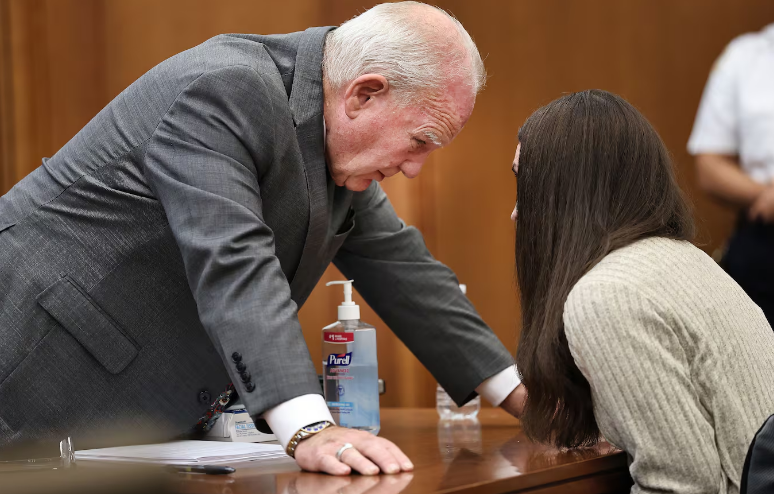
Clancy’s attorney, Kevin Reddington, argued that the juror’s position was preventing the other jurors from reaching a verdict.
Reddington asked the judge to remove the juror and replace him with an alternate.
He also warned that leaving the situation unresolved could result in a mistrial.
The judge, however, declined to remove the juror.
Judge Sullivan questioned jurors individually and determined that there was not enough evidence to conclude the juror was refusing to follow the law.
The jury was therefore sent back to deliberate.
:max_bytes(150000):strip_icc():focal(886x640:888x642):format(webp)/lindsay-clancy-trial3-9326-b486bdcc6dcf409990e5bd6aaab24ded.jpg) A TENSE COURTROOM EXCHANGE
A TENSE COURTROOM EXCHANGE
The dispute became increasingly heated.
Reddington argued that the court needed to make its instructions even clearer, particularly concerning reasonable doubt.
At one point, Judge Sullivan responded with visible frustration, sarcastically asking what more the defense wanted him to do after the instructions had already been repeatedly given.
The exchange underscored just how close the trial had come to breaking down.
The jury consisted of nine women and three men, and the defense later indicated that the panel appeared to be split 11-1.
But the identity of the holdout juror and the precise nature of his position became a fiercely contested issue.
THE DEFENSE’S THEORY
Clancy’s defense has never seriously disputed that she was responsible for the children’s deaths.
Instead, the central question has been whether she was criminally responsible for her actions.
Reddington argued that Clancy was suffering from severe postpartum psychosis and other psychiatric problems when the children died in January 2023.
The defense presented evidence that Clancy’s mental health had deteriorated dramatically in the period leading up to the incident.
Her attorneys also argued that medications and treatment she received contributed to her worsening condition.
Their position was that Clancy’s mental state prevented her from understanding the wrongfulness of what she was doing or from being held legally responsible in the ordinary way.
PROSECUTORS TOLD A VERY DIFFERENT STORY
Prosecutors accepted that Clancy had experienced serious mental-health problems.
But they argued that those problems did not make her legally insane.
Instead, prosecutors said she deliberately carried out the acts that resulted in the deaths of her three children.
The children — 5-year-old Cora, 3-year-old Dawson and 8-month-old Callan — died in January 2023.
Clancy subsequently attempted suicide and survived with severe physical injuries, including paralysis.
The prosecution argued that she had planned what she was doing, while the defense maintained that she was experiencing a profound psychiatric crisis.
JURY DELIBERATIONS STRETCHED ON FOR DAYS
After more than six weeks of testimony, the case went to the jury.
What followed was nearly 40 hours of deliberations over seven days.
The jurors repeatedly told the judge they were unable to reach a unanimous verdict.
Judge Sullivan issued additional instructions intended to encourage them to continue discussing the evidence and reconsider their positions.
But the deadlock remained.
The dispute over the lone juror then became the most dramatic moment of the deliberations.
THE LAST-DITCH LEGAL FIGHT
On Friday morning, the judge indicated that he was prepared to declare a mistrial.
Reddington made a final attempt to stop that from happening.
He sought emergency intervention from the Massachusetts Supreme Judicial Court, arguing that the disputed juror should be removed and that the remaining jurors should be allowed to continue deliberating.
The request was denied.
With no unanimous verdict possible, Judge Sullivan ultimately declared a mistrial.
THERE IS STILL NO VERDICT
The mistrial does not mean Clancy has been found guilty.
It also does not mean she has been acquitted.
The criminal case remains unresolved.
Prosecutors must now decide whether to pursue another trial, while the defense could seek other legal options, including negotiations or challenges to the charges.
A hearing has been scheduled for September 29 to determine the next steps.
A CASE THAT HAS DIVIDED THE PUBLIC
The Clancy case has drawn enormous attention because it sits at the intersection of criminal responsibility, postpartum mental illness and the devastating consequences of a psychiatric crisis.
For the victims’ family, however, another trial would mean revisiting the deaths of three children all over again.
Patrick Clancy, Lindsay’s estranged husband and the children’s father, has previously spoken about the extraordinary pain surrounding the case.
Following the mistrial, his attorney said that the prospect of another trial would be extremely painful for him.
For Clancy, meanwhile, the mistrial means the most important legal question remains unanswered:
Was she criminally responsible for what happened to her children?
The first jury could not agree.
And after one of the most dramatic jury disputes of the trial, that question will now have to be confronted again.
There was no verdict. There was no acquittal. And the Lindsay Clancy case is not over.