I Paid an Elderly Veteran’s Diner Bill—Two Weeks Later, a Four-Star Marine General Summoned Me to His Office
PART 1 — THE STRANGER IN THE DINER
“Corporal Reynolds.”
The moment I heard those words, my heart nearly stopped.
Two weeks earlier, I’d helped an elderly stranger at a small diner near Norfolk, Virginia, after his credit card was declined.
He wore a faded Vietnam veteran cap and an old jacket. I paid his bill, gave him my name, and went home without thinking much about it.
Now that same man was sitting across from my commanding officer.
Only the old jacket and cap were gone.
He wore a perfectly pressed Marine Corps uniform.
Four silver stars gleamed on his shoulders.
I snapped to attention, terrified I’d somehow stumbled into the wrong room.
But the general knew exactly who I was.
And when he opened a thick folder bearing my name, I realized he’d come for a reason far more important than thanking me for a meal.
My name is Jenna Reynolds.
I was a Marine corporal stationed near Norfolk, Virginia, when an ordinary act of kindness unexpectedly brought me face-to-face with one of the most senior officers in the Marine Corps.
It began on a rainy evening after an exhausting day.
Everything that could go wrong seemed to have gone wrong twice.
By the time I finished work, I was too tired to cook and not quite ready to go home.
Rain streamed across my windshield as I pulled into a little diner near base.
The parking lot was nearly empty.
Inside, only a few customers remained.
I ordered coffee, found a quiet seat, and tried to forget about the day.
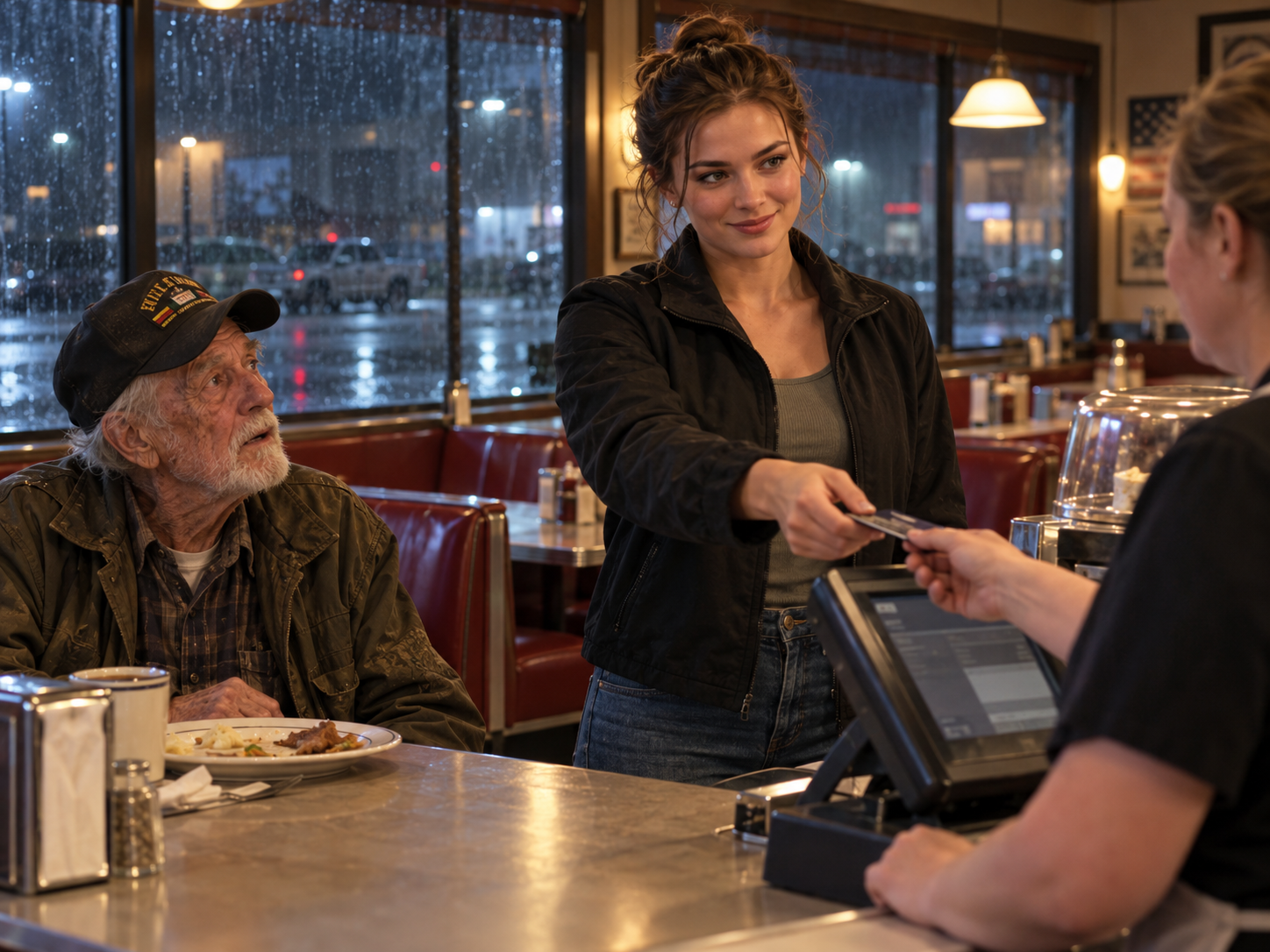
I was halfway through my cup when I noticed an elderly man standing at the register.
He wore a faded cap identifying him as a Vietnam veteran.
The cashier tried processing his card.
It was declined.
She tried again.
Declined.
The man opened his wallet and counted the bills inside.
Then he looked at his receipt.
He counted once more.
There wasn’t enough.
Nobody laughed.
Nobody said anything cruel.
But the silence made his embarrassment painfully obvious.
I watched him lower his eyes toward the counter.
He wasn’t making a scene.
Wasn’t blaming the cashier.
He simply seemed unsure how to handle the situation without drawing more attention.
Before I’d fully considered what I was doing, I stood and walked toward the register.
“Add his bill to mine.”
The elderly man turned.
His expression was serious.
“Young lady, you don’t need to do that.”
“I know.”
He studied me for a moment.
“Then why would you?”
I shrugged.
“Because tonight your card isn’t working, and mine is.”
He stared at me.
Then the faintest smile appeared on his face.
It was barely noticeable.
But I could tell the tension had eased.
I paid the bill.
To me, that was all there was to it.
Someone had needed a little help.
I’d been able to provide it.
No complicated explanation was necessary.
After the payment went through, the man looked at me more closely.
“You’re a Marine, aren’t you?”
I blinked.
I wasn’t wearing my uniform.
Nothing about my clothing identified my branch of service.
“Yes, sir.”
He nodded.
“Thought so.”
I wondered what had given me away.
Perhaps my posture.
Or the way I’d addressed him.
But I didn’t ask.
I wished him a good evening and prepared to leave.
Then he called after me.
“Marine.”
I turned.
“Yes, sir?”
“What’s your name?”
“Corporal Jenna Reynolds.”
He repeated it slowly.
“Corporal Reynolds.”
Something about the way he said it made me think he wanted to remember.
I gave him a polite nod.
Then stepped outside into the rain.
By the time I drove home, I was thinking about getting some sleep.
I certainly wasn’t thinking about the elderly stranger whose dinner I’d purchased.
And I never expected our paths to cross again.
Two weeks passed.
My routine continued as usual.
Work.
Training.
Assignments.
The responsibilities that came with being a Marine corporal.
Then one afternoon, my staff sergeant appeared at my desk.
“Reynolds. The commanding officer wants you.”
I looked up.
“Now?”
“Right now.”
My stomach sank.
There are few things more effective at making a junior Marine mentally review every mistake they’ve ever made than an unexpected summons to the commanding officer’s office.
As I walked down the hallway, I began searching my memory.
Had I missed a deadline?
Made an error in a report?
Misunderstood an instruction?
By the time I reached the office, I’d imagined at least twelve different reasons I might be in trouble.
I stopped outside the door.
Straightened my uniform.
Then knocked.
“Enter.”
I opened the door.
And froze.
The man from the diner was sitting across from my commanding officer.
For a moment, I couldn’t process what I was seeing.
The face was unmistakable.
The same steady eyes.
The same composed expression.
But he wasn’t dressed like the elderly customer I’d met on that rainy evening.
His Vietnam veteran cap was gone.
So was the worn jacket.
Instead, he wore a Marine Corps general officer’s uniform.
Perfectly fitted.
Perfectly pressed.
Then my eyes reached his shoulders.
Four stars.
My breath caught.
For one absurd second, I glanced behind me, convinced I must have entered the wrong office.
But before I could move, the elderly man spoke.
“Corporal Reynolds.”
I snapped to attention.
“Sir!”
He rose slowly.
“Relax, Corporal.”
“Yes, sir.”
I managed to loosen my posture by approximately half an inch.
The general seemed to notice.
But he didn’t comment.
On the desk between him and my commanding officer sat a thick folder.
My name was printed across the front.
The general opened the folder.
I watched him turn through the pages.
Training records.
Performance evaluations.
Physical fitness scores.
Recommendations.
My entire military record appeared to be sitting in front of him.
My stomach tightened.
Why would a four-star general need to review a corporal’s file?
Had I done something wrong?
Was there a problem I didn’t know about?
He looked up.
“Do you remember me?”
“Yes, sir.”
“What did you think I was when we met?”
“A veteran, sir.”
One eyebrow lifted.
“I am a veteran.”
My commanding officer lowered his head, apparently trying to conceal a smile.
I felt my face grow warm.
“Yes, sir.”
The general continued watching me.
“You didn’t know who I was when you paid my bill.”
“No, sir.”
“You weren’t expecting anything in return?”
“No, sir.”
He paused.
Then asked a question I hadn’t anticipated.
“What if you’d known who I was?”
I thought carefully before answering.
I understood what he was asking.
Would I have helped him only because he was important?
Would I have behaved differently if I’d recognized his rank?
The truth was simple.
“I still would’ve paid the bill, sir.”
This time, the general smiled.
A genuine smile.
For a moment, he looked exactly like the elderly man I’d met beside the diner register.
Then he rested his hand on the folder.
“Corporal, that dinner bill isn’t the reason you’re here.”
I blinked.
I had assumed he wanted to thank me.
Perhaps acknowledge the kindness.
Maybe he’d somehow learned where I was stationed and decided to express his appreciation.
But his words suggested something else entirely.
He explained that after our encounter, he’d made inquiries about me.
He wanted to know whether the Marine who had helped a stranger behaved with the same integrity during ordinary military service.
When nobody influential was watching.
When there was no possibility of receiving a reward.
When the only people observing were fellow Marines and immediate supervisors.
I looked at the records spread across his desk.
He hadn’t merely remembered my name.
He’d investigated the kind of Marine I was.
The general turned another page.
Then removed a single document from the folder.
He studied it briefly before looking back at me.
“Sometimes someone has to determine whether a Marine is prepared for greater responsibility.”
I remained silent.
He extended the document toward me.
For a moment, I didn’t move.
My commanding officer gave a small nod.
“Take it, Reynolds.”
I stepped forward and accepted the paper.
Then lowered my eyes.
Across the top was an official heading.
I recognized it immediately.
And I could hardly believe it was associated with my name.
My heartbeat accelerated.
The document represented an opportunity I had never seriously imagined receiving at my current rank.
I was a corporal.
There were Marines with far more seniority and experience than I had.
Yet here I was, holding a paper that appeared to place me in consideration for something normally reserved for people much farther along in their careers.
I looked up.
The general was studying my reaction.
“Helping me at the diner was what brought you to my attention,” he said quietly.
He touched the folder again.
“What I discovered afterward is why I’m sitting here today.”
I glanced toward my commanding officer.
He seemed completely aware of what the general was discussing.
I was the only person in the room struggling to understand how my life had taken such an unexpected turn.
Two weeks earlier, I’d been an exhausted Marine drinking coffee in a nearly empty diner.
I’d noticed an elderly veteran struggling to pay for his meal.
I hadn’t known his name.
His rank.
Or his influence.
I certainly hadn’t imagined he’d later review my evaluations, fitness scores, training history, and recommendations.
And yet he’d apparently found something in those records that mattered far more than the bill I’d paid.
The general gave me another small smile.
It was the same faint smile I’d seen when I’d told him his card wasn’t working and mine was.
Then he leaned forward.
“Now, Corporal, let’s talk about your future.”
I stared at the document in my hands.
My mind was racing.
I thought about all the training I’d completed.
The evaluations I’d worried over.
The effort I’d put into becoming someone my fellow Marines could depend on.
None of it had seemed extraordinary at the time.
It was simply the work I was expected to do.
But a four-star general had examined those records and reached a conclusion I wasn’t prepared for.
He believed I might be ready for something more.
Something far beyond the opportunities usually offered to a Marine at my rank.
The document remained in my hands.
My commanding officer watched quietly.
The general waited for me to respond.
And suddenly, the diner seemed like the smallest part of the story.
The real mystery wasn’t why a four-star general remembered the corporal who bought him dinner.
It was what he’d discovered in my service record that convinced him I deserved an opportunity normally given to Marines far above my rank.
I looked down at the official heading again.
Then raised my eyes toward the general, realizing that the most important conversation of my career was only beginning.
PART 2 — THE OPPORTUNITY NO ONE BELIEVED I DESERVED
The heading read:
MARINE CORPS LEADERSHIP DEVELOPMENT INITIATIVE — SPECIAL CANDIDATE REVIEW.
Underneath, in smaller letters, was a line that made my stomach tighten.
Recommendation for accelerated leadership assessment and consideration for future commissioning pathways.
I read it twice.
Then a third time.
“Sir,” I finally managed, “there must be some mistake.”
General Thomas Whitaker leaned back in his chair.
“That’s an interesting response, Corporal. Most Marines would ask when they could start.”
“With respect, sir, most Marines wouldn’t expect a four-star general to hand them something like this.”
“Fair enough.”
He glanced at Colonel Richard Hayes, my commanding officer, who had remained unusually quiet.
“Tell her what you told me, Colonel.”
Hayes folded his hands.
“Reynolds, six months ago, during the coastal readiness exercise, your section experienced a communications failure. You rebuilt the reporting process using backup equipment, maintained accountability of the personnel assigned to your team, and got accurate information to the operations center before the exercise concluded.”
“Yes, sir.”
“You also recommended corrective measures that reduced reporting delays during the next evaluation.”
“Yes, sir.”
“And when the after-action report was submitted, your name appeared nowhere in the section describing those improvements.”
I stopped breathing for a moment.
That wasn’t a question.
It was a fact.
One I had spent months trying not to think about.
The general watched my expression change.
“Does that surprise you?”
“No, sir.”
“Explain.”
I looked at Hayes.
He gave the slightest nod.
I chose my words carefully.
“The report was submitted through my section leadership, sir.”
“That doesn’t answer my question.”
“No, sir.”
Whitaker leaned forward.
“Who developed the replacement reporting procedure?”
“I did, sir. With assistance from the Marines in my section.”
“And who received the credit?”
I hesitated.
“Staff Sergeant Daniel Mercer, sir.”
The room grew quiet.
Mercer had been my immediate supervisor during the exercise.
He was experienced, confident, and well respected by senior leadership.
He was also the man who had told me, after the report was submitted, that junior Marines shouldn’t concern themselves with recognition.
At the time, I had accepted that explanation.
Or convinced myself I had.
“Why didn’t you challenge the report?” Whitaker asked.
“Because the procedure worked, sir. That was the important part.”
“Was it?”
I frowned.
“Sir?”
“Was it the only important part?”
I didn’t know how to answer.
He tapped one of my evaluations.
“Leadership isn’t simply doing good work, Corporal. It’s making sure good work can be repeated, improved, and credited accurately. When one Marine takes recognition belonging to another, the institution loses information about who is actually capable of what.”
My face grew hot.
I had never heard an officer discuss my overlooked work so directly.
Whitaker closed the folder.
“The initiative you’re being considered for brings promising Marines into a demanding assessment process. It includes leadership evaluations, professional education, mentorship, and potential recommendations for future commissioning programs. There are eligibility requirements, further training, and no guarantees.”
He paused.
“I’m not offering you a commission, Corporal. I’m offering you a chance to prove you might earn one.”
My fingers tightened around the document.
“I understand, sir.”
“Do you?”
“Yes, sir.”
“Then understand something else. Your diner encounter opened a door. Your record persuaded me there was something worth examining behind it. But the door stays open only if you can walk through it on your own.”
I nodded.
He studied me.
“Before I recommend you for the assessment, I have one question.”
“Yes, sir.”
“Why did you join the Marine Corps?”
It was the simplest question of the afternoon.
And somehow the hardest.
I could have given him the answer I’d used at enlistment.
Service.
Discipline.
Opportunity.
All true.
But none complete.
“My father was a Marine, sir.”
Whitaker waited.
“He served for twenty-two years. Gunnery Sergeant Michael Reynolds.”
The general’s expression changed slightly.
“Reynolds,” he repeated.
“Yes, sir.”
“Where did he serve?”
I told him.
Then I explained how my father had retired after years of deployments and injuries that never seemed serious enough for him to complain about.
How he had spent his final years fixing neighbors’ cars for almost nothing.
How he had carried groceries for elderly people who couldn’t afford delivery.
How, when I was seventeen, I’d watched him give away his winter coat to a homeless veteran outside a grocery store.
The general listened without interrupting.
“My father used to tell me that the uniform wasn’t supposed to make people afraid of you,” I said. “It was supposed to make them feel they could depend on you.”
My throat tightened unexpectedly.
“He died when I was nineteen.”
“I’m sorry, Corporal.”
“Thank you, sir.”
The room remained silent.
Then Whitaker opened the folder again.
“There is something you should know.”
He removed another sheet.
It contained a handwritten notation from my original enlistment interview.
Apparently, my recruiter had recorded my answer to a question about long-term ambitions.
I read the sentence aloud.
“I want to become an officer who never forgets what it’s like to be the person nobody notices.”
For several seconds, I couldn’t speak.
I had forgotten writing those words.
Whitaker hadn’t.
“Do you still want that?”
I swallowed.
“Yes, sir.”
“Then stop assuming you don’t belong in rooms where decisions are made.”
I looked at him.
He pointed toward the document.
“Leadership requires humility, Reynolds. It does not require you to disappear.”
When I left the office twenty minutes later, the paper in my hand felt heavier than my entire field pack.
I was still a corporal.
Still responsible for tomorrow’s assignments.
Still expected at morning formation.
But something had shifted.
For the first time since my father died, the future I’d quietly stopped imagining seemed possible again.
Unfortunately, not everyone shared my excitement.
By the following morning, half the unit knew about the general’s visit.
By lunch, the rumors had become ridiculous.
According to one version, I had saved the general’s life.
According to another, I was his granddaughter.
One Marine claimed I’d been secretly recruited for intelligence work.
My friend Corporal Maya Torres nearly choked on her sandwich when she heard that one.
“Congratulations, Agent Reynolds,” she whispered. “Please remember the little people when you’re running the Pentagon.”
I laughed.
It felt good.
For about thirty seconds.
Then Staff Sergeant Mercer entered the dining area.
The conversations around us grew quieter.
He walked straight toward our table.
“Reynolds.”
I stood.
“Yes, Staff Sergeant.”
“I hear you’ve developed some impressive connections.”
His voice was polite.
Too polite.
“Sir, I was selected for consideration for a leadership assessment.”
“Because you bought somebody a cheeseburger?”
Several nearby Marines lowered their eyes.
I kept my expression neutral.
“No, Staff Sergeant.”
“That’s what people are saying.”
“I can’t control what people are saying.”
His jaw tightened.
“Careful.”
“Yes, Staff Sergeant.”
He stepped closer.
“Some of us have spent years earning opportunities around here. We don’t get handed them because we happened to meet the right person at dinner.”
The words struck harder than I expected.
I could feel every pair of eyes in the room.
“I understand, Staff Sergeant.”
“Do you?”
I didn’t answer.
He looked at my tray.
“Finish eating. Then report to supply. Inventory audit. Every item.”
“Today?”
“Is that a problem?”
“No, Staff Sergeant.”
“Good.”
He walked away.
Torres waited until he was out of earshot.
“That wasn’t about inventory.”
“I know.”
“You need to tell someone.”
“Tell them what? That my staff sergeant gave me work?”
She looked frustrated.
“Jenna, don’t start doing that thing again.”
“What thing?”
“Pretending something isn’t happening because admitting it would create a problem.”
I didn’t answer.
Because she was right.
Over the next five days, my workload doubled.
I was assigned late inspections, repetitive administrative tasks, and equipment reviews that normally rotated among several Marines.
Nothing was openly improper.
Nothing I could easily point to and say, There. That’s retaliation.
But the message was unmistakable.
Mercer wanted me exhausted.
He wanted me distracted.
And with my leadership assessment scheduled in eleven days, every lost hour mattered.
One evening, after completing a supply inventory near midnight, I returned to the barracks and found Torres waiting in the hallway.
She held a printed email.
“Before you say anything,” she whispered, “read this.”
It was a notice from the initiative’s administrative office.
My application had been flagged.
The subject line read:
CANDIDATE ELIGIBILITY REVIEW — POTENTIAL INTEGRITY CONCERN.
I read the message slowly.
Someone had submitted an allegation that I had falsified portions of my leadership experience during the coastal readiness exercise.
According to the complaint, I’d claimed credit for procedures developed by senior personnel.
My hands went cold.
“That isn’t true,” I said.
“I know.”
I looked at the timestamp.
The allegation had been filed that afternoon.
Less than an hour after Mercer had informed me that I would be responsible for another late inspection.
Torres watched my expression.
“Jenna?”
I looked down at the last line.
Candidate participation may be suspended pending administrative review.
For a moment, I couldn’t hear anything except the ventilation system humming above us.
Two weeks earlier, an elderly stranger had changed the direction of my life.
Now someone was trying to change it back.
And the worst part wasn’t that I might lose the opportunity.
It was that the allegation attacked the one thing I’d always believed I could protect.
My integrity.
PART 3 — THE FILE THAT WAS NEVER SUPPOSED TO BE FOUND
At 0600 the following morning, I requested a meeting with First Sergeant Elena Brooks.
I didn’t sleep the night before.
Every time I closed my eyes, I saw the allegation.
Potential integrity concern.
Four words.
Four words capable of undoing years of work.
Brooks was a woman in her forties with an expression that made excuses die before they reached her desk.
She listened while I explained the email.
When I finished, she held out her hand.
“Show me.”
I gave her the document.
She read it carefully.
Then she looked up.
“Who do you believe submitted this?”
“I don’t know, First Sergeant.”
“Who might have reason to?”
I hesitated.
She noticed.
“Reynolds, I’m not asking you to accuse somebody without evidence. I’m asking whether there’s relevant history.”
I explained what had happened after the general’s visit.
The inventory assignments.
The comments at lunch.
The increasingly inconvenient schedule.
And the fact that Staff Sergeant Mercer had been credited with the reporting procedure I developed during the readiness exercise.
Brooks took notes.
When I finished, she set down her pen.
“Why didn’t you report the workload concerns earlier?”
“Because I could complete the assignments.”
“That wasn’t my question.”
I stared at my hands.
“I didn’t want to seem like I was complaining because I was getting special attention.”
Brooks sighed.
“Corporal, there’s a difference between accepting hard work and allowing someone to use authority to undermine you.”
I looked up.
She leaned forward.
“You need to learn that difference if you want to lead Marines.”
Those words stayed with me.
She explained that an allegation was not a finding, and that the appropriate personnel would review the matter. She also instructed me to preserve every relevant document and avoid discussing the accusation with anyone outside the proper channels.
Then she made a phone call.
Within an hour, I was sitting across from Captain Olivia Bennett, an officer assigned to coordinate the administrative review.
Bennett spoke with precise, deliberate calm.
“Corporal Reynolds, we’re going to establish what happened during the exercise. We aren’t going to decide anything based on rumors.”
“Yes, ma’am.”
“Do you have original copies of the reporting procedure?”
“I believe so.”
“Believe?”
“I saved the working files on the approved unit system, ma’am.”
“Can you identify their location?”
“Yes, ma’am.”
“Good. We’ll arrange to preserve and examine the records through the authorized process.”
She made another note.
“Did anyone assist you?”
“Corporal Torres helped test the backup radios. Lance Corporal Adams tracked message times. Sergeant Lewis reviewed the final checklist.”
“Names are useful. So are records.”
I nodded.
For the first time since receiving the allegation, I felt something other than helplessness.
There was a process.
There were facts.
And I had facts.
Or so I thought.
By that afternoon, the original shared folder appeared empty.
The subdirectory that had contained my drafts was gone.
So were the annotated checklists.
Only the final approved version remained.
The version bearing Mercer’s name.
I stared at the screen.
Then refreshed it.
Nothing.
I checked the archive location.
Nothing.
A cold feeling spread through my chest.
A records custodian confirmed that the files were no longer visible in the normal shared directory, but cautioned that this did not establish deletion or misconduct.
I understood.
Still, the timing was difficult to ignore.
When I told Torres, she slammed her palm against the table.
“That’s impossible.”
“Apparently not.”
“We worked on those files for three nights.”
“I remember.”
“And Adams has the timing sheets.”
“He transferred last month.”
“Then call him.”
I rubbed my forehead.
“I don’t want to drag everyone into this.”
Torres stared at me.
Then she said something I never forgot.
“Jenna, protecting people doesn’t mean protecting whoever is hurting them.”
I looked away.
That evening, I called my mother.
She lived in a small house outside Raleigh, North Carolina, where she had raised me and my younger brother after my father died.
She answered on the second ring.
“Sweetheart?”
Something in her voice made my throat tighten.
“Hi, Mom.”
“What’s wrong?”
I tried to laugh.
“Why does something have to be wrong?”
“Because you only call me after nine on a weekday when you’re either sick, worried, or trying to figure out how to fix something without asking for help.”
I closed my eyes.
Mothers.
They knew too much.
I told her everything.
The diner.
The general.
The leadership opportunity.
Mercer.
The allegation.
When I finished, she was quiet.
Then she said, “Your father would be proud of you.”
“Mom, I might lose everything.”
“You might lose an opportunity. That’s not the same as losing everything.”
“It feels like it.”
“I know.”
Her voice softened.
“But I want you to remember something.”
I waited.
“Your father didn’t teach you to be kind because kindness would bring rewards. He taught you because the world has enough people who look away when somebody needs help.”
Tears stung my eyes.
“And he didn’t teach you to be honest because honesty was easy,” she continued. “He taught you because sometimes it’s the only thing you have left when everything else gets taken.”
I wiped my face.
“I wish he were here.”
“So do I.”
For a few seconds, neither of us spoke.
Then Mom said, “There’s something in his old trunk I think you should see.”
“What?”
“A notebook he kept during his last years in uniform. I found it when I was cleaning the closet.”
“What does it say?”
“Come home this weekend. I’ll show you.”
I almost told her I couldn’t.
I had too much to do.
Too much uncertainty.
Too much fear.
But for once, I said yes.
Saturday morning, I drove to North Carolina.
My mother met me at the door.
She hugged me longer than usual.
My father’s old wooden trunk sat on the kitchen table.
It was scratched and battered, with faded stickers from duty stations long past.
Inside were photographs, ribbons, letters, and notebooks.
Mom handed me a small black journal.
“Page forty-seven.”
I opened it.
My father’s handwriting was unmistakable.
Strong, slightly slanted letters.
The entry was dated three years before his retirement.
Today a young Marine asked me what separates a leader from someone who simply has authority.
I told him authority can be issued with a promotion. Leadership has to be earned again every day.
The mistake we make is assuming rank tells us everything about character.
Sometimes the most important Marine in the room is the one nobody thinks to thank.
I read the passage twice.
Then a third time.
Below it, my father had written another sentence.
Never mistake quietness for weakness. Sometimes the strongest person in the room is the one who refuses to become cruel.
I covered my mouth.
Mom placed a hand on my shoulder.
“There’s more.”
She turned several pages.
My father had written about a junior Marine whose contribution to a training exercise had been overlooked.
He had intervened, corrected the report, and made sure the Marine received recognition.
The young Marine’s name wasn’t recorded.
But the last line stopped me.
If I ever find myself too important to notice the person doing the work, it’s time to take off the uniform.
I sat at the kitchen table and cried.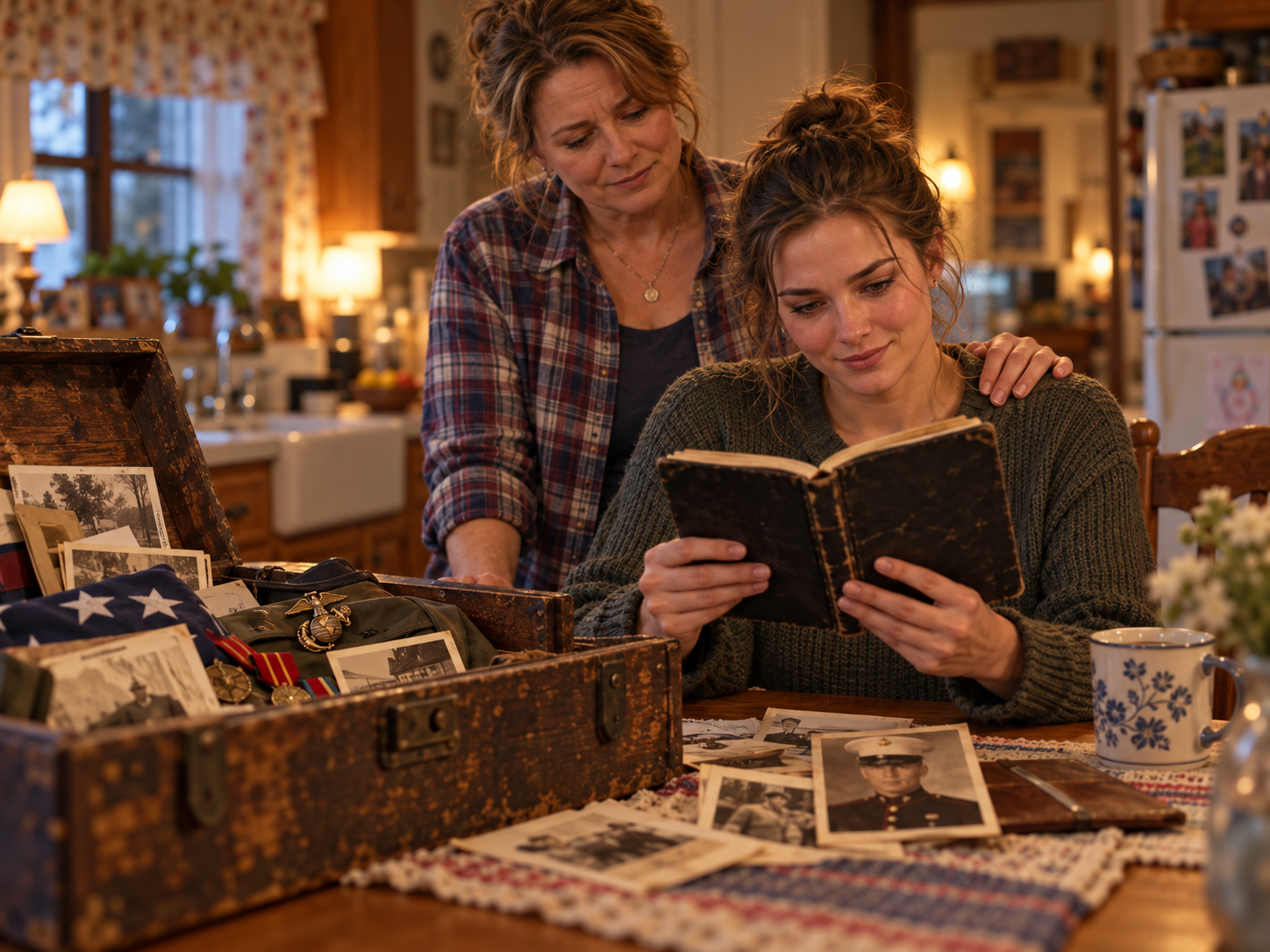
Not because I was afraid anymore.
Because I finally understood something.
I had spent years trying to honor my father’s service by doing everything perfectly.
Following instructions.
Avoiding conflict.
Never making trouble.
But my father hadn’t believed leadership meant staying silent when something was wrong.
He had believed it meant taking responsibility.
Even when responsibility was uncomfortable.
On Sunday evening, I returned to Norfolk with the journal in my bag and a different kind of determination.
Monday morning, I submitted a detailed statement to Captain Bennett.
I provided dates, names, and an explanation of each contribution.
I identified the original file locations.
I included records of messages from the exercise and explained where additional documentation might exist.
I didn’t accuse Mercer of deleting anything.
I didn’t speculate about his motives.
I told the truth.
Every part I could support.
Three days later, Bennett called me into her office.
“Corporal Reynolds, we recovered archived versions of the working documents through the authorized system administrators.”
I felt my entire body go still.
“The files?”
“Yes.”
“And?”
“They establish that you created the earliest documented versions of the replacement procedure. They also show contributions from several other Marines.”
I exhaled.
“Thank you, ma’am.”
“Don’t thank me yet.”
She slid a page across the desk.
“The review has identified additional discrepancies.”
My eyes moved down the document.
The official report had been revised after its initial submission.
The revision removed my name from the acknowledgment section.
It also removed Torres and Adams.
The changes were made using credentials assigned to Mercer’s account.
I stared at the timestamp.
11:43 p.m.
The night before the final evaluation.
Bennett continued.
“We’re reviewing the circumstances. Account activity alone doesn’t establish who physically made each change. But there are enough questions to require further inquiry.”
I nodded.
Then she said something unexpected.
“There’s another issue.”
My pulse quickened.
“What issue, ma’am?”
“The leadership assessment program has received additional allegations. Not just about your individual contributions.”
She paused.
“About your suitability for leadership.”
I looked at her.
“What kind of allegations?”
She hesitated before answering.
“Claims that you are divisive, that you encourage junior Marines to challenge authority, and that you prioritize personal recognition over mission accomplishment.”
I almost laughed.
Not because it was funny.
Because the accusations described the exact opposite of everything I had tried to be.
“Who said that?”
“We’re determining the origin.”
I sat silently.
Bennett watched me for a moment.
“Corporal, I need you to understand something. This review may take longer than anticipated. Your assessment slot is approaching.”
“Will I lose it?”
“I can’t promise you won’t.”
My heart sank.
She continued.
“But you should also know that your leadership package contains a recommendation we hadn’t previously discussed.”
I looked up.
“From whom?”
“Retired Master Gunnery Sergeant Robert Ellis.”
The name meant nothing to me.
“Who is he?”
Bennett studied my face.
“He supervised one of your father’s units during his early career.”
My stomach tightened.
“And he apparently wrote a letter about you before General Whitaker ever met you.”
I stared at her.
“That doesn’t make sense.”
Bennett opened another folder.
“The letter was received nearly eight months ago.”
Eight months.
Long before the diner.
Long before the four-star general.
Long before any of this began.
She turned the document toward me.
At the top was my name.
Beneath it was a paragraph that made my eyes widen.
Corporal Jenna Reynolds may not know that I have been observing her professional development. I believe she possesses a particular quality that our future leaders cannot afford to lose.
I looked up.
“Ma’am, why would someone who knew my father be watching my career?”
Bennett’s expression became serious.
“That’s a question I think you should ask Master Gunnery Sergeant Ellis.”
Then she handed me his contact information.
And I realized the mysterious general wasn’t the only person who had been paying attention.
PART 4 — THE PRICE OF DOING WHAT IS RIGHT
Robert Ellis lived in a modest brick house outside Richmond.
When I called, he answered with a voice so deep I instinctively straightened my back.
“Ellis.”
“Master Gunnery Sergeant Ellis? This is Corporal Jenna Reynolds.”
There was a brief silence.
Then he said, “Michael’s daughter.”
My throat tightened.
“Yes, sir.”
“I’ve been wondering when you’d call.”
We arranged to meet that weekend.
He opened his front door before I reached the porch.
He was tall, broad-shouldered, and walked with a slight limp.
His hair was almost entirely white.
But his eyes were sharp.
He looked at me for several seconds.
Then smiled.
“You’ve got your father’s face.”
I didn’t know what to say.
He stepped aside.
“Come in, Marine.”
His living room was filled with photographs.
Marines in desert uniforms.
Marines standing beside helicopters.
Marines celebrating promotions and retirements.
On the mantel sat a framed photograph of my father.
I stopped.
Ellis noticed.
“Taken in Okinawa. Your dad had just talked a young lieutenant out of making a very expensive mistake.”
I laughed despite myself.
“That sounds like him.”
“It does.”
Ellis poured coffee.
Then sat across from me.
“You want to know why I wrote that letter.”
“Yes, sir.”
He nodded.
“Your father saved my career.”
I blinked.
“How?”
Ellis looked toward the photograph.
“We were both young Marines. I was a sergeant. He was a corporal. During a training operation, I made a judgment call that nearly resulted in a serious accident.”
He paused.
“Nobody was hurt. But I was embarrassed, frightened, and more concerned with how it would look than I should’ve been.”
“What happened?”
“I tried to minimize my mistake in the first report.”
I stared at him.
Ellis didn’t look away.
“Your father knew what happened. He came to me privately and told me I had twenty-four hours to correct the record. If I didn’t, he would report the discrepancy himself.”
“What did you do?”
“I corrected it.”
“Were you punished?”
“Yes.”
He smiled faintly.
“Deservedly.”
I waited.
“The punishment wasn’t what changed me. Your father’s willingness to confront me was. He could have exposed me publicly. Could have made himself look good at my expense. Instead, he gave me the chance to do the right thing.”
Ellis leaned forward.
“He didn’t protect my mistake, Jenna. He protected my opportunity to become better than it.”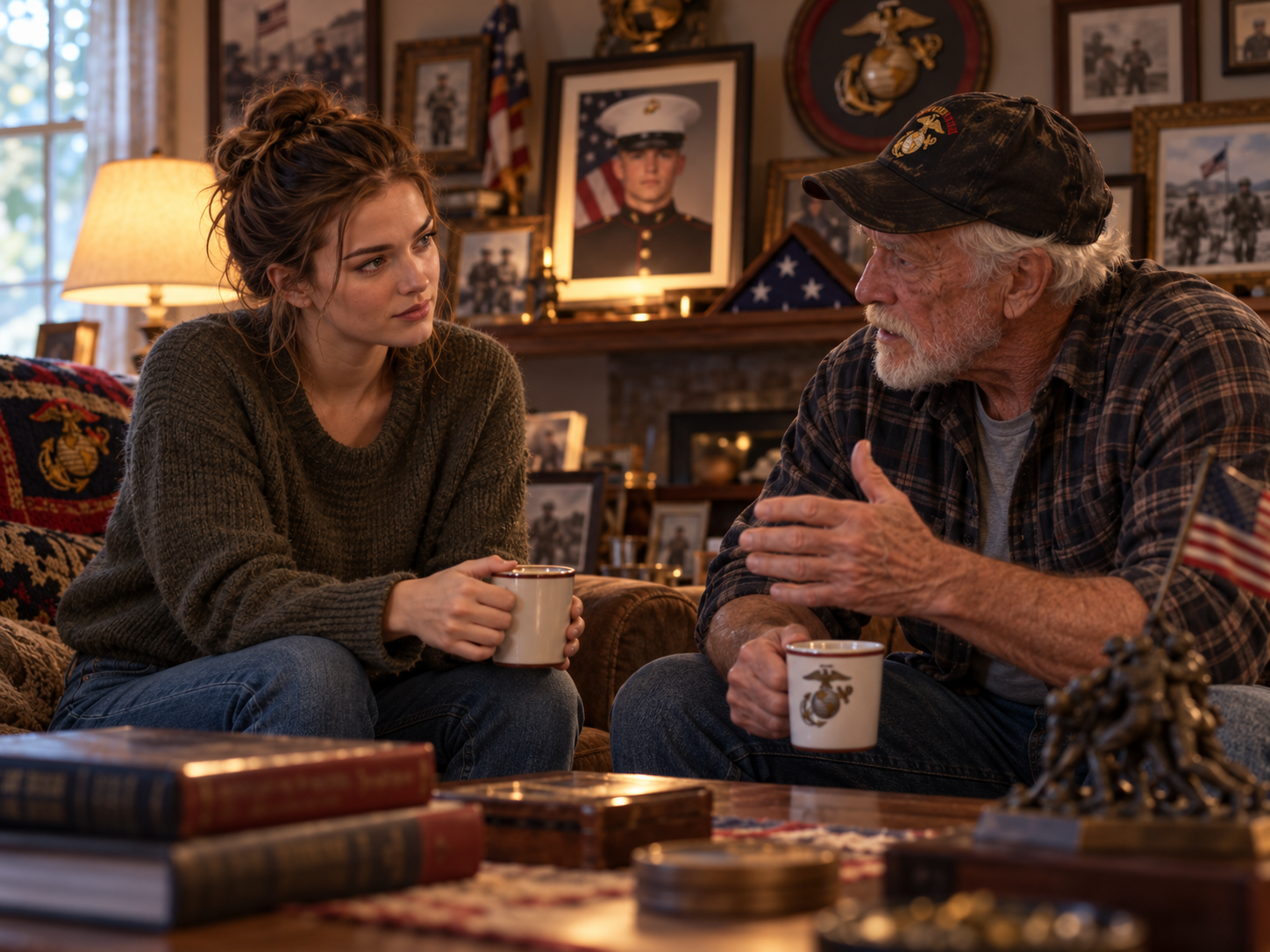
I looked down at my coffee.
“Why did you write about me?”
“Because I watched you do something similar.”
I frowned.
“When?”
“Two years ago. During a logistics exercise, a young Marine in your section made an inventory error.”
I remembered immediately.
Lance Corporal Nathan Price.
He had entered an incorrect equipment serial number.
The discrepancy had delayed an inspection.
His supervisor was ready to recommend formal counseling.
I had reviewed the records, discovered that the labeling system was confusing, and helped Price correct the error.
Then I’d proposed a checklist to prevent similar mistakes.
Price still received corrective instruction.
But the problem was fixed.
And nobody humiliated him.
Ellis nodded when I explained.
“I was serving as an invited evaluator. I saw how you handled it. Later, I read your performance reports.”
“Why didn’t you introduce yourself?”
“Because I didn’t want you treating me differently because I knew your father.”
I thought of the diner.
Another older Marine.
Another quiet observer.
Another unexpected connection.
Ellis smiled.
“You see the pattern?”
I looked up.
“Sir, did you know General Whitaker?”
His expression changed.
“Oh, yes.”
“How well?”
“We served together years ago.”
Something shifted in my chest.
“Did you arrange for him to meet me?”
“No.”
The answer came immediately.
“I hadn’t spoken to Tom Whitaker in months when he called me after meeting you.”
I stared.
“He called you?”
“He was reviewing your record. Saw my recommendation. Wanted to know why I’d written it.”
“And what did you tell him?”
Ellis smiled.
“That you were the kind of Marine who didn’t need an audience to do the right thing.”
I looked away.
For a moment, I thought I might cry again.
Then Ellis’s voice became serious.
“I hear you’re having trouble.”
I nodded.
He listened while I explained the allegations.
When I finished, he was quiet.
Then he asked, “What do you want to happen?”
“I want my record cleared.”
“Of course.”
“And I want the assessment opportunity.”
“Reasonable.”
I hesitated.
“I also want the people who helped during that exercise to receive proper credit.”
Ellis smiled.
“There she is.”
“Sir?”
“Michael’s daughter.”
He leaned back.
“Now let me ask something harder. What if correcting the record means exposing a Marine who has served honorably in other circumstances?”
I thought of Mercer.
His years of service.
His experience.
The younger Marines who admired him.
“I don’t want to destroy his career.”
“That’s not the question.”
I looked up.
Ellis’s eyes were steady.
“Can you accept that telling the truth may have consequences you don’t control?”
I took a breath.
“Yes, sir.”
“Good. Because integrity isn’t choosing outcomes. It’s choosing conduct.”
I drove back to Norfolk with that sentence echoing in my mind.
Three days later, the administrative review reached a turning point.
The investigators established that the reporting procedure had originated with my working group.
The archived drafts confirmed it.
The message records supported it.
Statements from Torres, Adams, and Sergeant Lewis corroborated the timeline.
The review also found evidence that Mercer had directed the removal of our names from the final report.
When confronted, he acknowledged the changes.
He insisted the procedure was a section-level accomplishment and that individual recognition was unnecessary.
But there was another issue.
He had submitted the allegations against me.
And he admitted that he had done so without verifying them.
His explanation was that he believed I had exaggerated my contribution after attracting the general’s attention.
The reviewers did not accept that suspicion as sufficient justification for the claims he’d made.
I was informed that appropriate administrative and command processes would address the matter separately.
My immediate concern was simpler.
The allegations against me were not substantiated.
The candidate restriction was lifted.
My record would be corrected.
I should have felt victorious.
Instead, I felt exhausted.
That afternoon, Mercer requested to speak with me.
I agreed, but only after First Sergeant Brooks arranged for the meeting to take place in her office.
Mercer entered looking older than I remembered.
His shoulders were stiff.
He avoided my eyes.
Brooks remained present.
“Staff Sergeant,” I said.
He nodded.
“Reynolds.”
For a long moment, nobody spoke.
Then he cleared his throat.
“I owe you an apology.”
I wasn’t prepared for that.
He continued.
“I believed you’d used your connection to the general to undermine me.”
“I didn’t, Staff Sergeant.”
“I know that now.”
His jaw tightened.
“I was wrong.”
The words hung between us.
I waited.
He looked down.
“When the general started asking questions about the exercise, I thought you were trying to take credit away from my section.”
“I was part of your section.”
He looked up.
For the first time, he seemed genuinely surprised by my response.
I continued.
“I never wanted to embarrass you. I wanted the work to matter.”
Mercer swallowed.
“I understand.”
“Do you?”
He didn’t answer immediately.
Then he said, “I should have named the Marines who contributed. I was afraid senior leadership would think I hadn’t been in control.”
Brooks folded her hands.
“Staff Sergeant, acknowledging subordinate contributions is not a failure of leadership.”
“Yes, First Sergeant.”
Mercer faced me again.
“I’m sorry, Corporal.”
I believed he meant it.
But believing an apology didn’t erase what had happened.
“Thank you, Staff Sergeant.”
He nodded.
I took a breath.
“I hope you’ll make sure this never happens to another Marine.”
He looked at me for several seconds.
Then answered quietly.
“So do I.”
After he left, Brooks turned toward me.
“You handled that well.”
“I don’t feel like I did.”
“Why?”
“Because part of me wanted to say something cruel.”
She gave a faint smile.
“That’s usually why restraint requires effort.”
I looked down.
“What’s going to happen to him?”
“His command will address his conduct. That’s not your responsibility.”
I nodded.
Brooks leaned forward.
“Your responsibility is preparing for the assessment.”
I looked up.
“It’s still happening?”
She smiled.
“You leave Monday.”
For the first time in weeks, I felt excitement without fear immediately swallowing it.
Then Brooks handed me another document.
It listed the assessment requirements.
Physical endurance.
Operational planning.
Leadership exercises.
Written evaluations.
Peer assessments.
Oral boards.
And a demanding field exercise that would test decision-making under pressure.
I scanned the pages.
Then stopped at a familiar name.
Captain Andrew Callahan.
He was listed as the lead evaluator.
I had heard of him.
Everyone in our command had.
Callahan had a reputation for believing that exceptional opportunities should go to Marines with exceptional records.
He was also a former subordinate of Mercer’s mentor.
I looked at Brooks.
“First Sergeant, does Captain Callahan know about the investigation?”
“He’ll receive the appropriate information. Your evaluation is supposed to be based on your performance.”
I nodded.
But something about the name unsettled me.
And when I arrived at the assessment site four days later, I discovered my concern wasn’t entirely misplaced.
Callahan stood at the front of the briefing room.
He looked over the candidates.
Then his eyes settled on me.
“Corporal Reynolds.”
I rose.
“Yes, sir.”
He studied me.
“So you’re the Marine everyone keeps talking about.”
The room grew quiet.
I held his gaze.
“Yes, sir.”
He set down his clipboard.
“Let’s establish something immediately.”
His voice carried across the room.
“A four-star general may have opened the door for you, Corporal. But he won’t be here to carry you through it.”
I straightened.
“I wouldn’t expect him to, sir.”
Callahan’s expression hardened.
“Good.”
He pointed toward the training field outside.
“Because by the time we’re finished, we’re going to find out whether you belong here at all.”
PART 5 — THE MARINE I CHOSE TO BECOME
The first morning began before sunrise.
Forty-eight candidates stood on a cold training field while Captain Callahan explained the rules.
We came from different assignments.
Different specialties.
Different stages of our military careers.
Some had years more experience than I did.
A few were already staff noncommissioned officers.
Others had previous college coursework or specialized training.
I was one of the lowest-ranking Marines there.
And, judging by the conversations around me, the most recognizable.
“That’s her,” someone whispered behind me.
“The diner corporal.”
I pretended not to hear.
Callahan paced in front of the formation.
“This assessment is designed to measure judgment, endurance, professionalism, adaptability, and leadership potential. It is not a popularity contest.”
His eyes passed over me.
“It is also not a reward for having an interesting story.”
Several candidates shifted.
I kept my expression neutral.
He stopped.
“Every candidate begins with the same opportunity to demonstrate competence. Your results will be documented. Your decisions will be questioned. And if you fail, the reasons will be recorded.”
He looked down at his clipboard.
“Let’s begin.”
The physical assessment was brutal.
Long-distance movement.
Casualty evacuation drills.
Equipment transport.
Team coordination.
By noon, my shoulders ached and my legs felt heavy.
But I wasn’t struggling alone.
A sergeant from Camp Lejeune twisted his ankle during a movement exercise.
He tried to continue.
I noticed his limp.
“You need medical evaluation,” I told him.
“I’m fine.”
“You’re not.”
He glared.
“Reynolds, mind your own assessment.”
I hesitated.
Every second mattered.
Stopping could affect our team score.
But ignoring an injury could make it worse.
I signaled the evaluator.
The sergeant was examined and removed from the event.
We lost time.
Our team finished behind several others.
That evening, Callahan questioned my decision.
“You interrupted the movement.”
“Yes, sir.”
“You knew it would affect your score.”
“Yes, sir.”
“Why?”
“Because the sergeant was injured.”
“That’s not what I asked.”
I took a breath.
“Because continuing without evaluation could have caused further injury, sir. I understood the time penalty.”
Callahan studied me.
“Did you consider the other candidates?”
“Yes, sir.”
“And you made that decision anyway?”
“Yes, sir.”
He wrote something.
I couldn’t read it.
“Dismissed.”
By the third day, exhaustion had stripped away most of our formal politeness.
Candidates argued over assignments.
Small disagreements became personal.
People who had arrived confident began doubting themselves.
I was no exception.
During a planning exercise, I made an error estimating how long a simulated equipment movement would take.
Our team missed a required planning milestone.
A gunnery sergeant named Patrick Doyle confronted me afterward.
“You’re supposed to be some kind of leadership prodigy?”
I looked at him.
“No, Gunnery Sergeant.”
“Then why are you here?”
“Same reason you are. To be evaluated.”
He stepped closer.
“Some of us earned our place without a general making phone calls.”
The words stung.
But this time, I didn’t lower my eyes.
“With respect, Gunnery Sergeant, I didn’t choose how I was identified. I’m responsible for what I do while I’m here.”
He stared.
Then shook his head.
“We’ll see.”
That night, I sat alone in the barracks reviewing my mistakes.
I had missed a calculation.
Failed to challenge an unrealistic assumption.
And spent too much time worrying about whether others accepted me.
I opened my father’s notebook.
The pages were worn from being handled.
I found the passage about authority and leadership.
Read it.
Then turned to a blank page.
For the first time, I began writing my own notes.
Leadership lesson, day three: Being afraid of looking unqualified can make you less willing to ask the questions that would prevent a mistake.
I stared at the sentence.
Then added another.
Ask anyway.
The final assessment was scheduled for Friday.
It was a complex field exercise involving simulated communications disruptions, movement constraints, incomplete information, and competing priorities.
Candidates would rotate through leadership positions.
The scenario was designed so that following the original plan without reassessment would lead to failure.
We didn’t know that at the beginning.
All we knew was that the exercise would be decisive.
I was assigned as an assistant team leader.
Doyle was the designated lead.
Our team included eleven Marines.
We received a mission brief.
Move simulated relief supplies to a designated collection point while maintaining accountability, communications, and safe movement procedures.
The scenario included a fictional coastal community recovering from severe storm damage.
It wasn’t combat.
But the leadership problems were real enough.
We had limited time.
Conflicting reports.
And several simulated emergencies introduced by evaluators.
The first hour went smoothly.
Then communications failed.
One radio stopped receiving.
A message arrived late.
A route was declared unavailable.
Doyle became increasingly frustrated.
“Use the original plan,” he ordered.
I checked the updated information.
“Gunnery Sergeant, the route is restricted.”
“We’ll verify when we get there.”
“That could cost us more time.”
He turned.
“Reynolds, I gave an order.”
“Yes, Gunnery Sergeant.”
I paused.
“May I recommend an alternative?”
He stared at me.
For a moment, I thought he would refuse.
Then he exhaled.
“Make it quick.”
I suggested reorganizing our communications, confirming the restriction through the available control channel, and moving to the designated alternate route if confirmed.
Doyle considered it.
Then nodded.
“Do it.”
We adjusted.
For twenty minutes, things improved.
Then the exercise changed completely.
An evaluator approached carrying a red scenario card.
Doyle read it.
His expression tightened.
“What is it?” I asked.
He handed it to me.
Simulated civilian casualty at the collection point. Medical support delayed. Team must reassess priorities while preserving accountability and mission-critical supplies.
Doyle cursed under his breath.
We had already lost time.
Now we faced another problem.
He began issuing orders rapidly.
Two Marines moved toward the casualty location.
Another started unloading equipment.
The remaining personnel waited for instructions.
Then a second evaluator approached.
Another scenario card.
Secondary communications disruption. One team member unaccounted for during movement.
Everything stopped.
Doyle looked from one card to the other.
His breathing quickened.
“We can’t do all of this.”
Nobody answered.
He turned toward me.
“Reynolds.”
“Yes, Gunnery Sergeant.”
“Take over accountability. Find the missing Marine.”
I moved immediately.
We confirmed our roster.
Established the last known location.
Requested the appropriate simulated search coordination.
Within minutes, we determined the missing Marine’s position through the exercise control process.
But the rest of the scenario was deteriorating.
Doyle had become so focused on restoring the original timeline that the casualty response and supply priorities were competing without clear coordination.
I returned to him.
“Gunnery Sergeant, recommend a short planning reset.”
“We don’t have time.”
“We’re losing more time by changing directions every two minutes.”
He glared.
I lowered my voice.
“We need one clear set of priorities.”
For a moment, I thought he might order me away.
Then he looked at the Marines standing around us.
He saw what I saw.
Confusion.
Fatigue.
People working hard without understanding the overall plan.
He exhaled.
“All right. What do you recommend?”
I laid it out.
Accountability first.
Immediate simulated casualty response through the designated exercise procedures.
Confirm which supplies were essential.
Assign clear responsibilities.
Reestablish a communications fallback.
Then update the movement plan.
Doyle listened.
At the end, he nodded.
“Do it.”
I hesitated.
“Gunnery Sergeant, you’re the team leader.”
He looked at me.
For the first time all week, there was no contempt in his expression.
“Then help me lead.”
We worked together.
Doyle assigned the teams.
I coordinated reporting.
Another Marine reorganized the supply load.
A sergeant established a reliable message relay using the approved backup procedure.
We didn’t finish first.
We weren’t even close.
But we completed the exercise safely, maintained accountability, and met the essential scenario requirements.
At the final briefing, Callahan reviewed the results.
He praised several candidates.
Criticized others.
Identified mistakes.
Then he looked at our team.
“Gunnery Sergeant Doyle.”
Doyle stood.
“Yes, sir.”
“Your initial response to the scenario changes was inadequate.”
“Yes, sir.”
“You became fixated on recovering lost time instead of reassessing priorities.”
“Yes, sir.”
Callahan continued.
“However, you eventually accepted a revised plan and restored coordination. What changed?”
Doyle was quiet.
Then he looked toward me.
“Corporal Reynolds challenged my assumptions, sir.”
Callahan raised an eyebrow.
“And?”
“She was right.”
The room fell silent.
Doyle continued.
“She didn’t undermine my authority. She helped me use it properly.”
I stared at him.
I hadn’t expected that.
Callahan looked at me.
“Corporal Reynolds.”
I stood.
“Yes, sir.”
“Did you consider taking command of the team yourself?”
“No, sir.”
“Why not?”
“Because Gunnery Sergeant Doyle remained the designated leader, sir. My responsibility was to provide information and help the team succeed.”
Callahan studied me.
“And if he had refused your recommendation?”
“I would have continued to carry out lawful orders while raising any immediate safety concerns through the appropriate channels, sir.”
He nodded slowly.
Then said, “Interesting.”
That was all.
No smile.
No praise.
Just one word.
Interesting.
The assessment ended Saturday morning.
We cleaned our equipment, turned in evaluation materials, and attended a final administrative briefing.
We were told results would be reviewed before recommendations were issued.
There would be no immediate decisions.
No guarantees.
No promises.
I returned to Norfolk exhausted and uncertain.
A week passed.
Then another.
I resumed my regular duties.
Mercer had been reassigned while his command addressed the findings of the earlier review.
A new staff sergeant took responsibility for our section.
The reporting procedure I’d helped develop was formally reviewed and retained.
My teammates received corrected acknowledgment.
For the first time in months, work felt normal.
Then one Tuesday afternoon, Staff Sergeant Collins appeared at my desk.
“Reynolds, you’ve got a visitor.”
I looked up.
“Who?”
He smiled.
“Someone who apparently likes diners.”
My stomach flipped.
I followed him to the conference room.
General Whitaker stood by the window.
This time, he wore civilian clothing.
A navy blazer.
Gray trousers.
And the familiar faded Vietnam veteran cap.
He turned when I entered.
“Corporal Reynolds.”
I came to attention.
“Sir.”
He smiled.
“At ease.”
I relaxed.
A little.
He pointed toward a chair.
“Sit down.”
I did.
He sat across from me.
For a moment, neither of us spoke.
Then he placed a folder on the table.
Another folder.
I almost laughed.
“Sir, I’m beginning to think you enjoy making me nervous.”
Whitaker chuckled.
“Occupational hazard.”
He opened it.
“Your assessment results have been finalized.”
My hands tightened together beneath the table.
“Yes, sir.”
“Your physical performance was strong. Your planning assessment showed areas for improvement.”
I nodded.
“Your written evaluations were above average. Your peer assessments were unusually consistent.”
He paused.
“You also received high marks for ethical judgment, adaptability, and collaborative leadership.”
My heartbeat accelerated.
He removed a document.
“The board has recommended you for continued development and formal counseling on your eligibility for an established Marine Corps commissioning pathway.”
I stared.
He continued.
“That recommendation is not a commission. You still have educational requirements, selection processes, and substantial work ahead. But your record supports taking those steps.”
I couldn’t speak.
Whitaker slid the document toward me.
“Congratulations, Corporal.”
I looked down.
My name was printed beneath the official recommendation.
For several seconds, I simply stared.
Then I whispered, “Thank you, sir.”
He watched me.
“Do you know what impressed me most?”
I shook my head.
“Your final exercise.”
I looked up.
“You didn’t win,” he said.
“No, sir.”
“You made mistakes.”
“Yes, sir.”
“You also listened, adapted, and helped another leader succeed when you could have tried to make yourself look better.”
He leaned forward.
“That’s harder than people think.”
I swallowed.
“Sir, may I ask you something?”
“Of course.”
“Why were you at that diner that night?”
His expression softened.
For the first time since we’d met, he looked genuinely tired.
“My wife and I used to go there.”
I remained quiet.
“Every Friday when I was stationed nearby, we’d sit in the back booth. She’d order pie. I’d complain about the coffee.”
He smiled faintly.
“She always said I was too stubborn to admit I liked it.”
I listened.
“She passed away last year.”
My chest tightened.
“I’m sorry, sir.”
“Thank you.”
He looked down at his hands.
“That evening was the anniversary of our first dinner together.”
I said nothing.
“I’d been having a difficult day. I went there because I wanted to feel close to her for a little while.”
He paused.
“My card was declined because I’d forgotten to update some account information after it expired. A small inconvenience. Nothing serious.”
He looked toward the window.
“But standing there at the register, I felt old. Foolish. Alone.”
My eyes filled.
Then he turned back toward me.
“And a young Marine came over and paid for my dinner without asking who I was.”
I wiped beneath one eye.
Whitaker smiled.
“Do you know what my wife used to tell me?”
I shook my head.
“She said the true measure of a person’s character is how they treat someone who cannot do anything for them.”
I thought of my father.
His old coat.
The groceries he’d carried.
The notebook in my bag.
Whitaker continued.
“You reminded me of her that evening.”
Neither of us spoke for a long moment.
Then I asked, “Sir, can I tell you something?”
“Please.”
“My father used to say something similar.”
I told him about Gunnery Sergeant Michael Reynolds.
About the notebook.
About the words I’d carried with me since childhood.
When I finished, the general’s eyes were bright.
“Your father sounds like he was a remarkable Marine.”
“He was, sir.”
Whitaker nodded.
“And he raised one.”
I couldn’t stop the tears then.
Not completely.
I tried.
But one escaped.
Then another.
The general pretended not to notice.
After a moment, he stood.
I rose with him.
He extended his hand.
I shook it.
“Corporal Reynolds, I hope you’ll remember something as your career progresses.”
“Yes, sir.”
“Rank is temporary. The responsibility that comes with it is real. And the way you treat people will outlast both.”
I nodded.
He smiled.
“Also, next time we meet at the diner, I’m buying.”
I laughed.
“Sir, I’d appreciate that.”
He placed his cap on his head.
Then walked toward the door.
Before leaving, he stopped.
“One more thing.”
“Yes, sir?”
“The bill.”
I blinked.
“Sir?”
“How much was it?”
I thought for a moment.
“Eighteen dollars and forty-two cents, sir.”
He smiled.
“You remember.”
“I remember now.”
He shook his head.
“Best eighteen dollars and forty-two cents anyone ever spent on me.”
Then he left.
I stood alone in the conference room holding the recommendation.
And for the first time, I truly understood what had happened.
The general hadn’t given me a future.
He had noticed a possibility.
Others had confirmed it.
And I had been given the chance to work toward it.
The months that followed were not easy.
There were college transcripts to obtain.
Academic plans to develop.
Training requirements to meet.
Interviews.
Financial decisions.
Long evenings studying after long days on duty.
There were moments when I wondered whether I was capable of reaching the next stage.
But I kept going.
I earned promotion to sergeant while continuing the education and professional development required for my chosen path.
I completed the necessary academic work over time, with guidance from mentors and countless hours of effort.
I applied through the proper selection process.
My first application wasn’t selected.
That disappointment hurt more than I expected.
For three days, I avoided talking about it.
Then I opened my father’s notebook.
Found a blank page.
And wrote:
Not selected does not mean not capable.
I reviewed the feedback.
Improved my application.
Completed additional coursework.
Asked for help where I needed it.
And applied again.
The second time, I was selected for the next stage.
Years after that rainy evening in Norfolk, I stood on a parade field at Marine Corps Base Quantico wearing a freshly pressed uniform.
My mother stood in the audience.
Maya Torres, now a staff sergeant, had traveled to be there.
Robert Ellis sat beside them.
And in the second row, wearing a dark suit and his familiar veteran cap, sat retired General Thomas Whitaker.
He had left active service by then.
His hair was whiter.
His movements slower.
But his eyes were just as steady.
When the ceremony concluded, my mother approached.
She was crying.
I laughed.
“Mom, please. You’re going to make me cry.”
She pulled me into her arms.
“Your father would have loved this.”
I closed my eyes.
“I know.”
Torres hugged me next.
“Look at you,” she said. “Lieutenant Reynolds.”
“Don’t start.”
“Oh, I’m absolutely starting.”
Ellis shook my hand.
Then pulled me into a hug that nearly cracked my ribs.
“Michael would be proud,” he whispered.
Finally, Whitaker approached.
I stood straighter.
He smiled.
“Lieutenant.”
“General.”
“Congratulations.”
“Thank you, sir.”
He looked at the new insignia.
Then at me.
“Was it worth it?”
I thought about everything that had happened.
The accusations.
The fear.
The late nights.
The failed application.
The second attempt.
The people who had helped me.
The lessons I had learned.
And the person I had become.
“Yes, sir.”
He nodded.
“I thought it might be.”
Then he reached into his jacket.
For one ridiculous second, I expected another folder.
Instead, he withdrew a small receipt.
It was old.
Faded.
Carefully preserved inside a clear sleeve.
I recognized the diner logo.
My breath caught.
“You kept it?”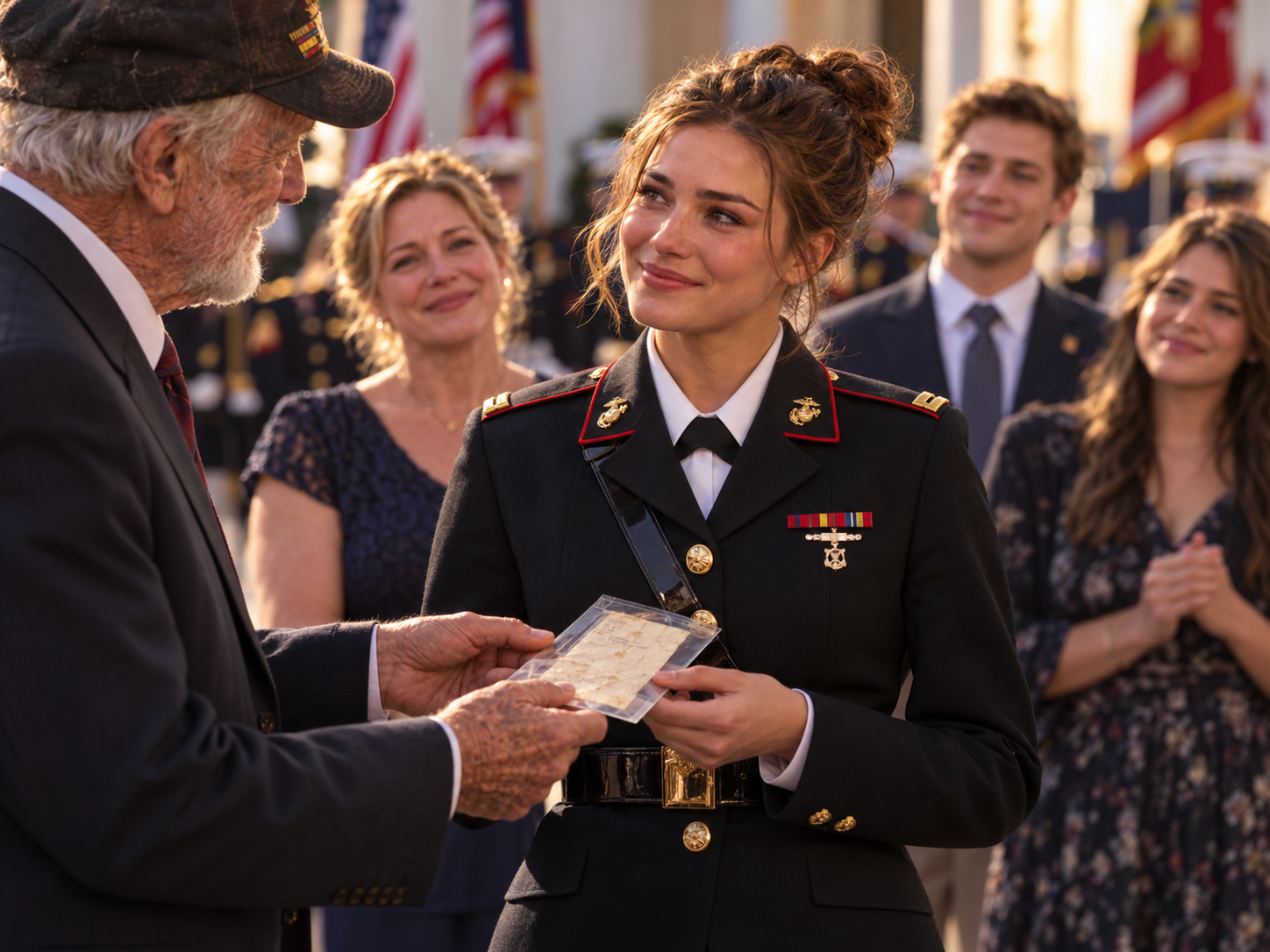
He smiled.
“Of course.”
I looked at the amount.
$18.42.
The date.
The location.
The ordinary record of an ordinary meal.
He turned the receipt over.
On the back, in his neat handwriting, were seven words.
Someone remembered what it means to serve.
My eyes blurred.
“Sir…”
Whitaker folded my hand around the sleeve.
“Keep it.”
I shook my head.
“I can’t.”
“You can.”
He looked toward the other newly commissioned officers celebrating with their families.
“One day, Lieutenant, you’ll find yourself in a position to open a door for someone else.”
I looked back at him.
“When that day comes, I want you to remember how this felt.”
I held the receipt tightly.
“I will, sir.”
He smiled.
“I believe you.”
Three years later, I was serving as a first lieutenant when I encountered a young lance corporal sitting alone outside the unit office.
His name was Aaron Miller.
He was twenty years old.
He looked exhausted.
A folder rested on his knees.
When I asked if he was all right, he tried to stand.
“Ma’am.”
“At ease, Marine.”
He hesitated.
Then explained that he’d missed an important administrative appointment because he’d been helping another Marine with a family emergency.
Now he was afraid the situation would damage his record.
I listened.
I asked questions.
I reviewed the relevant information.
And instead of assuming carelessness, I helped him identify the proper steps to explain what had happened and resolve the issue.
He stared at me afterward.
“Ma’am, why are you helping me?”
I thought about a rainy evening.
An embarrassed old man.
A declined credit card.
A little diner near Norfolk.
Then I smiled.
“Because you needed help, and I could provide it.”
He looked confused.
But he smiled back.
That evening, I returned to my office and opened the top drawer of my desk.
Inside was a small framed receipt.
$18.42.
Beside it lay my father’s black notebook.
I placed my hand over both.
For years, I had believed that the most important day of my military career would be the day I earned my commission.
I had been wrong.
The most important day had been an ordinary rainy evening when nobody was watching.
A day when I was tired.
Frustrated.
Ready to go home.
A day when I could easily have looked away.
Instead, I had helped a stranger.
Not because I wanted recognition.
Not because I expected a reward.
Not because I knew he was a general.
But because I believed someone should.
And although that small decision eventually opened an extraordinary door, the greatest gift it gave me wasn’t my career.
It was the understanding that the smallest moments often reveal the largest truths about who we are.
I had spent years trying to become the kind of Marine my father would have admired.
In the end, the lesson he left me was simpler than any promotion, award, or title.
You don’t have to be important to make a difference.
You have to be willing to notice when someone needs you.
And sometimes, an act of kindness costs only eighteen dollars and forty-two cents.
But its impact can last a lifetime.
THE END