The Power of Brotherhood: How Tank and Tyler’s Story Changed the Veterans’ Day Parade Forever
The True Meaning of Service: The Story of Tank, Tyler, and a Veterans’ Day March
There are stories that inspire us, stories that redefine our understanding of courage, sacrifice, and the bonds of service. This is one such story—one that showcases not just the resilience of individuals, but also the incredible spirit of unity that comes when people stand together for what is right. This story is about more than just a Veterans Day parade; it’s about the power of community, the strength of veterans, and the unwavering commitment to carrying each other through life’s hardest moments.
On November 11th, 2023, a seemingly simple Veterans Day parade became the stage for one of the most profound acts of service and solidarity that would resonate across the country. What started as a personal mission for one wounded soldier quickly turned into a public movement that would change not only the lives of those involved but also the communities around them. This is the story of Tyler Brooks, an Afghanistan veteran, and Jim “Tank” Morrison, a Vietnam veteran, who together created a moment that forever shifted how we view military service and the meaning of brotherhood.
A Wounded Soldier’s Simple Wish
Tyler Brooks was 26 years old. He was a decorated soldier, a Purple Heart recipient, and a Bronze Star honoree, having served in Afghanistan where he lost both legs to an IED explosion. Despite the tremendous physical and emotional challenges he faced, Tyler was determined to continue the traditions that had been passed down through his family for generations. His grandfather had marched in the Veterans Day parade after World War II. His father followed suit after his own service in Vietnam. For Tyler, it seemed only natural that he would do the same, honoring the legacy of the men who came before him.
However, when Tyler approached the city officials about his desire to participate in the parade, he was told that it wouldn’t be possible. The parade route, which stretched three miles across cobblestone streets and steep curbs, was simply not wheelchair accessible. No ramps. No accommodations. Officials even suggested that Tyler could instead wave from a float, but the idea of not being able to walk the same route as his forefathers devastated him.
But the insult didn’t stop there. Tyler later learned that one city official, when confronted about the accessibility issue, reportedly told him that if he couldn’t walk the route like everyone else, he simply shouldn’t participate at all. For a man who had already sacrificed so much for his country, this was a punch to the gut.
Tyler wasn’t seeking sympathy. He wasn’t asking for special treatment. All he wanted was to walk the same route that his father and grandfather had walked, to feel the same pride and camaraderie that veterans before him had felt. The lack of understanding from the city officials only fueled his resolve. But he needed help. He needed someone to take a stand with him.
A Hero’s Stand: Tank’s Response
Enter Jim “Tank” Morrison, a Vietnam War veteran who had seen more than his fair share of hardship. Tank, a man built like an oak tree—six foot three, nearly 300 pounds—had his own physical battles, including bad knees from his time in Vietnam and a back injury that never healed properly. Despite these struggles, Tank was a man of principle. When he heard Tyler’s story, he didn’t hesitate.
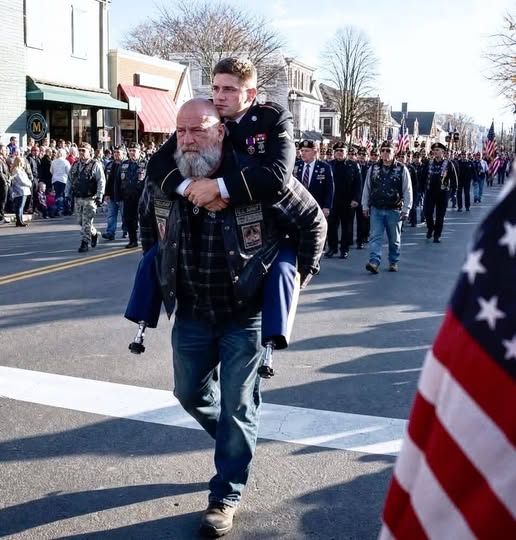
Tank stood up in that American Legion hall in Phoenix and said, “Get on.” He wasn’t asking Tyler to sit in a car or on a float. He wasn’t offering him a second-rate solution. Tank was offering to carry him—to walk the entire three-mile route on his behalf.
Tyler was taken aback. “You can’t carry me three miles,” he said, stunned by the offer.
Tank, with the kind of calm conviction only a man who had served his country could have, simply replied: “My knees survived Vietnam. They’ll survive this.”
It was a simple declaration, but one that embodied everything Tank stood for. He wasn’t offering pity. He was offering solidarity, a willingness to go the extra mile for a fellow veteran. Tank’s dedication to his brothers in arms was clear, and he wasn’t about to let Tyler’s wish go unfulfilled. He wasn’t asking for recognition, and he wasn’t seeking praise. He was simply doing what needed to be done.
An Unlikely Alliance: The Parade That Would Change Everything
As Veterans Day approached, Tank gathered his fellow veterans to help Tyler. What began as a single act of compassion soon grew into a movement. Other veterans, many of whom had served in Vietnam, Korea, Iraq, and Afghanistan, rallied around Tyler. The camaraderie of veterans was on full display as they stood together, united in their mission to ensure that Tyler’s dream of marching in the Veterans Day parade would not be denied.
A few days before the parade, the mayor’s office called Tank and warned him not to make the event a spectacle. Tank, ever the tactician, had no time for such concerns. “Removing combat veterans from a Veterans Day parade would be one hell of a headline,” Tank responded.
The morning of November 11th arrived, and Tyler, in full uniform with his medals shining, made his way to the parade route. Tank, flanked by his motorcycle club and fellow veterans, stood ready to support him. But something unexpected happened as the parade began.
Veterans from different wars and different generations began walking up to Tank, volunteering to help. A Marine from Somalia. A female Iraq veteran who had lost her arm. Veterans from all over came forward, offering to help Tyler march in honor of all the men and women who had sacrificed for their country. By the time the parade started, more than fifty veterans had gathered around Tyler.
But Tank didn’t give up his position. He was still carrying Tyler, despite the physical strain it was placing on him. His knees were failing, but his resolve remained unshaken. “He wants to march with veterans,” Tank had said. “Then he marches.”
A City Transformed: The Power of Unity and Compassion
As the parade moved forward, something extraordinary happened. The crowd, which had been expecting the usual Veterans Day procession, was silent. The sight of an older Vietnam veteran, struggling under the weight of his own physical limitations, carrying a younger soldier who had lost both his legs, left the onlookers in awe.
The applause began slowly, then grew into something that could only be described as a standing ovation. The crowd, once passive spectators, had now become participants in the moment. They were saluting not just Tyler, but every veteran who had served their country, every soldier who had been left behind or forgotten, and every person who had ever carried the weight of war on their shoulders.
As Tank and Tyler approached the reviewing stand, the mayor, visibly upset, tried to confront the scene. “You’re making a mockery of this parade,” he said, his voice full of frustration.
Tank, never one to back down, stopped in the middle of the street and turned to the mayor. “This young man lost his legs serving his country,” he said, his voice strong. “He wanted to march the same route his father and grandfather marched. Your office told him he couldn’t because accessibility cost too much.”
The crowd went silent. Then Tyler spoke, his voice carrying through the stillness. “What part didn’t you mean? That wounded veterans are inconvenient? That we should stay hidden if we can’t walk?”
The silence was broken by a voice from the crowd: “Shame!”
The mayor, realizing the depth of the situation, backed away as the crowd erupted in support. Tyler had become a symbol of everything that was wrong with how veterans were treated, and Tank’s unwavering commitment to his fellow soldier had forced the issue into the national spotlight. The power of unity and compassion had transformed the situation into something bigger than anyone had expected.
A Lasting Impact: Changing the Course of a Community
By the time they reached the end of the parade route, Tank’s knees finally gave out. He dropped to one knee, still holding Tyler on his back, but Tyler insisted someone else take over. Tank, in his typical fashion, refused. “We do not leave brothers behind,” he gasped.
Then, something remarkable happened. Strangers—people who had been watching the parade from the sidewalks—moved into help. A teenager grabbed Tank’s arm, an elderly woman took the other side, and together they lifted him. This wasn’t just a parade; this was a community coming together to carry the weight that had been placed on these men. It was a tangible reminder that even in the hardest moments, we can’t do it alone, but together, we are unstoppable.
When they crossed the finish line, Tank collapsed onto the grass. Tyler sat beside him, tears in his eyes. “You could’ve hurt yourself doing this,” Tyler said, his voice filled with emotion.
Tank smiled and squeezed Tyler’s hand. “Too many veterans think nobody cares anymore,” he said softly. “You needed to know somebody would carry you before letting you be forgotten.”
The story spread like wildfire, making headlines across the country and beyond. The mayor resigned, and the next year, the city rebuilt the parade route to be fully accessible to all veterans. Local businesses began to hire wounded veterans, and schools created volunteer programs to help disabled veterans attend public events. The spirit of service and compassion that Tank and Tyler had ignited spread far and wide.
Conclusion: The Power of Brotherhood
Tank and Tyler’s story is one of extraordinary compassion, but it’s also a reminder of the responsibility we have to honor our veterans. Service is not just about military duty; it’s about supporting each other, especially when it’s hard. It’s about showing up when the road isn’t built for everyone to walk alone, and it’s about carrying each other when the burden becomes too heavy.
As we reflect on their story, let’s remember that real service is about more than flags and speeches. It’s about showing up for one another, lifting each other when we need it most, and making sure no one is left behind.