The Woman They Mistook for Staff Finally Revealed Her Husband’s Hidden Legacy
The Woman They Mistook for Staff Finally Revealed Her Husband’s Hidden Legacy
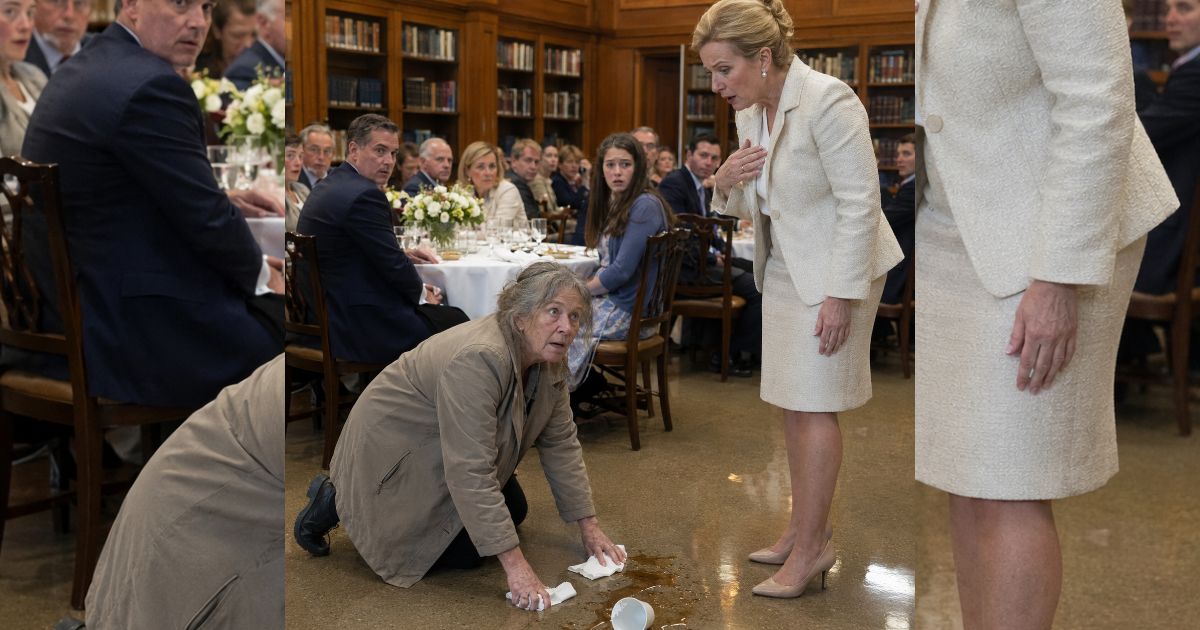
“Sweetheart, there’s coffee spilled near the donor table. Could you clean it up before one of the important people slips?”
The elegant woman pressed a handful of napkins into my hand like she was feeding scraps to a stray dog. Her pale-pink nails were flawless. Her diamond earrings sparkled every time she turned her head. Her smile wasn’t cruel, but it wasn’t kind either — it was the polite smile rich women give when they’ve already decided exactly where you belong.
I stared at her for a second, then looked down at the spreading brown puddle on the polished floor.
My knuckles were swollen from decades of opening stubborn cafeteria jars. My fingers were slightly bent from arthritis. There was an old burn scar on my wrist from a tipped soup pot twenty-three years ago. The only ring I wore was my thin wedding band, now loose because I had lost weight after Orson died.
My coat was old. My shoes squeaked. My hair had gone flat on the drive over.
I understood perfectly what she saw: just a tired, small woman in a faded coat standing near the back wall of a room full of money.
So I took the napkins.
Not because she was right. Not because I was ashamed. But because spilled coffee can hurt someone, and for my whole life I had cleaned up messes other people stepped over.
I knelt down. The room didn’t stop. No dramatic music played. No one gasped. Forks still clicked against plates, parents laughed softly, and a student adjusted the microphone on stage. Someone near the dessert table complained that the lemon squares were too dry.
And there I was — on my knees wiping coffee at a luncheon where I was supposed to be the guest of honor.
That’s how the day began.
My name is Ludivine Bell. I am sixty-seven years old. I worked in the school cafeteria for nearly forty years. I can look at a child’s lunch tray and instantly know if they’re truly hungry or just pretending not to be.
My husband, Orson, was the custodian at the same school. He passed away seven months earlier. Some mornings I still reached across the bed for the warm spot where his shoulder used to be.
The school had invited me because they were naming a scholarship after him.
It sounded beautiful when the principal called.
But that morning my granddaughter Tamsin, seventeen years old, had looked at my coat in the car and asked quietly, “You’re really wearing that, Grandma?”
Inside the school, everything sparkled — new lights, new chairs, glossy photos of smiling students — but the staff hallway still had the same chipped paint. Women like me always notice which parts get fixed and which parts are expected to stay ugly.
The luncheon was held in the old library. White tablecloths, stiff flowers, gold-printed place cards: The Orson Bell Memorial Scholarship Luncheon.
Then came Coralie Voss — the woman whose name was on half the plaques in the building. She didn’t recognize me. Why would she? Women like her are trained to spot donors, not lunch ladies.
So when the coffee spilled, she picked the oldest woman in the plainest coat and handed me the napkins.
After I finished wiping, my granddaughter whispered in horror, “Grandma…?”
Principal Crane rushed over, flushed. “Mrs. Bell! Oh my goodness, let me help you.”
The whole room heard the name.
Coralie’s hand flew to her pearls.
The principal announced loudly, “Everyone, this is Mrs. Ludivine Bell — Orson’s wife and our guest of honor today.”
The atmosphere changed instantly.
Coralie stammered an apology. I simply smiled and said, “It’s fine.” That polite lie older women learn by heart: It’s fine. Don’t worry. I understand.
During the speeches, speaker after speaker called Orson “a man with a smile, a broom, and a helping hand.” They showed a video of him sweeping floors and changing trash bags with soft piano music and captions like “Always smiling” and “A humble servant.”
Each compliment felt like another shovel of dirt burying the real man I loved.
Then old teacher Fenwick leaned over and whispered, “Did he ever tell you about the boiler?” He described how Orson had stayed in the basement for three freezing nights to keep the heat on so the school play could go ahead.
More voices joined in:
A teacher told how Orson fixed her car during her divorce so she could make it to court.
A former student named Callow stood up in tears: “He caught me stealing food from the trash. Instead of reporting me, he shared his lunch and helped me apply to trade school. I now own a repair shop with six employees and a house I never dreamed I’d have.”
Then my granddaughter Tamsin, voice shaking, held up Orson’s old metal box and began reading the tiny handwritten notes inside — secret records of every quiet act of kindness: bus passes paid, application fees covered, coats bought, cars towed anonymously, broken hearts listened to at midnight.
One note was about Bram Voss — Coralie’s own son. Orson had quietly paid for his car to be towed late one night without ever telling the wealthy family.
Bram turned pale. He stood up and apologized through tears.
Coralie stepped forward, eyes wet. “I was so wrong. Please forgive me.”
I finally took the microphone and spoke calmly but clearly:
“Please don’t judge a person by their uniform, their rough hands, or their old coat. My husband wasn’t just the man who swept the floors. He was the one who kept this entire school standing with invisible acts of love. His real legacy isn’t a fancy scholarship name — it’s the lives he quietly changed.”
I asked them to rename the fund The Orson Bell Quiet Rescue Fund — to support students who want to learn trades, practical skills, and those who need silent help.
The room erupted in applause. Everyone stood.
Coralie announced she would anonymously donate a large sum to the new fund.
Bram hugged me and whispered his thanks.
Tamsin ran into my arms, crying, “Grandma… I’m so proud of Grandpa.”
That day ended with people lining up to sign a new plaque that read:
“The invisible hands that hold up the world.”
And I knew Orson had never really left us. His quiet legacy was still alive — in every student he helped, every teacher he lifted, and in the hearts of those who finally understood the true value of humble service.