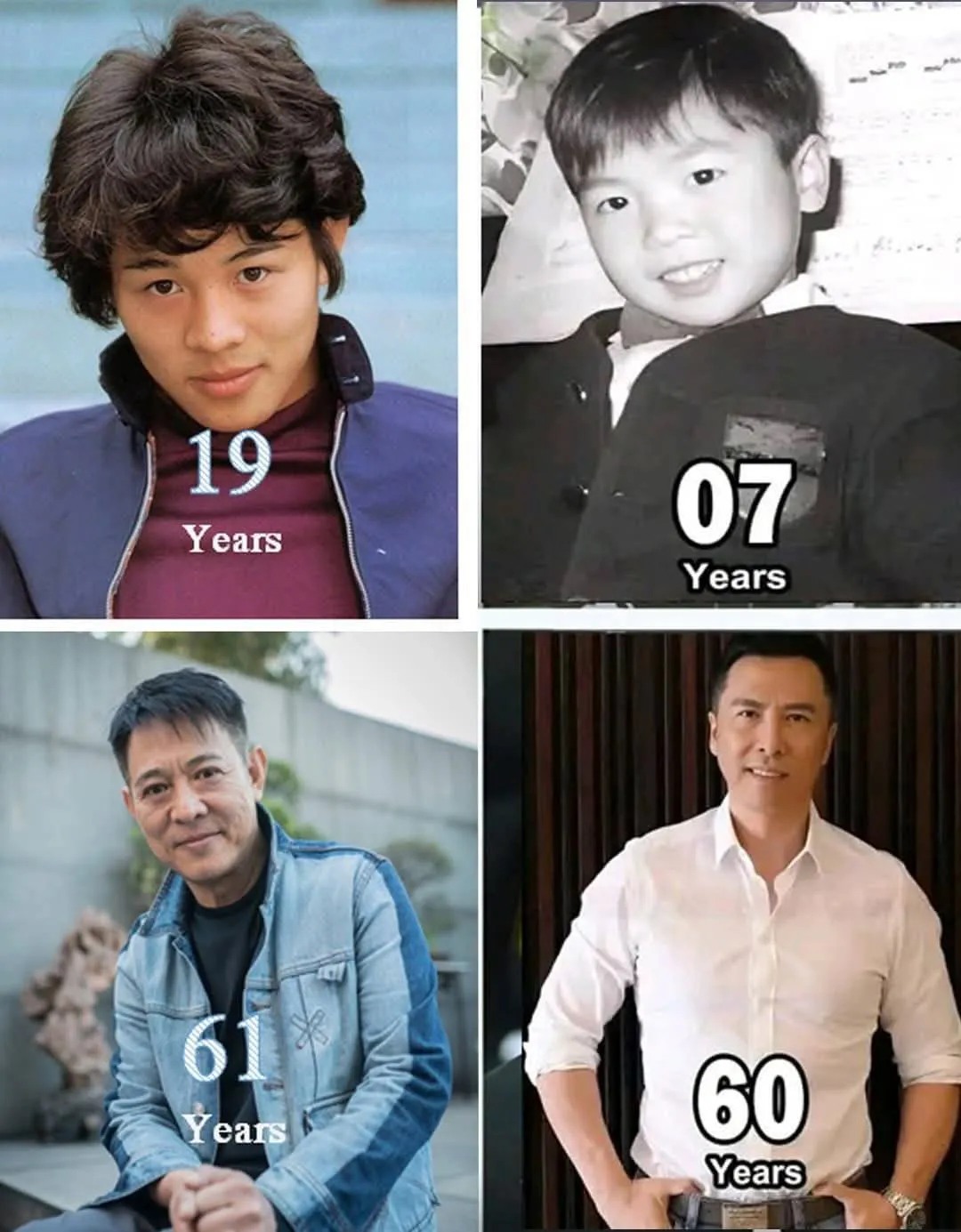
Jet Li and Donnie Yen Then and Now: How Two Martial Arts Legends Evolved From Fearless Fighters Into Global Icons
More than three decades ago, Jet Li and Donnie Yen stood opposite each other in Once Upon a Time in China II, armed with bamboo poles and moving with the speed, precision and intensity that would help define an entire generation of martial arts cinema.
Today, both men are in their 60s.
Their faces have changed. Their careers have evolved. Their priorities are different. Yet their names still carry enormous weight among action-film fans around the world.
Jet Li and Donnie Yen followed very different paths to superstardom, but together they helped transform Chinese martial arts cinema into a global phenomenon.
Their “then and now” transformation is not simply about aging. It is the story of two extraordinary performers growing from elite fighters into cultural icons.
Jet Li: From Wushu Champion to International Superstar
Long before Jet Li became a movie star, he was already an exceptional martial artist.
Born Li Lianjie in Beijing in 1963, he began practicing wushu as a child and eventually became a member of the Beijing Wushu Team.
Years of intense training gave him the discipline, flexibility and technical precision that would later become instantly recognizable on screen.
His movie breakthrough arrived with Shaolin Temple in 1982.
The film turned the young martial artist into a major star and helped introduce a new generation of audiences to traditional Chinese martial arts.
But Jet Li’s image as a true screen legend was cemented during the 1990s.
In Once Upon a Time in China, he portrayed Wong Fei-hung, the famous Chinese martial artist and folk hero.
Li brought something unusual to the character.
His movements could look graceful and controlled one moment, then explosively fast the next.
The film became one of the defining martial arts productions of its era and helped establish Li as one of Hong Kong cinema’s biggest stars.
More successful films followed, including Fong Sai-yuk, Fist of Legend and Tai Chi Master.
Each project strengthened his reputation as a performer capable of combining genuine martial arts ability with the heightened choreography of action cinema.
Then Hollywood came calling.
Jet Li Conquers Hollywood
For many American moviegoers, their first major introduction to Jet Li came in 1998 when he appeared in Lethal Weapon 4.
Instead of playing the hero, Li portrayed a dangerous villain.
His speed immediately stood out.
Even among experienced Hollywood action performers, Jet Li looked different. His movements were compact, efficient and startlingly quick.
Two years later, he took the leading role in Romeo Must Die, starring alongside Aaliyah.
The movie marked an important step in Li’s international career and was followed by films including Kiss of the Dragon, The One and Cradle 2 the Grave.
At the same time, he continued appearing in ambitious Chinese-language productions.
One of the most important was Hero, released internationally in the early 2000s.
The visually striking martial arts epic became one of his most celebrated films and demonstrated that action choreography could be both spectacular and emotionally expressive.
Later came Fearless, another major martial arts drama, followed by appearances in The Forbidden Kingdom and The Expendables franchise.
By then, Jet Li was no longer simply a martial arts actor.
He had become an internationally recognizable symbol of the genre.

The Moment That Changed Jet Li’s Life
Away from movie sets, however, Li’s outlook was changing.
His experience during the 2004 Indian Ocean tsunami had a profound effect on him.
Facing the possibility that he and his family might not survive pushed Li to think more seriously about mortality, purpose and what he wanted to do beyond entertainment.
In the years that followed, philanthropy became increasingly important in his life.
He became involved in humanitarian work and established the One Foundation, focusing on disaster relief and other charitable causes.
Health concerns also changed the public image of a man who had once seemed almost physically invincible.
Li revealed that he had been diagnosed with hyperthyroidism.
For fans who remembered him flying across movie screens, effortlessly defeating groups of opponents, seeing him speak openly about illness and aging was striking.
But Li gradually embraced that transformation.
Rather than trying to preserve the image of the eternally young action star, he increasingly focused on philosophy, meditation, spirituality and personal growth.
The younger Jet Li became famous for mastering his body.
The older Jet Li appears increasingly interested in mastering the mind.

Donnie Yen: A Different Road to Martial Arts Greatness
Donnie Yen was also born in 1963, but his journey toward stardom unfolded differently.
Born in Guangzhou, Yen spent part of his youth in the United States.
Martial arts were already part of his family life. His mother, Bow-sim Mark, became a respected martial arts teacher, exposing him to training from a young age.
Yen later trained in China and eventually entered the Hong Kong film industry.
His early career included collaborations with legendary action choreographer and director Yuen Woo-ping.
But unlike Jet Li, Yen did not immediately become a massive international star.
His rise was slower.
During the 1980s and 1990s, he appeared in numerous action movies while developing his own distinctive fighting style.
Yen was interested in more than traditional martial arts.
He studied and incorporated ideas from boxing, kickboxing, grappling and other combat systems.
That willingness to combine different techniques would eventually become one of his defining characteristics.
When Donnie Yen Fought Jet Li
One of the greatest moments in martial arts movie history arrived when Yen faced Jet Li in Once Upon a Time in China II in 1992.
Yen played General Nap-lan, an opponent worthy of Li’s Wong Fei-hung.
Their climactic duel became legendary.
The two fighters battled using long poles, turning an ordinary object into the centerpiece of an extraordinarily complex action sequence.
For martial arts fans, it became something special: two future icons fighting while still relatively young, years before either had completed his journey toward international fame.
They would eventually face each other again in Hero.
This time, their duel had a completely different tone.
Instead of the frantic energy of their earlier confrontation, the sequence was elegant and controlled, reflecting how both performers — and martial arts cinema itself — had evolved.
Ip Man Changes Everything
Donnie Yen had already enjoyed a long career by the time Ip Man arrived in 2008.
But the movie changed everything.
Yen portrayed Ip Man, the Wing Chun master who would later become famous as one of Bruce Lee’s teachers.
The role required restraint.
Instead of presenting Ip Man as an aggressive action hero, Yen portrayed him as calm, disciplined and dignified.
When he fought, however, the transformation was immediate.
Wing Chun’s rapid punches and close-range techniques created a style of action unlike the large, acrobatic movements associated with many earlier martial arts movies.
Audiences loved it.
Ip Man became an international success and spawned several sequels.
For many viewers, Donnie Yen and Ip Man became inseparable.
The franchise finally gave Yen the defining role that transformed him from a respected martial arts performer into a worldwide superstar.
Donnie Yen Goes Global
After Ip Man, Hollywood increasingly recognized Yen’s appeal.
He appeared as Chirrut Îmwe in Rogue One: A Star Wars Story, bringing both humor and martial arts skill to the blockbuster franchise.
He also appeared in xXx: Return of Xander Cage and Disney’s Mulan.
Then came another memorable character: Caine in John Wick: Chapter 4.
The blind assassin quickly became one of the movie’s standout figures.
Yen brought speed, humor, charisma and emotional weight to the role, proving that even after decades of action filmmaking, he could still create a character audiences wanted to see again.
And unlike Jet Li, whose recent years have moved increasingly toward spirituality and life away from intense action filmmaking, Yen remains deeply involved in creating new screen fights.
He has expanded his work behind the camera as a director, producer and action filmmaker.
His career has gradually transformed from simply performing choreography to controlling how entire action sequences and films are built.
Two Legends, Two Very Different Transformations
Looking at Jet Li and Donnie Yen then and now reveals something more interesting than physical change.
They represent two different versions of longevity.
Jet Li’s early career was built around astonishing athletic elegance.
His competitive wushu background made his movement extraordinarily clean and precise. At his peak, he seemed almost too fast for the camera.
But age, health challenges and personal experiences gradually moved him toward a quieter life focused on family, philanthropy and spiritual reflection.
Donnie Yen’s evolution has been different.
His physical style became harder, more experimental and increasingly influenced by multiple combat systems.
Instead of stepping away from action, he expanded his role within it.
Actor became choreographer.
Choreographer became producer.
Performer became director.
Even in his 60s, he continues searching for new ways to present martial arts on screen.
Their Legacy Is Bigger Than Any One Film
It is tempting to ask who was better: Jet Li or Donnie Yen?
But that question misses what makes their careers remarkable.
They brought different strengths to martial arts cinema.
Jet Li represented extraordinary speed, elegance and traditional wushu technique.
Donnie Yen became known for adaptability, intensity and a willingness to merge classical martial arts with modern combat styles.
Both helped introduce Asian action cinema to audiences far beyond Hong Kong and mainland China.
Both created characters that remain instantly recognizable decades later.
And both helped prove that martial arts stars could become true international movie stars without abandoning the traditions that shaped them.
The young Jet Li and Donnie Yen once stood across from each other as cinematic rivals.
More than 30 years later, they stand beside each other in film history.
Their bodies have aged, their careers have changed and their paths have moved in different directions.
But the old scenes remain.
The bamboo poles collide.
The fists move faster than expected.
And for a few unforgettable minutes, two future legends show the world exactly why their names would still matter decades later.