Robert Downey Jr. Saw Tom Holland’s First Marvel Scene Shrink — Then Asked the Question Holland Never Forgot
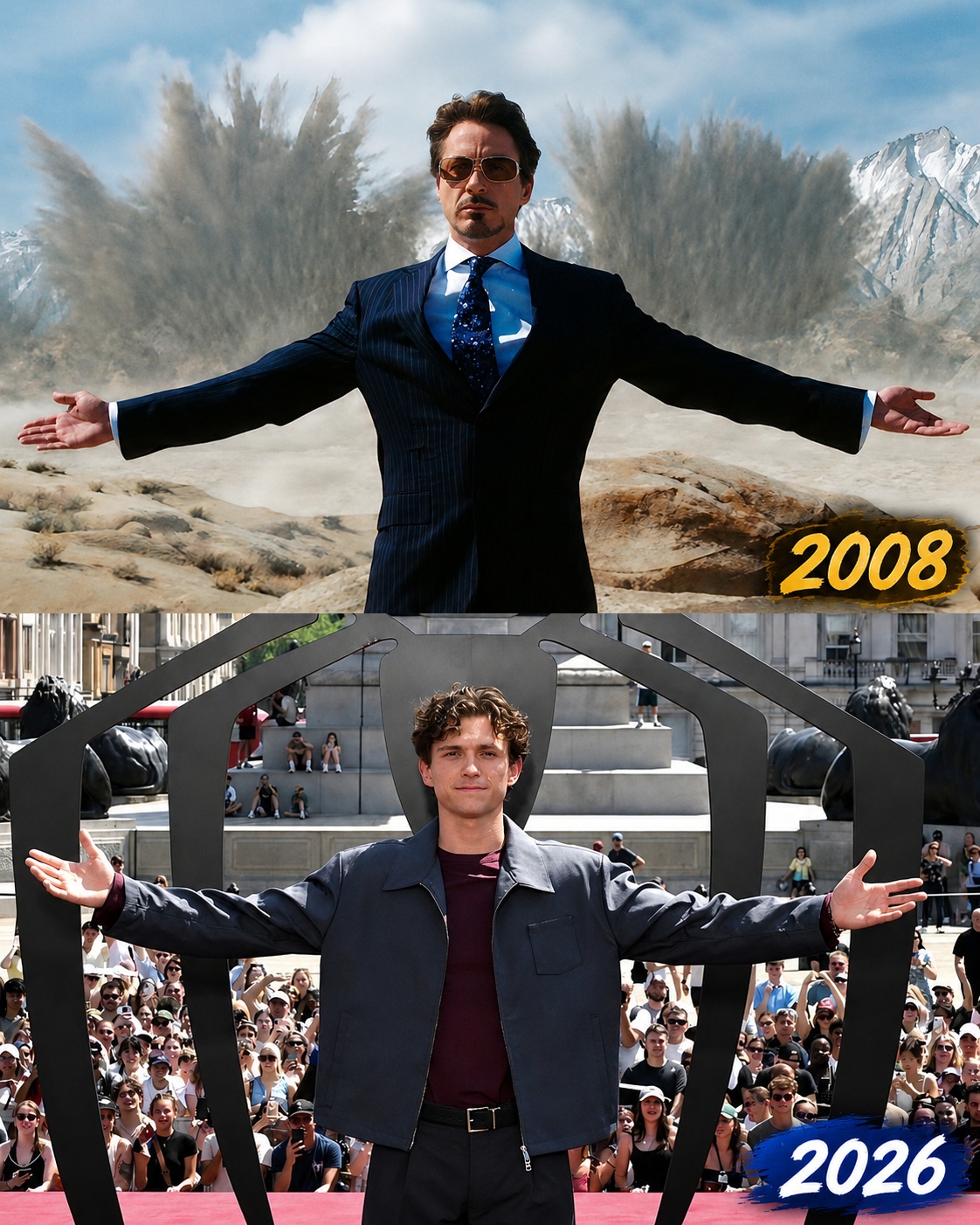
Tom Holland had already made it through the exhausting process of becoming Spider-Man.
He had won the role. He had screen-tested opposite Robert Downey Jr. He had rehearsed an unusually long scene—about eight pages of dialogue—that would introduce his version of Peter Parker to the Marvel Cinematic Universe.
Then Holland arrived on the set of Captain America: Civil War and saw what had happened to the scene.
Most of it was gone.
The eight pages Holland remembered from his audition had been reduced to roughly a page and a half or two pages by the time filming began. For a young actor making his first appearance in one of Hollywood’s biggest franchises, it could easily have been the kind of change he simply accepted.
But Downey noticed.
“Where’d all the kid’s lines go?” Holland recalled him asking.
What happened next lasted only a small part of the production of Civil War. But nearly a decade later, Holland was still telling the story—and by 2026, he was openly describing Downey as the kind of mentor he now hopes to become for somebody else.
The Audition That Changed Holland’s Life
Before audiences knew Holland as Peter Parker, Marvel had to solve a difficult casting problem.
Spider-Man was joining the MCU after two previous big-screen versions of the character had already been closely identified with Tobey Maguire and Andrew Garfield. Marvel needed someone young enough to make Peter genuinely feel like a teenager, but capable of holding his own beside established stars.
Holland’s audition process eventually put him in a room with Downey.
That mattered because the chemistry between Peter Parker and Tony Stark was going to become central to this version of Spider-Man.
Marvel casting director Sarah Finn later recalled that Holland distinguished himself during the Downey screen test not merely by delivering jokes, but by matching the older actor’s energy while still making Peter feel recognizably human. She described him as confident and funny, able to respond naturally to Downey while also bringing the qualities required of a superhero.
That ability was especially important because Downey was not simply reading lines mechanically.
Holland has recalled Downey improvising during the audition, forcing the young actor to react in the moment rather than cling rigidly to what was written. Holland kept up.
He got the job.
But winning Spider-Man was only the beginning.

Then Eight Pages Became Two
Holland’s first MCU appearance would come in 2016’s Captain America: Civil War, with Tony Stark visiting Peter Parker at the Queens apartment he shares with Aunt May.
The sequence had an enormous amount of work to do.
It had to introduce a new Peter without retelling his entire origin story. It had to establish that he already possessed his powers. It needed to show his intelligence, awkwardness and sense of responsibility. And it had to create enough chemistry between Peter and Tony to justify Stark bringing a teenager into a conflict involving the Avengers.
During Holland’s audition, that material had stretched across approximately eight pages.
On the actual set, Holland said, it had been dramatically shortened.
The reason was practical rather than personal. Holland recalled directors Anthony and Joe Russo explaining that the movie’s script was already too long and there simply was not enough time available to spend shooting the extended version of the scene.
For Holland, the situation contained an obvious imbalance.
He was the newcomer.
The Russos were directing a massive Marvel production. Downey had been the face of the MCU since Iron Man. Holland had only just been entrusted with one of Marvel’s most valuable characters.
He was hardly in the strongest position to demand more screen time.
Downey was.
Downey Spoke Up
After asking what had happened to Holland’s dialogue, Downey pushed for a simple solution.
Shoot the longer version.
According to Holland’s account on The Rich Roll Podcast in October 2024, Downey argued that the filmmakers should spend the time to capture the complete scene Holland had performed during the audition. If it proved too long later, they could always cut it during editing.
What mattered was having the material.
The Russos agreed.
And the decision produced a striking payoff.
“They used all of it,” Holland said.
The moment is easy to overlook because viewers watching Civil War never see the alternate version—the shortened introduction that might have existed if Downey had remained silent.
Instead, audiences meet a Peter Parker who gets time to breathe.
He talks with Tony. He tries to hide his secret identity. Tony tests him. Peter explains, in his own youthful way, why he feels obligated to use his abilities when he can help people.
The scene establishes a relationship that would soon become much more important.
Tony and Peter’s Onscreen Relationship Began Echoing Real Life
In Civil War, Tony Stark is the established superhero who recognizes something valuable in Peter and gives him an opportunity to enter a much larger world.
That dynamic continued into 2017’s Spider-Man: Homecoming. Marvel’s own description of the movie explicitly identifies Tony as Peter’s mentor, watching over the teenager as he struggles to balance high school with his ambitions as Spider-Man.
The real relationship between the actors should not be confused with the fictional one. Holland has never needed the story exaggerated into claims that Downey somehow “raised” him or became a literal father figure.
What Holland himself has said is more meaningful because it is more precise.
Downey became a mentor.
And the Civil War story offers a concrete example of what that mentorship could look like.
Downey did not simply give Holland advice about fame or acting. On a day when the younger performer had very little power, he recognized that Holland’s opportunity to show what he could do was disappearing—and used his own influence to protect it.
Ten Years Later, Holland Wants to Do the Same
By 2026, the balance had changed.
Holland was no longer the nervous newcomer arriving opposite one of Marvel’s biggest stars. He had spent a decade as Spider-Man and had become one of the most recognizable actors of his generation.
And when the conversation turned toward whoever might eventually follow him, Holland immediately returned to the example Downey had set.
“In the way that Robert Downey was such a mentor for me,” Holland told Esquire UK, he would like to provide that same kind of guidance to whoever comes next.
Holland even named Adolescence breakout Owen Cooper as a young actor he believed could be an exciting future choice, calling the rising British star highly talented.
There is no indication Holland is eager to abandon Spider-Man. His comments were about a future transition, whenever that eventually happens.
But they reveal how clearly he remembers being the young actor on the other side of that relationship.
Long before Holland had his own Marvel legacy, Downey looked across a movie set, noticed that the newcomer’s big scene had nearly disappeared and asked where his lines had gone.
The filmmakers could have cut the material afterward.
Instead, they filmed it.
They kept it.
And ten years later, Holland still remembers the actor who made sure he got the chance to show everyone why Marvel had chosen him in the first place.