11 Unforgettable Train Scenes That Became Part of Movie History
Trains have been part of cinema almost as long as movies themselves.
That makes sense. Few locations give filmmakers so many possibilities at once.
A train can represent escape, adventure or a painful goodbye. It can become a claustrophobic setting for suspense, a moving battlefield for an action sequence or even a magical doorway into another world.
And because a train is already moving, filmmakers immediately gain something every great movie scene needs: momentum.
Over the decades, directors have sent heroes racing across locomotive roofs, lovers chasing departing carriages, superheroes desperately stopping runaway trains and children boarding mysterious engines headed toward impossible destinations.
Some sequences are spectacular because of enormous stunt work.
Others are unforgettable because of what happens emotionally between the passengers.
And a few are memorable simply because filmmakers took the basic idea of a train and pushed it somewhere audiences never expected.
From Buster Keaton destroying a real locomotive to Spider-Man nearly tearing himself apart to save innocent passengers, these are some of the most memorable train moments ever put on screen.
The General Turned a Real Locomotive Into One of Silent Cinema’s Greatest Stunts
Long before computer-generated destruction made almost anything possible, Buster Keaton was already creating action sequences that still look dangerous nearly a century later.
His 1926 silent comedy The General takes place during the American Civil War and follows Johnnie Gray, a railroad engineer whose beloved locomotive — also called the General — is stolen by Union spies.
Johnnie sets off after them, creating what is essentially one enormous train chase.
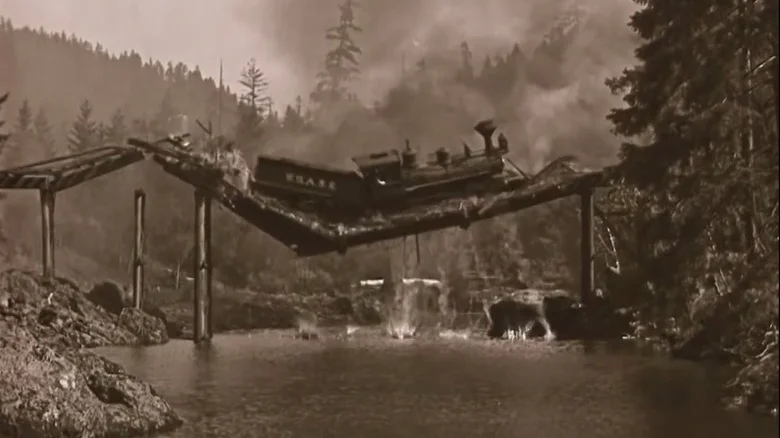
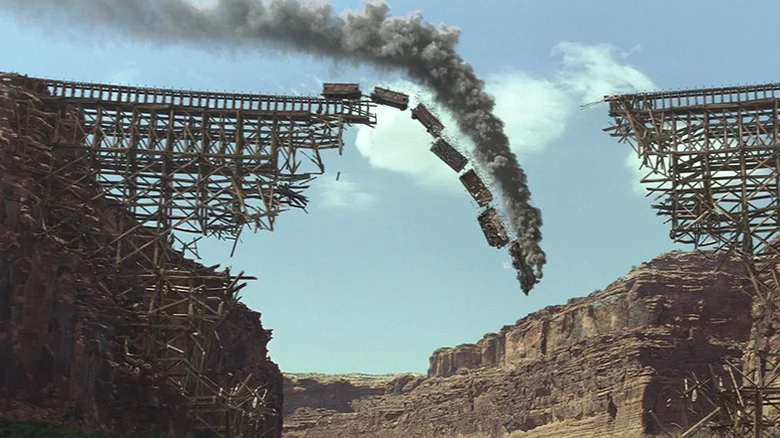
The movie’s most spectacular moment arrives when a locomotive attempts to cross a burning bridge.
The structure collapses beneath it.
The train plunges directly into the river.
What makes the sequence extraordinary is that audiences aren’t watching a miniature.
The filmmakers actually sent a working steam locomotive over the bridge.
The stunt reportedly cost around $42,000 at the time, making it one of the most expensive individual sequences of the silent-film era.
The wreckage remained in Oregon’s Row River for years afterward before much of it was eventually salvaged during World War II.
Modern audiences are accustomed to seeing entire cities destroyed digitally.
Keaton’s scene still has a different kind of power because what falls from that bridge was really there.
A real train.
A real bridge.
And one take that absolutely had to work.
Mission: Impossible Put Ethan Hunt on Top of a Speeding Train
Tom Cruise would eventually become famous for hanging from airplanes, scaling skyscrapers and throwing himself from cliffs on motorcycles.
But back in 1996, the first Mission: Impossible movie already showed audiences that Ethan Hunt wasn’t going to solve every problem from the safety of the ground.
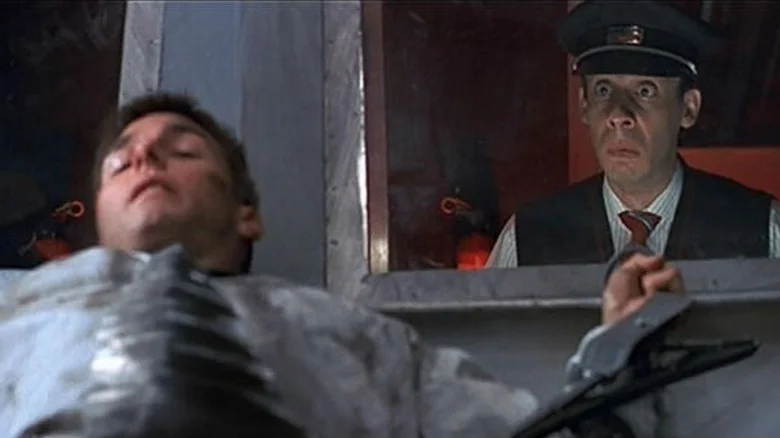
The movie’s finale puts Ethan on top of a speeding TGV train while pursuing Jim Phelps, the former mentor revealed to be the traitor inside the IMF.
Phelps intends to escape aboard a helicopter.
Ethan has other plans.
He climbs onto the roof of the train while enormous wind resistance threatens to throw him off. Then he connects the helicopter to the train, dragging it toward the Channel Tunnel.
As if that weren’t already ridiculous enough, the helicopter actually follows the train inside.
Ethan eventually destroys it using the movie’s memorable exploding gum and barely survives the blast.
Physics may have several complaints about the sequence.
Audiences generally don’t.
The scene established the kind of impossible escalation that would become the franchise’s signature: whatever Ethan Hunt is doing now, the next problem will somehow be even more dangerous
 .
.
Spider-Man 2 Made Saving a Train Look Painful
Superheroes stop disasters constantly.
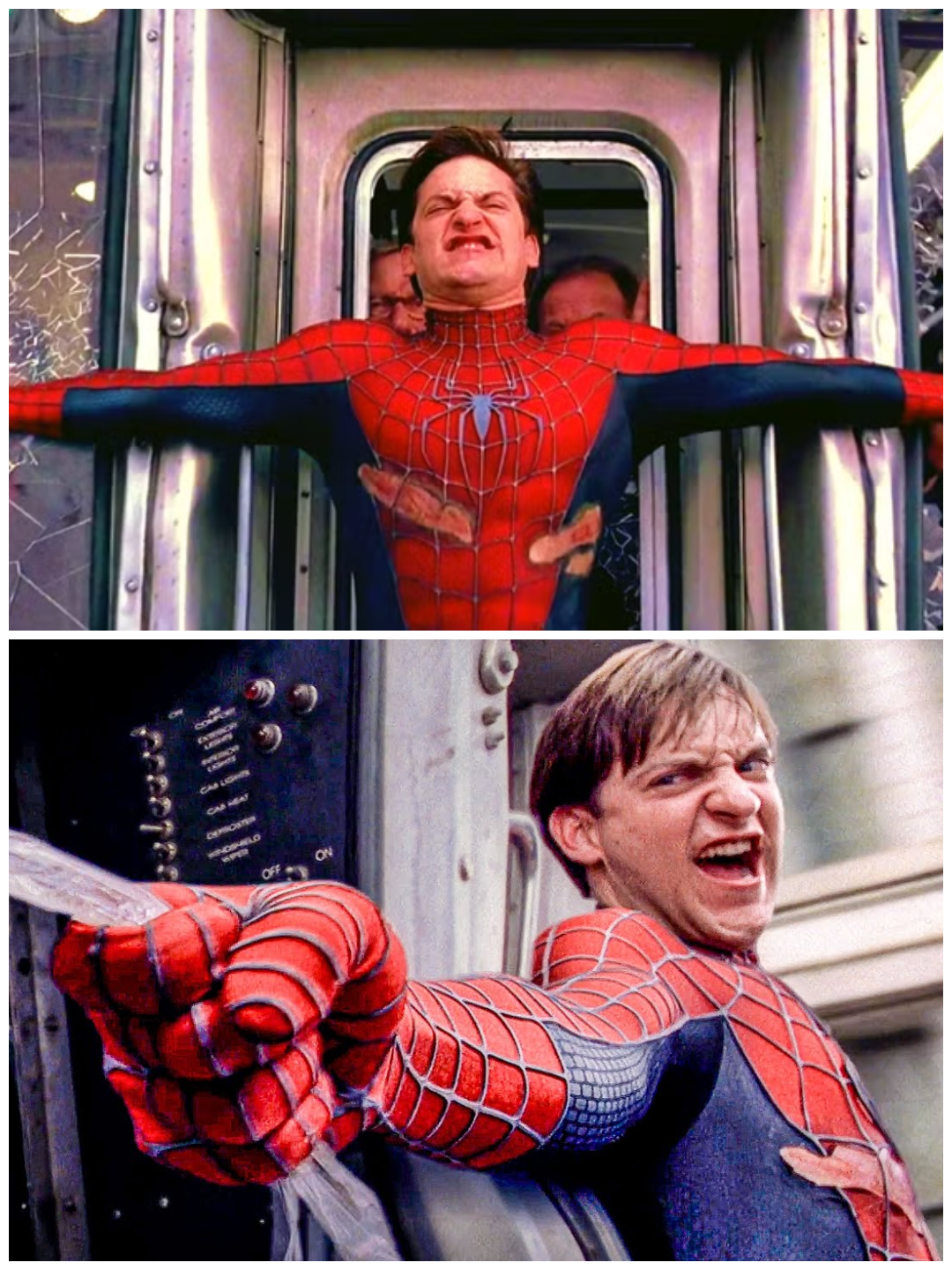
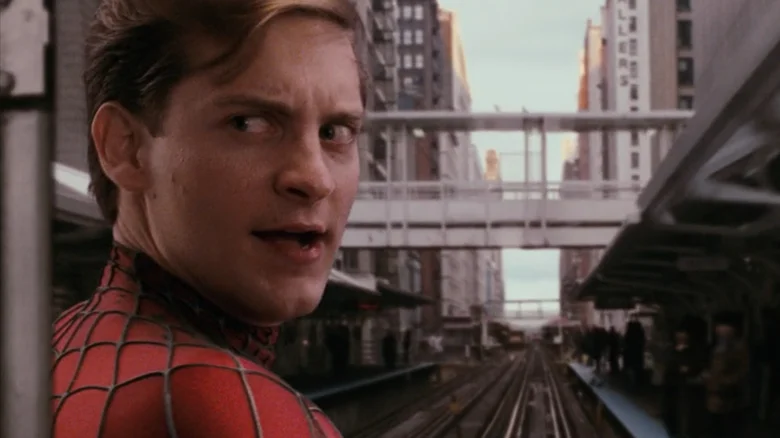
What makes the train sequence in Spider-Man 2 special is how difficult Sam Raimi makes the rescue feel.
Peter Parker has already spent much of the movie exhausted and overwhelmed. His personal life is falling apart, his powers have become unreliable and Doctor Octopus is considerably stronger than most ordinary criminals.
Then the two battle on a speeding elevated train.
Doc Ock uses his mechanical arms to attack Peter while passengers are trapped around them. He even throws innocent people from the train, forcing Spider-Man to save them in midair.
Then Octavius destroys the controls and leaves the train racing toward the end of an unfinished track.
Peter has no convenient device that can stop it.
So he uses himself.
He fires webs toward surrounding buildings and pulls with everything he has.
The sequence works because Spider-Man does not look invincible.
His suit tears.
His muscles strain.
His mask comes off.
His face twists in pain as the train drags him toward physical collapse.
Eventually, he succeeds — and immediately passes out.
Then comes the quieter part that makes the scene even better.
The passengers catch Peter before he falls and gently carry the unconscious hero through the train.
For a few moments, New Yorkers see exactly who has been risking his life for them: not an untouchable superhero, but an exhausted young man.
It’s one of the rare action sequences where the emotional payoff matters just as much as the spectacle.
Ant-Man Turned a Toy Train Into an Epic Battlefield
Marvel usually makes superhero battles feel enormous.
Ant-Man found a much funnier solution.
Make the heroes tiny.
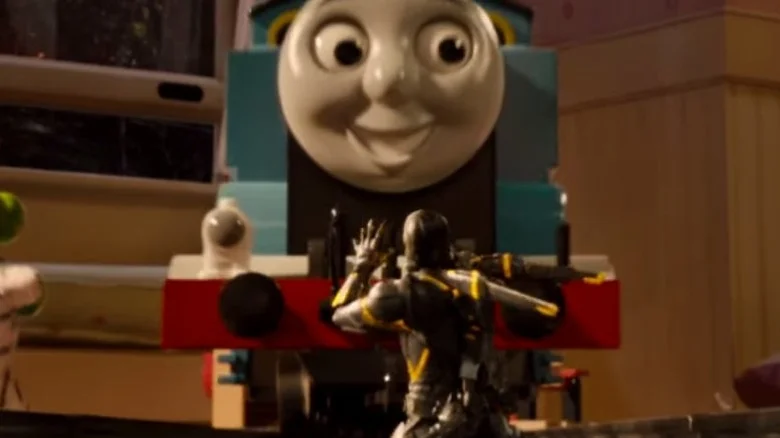
Scott Lang’s climactic fight with Yellowjacket takes place inside his daughter Cassie’s bedroom, where both men have been reduced to miniature size.
From their perspective, the room becomes a massive battlefield.
And Cassie’s Thomas the Tank Engine train set looks almost terrifying.
Scott and Yellowjacket leap between toy cars, throw objects at each other and perform superhero moves that seem enormous when the camera stays close to them.
Then the movie cuts to a wider perspective.
Suddenly, the supposedly gigantic train crash is just a little plastic Thomas tipping over.
That’s the joke at the heart of the entire sequence.
Ant-Man repeatedly asks viewers to experience two different scales at once.
To Scott, everything is life-or-death.
To anyone standing nearby, almost nothing is happening.
The movie saves its biggest train gag for the end, when one of Pym’s enlargement discs hits Thomas.
The little toy suddenly becomes a full-size locomotive, bursts through the house and crushes a police vehicle outside.
It’s one of the funniest examples of a superhero movie using perspective as the punchline.
Indiana Jones and the Last Crusade Explained Indy’s Entire Personality on One Train
By the time audiences reached the third Indiana Jones movie, they already knew the character’s trademarks.
The fedora.
The bullwhip.
The scar on his chin.
And his absolute hatred of snakes.
Indiana Jones and the Last Crusade decided to explain nearly all of them in one opening sequence.
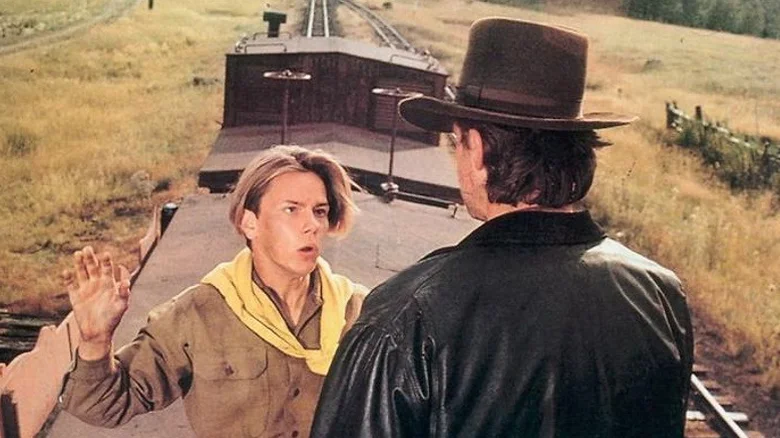
River Phoenix plays the teenage Indiana Jones in 1912.
After seeing grave robbers steal the Cross of Coronado, young Indy takes the artifact because he believes it belongs in a museum.
The thieves chase him onto a circus train.
What follows is essentially an origin story disguised as an action sequence.
Indy falls into a compartment filled with snakes, establishing the fear that will follow him into adulthood.
He grabs a whip while dealing with a lion and accidentally cuts his own chin, explaining the scar associated with Harrison Ford’s older Indy.
He eventually loses the artifact, but the leader of the treasure hunters respects his determination enough to place his fedora on the teenager’s head.
Within a few frantic minutes, the movie explains several details audiences had accepted for years.
It’s efficient, funny and completely in keeping with the adventure-serial tradition that inspired the entire Indiana Jones franchise.
Since You Went Away Used a Train for Heartbreak Instead of Action
Not every unforgettable train moment needs explosions.
Sometimes the train only has to leave.
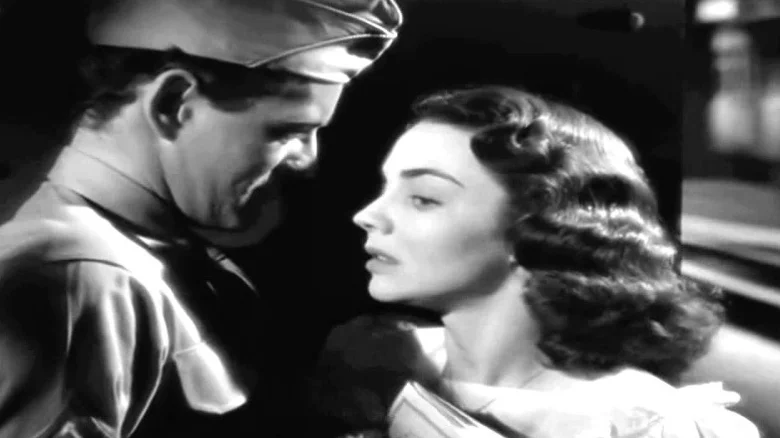
The 1944 World War II drama Since You Went Away uses the railroad for one of cinema’s classic romantic farewell scenes.
Teenager Jane, played by Jennifer Jones, falls in love with Army corporal Bill, played by Robert Walker.
The two become engaged, but Bill insists that they wait until the war ends before marrying.
Then the moment arrives when he must leave.
As the train pulls away, Jane runs alongside it, desperately trying to remain close for a few more seconds.
Bill throws his watch to her as a final gift.
For modern audiences, the image of someone running beside a departing train may feel familiar because so many later movies repeated or parodied it.
But in this story, the emotion lands particularly hard because the audience eventually learns that Jane and Bill will never see each other again.
Bill dies during the war.
The train isn’t simply carrying him away temporarily.
Without either character knowing it, this is their final goodbye.
That’s one reason train stations became such powerful locations in romantic movies.
Unlike an airport departure, the departing train remains visible.
The person you love slowly moves farther away while you stand in exactly the same place.
Back to the Future Part III Needed a Train to Reach 88 MPH
By the third Back to the Future movie, Doc Brown and Marty McFly have used some fairly unusual methods to send a DeLorean through time.
But getting stranded in 1885 creates one obvious problem.
There aren’t many vehicles capable of reaching 88 miles per hour.
Doc’s solution?
Borrow a steam locomotive.
Calling it a scientific experiment rather than a train robbery doesn’t make the plan any less dangerous.
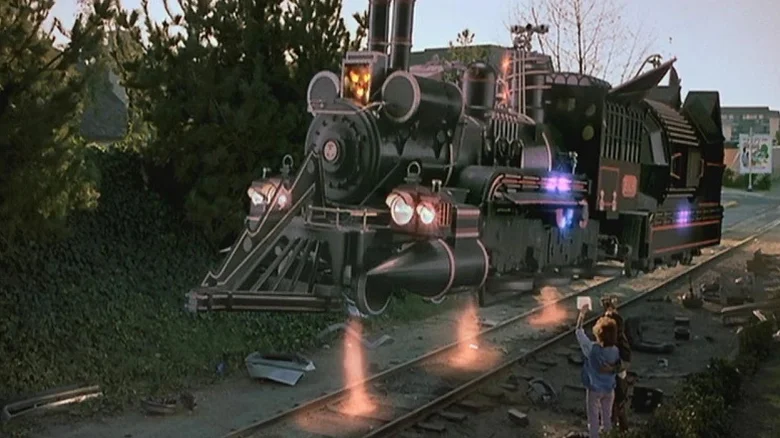
Doc calculates that the locomotive can push the DeLorean fast enough to activate the time machine. To generate the necessary speed, he creates special fuel logs designed to make the engine burn increasingly hotter.
There’s a catch.
The locomotive will eventually explode.
There’s another catch.
The track ends at an unfinished bridge.
And then Clara, the woman Doc loves, boards the train while trying to reach him.
The finale becomes a race involving Marty in the DeLorean, Doc moving across the locomotive and Clara desperately holding onto the train as it accelerates toward disaster.
Marty ultimately gets back to the future.
Doc rescues Clara using the hoverboard.
And the locomotive crashes into the ravine.
Then, in classic Back to the Future fashion, Doc returns at the end in something even more absurd: a flying steam-powered time-traveling train.
Apparently, once you’ve already turned a DeLorean into a time machine, historical rail technology is the logical next step.
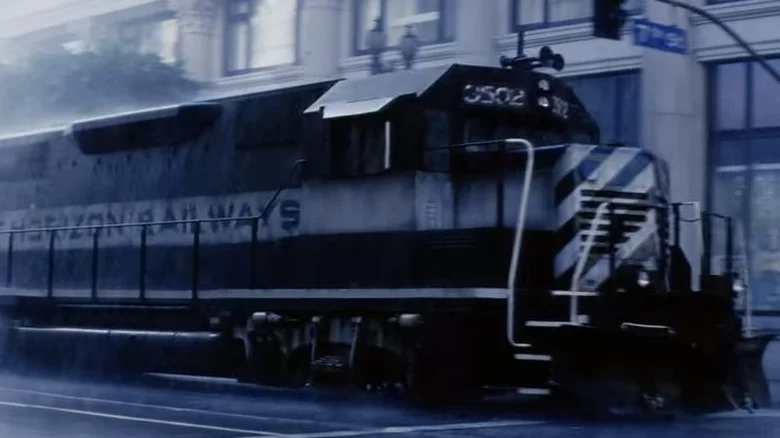
Inception Put a Freight Train in the Middle of a City Street
Christopher Nolan’s Inception takes place inside dreams, which means almost anything can happen.
Still, watching a full-size train suddenly thunder through ordinary downtown traffic is difficult to prepare for.
Dom Cobb and his team enter a shared dream while attempting to plant an idea in Robert Fischer’s subconscious.
The environment initially appears recognizable.
Cars move through streets.
Buildings stand where buildings should stand.
Then a locomotive crashes directly through traffic.
There are no rails.
It simply exists.
The train is a manifestation connected to Cobb’s subconscious and his memories of his late wife, Mal.
That makes the image much more than a random dream spectacle.
The train carries enormous emotional significance.
Years earlier, Cobb and Mal became trapped in Limbo, where they spent what felt like decades building a life inside a dream.
To convince themselves to wake up, they eventually lay across railroad tracks and allowed a train to kill their dream bodies.
The act successfully returned them to reality.
Unfortunately, the idea Cobb had planted in Mal’s mind — that her world was not real — followed her back.
So when a train later crashes through the dream city, it isn’t simply another strange piece of dream logic.
It’s Cobb’s guilt physically invading the mission.
Few filmmakers could make a locomotive appearing on a city street feel psychologically meaningful.
Nolan somehow does.
The Incredibles Used a Train Rescue to Help End the Superhero Era
The train sequence in The Incredibles is relatively short.
Its consequences shape the entire movie.
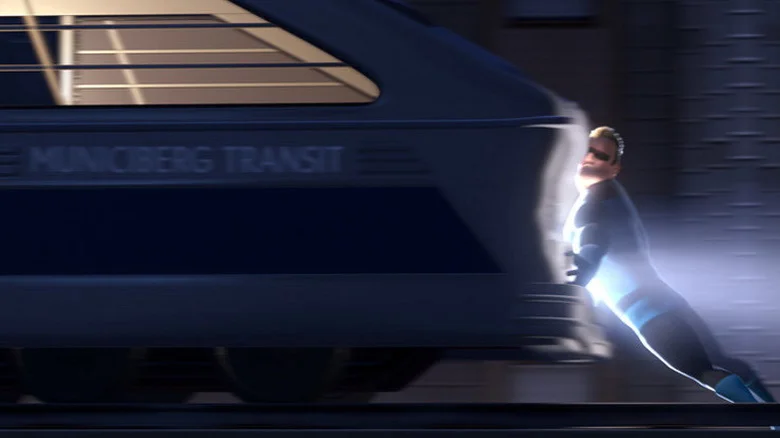
During the opening, Mr. Incredible is enjoying the height of his superhero career when his young admirer Buddy interferes with a confrontation involving Bomb Voyage.
A bomb ends up damaging an elevated railway.
A train filled with passengers races toward the destroyed section.
Mr. Incredible manages to stop it before it plunges from the track.
In another superhero movie, that would be the victory.
In The Incredibles, it becomes part of the problem.
Passengers are injured by the abrupt rescue and legal backlash follows.
Combined with other incidents, the public begins questioning whether superheroes are causing as much damage as they prevent.
The government eventually forces supers into hiding.
For Bob Parr, that decision destroys the life he loved.
Years later, he is stuck working a boring office job while desperately missing the days when people needed Mr. Incredible.
So the train rescue isn’t simply a spectacular opening stunt.
It helps create the world in which the rest of the film takes place.
Mr. Incredible saves everyone aboard.
And somehow still loses.
The Polar Express Made the Train the Entire Adventure
Most movies use trains to get characters from one scene to another.
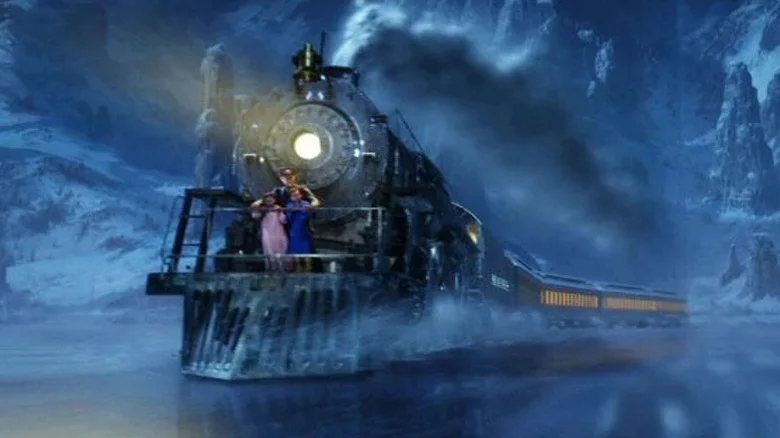
The Polar Express makes the train itself the destination.
Based on Chris Van Allsburg’s children’s book, the film follows a boy beginning to doubt whether Santa Claus really exists.
Then, late on Christmas Eve, an enormous steam locomotive mysteriously appears outside his home.
The conductor offers him a choice.
Stay where he is.
Or board.
The boy chooses the train and discovers other children traveling toward the North Pole.
From there, the locomotive behaves less like public transportation and more like a roller coaster.
It races across icy landscapes.
It skids across a frozen lake.
Passengers climb across cars while the train seems to ignore conventional physics.
Inside, dancing waiters perform the famous hot-chocolate sequence.
The journey moves between cozy Christmas fantasy and surprisingly eerie imagery, including the mysterious hobo the Hero Boy encounters on the roof.
That mixture is part of the movie’s distinctive atmosphere.
The train feels warm and magical one moment and enormous and unknowable the next.
For children watching the movie, the Polar Express represents the possibility that the impossible thing they’ve been told not to believe in might arrive outside the house anyway.
All they have to do is get on.
Harry Potter Made an Ordinary Train Ride Feel Like Entering Another Life
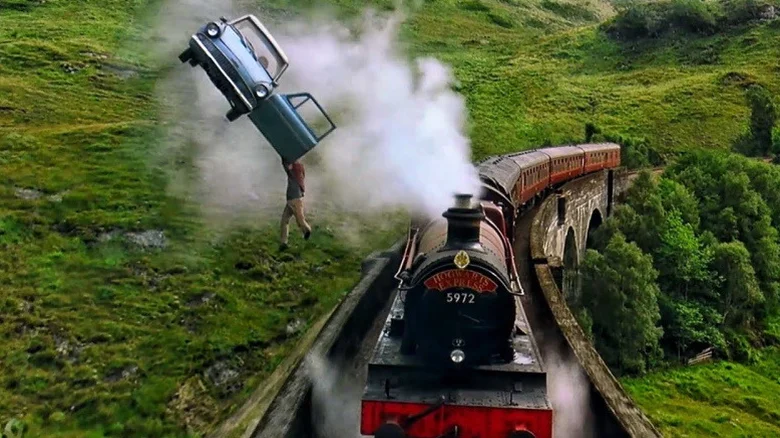
There may be no movie train more closely connected with childhood fantasy than the Hogwarts Express.
Harry Potter first reaches it in Harry Potter and the Sorcerer’s Stone after learning that Platform 9¾ is hidden somewhere inside King’s Cross Station.
The solution is wonderfully strange.
Run directly toward what appears to be a solid barrier between platforms.
Once Harry crosses through, the ordinary railway station gives way to a scarlet steam locomotive surrounded by young witches and wizards.
The trip changes everything.
Inside one carriage, Harry meets Ron Weasley.
Soon afterward, Hermione Granger enters.
The three children who will eventually face Voldemort together begin their relationship aboard that train.
Then there’s the food cart, which introduces Harry — and audiences — to Chocolate Frogs, Bertie Bott’s Every Flavor Beans and other Wizarding World treats.
Later Hogwarts Express journeys become less comfortable.
A Dementor nearly overwhelms Harry in Prisoner of Azkaban.
Draco Malfoy attacks and immobilizes him in Half-Blood Prince.
But the train never loses its symbolic importance.
Each journey marks the moment when Harry leaves the ordinary world behind and returns to the place where he truly feels he belongs.
For viewers, Platform 9¾ became an invitation:
Maybe the magical world isn’t somewhere far away.
Maybe it’s simply hidden behind the wall everyone else walks past.
The Lone Ranger Saved Its Biggest Spectacle for Two Runaway Trains
Disney’s 2013 The Lone Ranger struggled with critics and at the box office.
But even many viewers who disliked the movie agreed on one thing:
The final train chase is enormous.
The sequence throws practically everything onto the tracks at once.
The Lone Ranger races after one locomotive while Tonto commandeers another.
Villains are moving between cars.
Prisoners need rescuing.
Silver, the Lone Ranger’s horse, somehow manages to gallop across rooftops and eventually leap onto a moving train.
Meanwhile, the familiar “William Tell Overture” blasts over the entire sequence, turning the chaos into something resembling a giant live-action cartoon.
The action keeps escalating.
Characters jump between trains.
Bullets travel improbable distances.
Silver continues behaving less like a horse and more like a superhero.
And eventually a destroyed bridge sends a locomotive — along with the villain and his stolen silver — into the river below.
Subtle?
Not remotely.
But subtlety isn’t what the sequence is trying to achieve.
The finale embraces the exaggerated adventure spirit associated with the Lone Ranger character and commits fully to it.
Whatever problems the rest of the film may have, the train chase knows exactly what kind of movie it wants to be.
For several minutes, it works.
Why Train Scenes Keep Producing Great Movie Moments
Trains solve a filmmaking problem almost automatically.
They create movement before the scene even begins.
Characters cannot simply stop and think.
The destination is getting closer.
The bridge is approaching.
The person they love is leaving.
The villain is escaping.
The track is running out.
That built-in momentum explains why filmmakers have returned to trains since the silent era.
Buster Keaton used one for a stunt so enormous that the wreckage remained in a river.
Spider-Man 2 turned one into a test of how much pain a hero would endure for strangers.
Since You Went Away needed only a departing carriage to create heartbreak.
Harry Potter transformed one into the gateway between an ordinary childhood and a magical life.
And The Polar Express imagined an entire Christmas adventure around the simple childhood fantasy of boarding a train that shouldn’t exist.
The technology around movies has changed enormously since The General arrived in 1926.
The appeal of the train hasn’t.
As long as a locomotive can carry someone toward adventure — or away from someone they love — filmmakers will probably keep finding reasons to put one on screen.