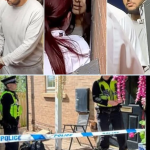
🚨 THE BOAT LEFT WITHOUT NOLAN — HOURS LATER, SOMEONE CALLED: “WE’RE SINKING.” TWO DAYS LATER, HIS BODY WAS FOUND.

🚨 THE BOAT LEFT WITHOUT NOLAN — HOURS LATER, SOMEONE CALLED: “WE’RE SINKING.” TWO DAYS LATER, HIS BODY WAS FOUND.
Nolan Wells was supposed to come home with his friends.
Instead, the boat returned to shore without him.
Hours later, a frantic emergency call came from a boat near Horn Island.
“We’re sinking.”
Two days after that, searchers found 18-year-old Nolan’s body near the island.
And now, the timeline of that Fourth of July trip is at the center of an investigation that has captured national attention.
Because the biggest question has never changed:
What happened to Nolan Wells after the boat left Horn Island?
A FOURTH OF JULY TRIP THAT ENDED IN TRAGEDY
Nolan Xavier Wells was 18 years old.
He was a college student.
A football player.
A son.
And on July 4, 2026, he went with friends by boat to Horn Island, a barrier island off the Mississippi Gulf Coast.
It was supposed to be a holiday outing.
Instead, it became the last day Nolan was seen alive.
According to authorities, Nolan did not return to the mainland with the group.
His friends told investigators that he had chosen to stay on the island.
His parents have questioned that explanation.
Nolan’s father, Elmore Wonsley, said his son had always been taught to stay with the group he arrived with.
“If you go with five, you come back with five,” he said.
For Nolan’s family, that remains one of the most difficult details to understand.
THEN THE BOAT LEFT
CBS News obtained GPS data from the Mississippi Department of Marine Resources showing the vessel’s movements that day.
The boat left a mainland dock at approximately 9:56 a.m.
It reached Horn Island around 11:14 a.m.
Several hours later, at approximately 4:31 p.m., the vessel departed the island.
But Nolan wasn’t on it.
The boat returned toward the mainland, later traveled into Fort Bayou, returned to the dock and eventually went to a boat launch.
The GPS data doesn’t explain why Nolan remained behind.
It doesn’t establish what happened on the island.
But it gives investigators a precise timeline that can be compared against witness statements and other evidence.
And then another piece of the timeline emerged.
“WE’RE SINKING”
A newly released recording captured a frantic call made from the boat around 4 p.m. on July 4.
A young caller told a private towing company that the boat’s bilge pump had stopped working.
Then came the words:
“We’re sinking.”
The dispatcher asked whether everyone was on board and safe.
The caller said yes.
He reportedly told the dispatcher there were about seven people on the boat.
The caller provided GPS coordinates near the northwest tip of Horn Island and asked for the vessel to be towed back to shore.
But the rescue never happened.
According to the recording, the boat’s owner later told the towing company that the group no longer needed assistance.
The call was disconnected.
The boat was not towed.
That recording has become one of the most discussed pieces of evidence surrounding Nolan’s final hours.
Not because it proves what happened to him.
It doesn’t.
But because it gives investigators another timestamp to place alongside the GPS data and witness accounts.
THE TIMELINE NOW RAISES A HAUNTING QUESTION
Nolan was reportedly last seen around 3 p.m.
The emergency call came around 4 p.m.
The boat left Horn Island around 4:31 p.m.
Nolan wasn’t aboard.
Later that night, he was reported missing.
Two days later, his body was found.
That sequence alone doesn’t tell investigators how Nolan died.
But it creates a narrow window in which the events of his final hours must be reconstructed.
And that is where the investigation becomes increasingly important.
WHAT DID NOLAN DECIDE TO DO?
Some of Nolan’s friends have said he chose to stay behind after the boat began experiencing problems.
One friend, Warren Hudson, later said Nolan stayed on the island with a girl he had met.
Hudson described the situation as an emergency involving the boat and said the group was trying to save it.
But Nolan’s parents have strongly questioned whether their son would voluntarily separate from the people he came with.
That disagreement is significant.
Because investigators aren’t simply trying to determine where Nolan died.
They also need to establish why he was alone when his friends left.
Was it a voluntary decision?
Was there a misunderstanding?
Did something happen before the boat departed?
Or was Nolan simply separated from the group during a chaotic afternoon?
The publicly available evidence has not answered those questions.
THEN SEARCHERS FOUND NOLAN
Nolan’s mother reported him missing after he failed to return home.
A large search operation followed.
The Coast Guard, Mississippi Department of Marine Resources, National Park Service and other searchers became involved.
On July 6, Nolan’s body was found near Horn Island.
Dental records confirmed his identity.
The search had ended.
But the investigation was only beginning.
WAS IT DROWNING?
Authorities initially said they believed Nolan drowned.
The sheriff also said there was no initial indication of foul play.
But investigators continued working to determine exactly what happened.
Then the family’s independent autopsy introduced another layer of uncertainty.
According to attorney Ben Crump, the preliminary independent examination classified both the cause and manner of death as:
“Undetermined pending investigation.”
The body had already undergone decomposition, making the forensic examination more difficult.
The state medical examiner’s office has said its autopsy followed standard procedures and urged the public not to draw conclusions before the investigation is complete.
That distinction is crucial.
An undetermined autopsy result does not establish homicide.
It does not establish an accident.
And it does not prove that anyone else caused Nolan’s death.
It means the available evidence did not allow the independent examination to reach a definitive conclusion.
THE AUDIO CREATED A SECOND WAVE OF QUESTIONS
After the emergency recording was released, social media exploded with theories.
Some listeners claimed they heard additional words or voices in the background.
Some began trying to identify individual voices.
Others attempted to reconstruct what was happening inside the boat.
But the recording itself is described as chaotic and difficult to hear in places.
And speculation about what a voice “might” say is not the same as forensic confirmation.
Nolan’s family, however, is taking the recording seriously enough to have experts examine it.
Their attorney Ben Crump said the family had retained audio specialists to analyze the call.
That could potentially help clarify what was happening during the call.
But until experts reach a documented conclusion, online interpretations remain just that:
interpretations.
THE GPS MAY BE JUST AS IMPORTANT
The distress call tells investigators what someone said.
The GPS tells them where the boat was.
Together, those two pieces can help establish a much more precise timeline.
If witness statements describe the boat being somewhere at a particular time, investigators can compare those accounts with the GPS record.
If the emergency call gives a specific location, investigators can compare that location with the recorded coordinates.
And if the timeline contains contradictions, those contradictions can become important investigative leads.
That’s why the GPS information matters.
It doesn’t solve the mystery.
But it gives investigators something concrete to work with.
RACE BECAME PART OF THE NATIONAL CONVERSATION
Nolan was Black.
The people he traveled with were predominantly white.
As uncertainty surrounding his death grew, questions about race and justice became part of the national conversation.
The Guardian reported that the case had renewed debate over race and equal treatment in Mississippi.
But there is an important line between asking whether racial dynamics affected the investigation and declaring that Nolan’s death was racially motivated.
The latter has not been established by the publicly available evidence.
Likewise, there has been no public finding establishing that someone from the boat killed Nolan.
The facts remain under investigation.
SOCIAL MEDIA HAS CREATED ANOTHER PROBLEM
As the case went viral, people began acting as online investigators.
Photographs were enlarged.
Videos were analyzed frame by frame.
Boat movements were mapped.
People searched old social-media posts.
Names were circulated.
Some theories became so widespread that they began to look like facts.
But investigators have warned against that kind of speculation.
Organizations involved in the search have reported seeing AI-generated photographs, videos and documents circulating online as supposed evidence.
That is especially dangerous in an unresolved death.
A fake image can create a fake suspect.
A misunderstood video can create a false timeline.
And a rumor repeated thousands of times can begin to feel like a documented fact.
WHAT WE KNOW
Nolan Wells was 18.
He traveled to Horn Island with friends on July 4.
The group later returned without him.
A boat associated with the trip made an emergency call reporting that it was sinking.
GPS data documents the boat’s movements.
Nolan was reported missing.
His body was found two days later.
Authorities initially suspected drowning and said there was no initial indication of foul play.
The family’s independent autopsy later classified the cause and manner of death as undetermined pending investigation.
The official investigation remains ongoing.
WHAT WE STILL DON’T KNOW
Why did Nolan remain on Horn Island?
Who was the woman reportedly with him?
What happened between his last known sighting and the boat’s departure?
What exactly happened during the emergency call?
What will the official autopsy and toxicology results show?
Did Nolan enter the water voluntarily?
Was his death an accident?
Or is there information investigators have not yet made public?
At this point, those questions remain unanswered.
THE FINAL HOURS
Perhaps the most haunting part of Nolan’s story is how ordinary that morning seemed.
An 18-year-old college football player went out with friends for the Fourth of July.
He was alive.
He was surrounded by people.
And by the end of the day, he was gone.
The boat returned without him.
A frantic call came from the water.
The search began.
Two days later, Nolan was found dead.
Now investigators are left with GPS coordinates, an emergency recording, witness accounts, forensic evidence and a family demanding answers.
But none of those pieces has yet produced a definitive explanation.
And that leaves one question hanging over Horn Island:
What happened to Nolan Wells in the hours after the boat left him behind?
His family is still waiting for an answer.
And until investigators can reconstruct those final hours, the most important part of Nolan’s story remains unwritten.