CHRISTA PIKE WAS DECLARED BRAIN DE@D — THEN SHE WOKE UP AND STARTED TALKING
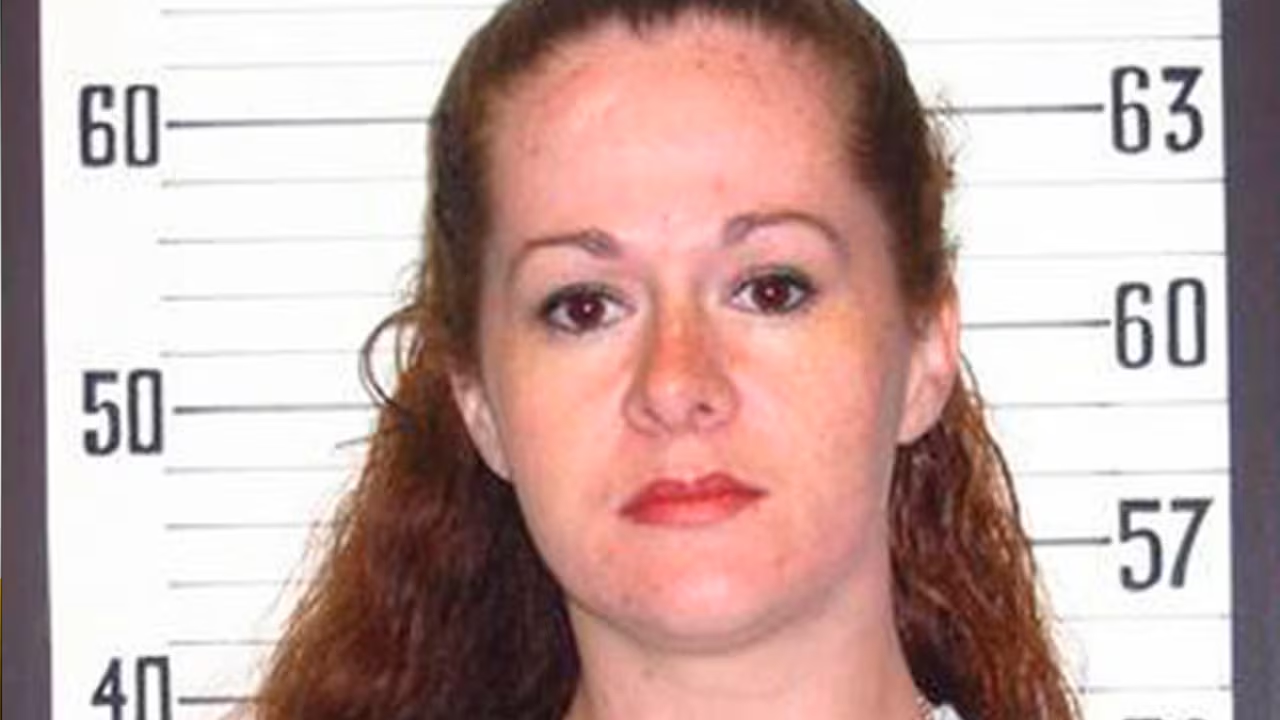
CHRISTA PIKE WAS DECLARED BRAIN DEAD — THEN SHE WOKE UP AND STARTED TALKING
Just days after surviving Tennessee’s failed execution attempt, Christa Pike’s lawyers were told she was not expected to survive. Then came a stunning turn that no one in the hospital expected.
Christa Pike was believed to be at the end of her life.
After surviving a failed execution attempt in Tennessee, the 50-year-old death-row inmate remained critically ill in a Nashville hospital. Her lawyers had been preparing for the worst.
Then, unexpectedly, she woke up.
And she began talking.
The extraordinary development came days after Tennessee attempted to execute Pike by lethal injection on September 30, 2026. Two doses of pentobarbital were administered, but Pike remained alive and was eventually transported from the prison to a hospital.
:max_bytes(150000):strip_icc():focal(749x0:751x2):format(webp)/Randy-Spivey-Nashville-2026-Christa-Pike-mugshot-100726-f1737966dfa0464d8219df29ce9f82d4.jpg) “CHRISTa WOKE UP AND BEGAN TALKING”
“CHRISTa WOKE UP AND BEGAN TALKING”
According to Pike’s attorney Randy Spivey, the legal team received devastating news on the evening of Monday, October 5.
They were told that Pike was brain dead and that life support was expected to be withdrawn the following day.
But Tuesday brought an astonishing reversal.
Spivey said that, to the shock of her lawyers and medical staff, Pike regained consciousness and began speaking.
“I don’t have an explanation for what happened between Monday night and Tuesday morning,” Spivey said.
Her first reported words were remarkably simple.
“Where am I?”
She also asked:
“Who are you?”
Her lawyers said she was aware of her surroundings and eventually began remembering details of the failed execution.
 SHE STILL FACES A LONG RECOVERY
Pike’s recovery is far from over.
Her attorneys said she remains seriously ill and is receiving intensive medical care.
She has developed pneumonia and a blood clot, while her arms and hands are severely swollen and injured following the failed lethal injection.
She has also been unable to swallow and has not been able to move her arms or hands, according to her legal team.
Her prognosis remains uncertain.
Doctors do not yet know how much physical function she may ultimately regain.
Her attorney described the swelling in her hands as extraordinary and said she still has a long road ahead.
But for a woman who was believed to be approaching the end of her life only hours earlier, simply waking up and speaking represented a dramatic change.
THE EXECUTION THAT FAILED
Pike’s extraordinary recovery follows one of the most unusual execution attempts in modern U.S. history.
On September 30, Tennessee attempted to carry out her death sentence at Riverbend Maximum Security Institution in Nashville.
Pike received two doses of pentobarbital.
But instead of dying, she continued breathing.
Witnesses heard sounds resembling snoring for an extended period, and she remained alive long after the first dose was administered.
She was ultimately taken from the prison by ambulance rather than leaving in a hearse.
The Tennessee Department of Correction said at the time that officials had followed the state’s established execution protocol and that no additional procedures were permitted under that protocol.
Pike was then taken to a hospital in critical condition.
WHY DID THE EXECUTION GO WRONG?
Pike’s lawyers have raised serious questions about how the lethal injection was administered.
They allege that medical problems made it difficult to establish a proper intravenous line and that the drugs may have entered surrounding tissue rather than being delivered correctly into a vein.
Her attorneys have described severe swelling, burns and blistering to her arms.
The state has said its established protocol was followed, while the legal team has accused officials of failing to properly respond to medical complications.
A judge has now ordered Tennessee officials to preserve evidence connected to the execution, including drugs, IV lines, needles, catheters, restraints, medical equipment, surveillance material and communications.
The evidence could become central to the legal battle over what happened inside the execution chamber.
A SECOND EXECUTION COULD BECOME A LEGAL BATTLE
Pike’s survival has also created an extraordinary legal question: Can Tennessee attempt to execute her again?
Her lawyers are asking Governor Bill Lee to commute her death sentence to life in prison without parole, arguing that she should not be subjected to another execution attempt.
There is currently no announcement that Tennessee will attempt to execute Pike again.
In the meantime, Governor Lee has suspended further scheduled executions in the state while officials investigate what went wrong.
Legal experts have said Pike’s situation could raise unprecedented constitutional questions because she survived after actually receiving the lethal chemicals.
THE CASE THAT PUT HER ON DEATH ROW
Pike has spent more than three decades on Tennessee’s death row.
She was convicted in connection with the 1995 killing of 19-year-old Colleen Slemmer, a fellow Job Corps student.
Pike was 18 when the crime occurred.
She was sentenced to death in 1996 and remained the only woman on Tennessee’s death row for much of her incarceration.
Her execution would have made her the first woman executed by Tennessee in more than 200 years.
Slemmer’s mother, May Martinez, witnessed the failed execution and has continued to speak publicly about the decades-long impact of her daughter’s death.
For Martinez and other members of Slemmer’s family, Pike’s survival has brought another complicated and painful chapter to a case that began more than 30 years ago.
“ANGRY AND CONFUSED”
Now awake, Pike is reportedly struggling to process what happened.
Spivey said she is “angry and confused” and understands that the state attempted to execute her.
Her lawyers say she remembers aspects of the procedure and is aware of what happened.
Yet physically, she remains extremely vulnerable.
She cannot currently swallow normally, has serious complications and has limited movement in her arms and hands.
Her recovery could take weeks or months, and her ultimate medical condition remains uncertain.
A STORY THAT HAS TAKEN AN UNEXPECTED TURN
On September 30, Christa Pike was expected to leave prison after Tennessee carried out her death sentence.
Instead, she left the prison in an ambulance.
Days later, her lawyers were told she was brain dead and preparing to come off life support.
Then she opened her eyes.
She spoke.
She began recognizing her surroundings.
And suddenly, a case that appeared to have reached its final chapter entered an entirely new and uncertain phase.
For now, Pike remains hospitalized while her lawyers fight to preserve evidence from the failed execution and seek to prevent another attempt.
The legal questions surrounding her future may take months or years to resolve.
But the most startling development has already happened:
Christa Pike was expected not to survive. Then, against those expectations, she woke up and started talking.