Pierce Brosnan Met His Match in Michelle Yeoh: How Tomorrow Never Dies Sent Them Down Two Very Different Paths
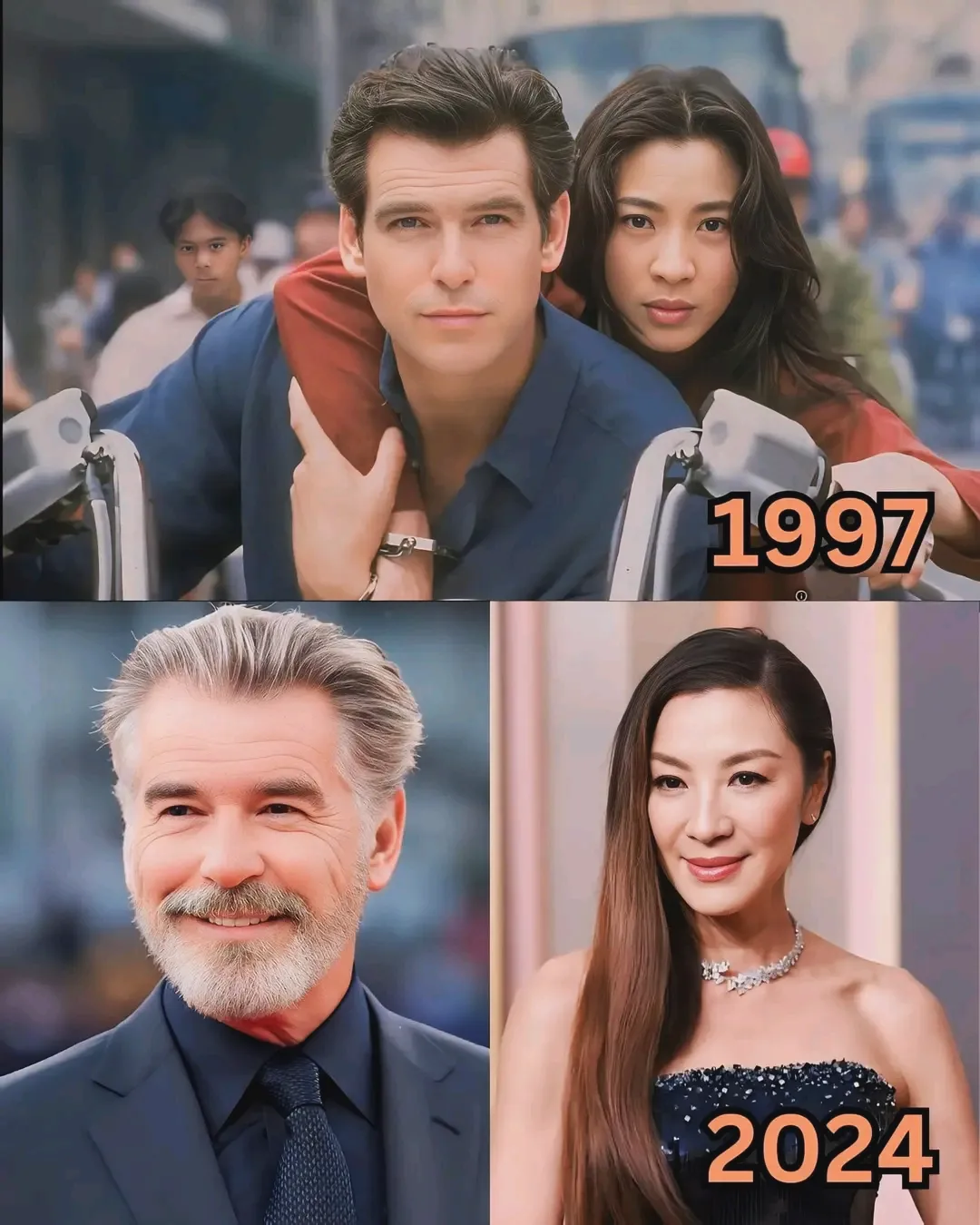
By the time James Bond and Wai Lin found themselves handcuffed together on a motorcycle, racing through the streets with a helicopter closing in behind them, Tomorrow Never Dies had made something unusually clear for a 1990s Bond movie: Pierce Brosnan’s 007 was not carrying Michelle Yeoh’s character through the adventure.
He was trying to keep up with her.
Released in 1997 as Brosnan’s second James Bond film, Tomorrow Never Dies paired the British secret agent with Wai Lin, a Chinese intelligence officer investigating the same conspiracy. The movie’s central threat came from media magnate Elliot Carver, who planned to manipulate events into provoking a confrontation between Britain and China.
But nearly three decades later, one of the film’s most memorable elements is not its villain or gadgets. It is the partnership between Brosnan and Yeoh—and what happened to both stars after they walked away from that mission.
Bond Meets Someone Who Is Already on the Case
Bond first crosses paths with Wai Lin while both are investigating Carver. From the beginning, she is not introduced as someone waiting for 007 to explain the danger.
She has her own intelligence service, her own mission and her own suspicions.
The official Bond site describes Wai Lin as a colonel in the Chinese People’s External Security Force who is intelligent, independent and exceptionally capable physically. Her investigation of Carver is already underway before she reluctantly joins forces with Bond.
That distinction matters.
The Bond franchise had featured formidable women before her. Pussy Galore could handle herself in Goldfinger. Anya Amasova in The Spy Who Loved Me was herself a highly trained Soviet agent. Grace Jones’ May Day was more physically imposing than the men around her.
Wai Lin, however, arrived with something different: Michelle Yeoh’s established identity as a genuine martial-arts action star.
She did not simply play a woman who was supposed to be dangerous. The audience could watch Yeoh demonstrate why she was dangerous.
Why Wai Lin Felt Less Like a “Bond Girl”
Before joining Bond, Yeoh had already built a formidable action résumé in Hong Kong cinema, including films such as Yes, Madam!, Police Story 3: Super Cop and Wing Chun. She developed a reputation for demanding physical performances and for doing stunt work herself. Yeoh later recalled that she loved performing her own stunts and had trained alongside top stunt professionals in Hong Kong.
That experience immediately changed the physical language of Tomorrow Never Dies.
One of Wai Lin’s showcase moments comes when attackers confront her at her field headquarters. Instead of waiting for Bond, she launches into a fast martial-arts fight of her own. The sequence was important enough that the official 007 archive later highlighted it specifically as an example of Wai Lin displaying Yeoh’s fighting abilities.
Yeoh reportedly wanted to perform all of her stunts during the production. Director Roger Spottiswoode and the production’s safety restrictions prevented her from doing some of the most dangerous work, but she still performed her own fight scenes.
Brosnan noticed.
He would characterize Yeoh as a “female Bond,” a description that reflected not simply Wai Lin’s status as another spy but Yeoh’s physical credibility beside 007.
It may be the most useful way to understand the character. Wai Lin was technically Bond’s leading woman, but much of the movie treats her as his counterpart.
The Motorcycle Chase Turned Their Partnership Into the Movie
Nothing captures that relationship better than their escape after being captured by Carver’s men.
Bond and Wai Lin flee by sliding down a massive banner hanging from Carver’s headquarters before escaping on a motorcycle while still handcuffed together. The chase escalates until a pursuing helicopter forces them into increasingly improbable maneuvers, including a motorcycle leap over the aircraft. For close shots during the banner stunt, a five-story mock-up was constructed so Brosnan and Yeoh could perform in front of the camera.
The sequence works because neither character can operate independently.
Bond controls the motorcycle at points; Wai Lin contributes her own timing and physical instincts. They argue, improvise and repeatedly switch between competing with each other and trusting each other.
That rhythm defines their chemistry throughout the film.
Brosnan plays Bond with the familiar confidence of a man accustomed to entering a room and taking control. Yeoh’s restrained, amused Wai Lin repeatedly refuses to give him that satisfaction. Their attraction develops from professional friction rather than immediate dependence.
By the time they attack Carver’s stealth ship together in the finale, they feel less like hero and sidekick than two agents temporarily sharing the same battlefield.
Brosnan Stayed With Bond—Then Tried to Escape His Shadow
After Tomorrow Never Dies, Brosnan continued down the path that had made him one of the world’s most recognizable movie stars.
He returned as 007 in The World Is Not Enough in 1999 and Die Another Day in 2002, completing a four-film run that had begun with GoldenEye in 1995.
Once Bond was behind him, however, Brosnan increasingly moved between genres rather than trying to recreate 007 indefinitely.
His performance as the troubled hitman Julian Noble in the 2005 dark comedy The Matador earned him a Golden Globe nomination. He later embraced musical comedy as Sam Carmichael in Mamma Mia!, appeared in Roman Polanski’s political thriller The Ghost Writer, returned to action films and eventually entered superhero territory as Doctor Fate in Black Adam.
His later career has continued to mix leading-man charisma with ensemble and character roles. In 2025, for example, he appeared alongside Helen Mirren, Ben Kingsley and Celia Imrie as Ron in Netflix’s The Thursday Murder Club.
Brosnan never stopped being associated with Bond, but he gradually proved he did not have to keep playing variations of him.
Yeoh Faced a Very Different Problem
For Yeoh, the aftermath of Tomorrow Never Dies was far more complicated.
Hollywood had just watched her play one of the Bond franchise’s most capable female characters. Yet instead of receiving a flood of equally interesting parts, Yeoh later said many of the offers she received were stereotypes.
She chose not to take them.
Yeoh told People that she did not work for almost two years because she could not accept the stereotypical roles being presented to her.
Then came Crouching Tiger, Hidden Dragon in 2000.
Ang Lee’s international success gave Yeoh a role that could use her physical skills while demanding far more emotionally. It became a major turning point, followed over the years by projects including Memoirs of a Geisha, Crazy Rich Asians, Star Trek: Discovery and Marvel’s Shang-Chi and the Legend of the Ten Rings.
And eventually, the actress once described as Bond’s female equivalent reached a milestone that none of her male Tomorrow Never Dies co-stars could have predicted in 1997.
From Wai Lin to an Oscar
In Everything Everywhere All at Once, Yeoh played Evelyn Wang, an exhausted laundromat owner whose ordinary family crisis expands into an absurd, emotional multiverse adventure.
The role required nearly every side of the performer audiences had watched develop across decades: martial arts, comedy, romance, regret, restraint and vulnerability.
At the 95th Academy Awards on March 12, 2023, Yeoh won the Oscar for Best Actress in a Leading Role. She became the first Asian woman to win the category, turning a career once constrained by Hollywood stereotypes into one of modern cinema’s most remarkable long-term breakthroughs.
Her career continued afterward, including Wicked and her return as Philippa Georgiou in Star Trek: Section 31.
That makes revisiting Tomorrow Never Dies especially interesting today.
In 1997, Pierce Brosnan was the established center of one of cinema’s biggest franchises, while Michelle Yeoh was entering a Hollywood system that still struggled to imagine enough roles for someone like her.
Brosnan continued being Bond and then spent years expanding beyond him.
Yeoh spent years refusing to be reduced by what Hollywood expected from an Asian action actress—and ultimately reached the Academy Awards stage.
Yet the beginning of that contrast is already visible in Tomorrow Never Dies.
Watch Bond and Wai Lin fighting beside each other, arguing over who should take control, or racing together on that motorcycle, and Brosnan’s old description suddenly feels remarkably appropriate.
For once, James Bond had not simply found another Bond girl.
He had met someone who could plausibly have been Bond herself.