My Daughter’s Martial Arts Instructor Humiliated Me in Front of Everyone—Until He Discovered I Was the Legendary “Silent Storm”
PART 1 — THE WOMAN EVERYONE UNDERESTIMATED
My sixteen-year-old daughter clutched my hand when her martial arts instructor pointed at me in front of an entire classroom and laughed.
“How about we show everyone what happens when an exhausted suburban mom goes up against a real fighter?”
I tried to walk away.
He blocked our path.
Then he mocked my clothes, embarrassed my daughter, and insisted that I step onto the mat with him.
He thought I was just a tired single mother who spent her days designing graphics and driving her daughter to practice.
What he didn’t know was that thirteen years earlier, the fighting world had known me as the Silent Storm.
And after the tragedy that took my younger brother’s life, I had made myself a promise.
I would never fight again.
My name is Lily Carter.
I’m thirty-eight years old, a single mother, and a graphic designer.
Most days, my life is ordinary.
I wake up early, prepare breakfast, check client messages, and make sure my daughter, Sarah, gets to school on time.
Then I spend hours at my computer working on designs, meeting deadlines, and answering emails.
In the evenings, I help with homework, make dinner, and drive Sarah to her activities.
It’s a simple life.
A quiet life.
And it’s exactly the kind of life I spent years trying to build.
To the parents and students at Sarah’s martial arts school, I was nothing special.
Just another mother sitting against the wall while her child practiced.
The woman in loose gray sweatpants.
The woman with tired eyes and a laptop bag.
The woman who rarely spoke unless someone asked her a question.
Nobody there knew I’d once spent six years competing professionally in mixed martial arts.
Nobody knew about the training camps, the competitions, or the years when fighting had been the center of my world.
And nobody knew why I’d suddenly walked away.
Thirteen years earlier, my younger brother had died in a tragic accident.
His death changed everything.
The last time I’d prepared for a serious fight, he had still been alive.
After losing him, I couldn’t bring myself to return to that world.
The training gyms.
The crowds.
The anticipation before a match.
Everything reminded me of the person I’d lost.
So I packed that part of my life away.
I stopped competing.
I stopped talking about my past.
And eventually, I became someone the people around me would never associate with professional fighting.
I became Sarah’s mother.
And that was enough for me.
Until the afternoon Jake Reynolds decided to turn my daughter and me into a public spectacle.
It began near the end of Sarah’s martial arts class.
I was sitting on a bench beside the wall, answering a work email, when Jake’s voice suddenly echoed through the dojo.
“Higher, Jenkins! Get that leg up!”
I looked up.
A fifteen-year-old boy stood on the blue training mats, trying to perform a kick.
His face was flushed.
His movements were uncertain.
He lifted his leg again, but it trembled before reaching the height Jake demanded.
Jake shook his head dramatically.
“Seriously? My grandmother could kick higher than that!”
Several students laughed nervously.
The boy lowered his eyes.
His shoulders sagged.
I watched him take a small step backward, clearly wishing he could disappear.
Jake, meanwhile, seemed delighted with himself.
He strutted across the mats in a spotless white martial arts uniform.
A black belt was tied tightly around his waist.
He stood about six feet tall, with broad shoulders and the heavy build of a linebacker.
Physically, he was an intimidating man.
And he seemed to enjoy making sure everyone noticed.
But as I watched him humiliate that teenager, I felt a familiar discomfort growing in my stomach.
I’d trained under demanding coaches.
Some had pushed me harder than I thought possible.
They expected discipline.
Precision.
Endurance.
And complete commitment.
But the best coaches I’d known had never needed to humiliate frightened students to prove their authority.
They understood something Jake apparently didn’t.
Real strength isn’t measured by how easily you can intimidate someone weaker than yourself.
It’s measured by how responsibly you use the power you have.
A mother sitting beside me leaned closer.
“Sensei Jake can be pretty harsh,” she whispered.
I glanced toward her.
She gave an uncertain smile.
“But I guess that’s how he gets results.”
I didn’t respond.
Because I was watching the boy on the mat.
He was trying again.
Not with confidence.
With fear.
He seemed more worried about being mocked than about learning the technique correctly.
That wasn’t training.
That was intimidation disguised as discipline.
I returned my attention to my laptop.
I told myself it wasn’t my place to interfere.
Sarah liked martial arts.
She’d worked hard to improve.
And I didn’t want to create problems for her.
A few minutes later, Jake finally dismissed the class.
Students began gathering their belongings.
Parents stood from their seats.
The atmosphere relaxed almost immediately.
Sarah hurried toward me.
She was still wearing her training uniform, and strands of hair clung to her forehead from the workout.
“Ready to go, Mom?”
I smiled.
“More than ready, sweetheart.”
She grinned.
I closed my laptop and picked up my jacket.
Then we headed toward the glass entrance doors.
We were only a few steps away from leaving when Jake shouted behind us.
“Hold on, everybody!”
His voice filled the room.
“Who wants to see something entertaining?”
The conversations stopped.
Several students turned around.
Parents paused near the benches.
I kept walking.
Then I heard him again.
“Let’s show these kids what happens when an ordinary person tries to challenge someone with real combat training.”
I felt Sarah’s fingers tighten around my sleeve.
“Mom,” she whispered. “Please, let’s just go.”
I squeezed her hand reassuringly.
But before we could reach the doors, Jake stepped toward us.
The students moved aside.
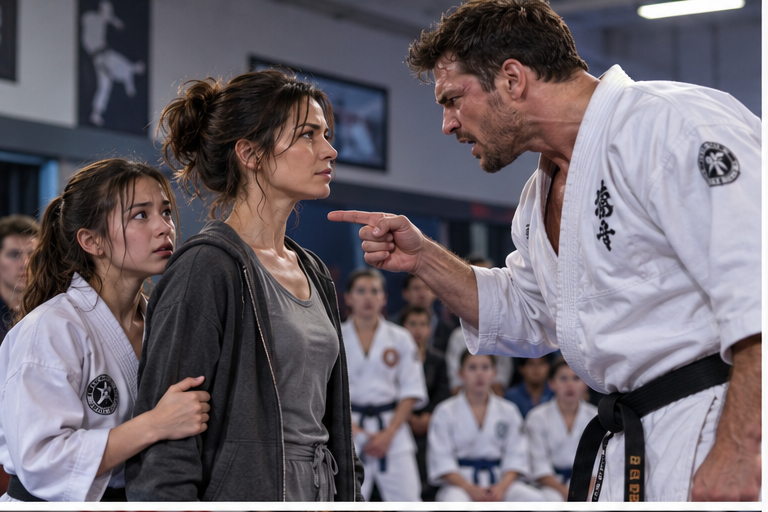
He pointed directly at me.
“You’re Sarah’s mom, aren’t you?”
I stopped.
“Yes.”
He looked me up and down.
His gaze settled on my oversized sweatpants.
Then he smirked.
“I see you sitting here every week watching us train.”
I waited.
He folded his arms.
“I bet you’ve started thinking you could do some of this yourself.”
“No,” I replied calmly.
He laughed.
“Come on. Don’t be shy.”
“I’m not interested.”
“Just a little friendly sparring match. I’ll take it easy on you.”
Sarah moved closer to me.
“Sensei Jake, my mom doesn’t—”
He cut her off.
“Relax, Sarah. Nobody’s going to get hurt.”
I looked down at my daughter.
Her face had gone pale.
She wasn’t excited.
She wasn’t amused.
She looked frightened.
I turned back to Jake.
“This isn’t necessary.”
He spread his arms toward the class.
“Actually, I think it is.”
Several students exchanged uncertain glances.
Jake continued.
“These kids need to understand the difference between real martial arts training and whatever suburban moms do to stay in shape.”
A few people gave uncomfortable laughs.
Others looked away.
I could see that some parents were embarrassed by his behavior.
Even several of the students seemed unsure how to react.
But Jake interpreted their silence as encouragement.
He smiled wider.
He wanted attention.
And he’d decided that humiliating me would be an easy way to get it.
After all, what could I possibly do?
I was a tired-looking mother in baggy clothes.
I didn’t have the appearance of someone who belonged in a fight.
And that was precisely why he’d chosen me.
He didn’t want to demonstrate a technique.
He wanted to demonstrate his superiority.
He wanted the students to laugh while he made someone else feel powerless.
Sarah tugged at my hand again.
“Mom, please.”
I turned toward her.
And what I saw in her expression hurt more than Jake’s insults.
She was ashamed.
Not of me.
Of the way her instructor was treating me in front of her classmates.
She was frightened that the situation would become worse.
And she desperately wanted us to leave before he humiliated me any further.
For thirteen years, I’d worked hard to give Sarah a peaceful childhood.
I had exchanged competition arenas for school pickups.
Training camps for grocery shopping.
Late-night workouts for helping with homework at the kitchen table.
I had chosen a life where my daughter didn’t have to worry about the dangers and pressures that once surrounded my career.
And I’d never regretted that choice.
Not once.
But standing inside that dojo, watching a grown man use his authority to frighten children and embarrass their parents, I felt something shift.
My breathing slowed.
My heartbeat settled.
The noise around me seemed to fade into the background.
It was a strange sensation.
One I hadn’t experienced in years.
A familiar stillness.
The kind of quiet that used to come over me before a professional fight.
Back then, people had given me a nickname.
The Silent Storm.
Not because I was loud.
Not because I enjoyed threatening opponents.
But because when a fight began, I became completely focused.
The crowd disappeared.
The distractions vanished.
And all that remained was the person in front of me.
I’d buried that part of myself after my brother died.
Now, standing beside my frightened daughter, I felt a trace of it returning.
I looked at Jake.
“You’re making your students uncomfortable.”
He grinned.
“They’re learning confidence.”
I glanced toward the boy he’d mocked earlier.
“By watching you embarrass people?”
Jake’s expression hardened.
“Sounds like you’re scared.”
I didn’t answer immediately.
Because the truth was, I wanted to leave.
I wanted to take Sarah home.
Make dinner.
Finish my work.
And forget this man existed.
But Jake moved closer, blocking our path again.
“Come on, Mom. One quick demonstration.”
He turned toward the students.
“Everybody watch carefully.”
I looked at Sarah.
She was still holding my hand.
I could have walked away.
And perhaps I should have.
But I couldn’t ignore the lesson Jake was teaching those children.
He was showing them that authority gave him permission to humiliate anyone he considered weaker.
And that cruelty was something to applaud.
I turned back toward him.
“Fine.”
Jake blinked.
Then smiled.
“Really?”
“One condition.”
His grin widened.
“Oh, this should be good. Let’s hear it.”
I looked directly into his eyes.
“When this is over, you apologize to your students.”
His smile faltered.
“For what?”
“For humiliating them to make yourself feel powerful.”
The room went silent.
Nobody laughed.
Nobody moved.
For the first time since he’d approached me, Jake looked genuinely surprised.
Then he threw his head back and burst out laughing.
“Lady, the only person apologizing is going to be you.”
He pointed toward the mat.
“Probably to the floor.”
I said nothing.
Instead, I removed my jacket.
Folded it carefully.
And placed it on the nearby bench.
Sarah watched me with wide eyes.
“Mom?”
I turned toward her.
For a moment, I saw the little girl I’d raised.
The child who had trusted me through every difficult day.
The person I’d built my entire new life around.
I placed a hand gently on her shoulder.
“It’s okay, sweetheart.”
She looked uncertain.
“Are you sure?”
I gave her a small, reassuring smile.
Then I stepped onto the blue training mat.
The room grew quieter.
Jake immediately began putting on a show.
He bounced on the balls of his feet.
Rolled his shoulders.
Cracked his neck.
And smiled at the students as though he were about to deliver an unforgettable performance.
He looked enormous compared with me.
Broad shoulders.
Heavy arms.
Confident movements.
A man completely convinced that the outcome had already been decided.
I stood several feet away.
Quietly.
Without posing.
Without boasting.
Without giving him the reaction he wanted.
And while Jake continued entertaining his audience, something was happening inside me.
My shoulders relaxed.
My breathing became even.
My feet settled naturally beneath my body.
I became aware of the mat under my shoes.
The space between us.
The rhythm of Jake’s movements.
The way he carried his weight.
The tension gathering in his shoulders.
I hadn’t thought about those details in years.
Yet suddenly they felt familiar.
As natural as breathing.
Thirteen years seemed to disappear.
I remembered the training rooms.
The long hours.
The discipline.
The countless repetitions that had once shaped my life.
And for the first time since losing my brother, those memories weren’t accompanied only by grief.
I was remembering the woman I’d been before everything changed.
The woman who had trained for six years to compete professionally.
The woman who understood that fighting wasn’t about anger or showing off.
It was about awareness.
Patience.
Control.
And knowing exactly when to act.
Jake raised his hands.
“All right, Mom,” he said loudly. “Let’s get this over with.”
I watched him.
He was impatient.
Overconfident.
And so certain I was helpless that he hadn’t bothered to take me seriously.
Several students leaned forward.
Sarah stood near the edge of the mat, her hands clasped tightly together.
Jake didn’t ask whether I was ready.
He didn’t wait for a signal.
He didn’t even give the demonstration a proper beginning.
Instead, he suddenly lowered his shoulder and surged toward me.
The students gasped.
Sarah cried out.
“Mom!”
Jake’s right arm came forward in a powerful punch aimed directly at my head.
For a fraction of a second, everything seemed to slow.
I could see his shoulder turning.
His weight shifting.
His fist moving through the space between us.
And deep inside me, something I had kept silent for thirteen years awakened.
My body remembered everything.
PART 2 — THE SILENT STORM RETURNS
I moved before his fist reached me.
Not dramatically.
Not with the exaggerated flourish Jake had been performing for his students.
I simply stepped outside the line of his punch, turned my shoulders, and let his momentum carry him past me.
His fist struck nothing.
His feet stumbled across the mat.
For one brief, almost ridiculous moment, the instructor who had promised to put me on the floor looked like a man trying to catch a bus that had already departed.
A few students gasped.
Jake spun around.
“What the hell?”
I lowered my hands.
“That was too fast for a demonstration,” I said. “Someone could get hurt.”
His face darkened.
“Don’t lecture me.”
“Then don’t swing at someone who hasn’t agreed to contact.”
He stared at me.
The room was so quiet that I could hear the hum of the ventilation system.
Near the wall, Sarah stood frozen.
I wanted to tell her we were leaving.
I should have told her.
But Jake had already decided that the embarrassment of missing his first punch was something he needed to correct.
“Beginner’s luck,” he announced.
He forced a laugh.
“See, kids? Sometimes an untrained person gets lucky.”
I didn’t answer.
Jake came forward again.
This time, he didn’t charge recklessly.
He circled me, testing the distance with small movements, trying to recover the appearance of control.
I recognized what he was doing.
He was looking for a reaction.
Fear.
Panic.
The nervous movement of someone who didn’t understand what was coming.
But I had spent years learning not to give an opponent information unnecessarily.
I remained still.
Jake feinted toward my face.
I didn’t move.
He shifted his weight and threw a quick combination.
I retreated just far enough to avoid the first strike, redirected the second, and turned away from the third.
No wasted movement.
No retaliation.
Jake’s breathing grew louder.
His expression changed from amusement to irritation.
“Stop running!”
“I’m not running.”
“Then fight!”
I looked at him steadily.
“You’re the only person here trying to hurt someone.”
That made him angry.
He lunged forward and reached for my upper body, apparently intending to throw me.
I recognized the attempt immediately.
His grip was strong.
His balance wasn’t.
I shifted my weight, controlled his movement, and guided him toward the mat.
The entire exchange lasted barely two seconds.
Jake landed on his back with a heavy thud.
I remained standing.
Nobody spoke.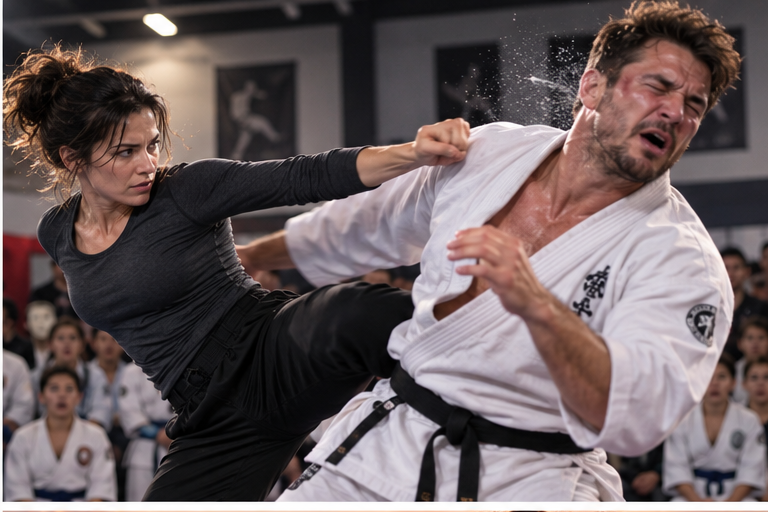
Then a little girl near the benches whispered, “Whoa.”
Jake stared at the ceiling.
His chest rose and fell.
For several seconds, he seemed unable to understand what had happened.
I stepped back to give him room.
“Are you all right?”
He sat up.
His face had turned crimson.
“You tripped me!”
“I redirected you.”
“That’s cheating!”
A teenage boy near the wall frowned.
“Sensei, isn’t that what you taught us last Tuesday?”
The question was innocent.
That made it worse.
Jake shot the boy a furious look.
“Quiet, Daniel.”
I recognized Daniel Jenkins, the student Jake had humiliated earlier.
He immediately lowered his eyes.
Something tightened in my chest.
Jake wasn’t simply embarrassed.
He was searching for someone smaller to punish for it.
I looked at Daniel.
“You asked a fair question.”
His eyes flickered toward me.
For the first time that afternoon, he almost smiled.
Jake climbed to his feet.
“All right,” he muttered. “Now we’re doing this seriously.”
“No,” I said.
He blinked.
“What?”
“We’re finished.”
I turned toward Sarah.
“Get your bag, sweetheart.”
But Jake stepped in front of me again.
His expression had become something uglier than arrogance.
It was desperation.
The desperation of a man whose authority depended entirely on other people believing he could never lose.
“You don’t get to walk away after embarrassing me in my own dojo.”
I looked at him.
“Then you understand how your students feel.”
A murmur moved through the room.
Jake’s jaw tightened.
He raised his voice.
“Nobody leaves!”
Several parents stiffened.
One father moved toward the entrance.
“Actually,” he said, “I think that’s enough.”
Jake ignored him.
He grabbed my wrist.
Hard.
The room seemed to contract around us.
I looked down at his hand.
Then back at his face.
“Let go.”
“Not until—”
“Jake.”
My voice wasn’t loud.
But something about it made him hesitate.
“Let. Go.”
He tightened his grip instead.
That was when I moved.
I rotated my arm to release his hold, stepped into a safer angle, and used his forward pressure to take him off balance.
He fell again.
This time, I followed him down just far enough to control his arm and prevent him from scrambling toward me.
I didn’t strike him.
I didn’t twist anything beyond what was necessary.
I simply held him in place.
“Stop resisting,” I said.
He struggled.
I maintained control.
“You’re going to injure yourself.”
His breathing became ragged.
“Get off me!”
“Will you stop?”
“Yes!”
I released him immediately and stood.
Jake rolled onto his side.
The silence that followed was different from the silence before.
It wasn’t anticipation anymore.
It was disbelief.
A man who had spent the entire afternoon convincing everyone that he was untouchable had just been controlled twice by a woman he’d publicly dismissed as an exhausted suburban mother.
And he hadn’t landed a single meaningful strike.
I stepped away.
My heart was steady.
My hands weren’t shaking.
That frightened me more than I expected.
Because somewhere beneath the controlled movements, the old memories were stirring.
I looked toward Sarah.
Her mouth was slightly open.
“Mom?”
I gave her a reassuring nod.
“Let’s go.”
Then someone spoke from the back of the room.
“Wait.”
It was an older man standing beside the entrance.
I hadn’t noticed him earlier.
He wore a navy windbreaker and carried a canvas gym bag over one shoulder.
His silver hair was cut short, and his posture had the unmistakable straightness of someone who had spent decades around athletes.
He was staring at me.
Not with amusement.
Not even with surprise.
With recognition.
He took one slow step forward.
“That footwork,” he murmured.
I felt a sudden chill.
He looked at my face more closely.
Then at the small scar above my left eyebrow.
His gym bag slipped from his shoulder.
“No,” he whispered.
I turned away.
But he said the words I’d spent thirteen years trying not to hear.
“Lily Carter?”
My stomach tightened.
He came closer.
“Lily Carter from the North American Fighting Circuit?”
Several parents looked between us.
Jake pushed himself upright.
“What are you talking about?”
The older man ignored him.
His eyes remained fixed on mine.
“You’re the Silent Storm.”
The room erupted.
“The what?”
“Silent Storm?”
“Is that a fighter?”
“Wait, I’ve heard that name.”
Sarah stared at me.
“Mom?”
I closed my eyes for a moment.
The older man spoke again, softer this time.
“It’s you, isn’t it?”
I recognized him now.
Thomas Whitaker.
He had been a ringside official during several of my professional fights.
Older, thinner, with more gray in his hair.
But unmistakably Thomas.
“Hello, Tom,” I said quietly.
He exhaled.
“My God.”
Jake gave a harsh laugh.
“Come on. You’re telling me this woman was some kind of professional fighter?”
Thomas turned toward him.
“Son, do you have any idea who you just tried to bully?”
Jake folded his arms.
“Apparently somebody with a good trick.”
Thomas’s expression hardened.
“She held a professional record of seventeen wins and one loss. She won two regional championships and defeated opponents who went on to compete internationally.”
I looked down.
I hadn’t heard those statistics spoken aloud in years.
Thomas continued.
“They called her the Silent Storm because she never wasted movement, never celebrated hurting anyone, and almost never lost control.”
He paused.
“She was one of the most technically disciplined fighters I ever officiated.”
Jake’s smile disappeared.
Several students turned toward me with astonished expressions.
But Sarah wasn’t smiling.
She looked wounded.
“Mom,” she whispered, “you were a professional fighter?”
I turned toward her.
“Sarah—”
“Why didn’t you tell me?”
There it was.
The question I’d avoided for thirteen years.
And suddenly, standing in front of a room full of strangers, I realized the humiliation Jake had intended for me was nothing compared with the pain of seeing my daughter discover that I’d hidden an entire part of myself from her.
Before I could answer, Jake spoke.
“This is ridiculous.”
He pulled out his phone.
“Anybody can claim to be somebody.”
Thomas gave him a cold look.
“Look her up.”
Jake tapped the screen.
His expression changed.
First skepticism.
Then confusion.
Then something approaching fear.
A teenager beside him leaned closer.
“That’s her.”
Another student gasped.
“She’s on the internet!”
Within seconds, phones were appearing throughout the room.
Old photographs.
Competition footage.
Interviews.
A younger version of me standing inside a cage with my hand raised.
My hair braided tightly against my head.
My face bruised.
A championship belt resting against my waist.
I felt the past rushing toward me.
Not gradually.
All at once.
And then Sarah saw something on a student’s screen.
A photograph of me beside a smiling young man.
He looked barely twenty.
Dark hair.
Bright eyes.
A mischievous grin.
His arm was draped around my shoulders.
Sarah pointed.
“Mom… who’s that?”
My breath caught.
Because I knew the photograph.
I remembered the exact moment it had been taken.
My brother, Noah, had insisted we pose together after my second championship victory.
He’d been laughing because I’d complained that my face looked swollen.
“Champions aren’t supposed to look pretty,” he’d told me. “They’re supposed to look impossible to beat.”
I stared at his face on the screen.
And thirteen years of carefully controlled grief cracked open.
“That’s your uncle Noah,” I whispered.
Sarah looked at me.
“The uncle who died?”
I nodded.
She studied the photograph again.
Then she asked a question that made the entire room disappear.
“Mom… did he die because of fighting?”
I couldn’t answer.
Not there.
Not with Jake watching.
Not with strangers holding up phones.
I reached for her hand.
“Let’s go home.”
This time, nobody stopped us.
But as we walked through the glass doors, I heard Thomas call after me.
“Lily, there’s something you need to know.”
I paused.
He looked deeply troubled.
“It’s about Noah.”
My entire body went cold.
“What about him?”
Thomas glanced toward Jake, then back at me.
“I don’t think you were ever told the whole story.”
PART 3 — THE SECRET BURIED THIRTEEN YEARS AGO
I didn’t sleep that night.
Sarah had barely spoken during the drive home.
She sat beside me in the passenger seat, looking out at the passing streetlights.
Every few minutes, I caught her reflection in the window.
She looked like she wanted to ask a hundred questions.
But she was afraid of the answers.
When we reached home, she went straight to her room.
I stood in the kitchen, still wearing the gray sweatpants Jake had mocked, and stared at the family photograph hanging beside the refrigerator.
Sarah at ten years old.
Me with my arms around her.
Both of us smiling.
It was taken during a summer trip to the coast.
A happy photograph.
A peaceful photograph.
But looking at it now, I wondered how much of our happiness had been built around things I’d refused to discuss.
At nine thirty, Sarah came downstairs.
She had changed into an oversized sweatshirt.
Her hair was damp from the shower.
She stopped in the doorway.
“Can we talk?”
I pulled out a chair.
“Of course.”
She sat across from me.
For a while, neither of us spoke.
Then she asked, “Was any of it real?”
I frowned.
“What do you mean?”
“The videos. The championships. All those people cheering for you.”
“Yes.”
She looked down at her hands.
“Why did you let me think you didn’t know anything about martial arts?”
I swallowed.
“I never said I didn’t know anything.”
“You never said you did, either.”
She was right.
That was the difficult part.
I had never told Sarah an outright lie about my career.
I’d simply avoided every conversation that might lead toward it.
I’d changed subjects.
Put away photographs.
Ignored old friends.
And convinced myself that silence was the same as protecting her.
“I’m sorry,” I said.
Sarah’s eyes filled.
“Did you think I wouldn’t be proud of you?”
The question broke something inside me.
“No, sweetheart.”
“Then why?”
I stared at the tabletop.
“Because I was afraid that if I started talking about that life, I’d have to talk about Noah.”
She was quiet.
I took a breath.
“Your uncle was three years younger than me. Our parents died when we were young, and for a long time, it was just the two of us.”
Sarah leaned forward.
“He was really your best friend?”
I smiled sadly.
“He was my biggest supporter. My worst critic. My loudest fan. And the most annoying little brother anyone could ask for.”
She gave a faint smile.
“He sounds fun.”
“He was.”
I looked toward the dark window.
“Noah loved everything about fighting. He studied techniques, watched competitions, and helped me prepare for matches. He wanted to become a coach.”
“What happened to him?”
My throat tightened.
For thirteen years, I’d carried a simplified version of the story.
An accident.
A terrible night.
A tragedy nobody could undo.
But Sarah deserved more than that.
“He was driving home after helping at a training facility. There was a storm. His car went off the road near a bridge.”
Sarah’s face softened.
“I’m sorry, Mom.”
I nodded.
“The police said the roads were dangerous. They said he lost control.”
“And you blamed yourself?”
I looked at her.
She was sixteen.
Old enough to recognize grief.
Young enough that I still wanted to protect her from its sharpest edges.
“I’d argued with him that afternoon,” I admitted.
“About what?”
“He thought I was pushing myself too hard. I was preparing for a major fight, and I wasn’t listening to anyone.”
I remembered Noah standing in the gym doorway.
His arms folded.
His expression unusually serious.
Lily, something isn’t right.
I’d been exhausted.
Irritated.
Obsessed with winning.
And I’d dismissed him.
“That was the last real conversation we had,” I whispered.
Sarah reached across the table.
Her fingers closed around mine.
“You couldn’t have known.”
“I know.”
But knowing something and believing it are different.
The next morning, I received a call from Thomas Whitaker.
He sounded relieved when I answered.
“I wasn’t sure you would.”
“I almost didn’t.”
“I understand.”
I stood beside the kitchen window, watching Sarah leave for school.
“What did you mean yesterday?”
Thomas was silent for several seconds.
Then he said, “I need to show you something.”
An hour later, I met him at a small diner on the edge of town.
He was sitting in a booth near the back, a battered leather folder resting beside his coffee.
When he saw me, he stood.
“Lily.”
“Tom.”
He offered an awkward smile.
“You haven’t changed much.”
“I have.”
His expression softened.
“Yes. I suppose we all have.”
I sat opposite him.
“Tell me about Noah.”
Thomas opened the folder.
Inside were old photographs, newspaper clippings, and copies of competition documents.
He removed a yellowed envelope.
“I was helping organize the archives for a regional athletic foundation. A few months ago, we received records from the old Eastbridge Training Center.”
My stomach tightened.
Eastbridge.
The facility where Noah had worked.
The place I’d refused to visit after his death.
Thomas slid a photocopied document toward me.
It was an internal incident report.
Dated three days before Noah’s accident.
At the bottom was my brother’s signature.
I stared at it.
“What is this?”
“Noah filed a safety complaint.”
I looked up.
“Against whom?”
“The management at Eastbridge.”
Thomas pointed to several paragraphs.
“He reported that instructors were allowing dangerous unsanctioned sparring sessions involving inexperienced students. He also questioned some of the facility’s injury records.”
I read the document.
My hands began to tremble.
Noah had written in the careful, precise language he used when he wanted people to take him seriously.
He described students being pressured into fighting despite injuries.
Coaches discouraging parents from reporting incidents.
A teenage athlete suffering a concussion during an unauthorized demonstration.
And then I reached the final paragraph.
I believe these practices are placing young athletes at unacceptable risk. If management refuses to intervene, I intend to submit this information to the state athletic authorities.
I looked at Thomas.
“Why have I never seen this?”
“Because the complaint was never formally processed.”
“Why?”
“That’s what I’ve been trying to understand.”
I stared at the page.
For years, I’d believed Noah had been driving home after an ordinary training session.
But this suggested he’d been involved in something much more serious.
Thomas removed another document.
“This was found with the report.”
It was a handwritten note.
Only a few lines.
But I recognized Noah’s handwriting immediately.
If anything happens to me, please make sure Lily knows I tried to do the right thing.
My vision blurred.
I pressed my hand against my mouth.
Thomas waited.
After a long moment, I managed to speak.
“Are you telling me someone hurt him?”
“No,” Thomas said carefully. “I’m telling you he was trying to expose dangerous practices before he died. I don’t have evidence that his accident was anything other than an accident.”
I nodded slowly.
It mattered that he said that.
Because grief can turn uncertainty into certainty when certainty offers someone to blame.
Thomas leaned forward.
“But there’s another reason I wanted to find you.”
I looked up.
“The Eastbridge program was reorganized after Noah’s death. Several people left. Others moved into different training businesses.”
He hesitated.
“One of the assistant instructors at Eastbridge was a man named Richard Reynolds.”
The name hit me.
“Reynolds?”
Thomas nodded.
“Jake’s father.”
For a moment, I couldn’t speak.
“Are you sure?”
“I checked.”
I stared at him.
The room seemed to tilt.
Jake Reynolds.
The man who had humiliated my daughter.
The man who had grabbed my wrist.
The man whose teaching methods looked disturbingly similar to those Noah had condemned thirteen years earlier.
“Does Jake know?” I asked.
“I don’t know.”
Thomas sighed.
“But Richard Reynolds is listed as the principal owner of the company operating your daughter’s dojo.”
I sat back.
Suddenly, yesterday’s confrontation felt less like an isolated incident.
Not because I believed Jake had deliberately targeted me over Noah.
There was no evidence of that.
But because the same culture Noah had fought against appeared to have survived.
Different building.
Different students.
Same belief that intimidation was discipline.
I looked down at my brother’s signature.
“What do you want me to do?”
Thomas met my eyes.
“I want you to know your brother wasn’t simply being difficult or overprotective. He was trying to help people.”
I stared at the document.
Then I asked, “Can I keep a copy?”
“Of course.”
When I returned home, three news vans were parked outside my neighborhood.
At first, I thought there had been an accident.
Then I saw the cameras.
A reporter spotted my car.
“Ms. Carter!”
Another raised a microphone.
“Lily! Is it true you assaulted a martial arts instructor?”
I stopped walking.
“What?”
A woman hurried toward me.
“Jake Reynolds has released a statement alleging that you attacked him during a training demonstration and caused him significant injuries.”
My stomach dropped.
She continued.
“He says you misrepresented your experience and used excessive force.”
I stared at her.
That wasn’t what had happened.
Not even close.
Before I could respond, my phone vibrated.
A message from Sarah.
Mom, please come home. Everyone at school is talking about you.
Then another message appeared.
A link.
I opened it.
Jake had uploaded an edited video.
It began with him falling to the mat.
It showed me controlling his arm.
It ended with him sitting on the floor, looking shaken.
The moments where he’d mocked me, blocked our exit, thrown the first punch, and grabbed my wrist were missing.
Above the video, Jake had written:
Professional fighter attacks local instructor during children’s class. Our school will not tolerate violence.
The video already had hundreds of thousands of views.
And beneath it, strangers were calling me a bully.
A dangerous mother.
A woman who should never have been allowed near children.
I looked at the cameras outside my house.
Then at the photograph of Noah visible through my front window.
For thirteen years, I’d avoided public attention because I believed it would bring back everything I’d lost.
Now the past had found me anyway.
And this time, it was threatening my daughter.
PART 4 — THE TRUTH THEY TRIED TO SILENCE
By the following morning, the video had crossed two million views.
My phone barely stopped ringing.
Some messages were supportive.
Former fighters recognized me.
Old fans sent photographs and memories.
A few people even thanked me for standing up to an abusive instructor.
But the loudest voices were angry.
They accused me of attacking a man who had invited me to participate in a harmless demonstration.
They demanded that I be banned from Sarah’s school.
Someone posted my business website.
Within hours, several clients had contacted me asking whether the accusations were true.
One canceled a contract.
Another suspended a project until the situation was resolved.
I sat at my kitchen table, staring at the emails.
For years, I’d worked to build a stable life.
A reliable income.
A safe home.
A future for Sarah.
Now it seemed possible that one man’s wounded pride could unravel everything.
Sarah came downstairs carrying her backpack.
She looked exhausted.
“Mom, I don’t want to go to school.”
I closed my laptop.
“Did something happen?”
She hesitated.
“Some kids are saying you hurt Sensei Jake on purpose.”
I felt my chest tighten.
“What did you tell them?”
“That he started it.”
She swallowed.
“They said I was lying.”
I moved toward her.
“Sarah—”
“And then someone showed me a post saying you were responsible for Uncle Noah’s death.”
I stopped.
The words struck harder than anything Jake had thrown at me.
“Who said that?”
“I don’t know. Some anonymous account.”
She looked at me with frightened eyes.
“Mom, what if people keep doing this?”
I pulled her into my arms.
“I won’t let you face it alone.”
She held me tightly.
For the first time since the confrontation, I felt genuine anger.
Not the sharp, physical anger that had once accompanied difficult fights.
Something deeper.
A mother’s anger at watching her child suffer because an adult refused to accept responsibility.
That afternoon, I met with an attorney named Rebecca Morgan.
She specialized in civil disputes and had been recommended by an old friend.
Rebecca listened without interrupting as I explained everything.
When I finished, she leaned back.
“Do you have the original video?”
“No.”
“Do you know who recorded it?”
“Several parents had their phones out.”
“Then that’s where we start.”
She tapped her pen against the table.
“Don’t respond publicly yet. Don’t threaten Jake. Don’t contact him directly.”
I nodded.
“Can he sue me?”
“He can file a claim. Whether he can prove it is another matter. But we need evidence, not assumptions.”
She studied me.
“And Lily, I need to ask something difficult.”
“Go ahead.”
“Why did you agree to step onto the mat?”
I looked down.
“Because I wanted him to stop humiliating those kids.”
“That may explain your decision. It doesn’t automatically make it wise.”
I gave a tired smile.
“I know.”
Rebecca’s expression softened.
“Good. Then we can work with the truth.”
That evening, Daniel Jenkins’s mother called me.
Her name was Melissa.
She was the woman who had sat beside me during class.
Her voice trembled.
“I should have said something that day.”
“You don’t owe me an apology.”
“Yes, I do.”
She paused.
“Daniel has been afraid of Jake for months. He used to love martial arts. Now he gets stomachaches before class.”
I closed my eyes.
“I’m sorry.”
“There’s something else.”
I waited.
“Daniel recorded the entire confrontation.”
I sat upright.
“What?”
“He was testing the camera on his new phone. He started recording when Jake called you over.”
My heart began pounding.
“Does he still have it?”
“Yes.”
“Melissa, please don’t send it to anyone else yet. My attorney can help preserve the original.”
She exhaled.
“That’s why I’m calling.”
The next day, Rebecca received the unedited recording.
We watched it together.
Every insult.
Every attempt to leave.
Every warning.
Jake’s first punch.
His second attack.
His hand gripping my wrist.
And my repeated efforts to end the confrontation.
The video was clear.
Undeniable.
Rebecca paused it.
“That changes things.”
But the most important part wasn’t the fight.
It was the beginning.
Daniel had recorded Jake mocking another student before turning his attention toward me.
He’d captured the frightened faces.
The uncomfortable laughter.
The way the children lowered their eyes whenever Jake raised his voice.
It showed something much larger than one confrontation.
A pattern.
Rebecca contacted several parents.
Within days, more people came forward.
One mother described her twelve-year-old daughter being forced to continue training after complaining of dizziness.
A father said his son had been publicly ridiculed for crying after an injury.
Another parent reported that Jake had threatened to remove a student from an upcoming competition if the family complained about his methods.
Not every allegation could be independently verified.
But enough people had similar experiences that Rebecca recommended submitting formal complaints to the relevant organizations and local authorities.
Meanwhile, Thomas continued investigating the historical records.
He found no proof that Noah’s death involved foul play.
The original police report described wet roads, poor visibility, and a vehicle leaving the roadway.
But Thomas discovered that Noah had scheduled a meeting with athletic regulators for the morning after his accident.
A meeting that never happened.
He also located an old letter from Richard Reynolds.
It had been sent to Eastbridge management after Noah filed his complaint.
The language was dismissive.
Richard described Noah as inexperienced, overly emotional, and incapable of understanding the discipline required to develop serious competitors.
I read the letter twice.
Then a third time.
It sounded painfully familiar.
The same contempt Jake had shown Daniel.
The same assumption that fear created strength.
The same willingness to humiliate anyone who questioned authority.
I folded the paper carefully.
My brother had tried to challenge that mentality.
And thirteen years later, I had encountered it again.
The following Friday, Rebecca arranged a meeting with Richard Reynolds.
He agreed only after learning that several families were preparing formal complaints.
We met in a conference room at her office.
Richard arrived wearing an expensive charcoal suit.
He was in his early sixties, with neatly combed gray hair and the practiced confidence of someone accustomed to controlling conversations.
Jake followed him.
His right wrist was wrapped in a support brace.
He avoided looking directly at me.
Richard sat down.
“Let’s not waste time.”
Rebecca opened her folder.
“Agreed.”
Richard looked at me.
“Ms. Carter, my son made an error in judgment. But your response was disproportionate.”
I remained silent.
He continued.
“You have a professional fighting background. You should have known better.”
“You’re right,” I said.
That surprised him.
I leaned forward.
“I should have left sooner. I should never have allowed the situation to become physical.”
Jake smirked.
Then I continued.
“But your son blocked our exit, attacked without warning, and grabbed me after I told him to stop.”
Rebecca placed a tablet on the table.
“Here is the complete recording.”
We watched it.
Richard’s expression grew increasingly rigid.
When the video ended, nobody spoke.
Finally, he looked at Jake.
“You told me she challenged you.”
Jake stared at the floor.
“She embarrassed me.”
Richard’s jaw tightened.
“That wasn’t what I asked.”
Jake said nothing.
Rebecca slid another document across the table.
“We also have written statements from parents describing concerns about the dojo’s training environment.”
Richard barely glanced at them.
“Disgruntled parents complain about everything.”
I felt a familiar chill.
Those words.
That attitude.
I reached into my bag and removed Noah’s complaint.
“Thirteen years ago, my brother filed a report about dangerous training practices at Eastbridge.”
Richard went still.
I placed the document in front of him.
“Do you remember Noah Carter?”
For the first time, his confidence disappeared.
He stared at the signature.
Then slowly looked up.
“You’re Noah’s sister?”
“Yes.”
His expression changed.
Not to anger.
To something closer to regret.
“I remember him.”
I waited.
Richard looked down again.
“He was a stubborn young man.”
“He was trying to protect students.”
Richard’s mouth tightened.
“We had disagreements.”
“He reported injuries.”
“Yes.”
“And you dismissed him.”
Richard didn’t answer.
I leaned forward.
“Did you ever take his concerns seriously?”
The older man stared at the document.
After a long silence, he said, “No.”
The admission was so quiet that I almost missed it.
Jake looked at his father.
“Dad?”
Richard rubbed his forehead.
“Noah believed we were pushing students too hard. I thought he was trying to undermine the program.”
He paused.
“After he died, I told myself it had nothing to do with me.”
I felt my throat tighten.
“His accident wasn’t your fault.”
Richard looked at me.
“I know.”
“Then don’t turn his death into an excuse. The question is what you did with the warning he gave you.”
Richard had no answer.
Jake shifted in his chair.
“This has nothing to do with what happened at my dojo.”
I turned toward him.
“It has everything to do with it.”
His eyes narrowed.
“You think you’re better than me because you won some fights years ago?”
“No.”
I shook my head.
“I think you shouldn’t be teaching children until you understand the difference between discipline and cruelty.”
Jake pushed back his chair.
“You can’t tell me how to run my school!”
Richard suddenly slammed his hand against the table.
“Sit down.”
Jake froze.
Richard’s voice shook.
“Sit down, Jacob.”
Slowly, Jake obeyed.
Richard looked at Rebecca.
“What happens now?”
She folded her hands.
“The families have the right to pursue their complaints. Ms. Carter also has concerns about the misleading public statement and the edited video.”
Richard nodded.
“And what does she want?”
Rebecca glanced at me.
I had thought about that question for days.
Money would help replace the lost contracts.
A public apology might repair some of the damage.
But neither would be enough if Jake simply returned to teaching frightened children.
“I want the truth made public,” I said.
“And I want independent oversight of the dojo’s safety practices before Jake teaches another class.”
Richard studied me.
Then he nodded slowly.
“I’ll consider it.”
Jake stared at him.
“Dad, you can’t be serious.”
Richard didn’t look at his son.
“For once, Jacob, I am.”
I thought that might be the end.
I was wrong.
That night, Jake posted another video.
This time, he challenged me to a public fight.
A sanctioned exhibition, he called it.
A chance to settle the matter “the old-fashioned way.”
He promised to donate the proceeds to a youth martial arts charity.
But his final words made his intentions unmistakable.
“Silent Storm, if you’re really as good as everyone says, stop hiding behind lawyers and prove it.”
By morning, the video had gone viral.
Promoters began calling.
Former fighters offered opinions.
Commentators debated whether a thirty-eight-year-old retired athlete could still defeat a younger, heavier instructor.
And my daughter came into the kitchen carrying her phone.
“Mom,” she said quietly, “please tell me you’re not going to fight him.”
I looked at her.
Then at the screen.
At Jake’s smug expression.
At the thousands of comments demanding a spectacle.
And I finally understood what he wanted.
He didn’t want justice.
He wanted an audience.
The same thing he’d wanted in the dojo.
Only bigger.
Louder.
And more profitable.
I took Sarah’s phone and turned off the video.
“No,” I said.
“I’m not going to fight him.”
She exhaled.
But then I added something that surprised even me.
“I’m going to do something he won’t expect.”
PART 5 — THE FIGHT THAT MATTERED MOST
Three weeks later, I stood outside the Westbrook Community Athletic Center with my hands trembling.
Not because I was afraid of Jake Reynolds.
Not because I was preparing to enter another cage.
But because, for the first time in thirteen years, I was about to speak publicly about my brother.
The community center had agreed to host an open forum on youth sports safety.
Rebecca helped coordinate it.
Thomas contacted former coaches and athletic officials.
Several parents volunteered to speak.
A licensed youth sports psychologist agreed to discuss the effects of humiliation and intimidation on young athletes.
And I had been invited to share my experience.
No punches.
No trophies.
No winner’s belt.
Just a room full of people who wanted children to feel safe while learning something they loved.
Yet I was more nervous than I’d ever been before a championship fight.
Sarah stood beside me.
She wore jeans, white sneakers, and a navy sweatshirt.
Her hair was pulled into a ponytail.
“You’re doing that thing again,” she said.
I looked at her.
“What thing?”
“Staring at the door like it’s going to attack you.”
I laughed softly.
“Was I?”
“Definitely.”
She took my hand.
“You know you don’t have to do this.”
I looked through the glass doors.
Families were already gathering inside.
I recognized Melissa Jenkins.
Daniel stood beside her.
He was talking animatedly to another student.
For once, he didn’t look frightened.
“I think I do,” I said.
Sarah squeezed my hand.
“Then I’ll be right there.”
The auditorium was nearly full.
Some people had come because they cared about youth athletics.
Others were curious about the woman from the viral video.
A few reporters stood along the back wall.
And near the front, sitting alone, was Richard Reynolds.
Jake wasn’t with him.
I took my seat beside Thomas.
He leaned toward me.
“How are you holding up?”
“Ask me in an hour.”
He smiled.
“You always hated interviews more than fights.”
“Some things never change.”
The forum began with several speakers discussing coaching standards and student welfare.
Parents described their experiences.
Some stories were painful.
One mother explained how her daughter had stopped participating in sports after being repeatedly mocked for her weight.
A father described his son’s fear of disappointing an instructor who shouted whenever he made mistakes.
Daniel Jenkins was the youngest speaker.
He approached the microphone with visibly shaking hands.
For a moment, I worried he might change his mind.
Then he looked toward his mother.
She smiled.
He took a breath.
“I used to think being brave meant not being scared.”
The room became quiet.
He continued.
“But when I trained with Sensei Jake, I was scared all the time.”
His voice trembled.
“I thought something was wrong with me because I couldn’t do everything perfectly.”
He looked down at his notes.
“Then Mrs. Carter told me I had asked a fair question.”
He glanced toward me.
“That was the first time in a long time an adult at the dojo made me feel like I wasn’t stupid.”
I felt tears gathering.
Daniel straightened.
“I still want to learn martial arts. I just don’t want to be afraid of my teacher anymore.”
When he finished, the audience applauded.
Not loudly at first.
Then more strongly.
Daniel returned to his seat, and his mother wrapped an arm around his shoulders.
I looked at Sarah.
She was wiping her eyes.
Then the moderator called my name.
“Lily Carter.”
I stood.
The room quieted.
I walked toward the microphone.
For a moment, the faces blurred together.
I saw cameras.
Reporters.
Parents.
Students.
And suddenly I was twenty-five again, standing beneath bright arena lights while thousands of people waited for me to perform.
My heart began pounding.
Then I remembered something Noah used to say.
You don’t owe the crowd a show, Lily. You owe yourself the truth.
I took a breath.
“My name is Lily Carter.”
A few people smiled.
“Thirteen years ago, some people knew me as the Silent Storm.”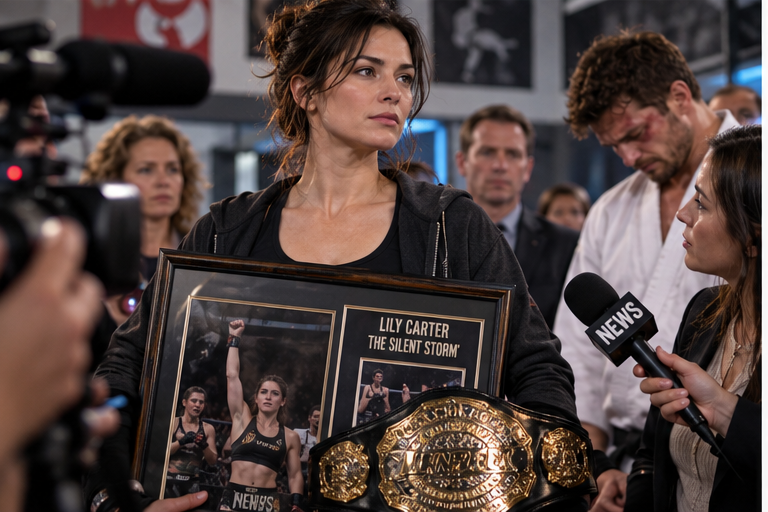
There was a ripple of recognition.
“I was proud of my career. I worked hard. I trained with extraordinary people. I learned discipline, patience, and respect.”
I paused.
“But somewhere along the way, I also learned how easily competition can become an excuse for cruelty.”
The room remained silent.
“I’ve been asked repeatedly why I didn’t simply fight Jake Reynolds again.”
I looked toward the cameras.
“The answer is simple.”
I steadied my voice.
“Because beating someone in a fight doesn’t automatically make you right.”
A few people nodded.
“And losing a fight doesn’t mean someone deserves humiliation.”
I thought of Jake lying on the dojo mat.
His face burning with embarrassment.
His anger growing because he couldn’t tolerate appearing weak.
“That afternoon, I made mistakes. I should have insisted on leaving. I should have asked another adult to intervene. I allowed myself to be drawn into a situation that never should have happened.”
I paused.
“But I also know that no instructor has the right to physically intimidate students or parents.”
I looked toward Daniel.
“Martial arts should teach children how to protect themselves without teaching them to enjoy hurting others.”
My voice grew steadier.
“Strength without compassion is just another form of weakness.”
Then I removed a folded photograph from my pocket.
It showed Noah and me after my second championship victory.
He was grinning.
I was holding a belt.
Both of us looked impossibly young.
“This is my brother, Noah Carter.”
My voice caught.
“He died thirteen years ago.”
I waited until I could continue.
“Noah loved martial arts. He believed they could change lives. He believed a good coach could help a frightened child become confident.”
I looked at the photograph.
“Before he died, he raised concerns about dangerous training practices at a facility where he worked.”
I paused.
“His death was a tragic road accident. I have no evidence that anyone caused it intentionally. But for years, I blamed myself for not listening to him when he tried to tell me something was wrong.”
The room was completely still.
“I can’t change what happened to Noah.”
I looked up.
“But I can honor what he believed.”
I unfolded a second sheet of paper.
It contained a proposal Rebecca and I had developed with several local coaches.
“We are establishing the Noah Carter Youth Martial Arts Fund.”
A murmur moved through the audience.
“The fund will support scholarships for children whose families can’t afford training. It will also help participating schools develop clear safety policies, confidential complaint procedures, and training for coaches.”
I looked toward Sarah.
“And we will make one promise to every child who enters a participating program.”
My voice strengthened.
“You will be challenged.”
“You will be expected to work hard.”
“You will learn discipline.”
“But you will never have to earn respect by accepting humiliation.”
The applause began slowly.
Then the entire auditorium rose.
I stood at the microphone, overwhelmed.
For thirteen years, I’d imagined returning to the fighting world would mean returning to the pain of losing Noah.
But standing there, hearing people applaud an idea he would have loved, I felt something unexpected.
Peace.
Not complete.
Not permanent.
But real.
After the forum, Richard Reynolds approached me.
He looked older than he had three weeks earlier.
“Lily.”
I turned.
“Richard.”
He held a folder.
“I wanted to give you this.”
Inside was a signed statement announcing that Jake had been removed from instructional duties pending an independent review.
The dojo would introduce new safety policies and an outside complaint process.
Richard had also agreed to cooperate with the families and provide the full original footage when requested.
I read the document carefully.
“Thank you.”
Richard shook his head.
“Don’t thank me yet. I should have acted sooner.”
He hesitated.
“There’s something else.”
I waited.
He reached into his jacket and removed a small envelope.
“I found this among the old Eastbridge records.”
My heart tightened.
On the front, in handwriting I recognized instantly, were two words.
For Lily.
I stared at the envelope.
Richard spoke quietly.
“Noah left it in the office. I don’t know why it was never delivered.”
My hands trembled as I took it.
The paper was yellowed.
The edges were worn.
I opened it carefully.
Inside was a single page.
Hey, Storm,
If you’re reading this, it probably means I chickened out of saying everything to your face.
I laughed through sudden tears.
That sounded exactly like Noah.
You work harder than anyone I’ve ever known. But sometimes I think you’ve forgotten why you started fighting.
It wasn’t for trophies.
It wasn’t for money.
It wasn’t to prove you were tougher than everyone else.
You started because you wanted to be strong enough to protect yourself and the people you love.
Don’t let the business change that.
And don’t let one bad day convince you that the whole world is bad.
Whatever happens with your next fight, I’m proud of you.
Not because you’re the Silent Storm.
Because you’re my sister.
Love, Noah.
I couldn’t finish reading aloud.
I pressed the letter against my chest.
For thirteen years, I’d remembered our last argument.
His frustrated expression.
My angry words.
The door closing behind him.
I’d convinced myself that those final moments defined our relationship.
But here, in my hands, was proof of something I’d almost forgotten.
Noah’s love had been larger than our last disagreement.
Richard stepped back quietly.
I didn’t know how long I stood there.
Eventually, Sarah approached.
“Mom?”
I turned toward her.
She saw the letter.
“Is that from Uncle Noah?”
I nodded.
“Would you like to read it?”
She took it gently.
As her eyes moved across the page, tears began sliding down her cheeks.
When she finished, she looked at me.
“He really loved you.”
I smiled through my tears.
“Yes.”
She handed the letter back.
“And I think he’d be proud of you now.”
I pulled her into my arms.
For a long time, neither of us spoke.
There was nothing we needed to say.
The months that followed were not magically easy.
The complaints against the dojo required time and careful review.
Jake initially refused to accept responsibility.
He continued insisting that the confrontation had been misunderstood.
But when the complete video became public, the edited version lost its credibility.
The original footage showed his behavior clearly.
Several media outlets corrected their earlier reporting.
Clients who had suspended projects contacted me again.
One apologized personally.
Another offered a new contract.
My business slowly recovered.
Rebecca helped negotiate a settlement resolving my dispute with the dojo’s operating company, including a correction of its public statements and compensation for documented losses.
The terms remained private.
I didn’t need a public victory parade.
I needed to pay my bills and protect my daughter.
Jake eventually issued a written apology.
It wasn’t poetic.
It wasn’t particularly warm.
And I couldn’t know whether he truly meant it.
But he acknowledged that he had acted inappropriately toward students and parents, and that his handling of the demonstration had been unsafe.
For me, that mattered more than hearing him admit I was the better fighter.
Richard resigned from day-to-day management of the school.
An independent director took over operations.
Several instructors were replaced.
New safety procedures were introduced.
Some families returned.
Others chose different programs.
Both decisions were understandable.
Trust, once broken, isn’t restored by a press release.
It has to be earned.
As for Sarah, she took a break from martial arts.
I didn’t pressure her to return.
For several weeks, we spent our evenings doing ordinary things.
Cooking.
Watching movies.
Walking through the neighborhood.
Talking about school.
And, gradually, talking about my past.
She asked about my first professional fight.
My toughest opponent.
My favorite training partner.
The worst injury I’d ever suffered.
I answered honestly.
Sometimes we laughed.
Sometimes I cried.
And sometimes I told her stories about Noah.
How he’d once driven six hours to watch a fight that lasted forty-three seconds.
How he used to bring me terrible homemade protein bars.
How he’d shout instructions from the audience even though he knew I couldn’t hear him.
Sarah loved those stories.
Especially the embarrassing ones.
One evening, she brought me an old photograph she’d printed from the internet.
It showed me standing in the cage after my final championship victory.
My face was bruised.
My hair was a mess.
My championship belt was raised above my head.
Sarah had written something beneath it.
My mom was a champion before I even knew what a champion was.
I stared at it for a long time.
Then I hugged her.
“Sweetheart, you know winning fights isn’t what makes someone a champion.”
She smiled.
“I know.”
“Then why did you write that?”
She shrugged.
“Because I think you were one anyway.”
Six months after the confrontation, the Noah Carter Youth Martial Arts Fund opened its first training program.
We rented space inside the Westbrook Community Athletic Center.
Thomas helped recruit instructors.
Rebecca volunteered legal guidance.
Melissa Jenkins organized parent communications.
And several former athletes offered to teach beginner classes.
I agreed to assist with technique and student development.
Not as a celebrity.
Not as a returning professional fighter.
Just as a coach.
The first afternoon, I arrived early.
The training mats were new.
The equipment was neatly arranged.
Sunlight streamed through the tall windows.
For a moment, I stood alone in the empty room.
The smell of the mats brought back memories.
The sound of distant footsteps.
The squeak of athletic shoes.
The familiar quiet before training began.
I closed my eyes.
For years, I’d believed that returning to a gym would mean betraying the promise I’d made after Noah’s death.
But I was beginning to understand that my promise had been born from pain.
Not from wisdom.
I’d promised never to fight again because I couldn’t bear the memories.
Yet Noah had never asked me to abandon what I loved.
He’d wanted me to remember why I loved it.
The door opened.
Sarah stepped inside wearing a fresh training uniform.
She looked around.
“Not bad, Mom.”
I smiled.
“High praise.”
She grinned.
Then Daniel Jenkins appeared behind her.
He carried a gym bag and looked nervous.
“Mrs. Carter?”
“Hi, Daniel.”
He glanced at the mats.
“Are you really going to teach us?”
“That’s the plan.”
He hesitated.
“Are you going to be strict?”
I considered the question.
“Yes.”
His shoulders tightened.
I continued.
“I’m going to expect you to listen, practice, and treat your classmates respectfully.”
He nodded.
“But if you make a mistake, we’ll work on it together.”
His expression relaxed.
“And if I can’t do something?”
“Then we figure out what you need to learn next.”
He smiled.
It was a small smile.
But it meant more to me than any championship belt I’d ever held.
Soon, the room filled with students.
Some were experienced.
Others had never trained before.
A few were shy.
One little boy refused to leave his mother’s side.
Another girl kept asking whether she would have to fight someone on her first day.
I reassured them.
We began with simple movement drills.
Balance.
Coordination.
Awareness.
Listening.
No shouting.
No humiliation.
No unnecessary contact.
When someone struggled, we slowed down.
When someone succeeded, we celebrated the effort as much as the result.
Halfway through class, I noticed Sarah helping a younger student adjust her stance.
The little girl kept losing her balance.
Sarah crouched beside her.
“Don’t worry,” she said. “I couldn’t do it at first either.”
The girl looked up.
“Really?”
“Really.”
Sarah demonstrated again.
Slowly.
Patiently.
The girl tried.
This time, she managed it.
Her face lit up.
Sarah clapped.
“See? You got it!”
I stood watching them.
And suddenly, I understood something that had taken me thirteen years to learn.
Strength doesn’t disappear when you stop fighting.
Sometimes it simply changes shape.
It becomes patience.
Protection.
Kindness.
The willingness to stand beside someone who is struggling instead of standing above them.
After class, the students gathered near the entrance.
Daniel approached me.
“Mrs. Carter?”
“Yes?”
He looked embarrassed.
“Can I ask you something?”
“Of course.”
He shifted his weight.
“Do you think I could ever be really good at martial arts?”
I smiled.
“I think you can become much better than you are today.”
He considered that.
“But what if I’m never the best?”
I crouched slightly so we were closer to eye level.
“Daniel, there will always be someone faster, stronger, or more experienced. That’s not something you need to fear.”
He listened carefully.
“The important thing is whether you’re learning, whether you’re treating people well, and whether you’re becoming someone you respect.”
He nodded slowly.
Then he smiled.
“Okay.”
As he walked away, I heard him tell his mother, “I want to come back next week.”
Melissa looked at me across the room.
Her eyes were shining.
I smiled back.
That was enough.
A year later, the program had grown beyond anything we’d imagined.
We had dozens of students.
A waiting list for beginner classes.
Volunteer coaches.
Scholarships funded by local businesses.
And a reputation for helping children who had lost confidence in traditional competitive environments.
We also had rules.
Clear ones.
Every student had the right to refuse unsafe contact.
Every parent had access to the program’s safety procedures.
Every instructor received training in appropriate coaching behavior.
And every child was encouraged to speak up when something felt wrong.
It wasn’t a perfect system.
No organization is.
But we worked to make it accountable.
One Saturday morning, Thomas arrived carrying a small wooden plaque.
He asked me to gather everyone near the entrance.
Sarah stood beside me.
Daniel and several other students crowded around.
Thomas cleared his throat.
“We wanted to do something special.”
He handed me the plaque.
Engraved across the front were the words:
NOAH CARTER TRAINING CENTER
Strength Through Respect. Courage Through Compassion.
I stared at it.
For a moment, I couldn’t breathe.
Thomas smiled.
“We thought it was time his name was on the wall.”
I ran my fingers over the letters.
Noah Carter.
My little brother.
The young man who had believed so fiercely in doing the right thing.
The person I’d spent thirteen years mourning.
And now, the person whose memory would help frightened children discover their own strength.
Sarah slipped her hand into mine.
“Do you like it?”
I nodded.
“I love it.”
She leaned against my shoulder.
“Uncle Noah would have loved it too.”
I looked around the room.
At the students.
The parents.
The coaches.
The sunlight spreading across the blue mats.
And for the first time in thirteen years, remembering my brother didn’t feel like opening an old wound.
It felt like opening a door.
That evening, Sarah and I returned home after a long day at the center.
We ordered pizza.
Watched a terrible comedy.
And argued affectionately about who had forgotten to buy orange juice.
It was ordinary.
Beautifully ordinary.
Later, while I washed the dishes, Sarah appeared in the kitchen doorway.
“Mom?”
“Yes?”
“Can I ask you one more question about the old days?”
I smiled.
“Go ahead.”
She hesitated.
“Do you ever miss being the Silent Storm?”
I turned off the faucet.
For a moment, I thought about the arenas.
The crowds.
The sound of my name echoing through a stadium.
The rush of victory.
The discipline of training.
The feeling of being completely focused on something I loved.
“Sometimes,” I admitted.
Sarah nodded.
“Would you ever fight professionally again?”
I thought carefully before answering.
“No.”
“Because of Uncle Noah?”
I shook my head.
“Not anymore.”
“Then why?”
I looked toward the living room, where her schoolbooks were scattered across the coffee table.
At the family photographs on the walls.
At the peaceful home we’d built together.
“Because I already had that chapter of my life,” I said. “And it was important. But I don’t need to repeat it to prove it mattered.”
Sarah smiled.
“So you’re retired?”
“Very retired.”
She laughed.
Then she stepped closer.
“But you’re still the Silent Storm, right?”
I looked at her.
And I smiled.
“I suppose a little part of me always will be.”
She wrapped her arms around me.
“Good.”
“Why good?”
She pulled back.
“Because someday, when I have kids, I want to tell them their grandmother was a legendary fighter.”
I laughed.
“Oh, really?”
“Absolutely.”
She grinned.
“And then I’m going to tell them the best thing she ever did wasn’t winning a championship.”
I raised an eyebrow.
“What was it?”
Sarah looked at me with the same bright eyes she’d had as a little girl.
“She taught people they didn’t have to be cruel to be strong.”
I couldn’t speak.
So I simply hugged her.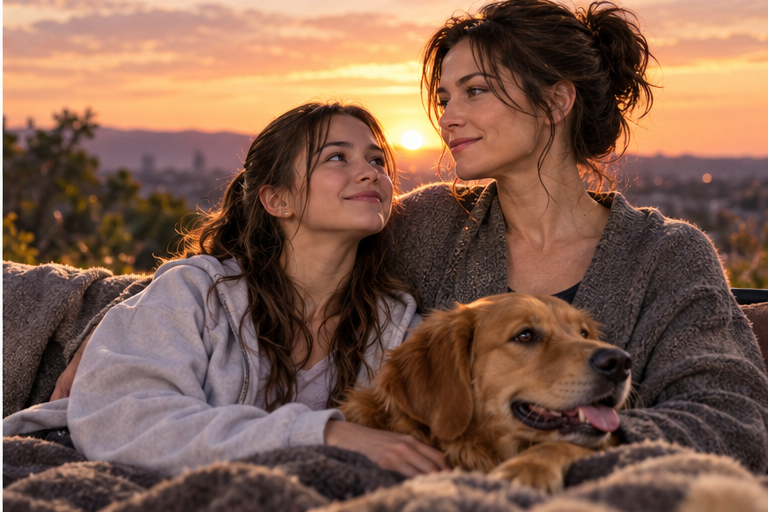
Outside, the evening settled quietly over our neighborhood.
Somewhere in the house, my phone buzzed with another work email.
There were dishes to finish.
Bills to pay.
A training schedule to prepare.
And breakfast to make in the morning.
My life was still ordinary.
I was still a single mother.
Still a graphic designer.
Still the woman who wore loose gray sweatpants and sometimes forgot where she’d left her car keys.
But I no longer felt the need to hide the person I’d been.
The fighter.
The sister.
The champion.
The grieving young woman who had lost her way.
All of those versions of me belonged to the same story.
And I finally understood that moving forward didn’t require abandoning any of them.
Thirteen years earlier, I’d walked away from fighting because I believed it was the only way to survive losing my brother.
A year earlier, an arrogant instructor had dragged me back onto a mat because he thought humiliating me would make him look powerful.
He had wanted to prove that strength belonged to whoever could intimidate the room.
Instead, he’d reminded me of something Noah had tried to teach me long ago.
The strongest person isn’t always the one who can knock someone down.
Sometimes it’s the one who has every reason to strike back, every opportunity to seek revenge, and every ability to cause harm—
But chooses to build something better instead.
My name is Lily Carter.
Once, the fighting world called me the Silent Storm.
Today, the people who matter most call me Mom, Coach, and Friend.
And if you ask me which title means the most, I won’t hesitate.
Because the greatest victory of my life didn’t happen beneath arena lights.
It happened in a small training center filled with children who were finally learning to stand tall without being afraid.
And every time I walk through those doors and see my brother’s name on the wall, I remember the words he left for me.
Don’t let one bad day convince you that the whole world is bad.
I didn’t, Noah.
Not anymore.
THE END