MY MOTHER SWORE IN COURT THAT I HAD NEVER SERVED IN THE ARMY—THEN I LOOKED AT THE CLOCK AND SAID, “IN THIRTEEN MINUTES, EVERYTHING WILL BE DECLASSIFIED.”
PART 1 — THIRTEEN MINUTES UNTIL THE TRUTH
I sat motionless while my own mother stood before a judge and swore that my entire military career was a lie.
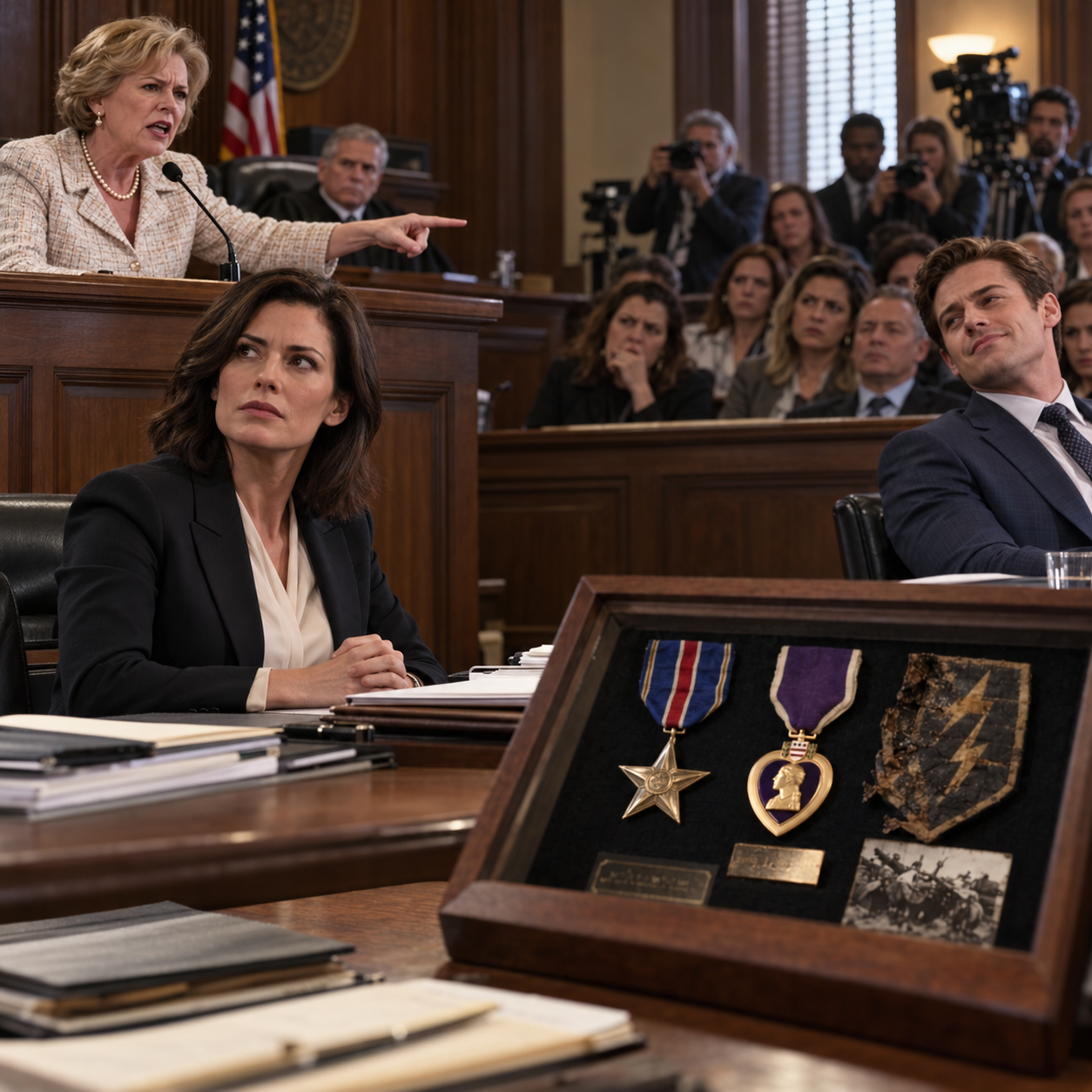
“She was never a soldier,” Evelyn Cross declared. “The medals, the injuries, the stories about serving overseas—she invented everything.”
She even pointed toward the scars hidden beneath my blouse and insisted they weren’t real.
The jurors exchanged disgusted looks.
Reporters hurried to write down every accusation.
Across the courtroom, my younger brother Ryan smiled as though he had already won control of our father’s multimillion-dollar defense company.
I didn’t defend myself.
I didn’t show them my scars.
And I didn’t tell them where I had earned the Silver Star and Purple Heart now being used as evidence against me.
Because the records that could prove my innocence were still classified.
But my family had overlooked one detail.
The classification was about to expire.
I glanced at the courtroom clock.
11:47 a.m.
My attorney leaned closer.
“Claire, what are you waiting for?”
I kept my eyes on the second hand.
“Authorization.”
“For what?”
I finally smiled.
“In thirteen minutes, everything will be declassified.”
Ryan stopped smiling.
And just as the second hand continued its slow journey toward noon, someone reached for the courtroom doors from the other side.
My name is Claire Cross.
And I learned a long time ago that betrayal doesn’t always arrive with shouting or threats.
Sometimes it comes in a familiar voice.
Sometimes it wears your mother’s face.
And sometimes it sits beneath the bright lights of a courtroom, calmly destroying your reputation while pretending to tell the truth.
The courtroom smelled of aging wood, overheated coffee, and the faint dust that rose whenever another stack of legal documents was opened.
Fluorescent lights buzzed above us.
A reporter seated behind the defense table scribbled continuously across a yellow legal pad.
Every few seconds, I heard the scratch of his pen.
He was recording my mother’s testimony.
Recording every accusation.
Every carefully chosen sentence.
Every lie she delivered with the calm confidence of someone who expected to be believed.
“She has never served in the United States Army,” my mother said.
Her voice was steady.
“She created an elaborate story about being a decorated veteran.”
A murmur passed through the gallery.
I kept my hands folded on the table.
My attorney leaned toward me.
“Claire, don’t react.”
“I won’t.”
He watched my face.
Then he sighed.
“Somehow, that concerns me even more.”
I didn’t answer.
Across the aisle, Ryan lowered his head.
But not quickly enough to hide his smile.
He had been waiting for this moment.
And from the look on his face, he believed everything was going according to plan.
The case had begun as a dispute over Cross Meridian Systems.
My father’s company.
He had built it from almost nothing.
Thirty years earlier, Cross Meridian had operated out of a rented industrial unit with limited equipment and more ambition than money.
Dad worked endless hours.
He missed family dinners.
Birthdays.
Holidays.
There were years when he seemed to spend more time with engineers and contractors than with his own children.
But he kept building.
Eventually, the company became a respected defense technology business with valuable contracts and obligations that required extraordinary care.
My father understood the importance of protecting those responsibilities.
He also understood that the wrong person in control could destroy everything he had spent decades creating.
Before cancer took away the last of his strength, he made his decision.
He transferred the controlling shares of Cross Meridian Systems to me.
He also named me executor of his estate.
He trusted me to protect the company.
Not because I was his oldest child.
Not because he wanted to punish Ryan.
But because he knew things about the business that the rest of the family refused to acknowledge.
And because he knew the truth about my military service.
There was one more reason.
A secret connected to my assignments.
A secret I had promised him I would never reveal without authorization.
Three days after Dad’s funeral, Ryan appeared with a new will.
According to the document, my father had changed his mind.
Everything was now supposed to belong to Ryan.
The company.
The controlling interest.
The authority to make decisions.
All of it.
I challenged the document.
I expected a legal dispute over signatures, dates, witnesses, and corporate records.
Instead, Ryan chose a different strategy.
He went after my credibility.
He accused me of pretending to be a decorated Army veteran.
He claimed I had fabricated my military history.
That I had forged documents.
That I had falsely represented federal records.
He used words designed to destroy a person’s reputation before the evidence could even be examined.
Stolen valor.
Fraud.
Forgery.
And he knew exactly why those accusations would be difficult for me to answer publicly.
The most important records from my service were sealed.
My deployment history involved protected operations.
My award citations, personnel documents, evacuation records, and witness statements were not available through ordinary public requests.
I couldn’t simply walk into court and reveal everything I knew.
Not without violating obligations I had sworn to uphold.
Ryan understood that limitation.
He had spent months preparing his case around it.
And now he was watching our mother repeat his accusations under oath.
The prosecutor approached the evidence table.
He picked up a wooden shadow box.
Then he turned it toward the jury.
Inside were three objects that meant more to me than anyone in that courtroom could understand.
My Silver Star.
My Purple Heart.
And a scorched unit patch.
The patch had survived a mission that had nearly taken my life.
I remembered exactly how it had looked when I brought it home.
The burned fabric.
The damaged stitching.
The smell that lingered long after everything else had been cleaned.
To me, those objects represented sacrifice.
Pain.
The people who had served beside me.
And the people who had not returned.
But in that courtroom, Ryan wanted them to mean something else.
He wanted them to look like props.
Cheap decorations purchased to support an invented identity.
The prosecutor held the shadow box higher.
My mother glanced at it.
Then she gave a small laugh.
“She bought those online.”
The words seemed to change the temperature of the room.
One juror leaned forward to examine the medals.
His expression hardened.
Another looked at me with open disgust.
A reporter stopped writing for a moment.
He stared at the display.
Then at me.
Across the aisle, Ryan’s attorney straightened a stack of papers that was already perfectly aligned.
He looked satisfied.
The prosecution had managed to turn the symbols of my service into supposed evidence of dishonesty.
For a few seconds, the courtroom became strangely quiet.
The judge’s hand rested beside his notes.
The prosecutor held the shadow box against his chest.
A ventilation system clicked on overhead.
The corner of a document fluttered on the evidence cart.
And nearly everyone in the room looked toward me.
Waiting.
Perhaps they expected me to cry.
Perhaps they wanted me to become angry.
Perhaps they hoped I would stand and say something that could be used against me.
I remained seated.
But beneath my blouse, the scar along my ribs began to ache.
It was an old injury.
One I usually managed to ignore.
Yet something about seeing that scorched patch brought the memory back with terrible clarity.
For a moment, I wasn’t sitting in a courtroom.
I was back inside the smoke.
I could hear helicopter blades.
The violent roar of machinery.
The crack of gunfire.
I remembered the smell of burning metal.
The pressure of damaged equipment against my shoulder.
The warmth of blood spreading beneath my uniform.
And the pain that made it difficult to breathe.
I remembered Major Ethan Walker.
His hands gripping my gear.
His voice shouting above the noise.
He dragged me through burning wreckage while bullets struck the ground behind us.
Every movement felt impossible.
Every second seemed to stretch.
But he kept pulling.
And somehow, we survived long enough to get out.
Those memories weren’t inventions.
The scars beneath my clothing weren’t fake.
The medals weren’t decorations from an online store.
They were real.
Every single one.
The problem was that the evidence remained protected.
The mission was still classified.
The records that could explain what had happened were sealed.
And Ryan had built his entire strategy around the belief that I would never be allowed to reveal them.
I looked down at my hands.
They were steady.
I had learned something during twelve years of service.
Fear didn’t always mean you had to move.
Anger didn’t always mean you had to speak.
And silence didn’t necessarily mean defeat.
Sometimes silence was the only way to honor a promise.
My father’s attorney approached the witness stand.
He looked directly at my mother.
“Mrs. Cross, did your daughter ever deploy overseas?”
My mother answered immediately.
“No.”
“Did she ever serve in the United States Army?”
“Never.”
He paused.
“Did you ever receive military correspondence addressed to her?”
My mother hesitated.
Only briefly.
Just long enough to make it appear that she was carefully searching her memory.
Then she shook her head.
“No.”
I watched her.
This was the woman who had raised me.
The woman who had once held my hand when I was sick.
The woman who knew I had spent years away from home.
And now she was standing before a judge, insisting those years had been nothing more than an elaborate deception.
At last, she turned toward me.
Our eyes met.
A small smile appeared on her face.
It was barely visible.
But I recognized it.
Victory.
She believed she had finally destroyed the last obstacle between Ryan and Cross Meridian Systems.
I wanted to ask her how she could do it.
How could a mother look at her daughter’s injuries and call them imaginary?
How could she stand in a courtroom and dismiss twelve years of sacrifice?
How could she choose a legal strategy over the truth?
For one moment, I imagined standing.
Pulling aside my blouse.
Showing the scars that crossed my ribs and shoulder.
Letting the jurors see what fire, metal, and violence had left behind.
But I knew scars alone wouldn’t prove where I had received them.
And I had made a promise.
A promise to my father.
I remembered one of his final clear afternoons.
Cancer had weakened him terribly.
His voice had become thin.
His hand felt almost weightless when I held it.
But his mind was still sharp enough to understand what was happening inside his company.
“They’re moving money,” he whispered.
I leaned closer.
“Who?”
“Through shell companies.”
His breathing was shallow.
I tightened my grip on his hand.
“Dad, we’ll handle it.”
He looked directly at me.
“Protect Cross Meridian.”
“I will.”
Then he added something that made my chest tighten.
“But don’t expose your unit.”
I knew exactly what he meant.
The truth about my service was connected to matters that could not be disclosed simply to settle a family argument.
Even a dispute over a company as important as Cross Meridian didn’t give me the right to reveal protected information.
I promised him I would protect both.
The company.
And the people whose safety depended on my silence.
Now, sitting in that courtroom, I understood just how expensive that promise had become.
My mother was calling me a fraud.
My brother was trying to take the business.
The jury was being shown medals and told they were fake.
Reporters were preparing to tell the world that Claire Cross had invented an entire military career.
And I couldn’t yet produce the records that would prove otherwise.
But Ryan had made one critical mistake.
He believed the silence would last forever.
It wouldn’t.
The questioning continued.
My mother answered each question with the same practiced confidence.
She denied my deployments.
Dismissed my awards.
And portrayed me as a daughter who had built her life around a fabricated military identity.
Every answer made Ryan look more pleased.
He sat back in his chair as though the outcome had already been decided.
His attorney occasionally leaned toward him to whisper something.
They exchanged brief looks.
The kind people share when they believe victory is inevitable.
I had seen that expression before.
In negotiations.
During investigations.
In rooms where someone believed they controlled all the information.
Confidence could be useful.
But it could also make people careless.
And Ryan was becoming careless.
He had forgotten that the truth didn’t disappear simply because it couldn’t yet be spoken.
I looked toward the clock above the judge’s bench.
11:47 a.m.
Thirteen minutes.
That was all.
My attorney noticed.
He leaned toward me again.
“Claire.”
I kept watching the clock.
“What?”
“You’ve looked at that clock three times.”
“I know.”
He lowered his voice.
“Is there something you haven’t told me?”
I finally turned toward him.
“There is something we’re waiting for.”
He frowned.
“What exactly?”
“Authorization.”
His eyebrows drew together.
“Authorization for what?”
I glanced toward Ryan.
He was still smiling.
Then I looked back at the clock.
The second hand moved steadily.
Tick.
Tick.
Tick.
For months, Ryan had relied on sealed records to make his accusations seem impossible to challenge.
He had assumed the documents would remain inaccessible.
He had assumed no one could verify my service.
He had assumed I would be forced to choose between defending myself and protecting classified information.
What he didn’t know was that a lawful release process was already reaching its final moment.
The records he had counted on remaining hidden were approaching their authorized declassification time.
And the people capable of confirming the truth were already on their way.
My attorney was still waiting for an answer.
I looked at him.
For the first time that day, I smiled.
“In thirteen minutes,” I said quietly, “classified becomes declassified.”
He stared at me.
Across the aisle, Ryan noticed the change in my expression.
His smile weakened.
He leaned forward.
For the first time since the hearing began, uncertainty appeared on his face.
It wasn’t fear.
Not yet.
Just the first sign that something wasn’t happening according to his plan.
I turned my attention toward the courtroom entrance.
The second hand continued moving.
And then—
A sound came from the back of the room.
The heavy courtroom doors rattled.
Someone on the other side had taken hold of the handle.
Ryan turned.
My mother stopped speaking.
And I remained perfectly still.
Because after twelve years of silence, the truth was finally approaching those doors.
PART 2 — THE OFFICER WHO WALKED THROUGH THE DOOR
The courtroom doors opened just wide enough for a uniformed court security officer to enter.
He wasn’t the man I had been expecting.
He approached the bench, handed a folded note to the bailiff, and returned to the entrance without looking toward either legal team.
Judge Margaret Holloway read the note.
Her expression changed.
“Counsel,” she said, “we have received a request concerning the handling of federal records in this proceeding.”
Ryan’s attorney, Martin Vale, immediately stood.
“Your Honor, whatever this is, I object to any interruption designed to delay the conclusion of Mrs. Cross’s testimony.”
Judge Holloway looked at him over her glasses.
“You haven’t heard the request yet, Mr. Vale.”
“Nevertheless, the timing is suspicious.”
“Sit down.”
He sat.
I checked the clock.
11:49.
Eleven minutes.
The judge instructed the bailiff to admit the visitors but warned that no testimony or documentary evidence would be received until it had been properly authenticated and disclosed to counsel.
The doors opened again.
Three people entered.
The first was a woman in a dark civilian suit carrying a secured document case. The second was a military legal officer wearing Army service dress. The third walked with a slight limp I would have recognized in a crowded airport, across a football field, or in complete darkness.
Lieutenant Colonel Ethan Walker.
Eight years had passed since I had last seen him in uniform.
His hair had gone silver at the temples. There were deeper lines around his eyes, and his left hand no longer closed completely because of injuries sustained on the same mission that had nearly killed me.
But when he saw me, he gave the smallest possible nod.
It was enough.
For a moment, the courtroom disappeared.
I was twenty-nine again, lying on the floor of a damaged aircraft, struggling to breathe through smoke while Ethan shouted that nobody was being left behind.
Then the memory passed.
I returned his nod.
Ryan leaned toward his attorney.
“Who the hell is that?”
Ethan heard him.
He didn’t answer.
The woman with the document case approached the bench.
“Your Honor, I’m Rebecca Shaw, counsel for the Department of Defense. This is Major Daniel Mercer from the Army’s legal office. We’ve been authorized to coordinate the release of certain records relevant to this proceeding, subject to the classification restrictions that remain in effect.”
Judge Holloway studied the credentials she presented.
“Does this involve the plaintiff, Claire Cross?”
“Yes, Your Honor.”
“Have these records been released?”
“Not yet. A preauthorized release becomes effective at noon Eastern time. We are here to ensure that nothing is disclosed prematurely and to present the material through the appropriate evidentiary process afterward.”
A whisper traveled through the room.
Ryan rose halfway out of his seat.
“That’s impossible.”
Judge Holloway struck her gavel.
“Mr. Cross, you will remain seated.”
Ryan dropped back into his chair.
I could see the questions forming behind his eyes.
How had I arranged this?
Who had I contacted?
What did they know?
For nearly a year, he had treated my silence as proof that I possessed nothing worth saying.
Now he was discovering that silence and helplessness were not the same thing.
My attorney, Thomas Reed, leaned toward me.
“You knew they were coming.”
“Yes.”
“For how long?”
“Four days.”
He stared at me.
“And you didn’t think to mention that?”
“I told you there was a pending authorization.”
“You neglected the part involving three federal officials walking into court.”
“I didn’t have confirmation that they would be permitted to attend until this morning.”
Thomas slowly removed his glasses.
“Claire, someday you’re going to explain how you remain this calm.”
I looked at my mother.
“Practice.”
Judge Holloway called a short recess until noon.
Nobody moved immediately.
Then the courtroom erupted.
Reporters rushed toward the hallway. Phones appeared. Conversations overlapped. Ryan’s attorney demanded a conference with the judge. My mother remained on the witness stand, staring at Ethan as though she were trying to remember where she had seen him before.
I knew exactly where.
At my father’s funeral.
Ethan had stood near the back of the church in civilian clothes.
He had approached my mother afterward, introduced himself as someone who had served with me, and offered his condolences.
She had thanked him.
Then, less than two months later, she had signed a sworn statement declaring that I had never served at all.
Ethan crossed the courtroom as the bailiff escorted the jury out.
When he reached me, he stopped.
“Major Cross.”
The sound of my rank struck something deep inside me.
For years, almost nobody outside the military had used it.
I stood.
“Lieutenant Colonel.”
He offered his hand.
I took it.
His grip was familiar.
Strong despite the damaged fingers.
“You look well,” he said.
“You’re still a terrible liar.”
A faint smile appeared.
“Some things never change.”
He glanced at the shadow box resting on the evidence table.
The smile vanished.
“I heard what they said.”
“I figured.”
“I’m sorry.”
“You didn’t say it.”
“No. But I should have been here sooner.”
I shook my head.
“You were exactly where you were supposed to be.”
He understood what I meant.
There had been names to protect.
Families who had already buried enough people.
And surviving personnel whose identities still mattered more than any victory I might achieve in a courtroom.
We had waited until the government could lawfully release a limited account of the operation without exposing them.
That decision had cost me nearly everything.
But there were costs I would pay again.
Ethan glanced toward my mother.
“Does she know who I am?”
“She knows you attended Dad’s funeral.”
His jaw tightened.
“And she’s still saying you never served?”
“Yes.”
For a moment, he looked as though he might cross the room.
Instead, he exhaled.
“Your father would hate this.”
“Dad hated paperwork more.”
Ethan almost laughed.
“He certainly did.”
My father had met Ethan nine years earlier, when Ethan was recovering from injuries sustained during an overseas deployment.
Cross Meridian had been developing emergency communications equipment intended to keep rescue teams connected when ordinary networks failed.
Dad had asked me to introduce him to someone who understood what communication failure actually meant in combat.
I introduced him to Ethan.
Their first conversation lasted four hours.
Afterward, Dad redesigned an entire product line.
The change had been expensive.
It had also saved lives.
Including mine.
At 11:57, the bailiff called everyone back.
Ethan returned to the rear of the room.
Rebecca Shaw opened her document case but left the sealed folders untouched.
Judge Holloway resumed the hearing and addressed the jury.
“Members of the jury, certain federal records may become available during today’s proceeding. You are not to speculate about their contents. Their relevance and admissibility will be determined according to law.”
Then she turned to my mother.
“Mrs. Cross, you remain under oath.”
My mother straightened.
Her confidence had returned, although something brittle now hid beneath it.
Judge Holloway asked whether she wished to clarify any previous answers.
“No, Your Honor.”
“Specifically, your testimony that your daughter never served in the Army?”
“That is correct.”
I felt Thomas shift beside me.
My mother had been given an opportunity.
She had refused it.
The clock reached 11:59.
Rebecca Shaw checked a secure government device.
Major Mercer stood beside her.
Nobody spoke.
The second hand moved.
Ten seconds.
Nine.
Eight.
My mother looked at Ryan.
He shook his head almost imperceptibly.
Five.
Four.
Three.
Two.
One.
Noon.
A soft tone came from Shaw’s device.
She read the authorization, checked the attached release schedule, and handed a certified packet to the bailiff.
“Your Honor,” she said, “the specified records have been officially declassified and approved for public release, with protected portions withheld. We are prepared to authenticate them.”
Judge Holloway examined the documents.
Then she looked directly at my mother.
“Mrs. Cross, I strongly recommend that you listen carefully.”
Major Mercer took the witness stand.
He identified himself, explained his authority to authenticate the Army records, and presented my official service verification.
Twelve years.
United States Army.
Multiple overseas deployments.
Honorable separation from active duty.
The judge admitted the certified service summary.
The courtroom went silent.
Major Mercer continued.
“Claire Elizabeth Cross served as a commissioned officer in the United States Army. Her service included assignments involving communications support, operational planning, and emergency recovery coordination.”
A juror raised a hand to his mouth.
The reporter behind me stopped writing.
Mercer turned a page.
“Her decorations include the Silver Star and Purple Heart. Their authenticity is confirmed by official Army records.”
My mother gripped the witness stand.
Her face lost its color.
Thomas stood.
“Major Mercer, were those awards purchased from an online retailer?”
“No.”
“Were they fabricated?”
“No.”
“Did Claire Cross falsely represent herself as a decorated veteran?”
“Not according to the military records I am authorized to present. Those records establish that she is a decorated Army veteran.”
Thomas paused.
“Could ordinary public searches have failed to reveal her service details?”
“Yes. Certain records were restricted, and some personnel information was not available through routine public channels.”
“Would the absence of those records establish that she had never served?”
“Absolutely not.”
Ryan stared at the table.
I watched him carefully.
He wasn’t merely embarrassed.
He looked frightened.
That told me more than any confession could have.
Major Mercer authenticated my award records.
Then Rebecca Shaw requested permission to present the released portion of an operation report.
Judge Holloway reviewed the document.
“Proceed.”
Shaw approached the witness stand.
“Major Cross was involved in a recovery mission designated Operation Iron Lantern. Certain operational details remain protected. However, the recently released summary confirms that her actions during that mission contributed directly to the survival of multiple American and allied personnel.”
My chest tightened.
Iron Lantern.
The name had lived in sealed files for years.
Hearing it spoken aloud felt almost unbearable.
Shaw continued.
“During an attack on a recovery aircraft, Major Cross sustained penetrating injuries and severe burns while helping secure communications equipment and evacuate wounded personnel.”
I looked at the scorched patch.
There it was.
Not every detail.
Not every terrible memory.
But enough.
Enough to prove I had been there.
Enough to reclaim my name.
Thomas turned toward Ethan.
“Your Honor, we request permission to call Lieutenant Colonel Walker, who has firsthand knowledge of these events.”
Vale rose.
“We object. This is an ambush.”
Judge Holloway’s expression hardened.
“Your client placed Ms. Cross’s military history directly at issue. The court will allow a recess for review of the newly released materials before further testimony. Mr. Walker may be called afterward.”
Ryan stood abruptly.
“This is staged!”
The judge struck her gavel.
“Sit down, Mr. Cross.”
“You can’t expect us to believe the government just happened to—”
“Another interruption and you will be removed.”
Ryan sat.
But before he did, he looked directly at me.
And what I saw in his eyes wasn’t the fury of a brother who had been proven wrong.
It was the panic of a man who knew the truth was going to lead somewhere else.
Somewhere far more dangerous.
The hearing resumed after counsel reviewed the released records.
Ethan was called.
He took the oath.
Thomas approached him.
“Lieutenant Colonel Walker, do you know Claire Cross?”
“Yes.”
“How?”
“We served together.”
“Were you present during Operation Iron Lantern?”
“Yes.”
“Did Major Cross receive the injuries documented in the newly released medical and award records?”
“Yes.”
“Did you personally witness the events that resulted in her decorations?”
“I witnessed the actions described in the released citation.”
Thomas hesitated.
“Would you tell the jury what happened?”
Ethan looked toward me.
I gave a small nod.
He faced the jurors.
“Our aircraft was struck during a recovery operation. We had wounded personnel aboard. Communications were failing, and fire was spreading through the compartment.”
His voice remained controlled.
“Major Cross had already been injured. She could have concentrated on getting herself out. Instead, she helped restore an emergency communications link and assisted in moving wounded personnel toward evacuation.”
He paused.
“She stayed until the others could be moved.”
I lowered my eyes.
Because I remembered the part the report could never communicate.
I remembered pleading with Ethan to leave me.
I remembered being certain we were going to die.
I remembered the fear.
Not courage.
Fear.
Ethan continued.
“When the compartment became untenable, I pulled her clear. She had serious injuries. We were fortunate that the evacuation succeeded.”
Thomas looked toward the medals.
“Lieutenant Colonel, are those the decorations awarded to Major Cross?”
“They are consistent with the awards documented in her service records.”
“And the patch?”
Ethan stared at the burned fabric.
For several seconds, he couldn’t speak.
Then he answered.
“That patch was recovered from her damaged uniform after the mission.”
My mother began crying.
Quietly at first.
Then harder.
I didn’t look toward her.
I couldn’t.
Ethan’s voice changed.
“Major Cross wasn’t pretending to be a soldier. She was one of the finest officers I ever served beside.”
The silence that followed was different from the silence before noon.
Before, people had been waiting for me to collapse.
Now they were confronting what they had helped turn into a spectacle.
Judge Holloway called a recess.
My mother’s testimony had been contradicted by authenticated federal records. She was advised of her right to obtain independent counsel before any further questioning concerning possible false testimony.
Ryan was ordered to remain available.
The judge also directed the parties to preserve all corporate records relevant to the disputed will.
I should have felt triumphant.
Instead, I felt exhausted.
Thomas placed a hand on my shoulder.
“You did it.”
I shook my head.
“No.”
He frowned.
“We just proved your military service.”
“Yes.”
“Your mother has been exposed.”
“Yes.”
“Then what’s wrong?”
I looked at Ryan.
He had already retrieved his phone.
His thumb moved rapidly across the screen.
A moment later, he slipped the device into his pocket.
I recognized the expression on his face.
He was changing plans.
“Thomas,” I said, “we need to freeze the company’s accounts.”
“Claire, we already requested an emergency preservation order.”
“Request it again.”
“Why?”
I watched Ryan reach for his briefcase.
“Because he just lost his first escape route.”
Thomas followed my gaze.
“And?”
“And now he’s going to use the second.”
At that moment, my phone vibrated.
A message appeared from Daniel Price, Cross Meridian’s chief financial officer.
CLAIRE. EMERGENCY. RYAN JUST AUTHORIZED A $19.6 MILLION TRANSFER. THE PAYMENT IS SCHEDULED TO CLEAR AT 2 P.M.
A second message arrived.
THE DESTINATION ACCOUNT BELONGS TO BLACKTHORN STRATEGIC HOLDINGS.
I knew that name.
My father had whispered it during the final week of his life.
And suddenly, the case was no longer about a forged will.
It was about something much bigger.
Something that might explain why my father had been so frightened before he died.
I looked toward Ryan.
He was watching me now.
Waiting to see whether I had received the message.
I held his gaze.
For the first time that day, neither of us smiled.
PART 3 — THE SECRET MY FATHER TOOK TO HIS GRAVE
The first thing I learned after leaving the courtroom was that nineteen million dollars could move faster than justice.
The second was that my brother had been preparing for defeat.
Thomas and I entered a conference room near the courthouse while reporters crowded the hallway.
Daniel Price joined us by video call.
He looked as though he hadn’t slept.
“Ryan’s authorization came through a legacy finance account,” he explained. “The account was supposed to have been disabled after your father’s death.”
“Who reactivated it?” I asked.
“We’re tracing that now.”
“Has the payment cleared?”
“Not yet. The bank’s fraud team placed a temporary hold after we challenged the authorization.”
“How long?”
“Until they complete their review. But if Ryan supplies what the bank considers valid corporate authority, they may release it.”
Thomas opened his laptop.
“Judge Holloway can address the preservation issue today.”
Daniel shook his head.
“There’s another problem.”
I already knew I wasn’t going to like it.
“Tell me.”
“Blackthorn Strategic Holdings has been receiving payments for eleven months. Consulting invoices, supplier advances, technical licensing fees. All approved through the executive finance system.”
“How much?”
He swallowed.
“Thirty-eight million dollars before today’s transfer.”
The room seemed to tilt.
Thirty-eight million.
My father had spent thirty years building Cross Meridian.
Ryan had been draining it while Dad was dying.
I forced myself to concentrate.
“Send Thomas every invoice, payment record, board authorization, and bank communication you have.”
“Already uploading them.”
“Has Ryan accessed the engineering archive?”
Daniel hesitated.
“That brings me to the next issue.”
I closed my eyes briefly.
“Of course it does.”
“Someone entered the restricted development network last night using a credential issued to a former contractor.”
“Which contractor?”
Daniel consulted his screen.
“Elias Voss.”
I opened my eyes.
The name struck harder than the missing money.
Elias Voss had been a senior technical consultant for Cross Meridian almost a decade earlier.
He was brilliant, charming, and extraordinarily good at making ordinary people believe he was indispensable.
My father had dismissed him after discovering irregularities in equipment sourcing and subcontractor payments.
At the time, Voss threatened litigation.
Then he disappeared from our lives.
Or so I had believed.
“Does Ryan know Voss?” Thomas asked.
“They attended conferences together,” Daniel said. “I assumed it was professional networking.”
I felt cold.
“It’s not networking.”
Thomas turned toward me.
“What aren’t you telling us?”
I walked to the window.
Below, reporters stood on the courthouse steps.
Someone held a photograph of my medals.
Someone else was speaking into a camera beneath a headline about the courtroom revelation.
The world had learned that my military service was real.
It had not yet learned why that mattered to Cross Meridian.
And I needed to decide how much I could tell Thomas without crossing the boundary that had ruled my life for years.
“Elias Voss wasn’t just a consultant,” I said. “He worked on a communications platform that Cross Meridian developed under government contract.”
Daniel nodded.
“The Meridian Relay.”
“Yes.”
The Meridian Relay had begun as a compact emergency network designed for conditions in which satellites, radio towers, and ordinary wireless systems were unavailable.
Its earliest versions were imperfect.
Unreliable in extreme weather.
Too slow in mountainous terrain.
Prone to failure when exposed to intense heat.
My father had nearly canceled the project.
Then I introduced him to Ethan.
And something changed.
The engineering team began listening to the people who would actually depend on the device.
Soldiers.
Rescue personnel.
Medical evacuation crews.
People who understood that a three-second communication delay could mean the difference between life and death.
The resulting system became one of Cross Meridian’s most important technologies.
A later version had helped us survive Operation Iron Lantern.
But there had been a problem.
A serious one.
During our deployment, an adversary had demonstrated knowledge of a vulnerability that should have been restricted to approved developers.
At the time, investigators examined several possibilities.
Compromised equipment.
Unauthorized technical access.
A breach somewhere in the contracting chain.
The investigation remained protected.
My father had been told only what he needed to know.
But he understood one critical fact.
Someone connected to Cross Meridian might have sold sensitive technical information.
And years later, he began to suspect the same network was operating again.
“Claire?” Thomas said.
I turned.
“Voss was dismissed after a compliance investigation. I can’t discuss every historical detail. What matters now is whether he’s obtained unauthorized access to current designs.”
Thomas nodded.
“That’s enough to justify immediate preservation and a formal security report.”
Daniel leaned closer to his camera.
“There’s more. The security logs show an attempted export of technical files.”
“Was it successful?”
“We don’t know. Our security team isolated the affected system, but they haven’t finished analyzing what left the network.”
I stared at the wall.
Ryan had always wanted to run the company.
But this wasn’t merely ambition.
This was reckless.
Dangerous.
And perhaps criminal.
“Lock down the restricted systems,” I said. “Preserve the logs, revoke compromised credentials, and notify the appropriate contract security officials. No one deletes anything.”
Daniel nodded.
“Understood.”
Thomas gathered the records we had received.
“Let’s get back before the judge.”
We returned to the courtroom at 1:18.
Ryan was already there.
He had changed his expression.
The panic was gone.
He now wore the solemn look of a man unfairly accused.
I had seen him use it since childhood.
When he broke a window and blamed the neighbor’s son.
When he stole money from Dad’s desk and blamed the housekeeper.
When he drove my car into a fence and insisted the brakes had failed.
Every time, our mother believed him.
And every time, the lie grew a little larger.
Judge Holloway heard Thomas’s request.
He presented the transfer alert, the account records, and the preliminary evidence of unauthorized system access.
Vale objected repeatedly.
“These are ordinary business transactions,” he said. “My client is an officer of Cross Meridian Systems.”
“An officer without authority to transfer corporate assets into undisclosed related entities,” Thomas replied.
Ryan stood.
“I have authority under my father’s revised will.”
Thomas turned toward him.
“The authenticity of that will is precisely what we’re litigating.”
Ryan’s jaw tightened.
Judge Holloway reviewed the documents.
She ordered the disputed funds preserved pending further proceedings, directed the parties to maintain relevant financial and electronic records, and prohibited transfers outside normal business operations without court approval.
Ryan’s face darkened.
Then the judge made an additional announcement.
“In light of the newly presented evidence, the court will permit expedited examination of the disputed testamentary document and related corporate authorizations.”
My mother lowered her head.
Vale requested a private conference.
The judge denied his attempt to postpone all further proceedings.
The case was unraveling.
But as we left the courtroom, Ryan caught up with me in the hallway.
“Claire.”
I kept walking.
He stepped in front of me.
“Can we talk?”
Thomas appeared beside me.
“Not without counsel.”
Ryan ignored him.
“This has gone too far.”
I stared at my brother.
“You testified through your attorney that I invented my military career.”
“I was told the records didn’t exist.”
“By whom?”
He looked away.
“People.”
“Who, Ryan?”
“Does it matter?”
“Yes.”
His voice sharpened.
“You think you’re so much better than everyone. Dad always treated you like you were some kind of hero.”
I felt the familiar ache behind my ribs.
“This isn’t about Dad’s approval.”
“Everything was about Dad’s approval!”
The words echoed through the hallway.
Several reporters turned.
Ryan lowered his voice.
“He gave you everything.”
“He gave me responsibility.”
“He gave you control.”
“Because he found missing money.”
Ryan’s eyes flickered.
I stepped closer.
“Blackthorn Strategic Holdings.”
He stopped breathing for a fraction of a second.
That was enough.
“Who is Elias Voss?” I asked.
Ryan’s expression hardened.
“You have no idea what you’re dealing with.”
“Then explain it.”
He leaned toward me.
“Dad wasn’t the saint you think he was.”
I felt anger rise.
“Be careful.”
“He knew about the money.”
“Yes,” I said. “He was trying to stop it.”
Ryan laughed bitterly.
“You really believe that?”
Then he said something that made me forget the courthouse, the reporters, and the entire morning.
“Ask your mother what happened the night Dad changed his will.”
I stared at him.
“What?”
Ryan took a step backward.
“You heard me.”
Then he walked away.
Thomas looked at me.
“Claire?”
I barely heard him.
Because my father had been heavily medicated during the final weeks of his life.
He had moments of clarity.
Moments of confusion.
And there was one night I remembered especially well.
The night before he supposedly signed the second will.
I had been at his bedside.
He had asked me to bring him an old photograph from his desk.
It showed the two of us standing outside Cross Meridian’s first workshop.
I was sixteen.
He was smiling.
For once, neither of us looked tired.
When I brought the photograph, he took my hand.
“Don’t let them turn you into enemies,” he whispered.
I thought he meant Ryan.
Now I wondered whether he had meant something else.
That evening, I went to my father’s house.
It was the first time I had entered since the funeral.
My mother still lived there, although she had stopped answering my calls months earlier.
The porch light was on.
The hydrangeas Dad had planted beside the steps were overgrown.
I stood outside for almost a minute before ringing the bell.
My mother opened the door.
She looked older than she had that morning.
Her makeup was gone.
Her eyes were swollen.
“Claire.”
I waited.
She moved aside.
I entered.
The house smelled like furniture polish and the lemon tea Dad used to drink.
Everything was exactly where he had left it.
His reading glasses.
His favorite chair.
The small brass compass he kept on the mantel.
For a moment, grief hit me so hard that I had to stop walking.
My mother noticed.
“He loved this house,” she whispered.
“Yes.”
“He loved you.”
I turned.
“Did he?”
She looked wounded.
“Of course he did.”
“Then why did you spend the morning telling strangers I had invented my life?”
She began crying again.
I didn’t move to comfort her.
Not this time.
“I need to ask you something,” I said.
She wiped her cheeks.
“Anything.”
“The night Dad supposedly signed Ryan’s will. Were you there?”
She went still.
I watched her carefully.
“Mom.”
“Yes,” she whispered.
“Was Dad awake?”
Her eyes filled.
“He was very sick.”
“That wasn’t my question.”
She looked toward his empty chair.
“He wasn’t himself.”
My stomach tightened.
“Did he understand what he was signing?”
She didn’t answer.
I took a step closer.
“Did you witness the signature?”
My mother pressed a hand against her mouth.
“I never wanted any of this.”
“Did you witness it?”
“No.”
The word was almost inaudible.
I felt the room go cold.
“Then why does your name appear as a witness?”
She began shaking.
“Ryan said it was what your father wanted.”
“And you believed him?”
“He said your father had changed his mind.”
“Did you see Dad sign it?”
“No.”
I stood completely still.
After months of accusations, fabricated documents, and public humiliation, my mother had finally admitted something true.
But it wasn’t enough.
“Who signed the will, Mom?”
She looked at me with terror in her eyes.
“I don’t know.”
I didn’t believe her.
And she knew it.
Then she whispered something that changed everything.
“Elias was there.”
I stared.
“Elias Voss?”
She nodded.
“He came to the house after midnight. Ryan told me he was helping with legal paperwork.”
“Why?”
“Because your father was going to expose them.”
My heart began pounding.
“Expose what?”
She sank into Dad’s chair.
For several seconds, she stared at her hands.
Then she looked up.
“The accounts. The missing money. The people Ryan was working with.”
I felt a terrible sense of confirmation.
“How much did you know?”
She began crying again.
“Not enough.”
“That’s not an answer.”
She looked toward the front window.
And whispered, “I was afraid.”
“Of Ryan?”
“Of Elias.”
At that moment, headlights swept across the curtains.
A vehicle stopped outside.
My mother went rigid.
Her face drained of color.
“Claire,” she whispered, “you need to leave.”
I turned toward the window.
A black SUV was parked across the street.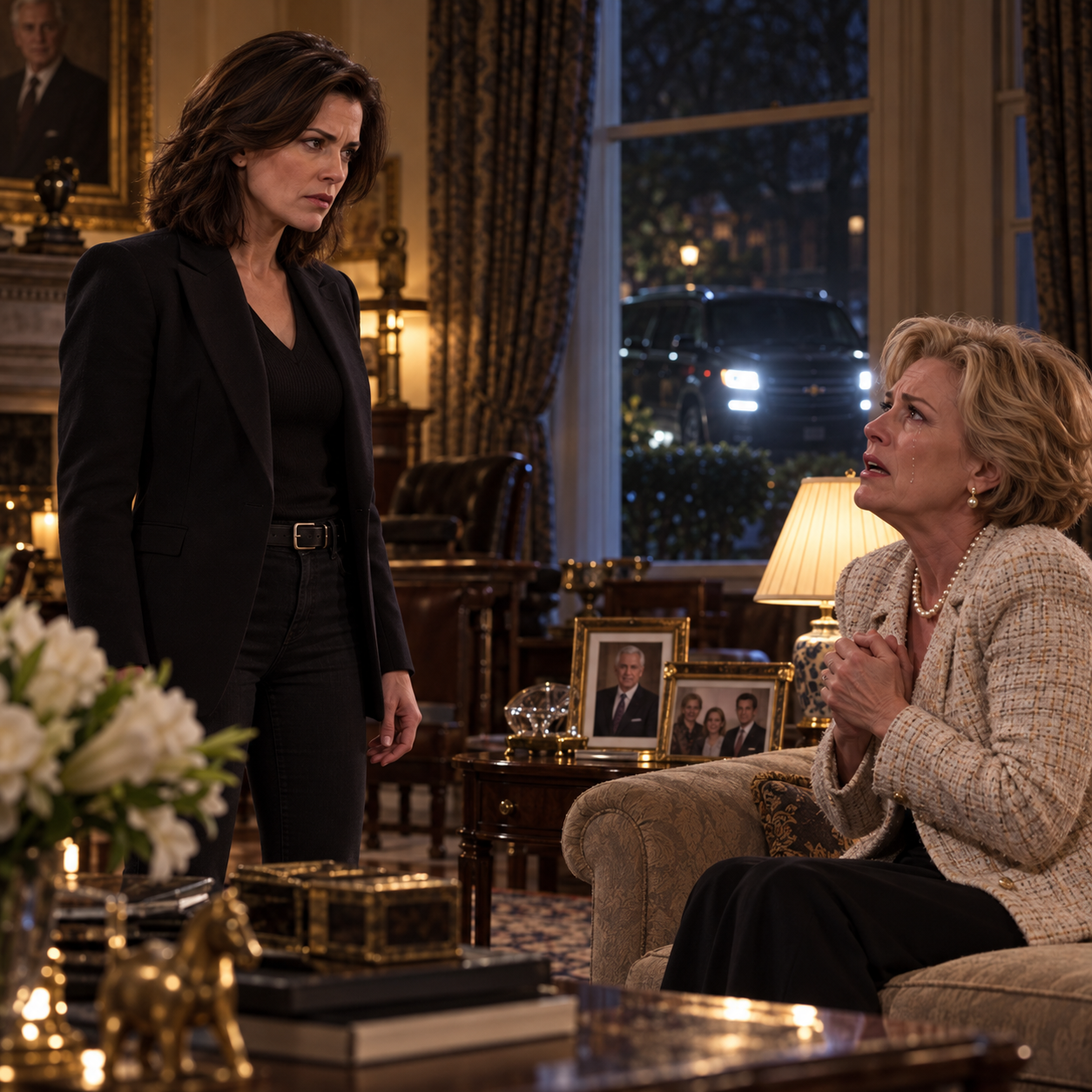
Its engine remained running.
The driver didn’t get out.
My mother gripped my arm.
“He said if I told you anything, he’d make sure neither of us ever saw another day of peace.”
“Who said that?”
She stared toward the vehicle.
“Elias.”
My phone vibrated.
An unknown number.
I answered.
A man’s voice spoke softly.
“Major Cross.”
I didn’t respond.
“I suggest you stop digging into your father’s business.”
“Who is this?”
A faint laugh.
“You already know.”
The call ended.
Across the street, the SUV’s headlights switched off.
And suddenly I understood why my father had been so desperate to transfer the company before he died.
Ryan hadn’t simply tried to steal his inheritance.
He had invited someone dangerous into our family.
Someone who knew how to exploit greed.
Someone who had waited years for another opportunity to reach Cross Meridian’s technology.
And someone who now knew I was closing in.
PART 4 — THE LAST MESSAGE FROM MY FATHER
I didn’t chase the SUV.
Twelve years in the Army had taught me the difference between courage and stupidity.
Instead, I photographed the vehicle from behind the curtains, recorded the time, and called the investigator working with our attorneys.
Then I escorted my mother away from the windows.
She resisted.
“Claire, don’t involve the police.”
“Why?”
“Because he’ll know.”
“He already knows.”
She looked at me with the helplessness of someone who had spent too long obeying the wrong person.
I hated seeing her that way.
I hated even more that a part of me still wanted to protect her.
Despite everything.
Despite the testimony.
Despite the lies.
She was my mother.
And that made the truth harder, not easier.
Thomas arrived forty minutes later with Detective Laura Bennett from the county financial crimes unit.
Bennett was direct, observant, and unimpressed by wealth.
She listened while my mother described the forged will, the midnight meeting, and Elias Voss’s threats.
Then she asked one question.
“Mrs. Cross, did you receive anything in exchange for signing the witness statement?”
My mother’s face crumpled.
I knew the answer before she spoke.
“Ryan paid off my debts.”
“How much?”
“Almost six hundred thousand dollars.”
I turned away.
Six hundred thousand dollars.
That was the price she had accepted for helping my brother destroy my father’s final wishes.
Or perhaps it was only part of the price.
Bennett continued.
“Did you know the statement was false when you signed it?”
My mother nodded.
“Yes.”
The admission seemed to drain whatever strength remained in her body.
Bennett explained that the confession could carry serious legal consequences and that my mother should have independent legal counsel before making further formal statements.
My mother agreed.
Then she asked to speak to me alone.
We stood in Dad’s study.
The room was lined with technical books, old photographs, and awards he had received throughout his career.
On his desk sat a model of the company’s first communications transmitter.
He had built it by hand.
I remembered watching him solder its components when I was a child.
My mother approached the desk.
“Your father left something for you.”
I looked at her.
“What?”
“He told me to give it to you if Ryan ever tried to take the company.”
“Why didn’t you?”
She closed her eyes.
“Because I thought Ryan would stop if he got what he wanted.”
I felt anger flare.
“You watched him accuse me of fraud.”
“I know.”
“You helped him.”
“I know.”
“And you kept something Dad wanted me to have?”
She nodded.
I wanted to shout.
Instead, I waited.
My mother knelt beside the bookshelf and removed a wooden panel beneath the lowest shelf.
Behind it was a small steel compartment.
Inside lay a sealed envelope.
My name was written across the front in my father’s handwriting.
CLAIRE — WHEN THE TRUTH BECOMES DANGEROUS.
My fingers trembled as I opened it.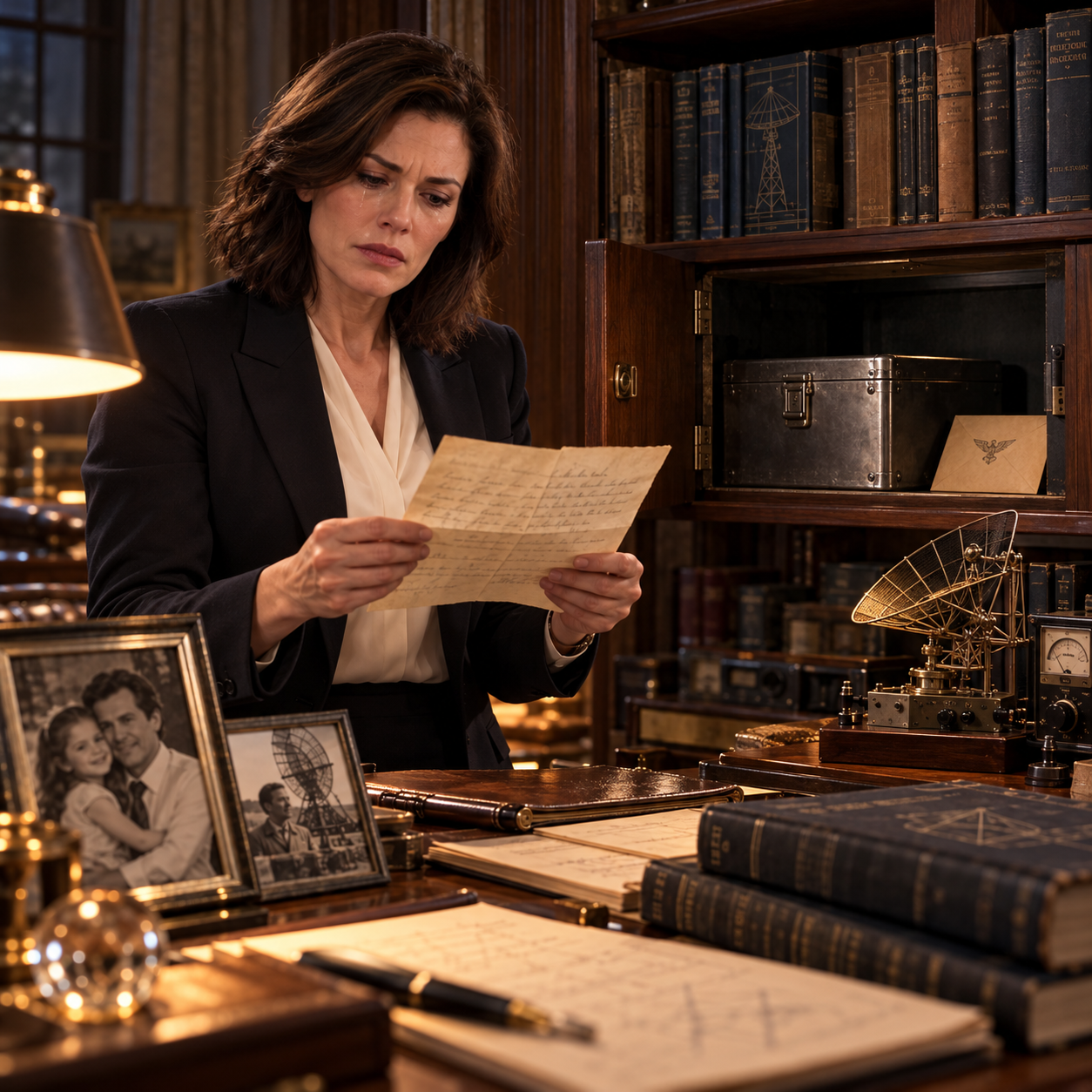
There was a letter.
A small electronic storage device.
And a photograph.
The photograph showed Dad standing beside Ethan and me at Cross Meridian’s research facility.
It had been taken two years before Dad became ill.
On the back, he had written:
The two people who taught me what this company was really for.
I swallowed hard.
Then I unfolded the letter.
My dearest Claire,
If you’re reading this, I failed to stop what I feared was coming.
I spent my life building machines because machines were easier for me to understand than people. A circuit either carried a signal or it didn’t. A component either worked or failed. Human beings were never that simple.
I made mistakes with your brother. I gave him responsibilities he had not earned because I hoped responsibility would teach him discipline. I gave him chances because I feared that withholding them would convince him I didn’t love him.
And I made mistakes with you.
I asked you to be strong so often that I forgot you deserved to be protected, too.
I stopped reading.
The words blurred.
For years, I had carried the belief that my father understood me only when I was useful.
When I could solve a problem.
When I could protect a secret.
When I could endure something difficult without complaining.
Now his handwriting reached across death and touched the part of me I had hidden even from myself.
I continued.
The financial records included with this letter document payments I believe were diverted through companies connected to Ryan and Elias Voss. I have preserved original contracts, internal reports, and correspondence with counsel. Give them to the proper authorities.
I also discovered an attempted transfer of technical design files. I cannot prove who intended to receive them, but the evidence is serious enough that I have notified the appropriate federal security office.
There is something else you must know.
Ryan once told me that you weren’t really a soldier because nobody could find your name in the places he searched. I told him that some people serve without being allowed to explain the details. He laughed.
I asked him to trust me.
He refused.
If he is using your silence against you now, please remember this: you do not owe anyone the destruction of your integrity in exchange for their approval.
Protect the company if you can.
Protect the people who depend on it.
But above all, Claire, protect the woman you are.
You have already given enough.
I am proud of you.
Not because of your medals.
Not because of your rank.
Because you remained kind in a world that repeatedly gave you reasons not to be.
Love, Dad.
I lowered the letter.
For the first time since the trial began, I cried.
Not quietly.
Not carefully.
I cried with the helpless grief of a daughter who had spent too many years trying to be strong enough for everyone.
My mother stood beside the desk.
She reached toward me.
I stepped away.
“Don’t.”
Her hand fell.
“I understand.”
“No,” I said. “I don’t think you do.”
She covered her face.
“I know I don’t deserve your forgiveness.”
I folded the letter.
“Forgiveness isn’t what we’re discussing.”
“Then what?”
“Truth.”
She looked at me.
“You need to tell everything you know. Not just enough to save yourself.”
She nodded.
“I will.”
I wanted to believe her.
But belief was no longer something I could give without evidence.
The next morning, Thomas and I met with federal investigators and Cross Meridian’s independent directors.
The storage device from Dad’s study contained encrypted financial archives and internal correspondence. Investigators created a forensic copy before authorized specialists examined its contents.
Dad had been meticulous.
He had saved supplier invoices.
Board meeting records.
Compliance alerts.
Correspondence with outside counsel.
And a recording of a meeting he had held with Ryan six weeks before his death.
We listened to that recording in a secure conference room.
Dad’s voice sounded weak.
But unmistakable.
“Ryan, these transfers have to stop.”
My brother replied, “You don’t understand how business works anymore.”
“I understand perfectly. You’re paying millions to companies that provide nothing.”
“They provide access.”
“To what?”
Silence.
Then Ryan said something that made every person in the room look up.
“Voss has buyers.”
Dad’s voice became sharper.
“Buyers for what?”
Ryan didn’t answer.
Dad continued.
“Those designs belong to Cross Meridian under government contracts. You cannot sell them.”
“It’s not that simple.”
“It is exactly that simple.”
There was a sound of something striking the desk.
Then Ryan shouted.
“You always choose Claire!”
Dad responded quietly.
“This isn’t about Claire.”
“It is always about Claire!”
The recording ended shortly afterward.
I sat staring at the speaker.
My father had known.
He had confronted Ryan.
And he had been trying to preserve evidence while cancer destroyed his body.
Thomas broke the silence.
“Your father was building a case.”
“Yes.”
“And Ryan knew it.”
“Yes.”
Detective Bennett looked at the files.
“Then we need to understand whether the attempted transfer happened before or after this conversation.”
A federal investigator answered.
“We’re tracing that now.”
Over the following days, the inquiry widened.
The evidence suggested that Blackthorn Strategic Holdings had been used to disguise improper payments, while another network of entities sought access to restricted technical material.
Elias Voss was identified as a central figure.
Ryan had signed several contracts that investigators believed were fraudulent.
The forged will appeared designed to give him control before the company’s compliance team could complete an internal audit.
And my mother had helped authenticate the false document.
But the most alarming discovery came from our engineering division.
A backup system contained evidence of a second attempt to extract restricted design files.
The attempt was scheduled to occur during a maintenance window the following Friday.
Someone inside the company had arranged it.
Someone who still possessed privileged access.
And that person was expected to be present at a board meeting Ryan had called under the disputed corporate authority.
I stared at the security report.
“He hasn’t stopped.”
Thomas looked grim.
“No.”
“Then we’re not just preserving evidence anymore.”
“What are you thinking?”
I looked at the list of scheduled attendees.
Ryan Cross.
Elias Voss.
And an outside systems consultant named Nathan Bell.
Bell’s name appeared in Cross Meridian’s employment records.
He had worked there for three years.
He had passed routine background checks.
He had access to the systems we believed Voss was targeting.
But he had also been one of the engineers my father personally mentored.
I remembered him as quiet.
Hardworking.
The kind of employee who stayed late because he cared about getting things right.
I didn’t want to believe he was involved.
Yet the evidence was pointing toward his credentials.
I asked our security director to examine every access log carefully and to avoid making accusations before the technical investigation was complete.
By Thursday evening, the picture had changed.
Bell’s credentials had been copied.
His access had been used from an unauthorized location.
And someone had planted evidence to make him appear responsible.
The breach was being orchestrated by someone who understood both our network and our personnel.
Voss.
He was trying to steal the files and leave an innocent engineer carrying the blame.
That realization made the situation personal in a different way.
I had seen what happened when an innocent person’s reputation became convenient collateral damage.
I was not going to let it happen again.
The next morning, the board meeting proceeded under observation and with the restricted systems isolated by our security team.
I attended in person.
Thomas sat beside me.
Two independent directors occupied the far end of the table.
Ryan entered ten minutes late.
He looked tired.
But his suit was immaculate.
He smiled when he saw me.
“Claire. Still pretending to run the place?”
I didn’t answer.
Elias Voss entered behind him.
He was older than I remembered.
His hair was thinner.
His expensive watch caught the conference room lights.
But his smile was the same.
Confident.
Amused.
Predatory.
“Major Cross,” he said.
My pulse quickened.
Very few people outside my former unit used that title casually.
“Mr. Voss.”
He extended his hand.
I didn’t take it.
He smiled wider.
“I hear congratulations are in order. Quite a dramatic courtroom performance.”
“My service wasn’t a performance.”
“Of course not.”
Ryan pulled out a chair.
“Can we get started?”
I looked at him.
“Absolutely.”
The meeting began with routine financial questions.
Then Thomas presented the preservation order.
Ryan objected.
The independent directors demanded explanations concerning Blackthorn.
Voss insisted his consulting contracts were legitimate.
For twenty minutes, they maintained their story.
Then our security director entered with an updated report.
The attempted access had been blocked.
The relevant systems were secure.
Investigators had preserved evidence tying unauthorized activity to a device associated with Voss’s consulting operation.
Voss stopped smiling.
Thomas laid the report on the table.
“Mr. Voss, would you like to explain why credentials assigned to a Cross Meridian engineer were used to initiate an unauthorized transfer from your consulting network?”
Voss leaned back.
“I have no idea what you’re talking about.”
“Then I’m sure the investigators will appreciate your cooperation.”
Ryan stood.
“This meeting is over.”
“No,” I said.
He turned toward me.
I stood slowly.
“It’s not.”
The room fell silent.
“You spent months trying to prove I was a fraud,” I told him. “You dragged our mother into court. You used Dad’s illness to justify a forged will. You moved company money into businesses that provided no legitimate value.”
Ryan’s face flushed.
“You can’t prove all of that.”
“Some of it has already been documented. The rest will be decided through the proper proceedings.”
I looked at Voss.
“And whatever you came here hoping to take, you’re not taking it.”
Voss stood.
His chair scraped across the floor.
“You’re making a serious mistake.”
I met his eyes.
“I’ve made plenty.”
He stepped closer.
“But this isn’t one of them.”
For a moment, he stared at me.
Then he reached into his jacket.
I didn’t move.
Neither did Thomas.
Voss removed his phone.
The relief was immediate but brief.
He placed it on the table.
“You’ve destroyed a very profitable opportunity,” he said.
From the doorway, a voice answered.
“That’s an interesting way to describe an alleged theft.”
Detective Bennett entered with two investigators.
Voss turned.
Ryan went pale.
Bennett introduced herself, explained that she had warrants relating to specified records and devices, and directed everyone to remain while the warrants were executed.
Voss looked toward the exit.
An officer stepped into view.
He stopped.
For the first time since I had met him, Elias Voss looked uncertain.
Ryan stared at me.
“You set us up.”
I shook my head.
“No, Ryan.”
I looked at the files spread across the conference table.
“You did this yourselves.”
The investigators began their work.
Voss was escorted out for questioning after the officers discovered additional evidence requiring immediate action.
Ryan’s phone and laptop were seized under the warrants.
He watched the devices disappear into evidence bags.
Then he turned toward me.
His expression changed.
The anger faded.
Something smaller took its place.
Fear.
“Claire,” he whispered, “don’t let them take everything.”
I looked at my brother.
I remembered the boy who used to follow me around the backyard.
The boy who begged me to teach him how to ride a bicycle.
The boy who cried when our dog died.
That boy had once loved me.
Perhaps some part of him still did.
But love could not erase what he had done.
“I didn’t take anything from you,” I said.
“You chose this.”
He lowered his head.
And for the first time in my life, I refused to carry the consequences of his choices.
PART 5 — THE LEGACY WORTH SAVING
Justice did not arrive all at once.
It rarely does.
There was no single dramatic verdict that repaired every injury.
No speech capable of restoring the years my family had stolen from me.
No courtroom revelation that could make my father’s chair less empty.
Instead, the truth emerged through months of hearings, forensic reviews, witness testimony, and evidence that could no longer be dismissed.
The disputed will was eventually declared invalid.
Handwriting analysis, witness statements, medical evidence, and the documents recovered from my father’s study established that the purported revision had not been properly executed by him.
The controlling shares remained with me under his valid estate plan.
Cross Meridian Systems survived.
But survival required change.
I appointed an independent compliance committee.
We replaced senior financial controls that had allowed Ryan to authorize questionable payments.
Outside auditors reviewed years of transactions.
Employees who had reported concerns were given protections.
And the company began cooperating with investigators to ensure that any improperly transferred funds could be recovered where possible.
We also learned that Nathan Bell, the engineer whose credentials had been stolen, had nearly resigned.
He came to my office one afternoon carrying a cardboard box.
“I thought everyone believed I was responsible,” he said.
I looked at him.
“Your credentials were compromised. That doesn’t make you guilty.”
“People were talking.”
“I know.”
He looked toward the door.
“I don’t think I can stay.”
I considered his face.
He reminded me of myself in the courtroom.
Someone judged by appearances while the evidence remained hidden.
“Nathan,” I said, “you deserve to work somewhere that protects you when the facts are uncertain.”
He gave a sad smile.
“I thought Cross Meridian was that place.”
“It should have been.”
I stood.
“And I’m going to make sure it becomes that place again.”
He stayed.
Six months later, he was leading a security improvement project that became one of our most successful internal reforms.
Some victories were measured in contracts.
Others were measured in people who decided they could trust again.
Ryan’s case took longer.
The financial investigations established a substantial pattern of fraudulent transactions and false corporate representations.
He eventually accepted a plea agreement on multiple charges.
The court imposed a prison sentence, financial restitution, and restrictions that ended his ability to control Cross Meridian.
When I attended his sentencing, he wouldn’t look at me.
Not at first.
His attorney spoke about his poor judgment.
His financial pressures.
His desire to prove himself.
The judge listened.
Then she asked Ryan whether he wished to address the court.
He stood slowly.
For the first time, he looked older than me.
“I spent my whole life believing my sister had something I didn’t,” he said.
His voice shook.
“I thought our father loved her more.”
I felt something tighten in my chest.
“I convinced myself that if I took the company, I would finally become the person he wanted me to be.”
He looked toward me.
“But the truth is, he gave me opportunities. I wasted them.”
The courtroom was silent.
Ryan swallowed.
“I hurt people who trusted me. I lied about my sister. I involved my mother. I helped people who were willing to damage the company my father built.”
He paused.
“I’m sorry.”
I wanted to know whether he meant it.
But remorse wasn’t something a person could prove with one speech.
The judge imposed sentence.
Ryan was led away.
He looked back once.
Our eyes met.
I didn’t smile.
I didn’t turn away either.
He had to face what he had done.
And I had to learn that I was allowed to survive it.
My mother’s case was different.
Her cooperation helped establish how the forged will had been created and how false testimony had been prepared.
She admitted that she had knowingly signed an inaccurate witness statement and later repeated false accusations under oath.
She faced legal penalties, financial consequences, and court-supervised conditions connected to her offenses.
But the punishment she spoke about most was losing her relationship with me.
For months, I refused her calls.
Not to hurt her.
Not to make her suffer.
I simply needed distance.
Every time I heard her voice, I remembered standing in that courtroom while she told strangers my injuries weren’t real.
I remembered her laugh when the medals were displayed.
I remembered the smile.
The little smile of victory.
Some wounds cannot be healed by an apology alone.
Then, one afternoon in early spring, I received a letter.
It was handwritten.
The envelope carried no dramatic message.
Just my name.
Inside, my mother had written six pages.
She didn’t ask me to forgive her.
She didn’t blame Ryan.
She didn’t claim she had been confused.
Instead, she described the choices she had made.
How she had favored Ryan since childhood because he seemed to need constant reassurance.
How she mistook my independence for emotional strength that required no protection.
How every time Ryan failed, she rescued him.
And every time I succeeded, she expected me to succeed again without encouragement.
One paragraph stayed with me.
I treated your strength as permission to hurt you. Because you never broke in front of me, I told myself nothing I did could really harm you.
I was wrong.
I read those sentences three times.
Then I folded the letter.
I didn’t answer immediately.
A month later, I invited her to meet me at a quiet café outside town.
She arrived early.
Her hair had gone almost completely gray.
She stood when she saw me.
“Claire.”
“Mom.”
We sat.
For several minutes, neither of us spoke.
Then she looked at my hands.
“I don’t know where to begin.”
“With the truth.”
She nodded.
“I knew you were in the Army.”
Hearing her say it aloud was harder than I expected.
“I knew when you left for training. I knew you deployed. I knew you came home hurt.”
My throat tightened.
“Then why?”
She stared into her coffee.
“Because admitting the truth meant admitting what Ryan had done. And if I admitted that, I had to face what I had allowed him to become.”
I watched her.
“You chose his comfort over my life.”
Tears filled her eyes.
“Yes.”
No excuse.
No argument.
Just the answer.
It didn’t erase anything.
But it was the first honest answer she had given me in a very long time.
“I can’t promise we’ll ever have the relationship we had before,” I said.
“I know.”
“And I won’t pretend this never happened.”
“I don’t expect you to.”
I took a breath.
“But I don’t want to spend the rest of my life hating you.”
She began crying.
This time, I didn’t move away when she reached across the table.
I let her touch my hand.
It wasn’t forgiveness.
Not yet.
But it was a beginning.
And beginnings, I had learned, could be valuable even when they were small.
The following summer, Cross Meridian held a ceremony at its original manufacturing facility.
We were opening a new research and training center dedicated to emergency communications technology.
The facility would support disaster-response equipment, rescue coordination tools, and engineering scholarships for veterans transitioning into civilian careers.
I had named it the Alexander Cross Center.
After my father.
Ethan attended.
He wore civilian clothes this time.
His limp was slightly worse, but his smile was unchanged.
He found me standing beside a display of our first transmitter.
“You actually did it,” he said.
“Did what?”
“Saved the company.”
I shook my head.
“A lot of people saved it.”
“That’s what good leaders usually say.”
I smiled.
“You’re getting sentimental.”
“Age.”
We walked through the facility together.
Young engineers demonstrated prototypes.
Veterans talked with students.
Employees who had endured the investigation stood beside families who knew little about what had happened behind the scenes.
I watched them.
The people my father had asked me to protect.
Ethan stopped beside a wall displaying photographs from Cross Meridian’s history.
One image showed my father standing outside the original workshop.
Another showed the first engineering team.
At the center was a photograph of Dad shaking hands with emergency responders after a major natural disaster.
Ethan studied it.
“He understood something most contractors don’t.”
“What?”
“That the technology isn’t the mission.”
I looked at him.
“The people are.”
He nodded.
For a moment, neither of us spoke.
Then he reached into his jacket.
“I brought something.”
He handed me a small envelope.
Inside was a photograph.
It had been taken years earlier, during a quiet moment before Operation Iron Lantern.
Ethan and I stood beside our team.
Everyone was smiling.
Everyone looked tired.
I recognized faces I had not seen in years.
Faces that still visited my dreams.
One of the men in the photograph had not come home.
I touched the edge of the image.
“Where did you get this?”
“An approved copy was released with the historical materials. I thought you should have it.”
I looked at him.
“Thank you.”
He nodded.
Then he said softly, “You know, there was a time I thought you weren’t going to make it.”
I looked down.
“So did I.”
“When we pulled you out, you kept asking about the others.”
I remembered.
Barely.
Fragments of pain.
Voices.
Someone telling me to stay awake.
Ethan continued.
“You never asked whether anyone would know what you’d done.”
I smiled sadly.
“I was a little busy trying not to die.”
He laughed.
Then his expression softened.
“That’s why what happened in that courtroom bothered me so much. They tried to turn your service into something it was never meant to be.”
“A way to win a family argument?”
“Yes.”
I looked at the photograph again.
“Maybe the most important thing is that it doesn’t belong to them anymore.”
Ethan nodded.
“It never did.”
Later that afternoon, I stepped onto the stage.
The room was full.
Employees.
Families.
Veterans.
Community leaders.
Engineers who had worked beside my father for decades.
My mother sat near the back.
I had invited her.
Not because everything was repaired.
But because healing, when it happened, would have to begin with honesty.
She watched quietly.
I approached the microphone.
For a moment, I thought about the last time I had stood in front of so many people.
The courtroom.
The accusations.
The medals held up like evidence of dishonesty.
My mother’s voice declaring that I had never served.
Then I looked at the faces before me.
And I understood how far I had come.
“My father founded Cross Meridian Systems with an idea,” I began.
“He believed communication could save lives. Not as a slogan. Not as a marketing strategy. But as a responsibility.”
I paused.
“He wasn’t a perfect man. He missed birthdays. He worked too late. He sometimes expected more from the people he loved than he knew how to give.”
A few people smiled.
“But when it mattered most, he understood that a company’s value isn’t measured only by its contracts or its revenue.”
I looked toward the engineers.
“It’s measured by what happens when someone depends on the work we do.”
The room fell quiet.
“There was a period when I believed protecting this company meant defending everything my father had built, exactly as he left it.”
I took a breath.
“I was wrong.”
Several people looked up.
“Protecting a legacy doesn’t mean refusing to change it. It means preserving the values worth keeping and having the courage to correct the failures.”
I thought of Ryan.
Of my mother.
Of the money that had disappeared.
Of Nathan Bell.
Of the employees who had been afraid to speak.
And of my father, writing his final letter with hands weakened by illness.
“Today, we’re committing to a different kind of strength. A company where people are accountable. Where employees can raise concerns without fear. Where innovation serves people rather than greed.”
I glanced at Ethan.
“And where service is respected, whether or not the people who served can tell every part of their stories.”
He lowered his head.
I continued.
“My father once told me that the most important signal is the one that reaches someone when all the others have failed.”
I smiled through sudden tears.
“I hope this center becomes that signal.”
The applause began quietly.
Then grew.
People stood.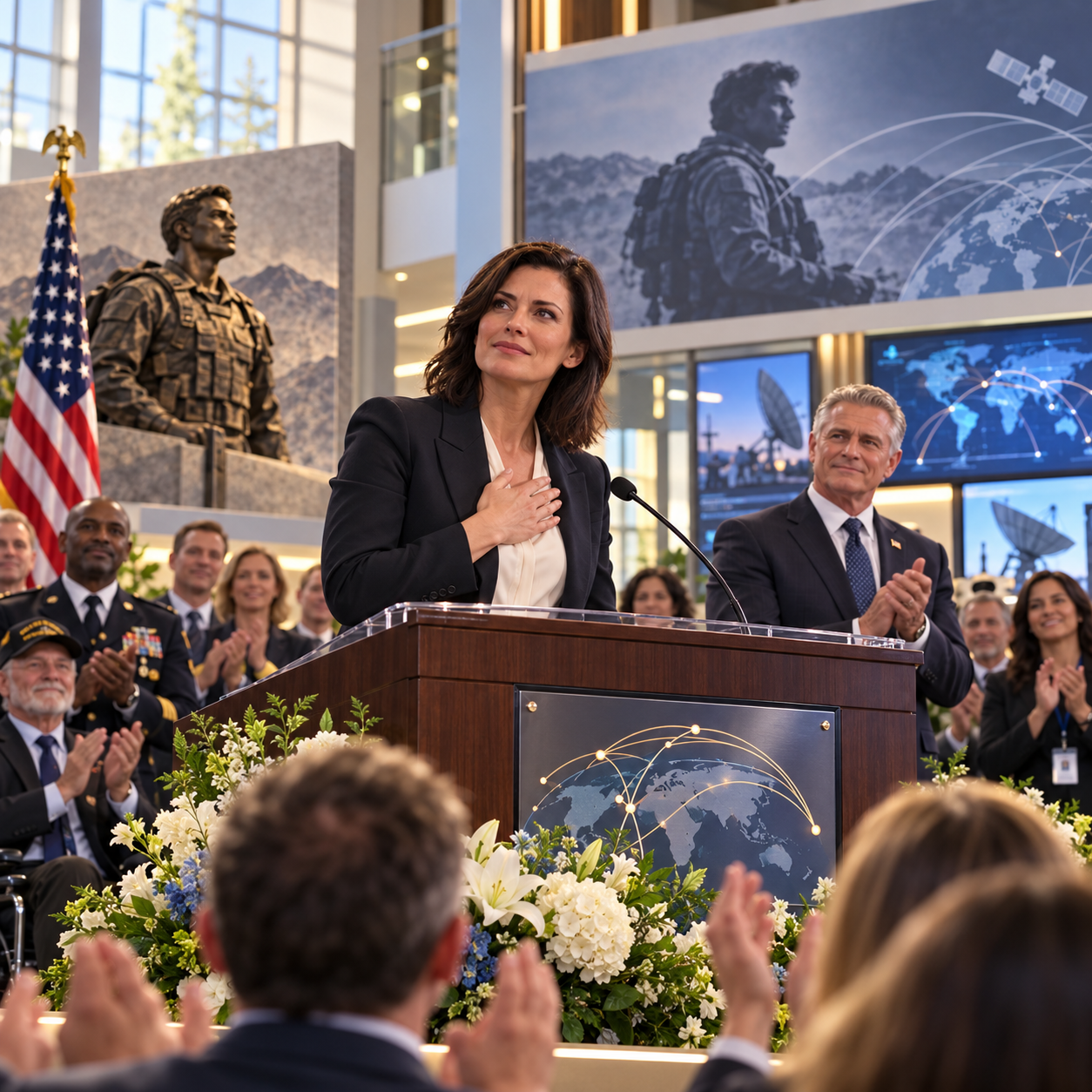
I saw engineers wiping their eyes.
Veterans exchanging glances.
Employees who had almost lost their jobs applauding beside colleagues who had helped protect them.
And near the back of the room, my mother stood.
She was crying.
But this time, she wasn’t performing for a courtroom.
She wasn’t trying to convince anyone of anything.
She was simply watching her daughter.
When the ceremony ended, I stepped outside.
The afternoon sun was warm.
A breeze moved through the trees along the parking lot.
For the first time in months, I felt no urgency to check my phone.
No need to watch a clock.
No expectation that some new betrayal was waiting around the corner.
I walked toward a bench overlooking the grounds.
Then I sat.
From my bag, I removed my father’s letter.
I had carried it with me for months.
The paper was beginning to soften along the folds.
I opened it to the final page.
You have already given enough.
I read the sentence again.
Then I looked toward the building.
For most of my life, I had believed strength meant enduring whatever was asked of me.
Being the responsible daughter.
The reliable officer.
The person who could absorb another disappointment without showing the damage.
But I was beginning to understand something different.
Strength could mean telling the truth.
It could mean setting boundaries.
It could mean refusing to rescue someone from the consequences of their own choices.
And sometimes, it could mean allowing yourself to be happy.
A voice interrupted my thoughts.
“Mind if I sit?”
I looked up.
Ethan stood beside the bench, holding two paper cups of coffee.
I smiled.
“Depends.”
“On what?”
“Whether you remembered I don’t take sugar.”
He handed me a cup.
“Some things are impossible to forget.”
I took it.
He sat beside me.
For a while, we watched the sun move across the trees.
Then Ethan reached into his pocket and removed a small brass object.
I recognized it immediately.
My father’s compass.
I stared at him.
“Where did you get that?”
“Your mother gave it to me before the ceremony. She said your father wanted you to have it, but she wasn’t sure you’d accept it from her.”
I took the compass.
The brass was scratched.
The glass had a small chip near the edge.
Dad had carried it for years.
When I was little, he used to place it in my hand and tell me that knowing where you were mattered less than knowing which direction you intended to go.
I opened it.
Inside the lid, someone had engraved a message.
CLAIRE — TRUST YOUR TRUE NORTH. LOVE, DAD.
I pressed my thumb against the words.
Ethan looked away, giving me privacy.
After a moment, I asked, “Do you think people can really change?”
He considered the question.
“Some can.”
“And the ones who can’t?”
“We can still stop letting them decide who we become.”
I looked at him.
“You rehearsed that.”
He grinned.
“A little.”
I laughed.
A real laugh.
The kind that came without effort.
Then I leaned back.
“I’m thinking about taking a vacation.”
Ethan looked astonished.
“Claire Cross? Voluntarily leaving work?”
“Don’t sound so shocked.”
“Should I alert someone?”
I nudged his shoulder.
He laughed.
“Where would you go?”
I thought about it.
For years, every destination had been attached to a mission, an assignment, a family obligation, or a problem that needed solving.
I wanted somewhere quiet.
Somewhere with mountains.
A place where the days didn’t begin with an alarm.
“Maybe Montana,” I said.
Ethan smiled.
“I know a place.”
“Of course you do.”
“Good fishing. Terrible cell reception.”
“That sounds perfect.”
We sat together as the afternoon slowly turned golden.
And for the first time in years, the future didn’t feel like something I had to defend.
It felt like something I was allowed to choose.
Three months later, I received a letter from Ryan.
He had begun serving his sentence.
His handwriting was uneven.
The letter contained no demands.
No excuses.
He wrote about the father we had both misunderstood in different ways.
About the years he had spent measuring his worth against mine.
About the shame he felt when he finally understood how much damage he had caused.
Near the end, he wrote:
I used to think Dad trusted you because you were his favorite.
Now I know he trusted you because you understood that being given power meant being responsible for other people.
I wanted the power without the responsibility.
I was wrong.
I read the letter twice.
Then I placed it in a drawer.
I didn’t respond that day.
But I didn’t throw it away.
Perhaps one day we would speak again.
Perhaps we would find a relationship different from the one we had destroyed.
Or perhaps the healthiest ending would be one in which we learned to live honestly at a distance.
I no longer needed to know.
Not every future required an immediate answer.
The following spring, I traveled to a military cemetery where one of my former teammates was buried.
Captain Samuel Hayes.
Sam had been part of Operation Iron Lantern.
He had been thirty-two years old.
He loved terrible jokes, old country songs, and photographs of his two little daughters.
He had never met his youngest child.
I stood before his headstone holding the photograph Ethan had given me.
For years, I had struggled with the knowledge that I survived a mission he did not.
Sometimes, when people praised my courage, all I could remember was his empty seat on the aircraft.
I knelt beside the stone.
“Hey, Sam.”
The wind moved gently through the grass.
I smiled sadly.
“You’d hate all the attention.”
I placed a small flag beside his grave.
“And you’d probably tell me to stop being so serious.”
I looked at his name.
For the first time, I allowed myself to say something I had resisted for years.
“I think I’m going to be okay.”
The words sounded strange.
But true.
Behind me, footsteps approached.
Ethan stopped a respectful distance away.
I stood.
He looked at the headstone.
Then at me.
“Ready?”
I took one last look at Sam’s name.
“Yes.”
We walked together toward the parking lot.
Beyond the cemetery, the world continued.
Traffic moved.
Birds circled above the trees.
Families lived ordinary lives made possible, in ways they might never know, by people whose names would not appear in history books.
I thought about the courtroom again.
The clock.
The accusations.
My brother’s smile.
My mother’s testimony.
For thirteen minutes, it had seemed as though my entire life depended on whether the truth could arrive in time.
But I understood something now that I hadn’t understood then.
The truth hadn’t begun at noon.
It had existed long before anyone in that courtroom was willing to acknowledge it.
It existed in the records.
In the scars.
In the people who had served beside me.
In the promises I had kept.
And in the sacrifices no document could ever fully explain.
At noon, the world had simply been allowed to see a small part of it.
My mother once stood before a judge and swore I had never served.
My brother tried to use that lie to take everything my father had built.
They believed that if they controlled the story, they controlled me.
They were wrong.
Because a person’s honor does not begin when others recognize it.
And it does not disappear when others deny it.
I was Claire Cross.
A daughter.
A sister.
A soldier.
A survivor.
And, at last, a woman no longer living for the approval of people who had refused to see her.
I had spent years waiting for permission to tell my story.
Now I was finally free to live the rest of it.
And that was the victory I had wanted all along.
THE END.