MY MOTHER SWORE UNDER OATH THAT I FAKED MY MILITARY SERVICE—BUT SHE DIDN’T KNOW MY CLASSIFIED RECORDS WOULD BE RELEASED IN THIRTEEN MINUTES
PART 1: THE THIRTEEN-MINUTE COUNTDOWN
I sat motionless in a courtroom while my own mother testified that I had never served a single day in the United States Army.
She looked directly at the judge and called me a liar.
She claimed the scars hidden beneath my blouse were fake, that I had purchased my military decorations online, and that twelve years of service had been nothing more than an elaborate fiction.
The jury seemed convinced.
Reporters wrote down every accusation.
My younger brother smiled across the aisle, already imagining himself in control of our father’s multimillion-dollar defense company.
What none of them understood was that I wasn’t remaining silent because I had no defense.
I was watching the clock.
Because the evidence that could destroy every lie told about me was classified.
And in thirteen minutes, that was about to change.
My name is Claire Cross.
And I learned that betrayal sounds most convincing when it comes from someone whose love you once believed was unconditional.
The courtroom carried the stale smell of aging wood, overheated coffee, and paper that had spent too many years inside filing cabinets.
Fluorescent lights buzzed above our heads.
Every time an attorney opened another folder, a faint cloud of dust rose from the pages.
Behind me, a reporter’s pen scratched steadily across a notebook.
He was recording every word my mother spoke.
Every accusation.
Every carefully delivered falsehood.
And my mother, Evelyn Cross, was making certain there would be plenty to write.
“My daughter was never in the Army,” she told the court.
Her voice was remarkably calm.
“She invented the entire story. The injuries, the medals, the deployments. None of it happened.”
A wave of murmurs moved through the spectators.
I remained seated at the defense table.
My hands were folded neatly in front of me.
I kept my eyes on the witness stand.
Beside me, my attorney shifted closer.
“Claire,” he whispered, “whatever you do, don’t react.”
“I wasn’t planning to.”
He glanced at my face.
My composure clearly unsettled him.
“Somehow,” he murmured, “that makes me more nervous.”
Across the aisle, my younger brother Ryan lowered his head.
But not quickly enough to hide the smile spreading across his face.
He thought he had already won.
And from the way the courtroom was responding, I could understand why.
The entire nightmare had begun with Cross Meridian Systems.
My father’s company.
He had built it from almost nothing.
Thirty years earlier, he had rented a small industrial unit, filled it with secondhand equipment, and started developing technology for defense applications.
There had been years when he worked through the night.
Years when family dinners were interrupted by urgent phone calls.
Years when the company survived only because he refused to let it fail.
Eventually, Cross Meridian grew into a respected defense technology business.
Its contracts became larger.
Its security requirements became stricter.
And the responsibilities attached to its work extended far beyond ordinary corporate management.
My father understood those responsibilities.
Ryan never seemed to.
As Dad’s health deteriorated, he began preparing for what would happen after his death.
Cancer had taken his strength slowly.
By the final months, even holding a glass of water exhausted him.
But his mind remained sharp during the moments when the medication allowed him to think clearly.
He transferred the controlling shares of Cross Meridian Systems to me.
He also appointed me executor of his estate.
It wasn’t a decision he made lightly.
He knew exactly what he was placing in my hands.
The company.
Its security obligations.
The livelihoods of its employees.
And a secret that I had promised him I would never reveal.
Three days after we buried him, Ryan appeared with a different will.
According to that document, Dad had supposedly changed his mind and left everything to my brother.
The company.
The controlling interest.
The estate.
All of it.
I challenged the document.
I expected the dispute to focus on signatures, dates, witnesses, and corporate records.
Instead, Ryan chose another strategy.
He went after my military service.
He accused me of inventing the very career that had shaped my adult life.
Stolen valor.
Fraud.
Forgery.
Falsified federal documents.
He claimed I had spent twelve years constructing a false identity to make myself appear trustworthy enough to inherit our father’s company.
It was a vicious accusation.
But it was also carefully calculated.
Ryan knew that much of my military record couldn’t be obtained through ordinary channels.
He knew that the work I had done remained protected.
And he knew I had made a promise to Dad that prevented me from revealing certain details.
So he built his case around information I couldn’t publicly discuss.
He treated my silence as evidence that I had something to hide.
And then he convinced our mother to testify against me.
I had expected Ryan to fight dirty.
I had known him long enough to understand how far he might go when money and power were involved.
But I had never imagined my own mother would sit under oath and deny that I had ever served my country.
Yet there she was.
Perfectly dressed.
Calm.
Composed.
Speaking as though she were merely correcting an unfortunate misunderstanding.
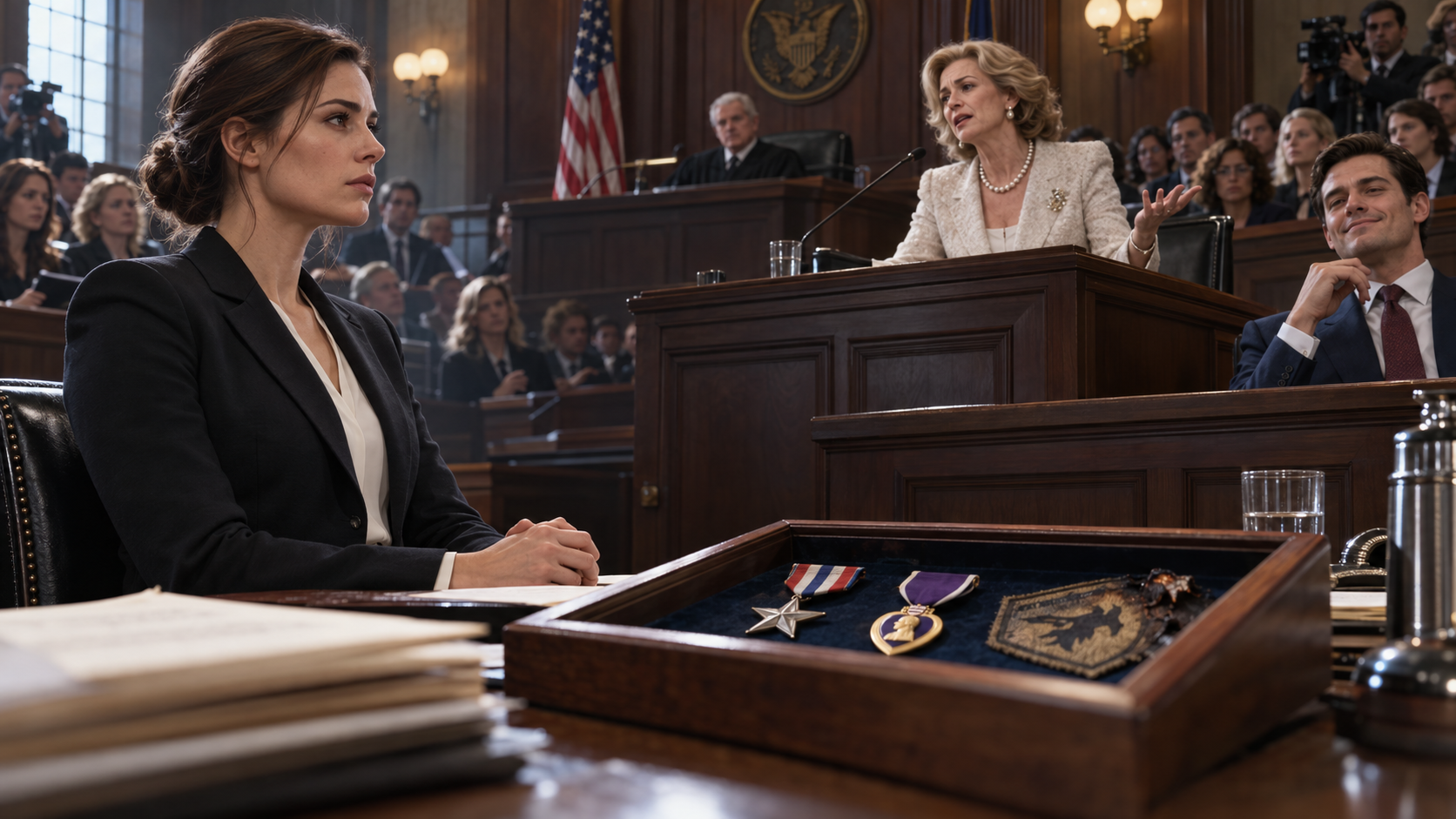
The prosecutor approached the evidence table.
He picked up a wooden shadow box and turned it toward the jury.
Inside were three things that meant more to me than anyone in that courtroom could possibly understand.
My Silver Star.
My Purple Heart.
And a scorched unit patch I had brought home from an operation that had nearly ended my life.
The patch was damaged along one edge.
Its fabric had been blackened by heat.
I remembered exactly how it had happened.
I remembered the smoke.
The screaming metal.
The blood.
And the men who hadn’t all returned the same way they had left.
The prosecutor held the box where everyone could see it.
My mother looked at the decorations.
Then she gave a small, dismissive laugh.
“She bought those on the internet.”
The words struck harder than I expected.
Not because I believed her.
Not because I doubted what I had earned.
But because I had once been a little girl who thought her mother would always defend her.
Now that same woman was using the most painful parts of my life to help destroy my credibility.
The jury reacted immediately.
One juror leaned forward to examine the medals, then looked at me with open disgust.
Another shifted backward in his chair, as though my supposed dishonesty had somehow contaminated the room.
A reporter stopped writing and stared.
Ryan’s attorney adjusted a perfectly straight stack of documents, clearly pleased with the effect.
In their version of the story, the medals were no longer symbols of sacrifice.
They were props.
Evidence of a carefully manufactured lie.
I watched the prosecutor hold the shadow box against his chest.
The judge’s hand rested beside his notes.
A ceiling vent switched on overhead.
The corner of a loose document fluttered against the evidence cart.
For a moment, the entire courtroom seemed suspended in silence.
Every eye was on me.
Then the scar beneath my blouse tightened.
It ran along my ribs, a permanent reminder of a day I could never fully forget.
And without warning, the courtroom disappeared from my mind.
I was back inside the smoke.
The helicopter blades were roaring.
Metal burned against my shoulder.
Blood soaked through my uniform.
The air tasted of fuel, dust, and fire.
I could hear gunfire striking the ground nearby.
And Major Ethan Walker was pulling me through the wreckage, dragging me away from the flames while rounds tore into the earth behind us.
I remembered trying to move.
I remembered the pain.
I remembered believing, for one terrible moment, that I would never make it home.
Then Ethan’s voice cut through the chaos.
He refused to leave me there.
That memory was real.
The scars were real.
The medals were real.
And the twelve years my mother had just erased with a few sentences were real.
But the documents that could prove it were still classified.
My personnel files were sealed because the mission remained protected.
My deployment history couldn’t be released through a standard records request.
Neither could the award citations.
The evacuation report.
The witness statements.
The official accounts of what had happened.
Those records existed.
But they were not available to the court.
At least, not yet.
Ryan understood that limitation.
He had spent months exploiting it.
He knew that if he demanded public evidence I wasn’t authorized to provide, my refusal could be presented as dishonesty.
He knew reporters would repeat the accusations.
He knew jurors might interpret missing records as proof that no records existed.
And he knew our mother’s testimony would make the story even more convincing.
A mother denying her own daughter’s military service.
What could appear more credible to strangers?
That was the cruelty of his plan.
He didn’t need to prove that my life was fabricated.
He only needed to persuade enough people that my inability to discuss it meant I had invented everything.
Family betrayal rarely begins with one enormous lie.
It grows through repetition.
One person makes an accusation.
Another supports it.
A third chooses not to question it.
Eventually, the accusation becomes familiar enough that people mistake familiarity for truth.
Ryan had built an entire legal strategy around that principle.
But there was another reason he wanted control of Cross Meridian.
A reason Dad had discovered before he died.
During one of his final lucid afternoons, I had been sitting beside his hospital bed.
His skin was pale.
His hand felt almost weightless in mine.
He had barely spoken all morning.
Then he opened his eyes and asked me to come closer.
“Claire,” he whispered, “there’s something wrong inside the company.”
I leaned toward him.
“What do you mean?”
His fingers tightened weakly around mine.
“They’re moving money through shell companies.”
I stared at him.
He took a shallow breath.
“Protect Cross Meridian.”
“I will, Dad.”
His eyes searched mine.
“But don’t expose your unit.”
The warning was unmistakable.
He knew the responsibilities attached to my service.
He understood that some truths couldn’t simply be revealed because a family dispute had become ugly.
I held his hand.
“I promise.”
He seemed to relax slightly.
And I kept that promise.
Even when Ryan produced the suspicious will.
Even when he accused me of fraud.
Even when our mother agreed to support his allegations.
I refused to disclose information I wasn’t authorized to reveal.
Because my father had entrusted me with two responsibilities.
Protect the company.
And protect the people whose work still depended on secrecy.
I wasn’t going to betray either obligation merely to win an argument in court.
Back in the courtroom, my father’s attorney approached the witness stand.
He looked directly at my mother.
“Mrs. Cross, did your daughter ever deploy overseas?”
“No.”
The answer came without hesitation.
“Did Claire Cross ever serve in the United States Army?”
“Never.”
I felt my fingers press together.
The attorney continued.
“Did you ever receive military correspondence addressed to your daughter?”
My mother paused.
Only briefly.
Just long enough to make it appear that she was searching her memory carefully.
Then she shook her head.
“No.”
I looked at her.
She turned toward me.
For the first time during her testimony, our eyes met.
And I saw a faint smile appear at the corner of her mouth.
It wasn’t uncertainty.
It wasn’t regret.
It was satisfaction.
She believed her words had finished me.
I wanted to stand.
I wanted to ask her how a mother could look at her daughter’s injuries and call them imaginary.
I wanted to pull aside my blouse and show the courtroom what fire, shrapnel, and twisted metal had done to my body.
I wanted to tell the jury about the nights I woke unable to breathe because my mind had returned to that burning wreckage.
I wanted them to know about Ethan Walker.
About the men who had risked everything.
About the people who had never come home.
But I remained seated.
I had learned long ago that anger could make a person reckless.
Discipline meant recognizing when silence was necessary.
And more importantly, recognizing the exact moment when silence was no longer required.
I slowly raised my eyes toward the clock above the judge’s bench.
11:47 a.m.
The second hand moved steadily.
My attorney noticed where I was looking.
He leaned closer.
“Claire,” he whispered, “what are you waiting for?”
I kept watching the clock.
“Authorization.”
He frowned.
“Authorization for what?”
The second hand continued its slow movement.
I could hear its faint ticking beneath the murmur of the courtroom.
Then, for the first time that morning, I smiled.
“In thirteen minutes,” I whispered, “classified becomes declassified.”
My attorney stared at me.
Across the aisle, Ryan had been watching our exchange.
His satisfied expression began to change.
Only slightly.
The smile disappeared.
His eyes narrowed.
He didn’t look frightened yet.
But for the first time since the trial began, he seemed uncertain.
I returned my attention to the clock.
The truth was still sealed.
The official records were still beyond the reach of ordinary legal requests.
And the people who could establish what had really happened during those twelve years had not yet entered the courtroom.
But they were already on their way.
Then a sudden metallic rattle broke the silence.
Someone had grasped the handle of the courtroom doors from the other side.
And as the doors began to move, I knew the thirteen minutes that would change everything had finally begun.
PART 2: THE MAN WHO WALKED OUT OF THE FIRE
The courtroom doors opened just wide enough for a uniformed court security officer to enter.
Behind him stood a woman in a charcoal suit, carrying a sealed leather document case.
She was tall, silver-haired, and possessed the unnerving stillness of someone accustomed to entering rooms where every word mattered.
I recognized her immediately.
Colonel Margaret Voss.
Army Judge Advocate General’s Corps.
For nearly eighteen months, she had been overseeing the legal review of records connected to an operation whose existence had never been publicly acknowledged.
She did not look toward me.
Instead, she approached the clerk, handed him an envelope, and spoke quietly.
The clerk examined the government seal.
Then he carried it to the bench.
Judge Harold Whitmore adjusted his glasses.
“Counsel,” he said, “we have received a communication from the Department of Defense.”
Ryan’s attorney, Thomas Grayson, stood.
“Your Honor, I object to the introduction of undisclosed materials at this stage.”
The judge hadn’t even opened the envelope.
“Mr. Grayson, you cannot object to something you haven’t seen.”
“I object to the timing.”
“Then you’re welcome to object again when we know what it is.”
A few spectators shifted in their seats.
My attorney, Daniel Mercer, looked at me.
“You knew someone was coming.”
“Yes.”
“How long?”
“Since yesterday afternoon.”
“And you didn’t tell me?”
“I told you there was a pending federal authorization.”
“You neglected to mention that authorization would arrive in person.”
I glanced toward Colonel Voss.
“I didn’t know who they would send.”
Daniel gave me the expression of a man reconsidering every assumption he had made about his client.
The judge opened the envelope.
His eyes moved across the first page.
Then the second.
When he reached the third, he stopped.
“Colonel Voss,” he said, “is this an authenticated communication?”
“Yes, Your Honor. Its release conditions are specified in the accompanying memorandum. I request a brief recess so that the court can verify its scope before any information is disclosed publicly.”
Grayson rose again.
“This appears to be an attempt to introduce sensational military material into a straightforward probate dispute.”
Colonel Voss turned toward him.
“Mr. Grayson, no military material has been introduced.”
Her voice was controlled, almost gentle.
“But I strongly recommend that you wait until the review is complete before deciding whether it is sensational.”
I had to lower my eyes to hide the beginning of a smile.
Judge Whitmore ordered a fifteen-minute recess.
But Colonel Voss approached the bench and quietly explained that the court needed to wait for a predetermined release time.
The judge consulted the clock.
11:49.
“Very well,” he said. “We will resume at noon.”
The gavel fell.
Around us, conversations erupted.
Reporters hurried toward the hallway.
Ryan’s attorney spoke urgently into his phone.
My mother stepped down from the witness stand and approached Ryan.
“What was that?” she demanded.
Ryan’s jaw tightened.
“Nothing important.”
“Then why did the judge stop everything?”
“Because Claire is staging another performance.”
He said it loudly enough for me to hear.
I stood slowly.
Ryan watched me approach.
For most of our lives, he had been comfortable treating me as an older sister who could be mocked, manipulated, or dismissed.
But he had never seen me in a place where my silence carried consequences.
“Ryan,” I said, “you should call your lawyer.”
He laughed.
“He’s standing right there.”
“Your criminal lawyer.”
The laughter disappeared.
My mother stepped between us.
“Enough, Claire. You’ve embarrassed this family long enough.”
I looked at her.
There was a time when hearing those words would have broken something inside me.
At seventeen, I had abandoned a college scholarship ceremony because she told me my acceptance into a military academy made the family look unfeminine and ridiculous.
At twenty-three, I had returned from training and found that she had turned my bedroom into Ryan’s private study.
At thirty, after months of rehabilitation, I had come home with a cane.
She had looked at it and asked whether I really needed to be so dramatic.
Every injury had been inconvenient to her.
Every achievement had been an insult to Ryan.
Every absence had been proof that I didn’t care enough.
I had spent years believing that if I explained myself more clearly, loved her more patiently, or succeeded more quietly, she might finally understand.
Now, standing in that courthouse, I recognized the truth.
She had understood far more than she ever admitted.
She had simply chosen which child mattered.
“I’m not the one who embarrassed this family,” I said.
Her expression hardened.
“You always were your father’s favorite.”
I studied her for a moment.
“No, Mom. I was the child he trusted with things that frightened him.”
Ryan stepped forward.
“You think you’re so special because Dad handed you some shares? You weren’t even here. I worked at that company while you disappeared for years.”
“You were paid a senior executive salary.”
“I earned it.”
“Then you shouldn’t have any trouble explaining where fourteen million dollars went.”
He stopped moving.
It lasted less than a second.
But I saw it.
The way his shoulders stiffened.
The quick movement of his eyes toward Grayson.
My mother saw it too.
“What fourteen million?”
Ryan turned on her.
“Don’t listen to her.”
I hadn’t intended to reveal that figure.
It was a calculation from the preliminary forensic review, not yet a final finding.
But Ryan’s reaction confirmed something I had suspected.
He already knew the amount.
Daniel touched my elbow.
“Claire. We need to talk.”
He guided me toward an empty conference room.
Once the door closed, his carefully maintained professionalism gave way.
“Tell me everything you legally can.”
I sat opposite him.
“Six months before Dad died, he discovered irregular payments to three subcontractors. The companies appeared legitimate, but their ownership records led to intermediaries connected to Ryan.”
“Why didn’t your father go to the authorities?”
“He did.”
Daniel leaned forward.
“He did?”
“He contacted the company’s security director and requested a preliminary internal review. When the transactions appeared to touch protected defense contracts, the matter was referred to the appropriate federal investigators.”
“And the investigation is active?”
“Yes.”
“Does Ryan know?”
“He suspects. That’s why he needed ownership transferred before the audit became public.”
Daniel rubbed his forehead.
“And your military records?”
“They’re part of a separate review. Certain portions are being released today. Enough to establish my service, awards, and relevant duties without identifying active personnel or compromising protected methods.”
“Why noon?”
“Because the final review and notification period ends at noon. Colonel Voss cannot disclose those records a minute earlier.”
He stared at me.
“You’ve been sitting through this knowing you could prove your innocence.”
“Knowing I might be authorized to prove it. The decision was confirmed yesterday. I couldn’t guarantee it before then.”
Daniel sat back.
For the first time since we met, he seemed genuinely angry.
Not at me.
At what had been done to me.
“I’ve spent twenty-six years practicing law,” he said. “I’ve seen siblings steal from each other. I’ve seen spouses invent accusations. I’ve seen parents manipulate wills.”
He shook his head.
“But I’ve never watched a mother erase her daughter’s life under oath.”
I looked toward the window.
Outside, a cold wind bent the branches of a leafless tree.
“She wasn’t always like that.”
Daniel remained quiet.
That was a kindness.
Because I knew I was lying to myself.
My mother had always favored Ryan.
The difference was that I had once mistaken endurance for love.
A knock sounded.
Colonel Voss entered.
“Captain Cross.”
I stood automatically.
“Colonel.”
She studied me with an expression that softened almost imperceptibly.
“How are you holding up?”
“Better than my attorney.”
Daniel gave an exhausted laugh.
Voss placed the leather case on the table.
“The releasable records have been authenticated. We have confirmation from the reviewing authority. The court can examine the originals, and certified copies are ready for admission.”
She hesitated.
“There is something else.”
I watched her.
“General Reeves requested that you be informed personally.”
My heart began beating faster.
“About what?”
“The remains-identification process is complete.”
For a moment, I couldn’t understand the words.
Then I did.
“Daniel Price?”
Voss nodded.
The room seemed to shift beneath my feet.
Staff Sergeant Daniel Price.
Thirty-two years old.
Father of two daughters.
The man who had kept our helicopter’s communications functioning after the first explosion.
The man who had handed me his spare radio battery because mine was damaged.
The man who had joked that I owed him coffee when we got home.
He had been listed as missing following the operation.
Not presumed to have survived.
Not confirmed dead.
For years, his family had existed in the unbearable space between hope and grief.
I closed my eyes.
“His wife?”
“She was notified this morning.”
“His daughters?”
“They’re with her.”
I gripped the edge of the table.
The medals in the courtroom had become the center of a spectacle.
But Daniel Price’s family had lived with the consequences of that operation every day.
And that was why secrecy mattered.
Not because classified information was glamorous.
Not because it made me important.
But because real people could be hurt when sensitive facts were handled carelessly.
Colonel Voss waited until I could speak.
“Thank you for telling me.”
She nodded.
“There’s one more person you should know is here.”
The door behind her opened.
And Major Ethan Walker stepped inside.
Except he wasn’t a major anymore.
The insignia on his uniform identified him as a colonel.
His dark hair had acquired silver along the temples.
A narrow scar crossed his jaw.
But his eyes were exactly as I remembered.
Steady.
Watchful.
And far too familiar with the cost of survival.
“Hello, Claire.”
For eight years, I had replayed the sound of his voice over helicopter blades.
For eight years, I had remembered him dragging me through burning wreckage.
For eight years, I had carried the knowledge that I was alive because he had refused to leave me.
I tried to answer.
Nothing came out.
Ethan crossed the room.
Then he did something neither of us had planned.
He embraced me.
Not ceremonially.
Not as an officer greeting another officer.
As a friend who had spent years wondering whether the person standing before him would ever truly come home.
“You’re late,” I whispered against his shoulder.
He smiled.
“Traffic.”
And for the first time since my father died, I laughed without feeling guilty.
Then the courthouse bell began striking noon.
Ethan released me.
Colonel Voss picked up the document case.
“It’s time.”
PART 3: WHEN THE TRUTH ENTERED THE COURTROOM
At exactly twelve o’clock, Judge Whitmore returned to the bench.
Every seat in the courtroom was occupied.
Reporters who had previously treated the proceedings as a sensational family inheritance dispute now sat with their phones silenced and their notebooks open.
My mother had returned to the witness stand.
Ryan sat beside Grayson, tapping one finger against the polished table.
He stopped when Colonel Voss entered.
Behind her came Ethan Walker.
Then two uniformed Army officers.
One carried a sealed evidence portfolio.
The other took a position near the rear wall.
There was nothing theatrical about their entrance.
No announcement.
No dramatic salute.
No attempt to intimidate the court.
They simply entered with the quiet confidence of people carrying information they had been entrusted to protect.
Judge Whitmore addressed the room.
“The court has reviewed a Department of Defense certification authorizing disclosure of specified previously classified records. The release became effective at twelve hundred hours today.”
He paused.
“These documents concern the military service of Captain Claire Elizabeth Cross.”
My mother’s expression changed.
Ryan’s finger stopped tapping.
Judge Whitmore continued.
“The court has verified the authentication process and will hear testimony regarding their contents. Information that remains classified will not be disclosed.”
Grayson stood.
“Your Honor, we maintain our objection to the late introduction of these records.”
Daniel rose.
“The allegations concerning my client’s military service were introduced by the petitioner. These records directly rebut those allegations, and we notified opposing counsel of the pending authorization as soon as we were permitted to do so.”
The judge nodded.
“Objection overruled, subject to the usual evidentiary limitations.”
Colonel Voss approached the witness stand.
After taking the oath, she identified herself and explained her role in the authentication process.
Daniel handed her the first document.
“Colonel, can you identify this?”
“Yes. It is a certified military service record for Claire Elizabeth Cross.”
“Does that record establish that she served in the United States Army?”
“It does.”
“For how long?”
“Twelve years of active military service, followed by a period of reserve affiliation.”
A murmur passed through the courtroom.
Daniel waited.
“Does the record indicate that Captain Cross served overseas?”
“Yes.”
“On more than one occasion?”
“Yes.”
“Can you establish whether the decorations presented earlier in this proceeding were legitimately awarded?”
Colonel Voss opened the second folder.
“I can.”
She read from the authenticated award record.
“Captain Claire Elizabeth Cross was awarded the Purple Heart for wounds received during hostile action.”
My mother lowered her eyes.
Voss continued.
“She was also awarded the Silver Star for gallantry in action during an operation whose broad circumstances are now authorized for limited public disclosure.”
Daniel turned toward the jury.
“Colonel, to be absolutely clear, did Captain Cross purchase those decorations online?”
“No.”
“Did she forge the citations?”
“No.”
“Was her military career fabricated?”
“No.”
“And were her deployment records previously unavailable through ordinary public requests because they contained classified information?”
“Yes.”
Daniel paused.
Then he asked the question that had waited beneath every accusation for months.
“Colonel, did the absence of publicly accessible records mean Captain Cross had never served?”
“Absolutely not.”
My mother gripped the witness stand.
The sound of a pen falling onto the floor seemed extraordinarily loud.
Ryan whispered something to Grayson.
His attorney didn’t respond.
Daniel returned to his table.
Then he picked up the scorched patch.
“Colonel, is this item authentic?”
Voss examined it carefully.
“Yes. It was recovered with Captain Cross’s personal effects following the operation.”
“Can you explain what happened to it?”
Her expression grew solemn.
“The fabric sustained heat damage during the destruction of a military aircraft.”
Daniel nodded.
“No further questions at this time.”
For a moment, no one spoke.
Then Grayson approached the witness stand.
His voice remained professionally controlled, although his face had lost much of its earlier confidence.
“Colonel Voss, isn’t it possible that a service record could contain inaccuracies?”
“An individual record can contain errors.”
“So your certification is not proof of every event described?”
“It certifies the records identified in the release. Their validity has been verified against multiple independent official sources.”
“And you cannot disclose the complete operational history?”
“Correct.”
“So portions remain secret.”
“Yes.”
Grayson turned toward the jury.
“Then there are still things this court doesn’t know.”
Colonel Voss looked directly at him.
“Of course there are.”
He paused.
She continued.
“There are also things this court has no lawful reason to know. Protecting classified information does not make a person’s documented service fictional.”
A few jurors exchanged glances.
Grayson returned to his table.
He had no further questions.
Then Daniel stood.
“Your Honor, we call Colonel Ethan Walker.”
My chest tightened.
Ethan walked to the witness stand and took the oath.
He sat with his shoulders straight and his hands resting naturally on the rail.
Daniel approached him.
“Colonel Walker, how do you know Claire Cross?”
“I served with her.”
“For how long?”
“Approximately seven years in overlapping assignments and operations.”
“Were you present when she sustained the injuries documented in her Purple Heart citation?”
“Yes.”
“Please tell the court what you witnessed, within the limits of the authorized release.”
Ethan looked toward me.
For an instant, the courtroom vanished from his expression.
I knew where he had gone.
Back to the desert.
Back to the smoke.
Back to the day when neither of us had expected to survive.
“Our team was conducting an evacuation in a hostile area,” he began. “An aircraft carrying personnel came under fire during the extraction. It was severely damaged and made a forced landing.”
He paused.
“Several people were injured. Fuel ignited near the wreckage. Communications were degraded. We were taking intermittent fire.”
Daniel kept his voice gentle.
“What did Captain Cross do?”
“She organized the movement of wounded personnel away from the aircraft.”
“Was she injured at that point?”
“Yes.”
“How seriously?”
“She had sustained penetrating injuries to her side and shoulder. There were also burns and significant blood loss.”
A juror brought a hand to her mouth.
Ethan continued.
“She refused evacuation while others remained exposed.”
“Did she understand the danger?”
“Completely.”
“Why did she stay?”
Ethan looked toward the jury.
“Because there were people who couldn’t move on their own.”
He described how I had returned toward the damaged aircraft.
How I had helped carry an injured communications specialist.
How I had directed others toward a safer position despite losing strength.
He did not exaggerate.
He did not turn the operation into a glorious adventure.
His words were restrained.
That made them more powerful.
“Eventually,” he said, “a secondary explosion struck the wreckage. Captain Cross was thrown against a section of damaged fuselage.”
Daniel glanced at me.
“And then?”
“I found her unconscious.”
“What did you do?”
“I carried her out.”
“Under fire?”
“Yes.”
“Why?”
Ethan’s answer came without hesitation.
“Because she would have done the same for me.”
My throat tightened.
Daniel allowed the silence to settle.
“Colonel Walker, the petitioner has suggested that Captain Cross manufactured the scars she carries. Are you able to address that allegation?”
Ethan’s expression hardened.
“I watched a military surgeon remove fragments of metal from her body. I visited her during rehabilitation. I saw her learn to walk without assistance again.”
He turned toward Ryan.
Then toward my mother.
“There is nothing manufactured about those injuries.”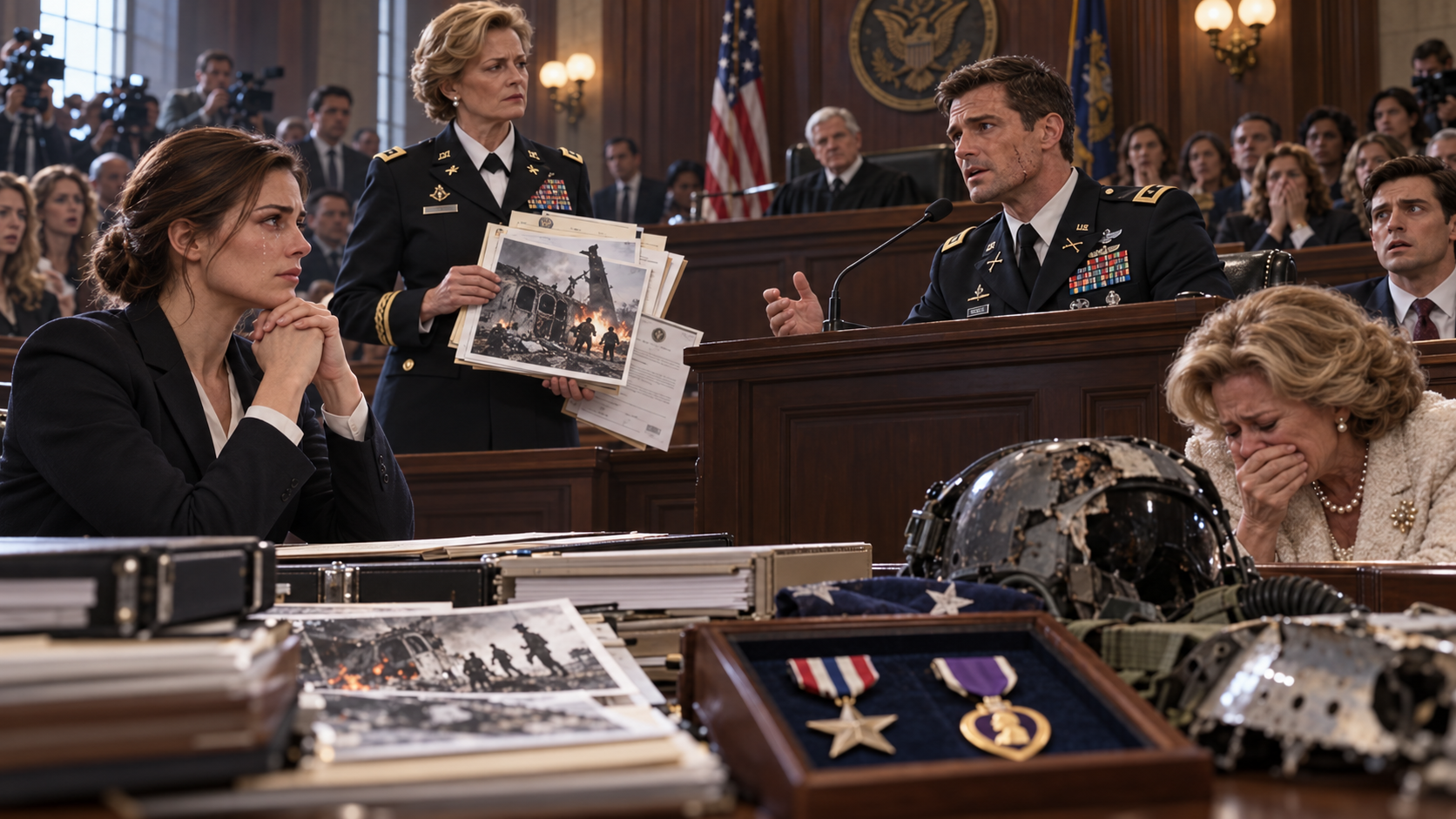
My mother began crying.
Not loudly.
Not dramatically.
Just enough for the jury to notice.
Once, I would have rushed to comfort her.
This time, I stayed where I was.
Daniel moved to his final question.
“Colonel Walker, based on your personal experience, how would you characterize Captain Cross’s service?”
Ethan looked straight at me.
“Honorable. Courageous. And repeatedly performed at considerable personal cost.”
His voice changed slightly.
Then he added, “There are soldiers whose courage you read about in official citations. And there are soldiers whose courage you remember because you were alive to witness it. Claire Cross is both.”
I lowered my eyes.
My hands were trembling.
For years, I had feared that speaking about my military service would endanger others.
Now, hearing Ethan speak within the authorized boundaries, I felt something I hadn’t expected.
Relief.
Not because strangers finally believed me.
But because I no longer had to carry every memory alone.
When Ethan stepped down, Daniel requested permission to introduce another document.
It was a letter.
Handwritten.
Dated eleven years earlier.
Addressed to Evelyn and Robert Cross.
The return address identified an Army medical facility.
Daniel approached my mother.
“Mrs. Cross, do you recognize this envelope?”
She stared at it.
“No.”
He presented a photograph.
“Do you recognize the handwriting?”
“No.”
“Are you aware that this letter was delivered to your home and signed for?”
“I don’t remember.”
Daniel placed the delivery confirmation beside the envelope.
“Is that your signature?”
She leaned forward.
Her face went pale.
“I suppose it could be.”
“You testified that you never received military correspondence addressed to your daughter.”
“I don’t remember this particular letter.”
Daniel opened it.
Inside was a photocopy of a note I had written during rehabilitation.
My hands had been too weak to hold a pen comfortably.
The writing tilted across the page.
Mom, I’m alive. The doctors say I’m improving. I can’t tell you where I’ve been, but I hope you’ll come when visitors are allowed. I miss home.
There was a long silence.
Daniel held up the second page.
“Mrs. Cross, attached to this correspondence is a visitor authorization form bearing your name.”
She gripped the rail.
“Robert handled those matters.”
“Did you visit your daughter at the hospital?”
“No.”
“Did you know she had been injured?”
“I knew she claimed she was injured.”
“Did you tell her father that you believed she was lying?”
My mother’s lips parted.
She looked toward Ryan.
He was staring down at the table.
“Mrs. Cross,” Daniel said, “please answer.”
“Yes.”
The admission seemed to drain the room of air.
I remembered waiting beside a hospital window.
Every morning, a nurse had asked whether I expected family visitors.
Every morning, I had said perhaps tomorrow.
Dad eventually came.
He sat beside me for six hours and cried when he thought I was asleep.
Mom never did.
For years, she told people the Army wouldn’t let her visit.
Now the truth was sitting in an evidence folder.
She had been invited.
She had simply chosen not to come.
Daniel placed the letter down.
“One final question. When you testified earlier that your daughter had never served, did you believe that statement was true?”
My mother began to answer.
Then stopped.
Her eyes moved toward Ryan again.
“Ryan said the records weren’t real.”
Daniel waited.
“Was that your answer?”
She swallowed.
“I believed my son.”
“And you disregarded the documents, the correspondence, and your daughter’s injuries?”
Tears rolled down her cheeks.
“I didn’t know what to believe.”
Daniel’s voice remained steady.
“Then why did you swear that you knew?”
She had no answer.
Judge Whitmore instructed the clerk to preserve the testimony and referred the apparent inconsistencies for review by the appropriate authorities.
The proceedings had not yet determined criminal liability.
But the significance was unmistakable.
My mother had been confronted with evidence directly contradicting her sworn statements.
Ryan leaned toward his attorney.
Whatever he whispered caused Grayson to turn sharply toward him.
“Is there something else you haven’t told me?” the attorney demanded quietly.
Ryan didn’t answer.
And that was when the next envelope arrived.
It wasn’t carried by a soldier.
It was delivered by a federal investigator.
The man approached the bench, identified himself, and handed the judge a sealed notice concerning a separate investigation into Cross Meridian Systems.
The judge read it carefully.
Then he looked at Ryan.
“Mr. Cross,” he said, “I strongly advise you to consult your counsel before making any further statements.”
Ryan stood.
“What is this?”
The judge’s expression did not change.
“Sit down, Mr. Cross.”
But Ryan remained standing.
Because he finally understood what my father had discovered.
The accusations against me had never been the real story.
They were only a way to keep the court from looking at what he had done.
And now the court was looking.
PART 4: THE SECRET MY FATHER TOOK TO HIS GRAVE
For the first time in my life, I saw Ryan genuinely afraid.
Not irritated.
Not offended.
Not angry because someone had challenged his authority.
Afraid.
His face had turned a sickly shade of gray.
He kept glancing toward the doors, as though measuring the distance between his chair and the nearest exit.
Grayson whispered urgently to him.
Ryan shook his head.
Then he said something that made his attorney close his eyes.
I couldn’t hear the words.
But Daniel could.
He leaned toward me.
“Your brother just asked whether the investigators found the offshore accounts.”
I looked at him.
“Then they have.”
The federal investigator was Special Agent Marcus Hale, assigned to a joint financial investigation involving defense-contract payments and suspected corporate fraud.
He had been working with the company’s independent security and compliance personnel for months.
I knew his name.
I had never met him in person.
That separation had been deliberate.
My role was to preserve the company records I lawfully controlled, maintain the integrity of my father’s estate, and avoid interfering with the investigation.
I wasn’t an investigator.
I had no authority to conduct searches.
And my military service did not give me power over a civilian probate proceeding.
But I did have something Ryan had underestimated.
A father who had kept meticulous records.
The hearing resumed after a conference among the attorneys and the judge.
Special Agent Hale’s notice did not magically prove Ryan guilty, nor did it allow confidential investigative materials to become public evidence without proper procedures.
Instead, it confirmed that relevant corporate records were subject to preservation and that a federal investigation was underway.
Daniel requested permission to proceed with the evidence already obtained through the estate’s forensic accounting review.
Judge Whitmore agreed.
“Mr. Mercer,” he said, “I remind you that this court is deciding the validity of estate instruments and the ownership interests at issue. We are not conducting a criminal trial.”
“Understood, Your Honor.”
Daniel called his next witness.
Rebecca Shaw.
She had been Cross Meridian’s chief financial controller for nearly nine years.
I remembered her as a quiet woman who wore sensible shoes, kept peppermint candy in her desk, and could identify a missing invoice from six months earlier without looking at a computer.
My father had trusted her.
Ryan had fired her eleven days before Dad died.
At the time, he said she was incompetent.
Now she walked into the courtroom carrying a carefully organized binder.
After taking the oath, Rebecca described a series of payments made to vendors whose services could not be independently verified.
The first payments were small.
Then they increased.
Consulting fees.
Technical development charges.
Emergency procurement expenses.
Several were approved directly by Ryan.
Others carried electronic authorizations that appeared to belong to my father.
Daniel presented an exhibit.
“Ms. Shaw, was Robert Cross capable of approving these transactions on the dates shown?”
Rebecca examined the pages.
“No.”
“Why not?”
“Some were approved while he was hospitalized and unable to access company systems. Others were dated after his death.”
The jury reacted.
Ryan leaned toward Grayson.
His attorney said nothing.
Daniel continued.
“Did you raise concerns about these transactions?”
“Yes.”
“With whom?”
“Ryan Cross.”
“What happened?”
“He told me that I misunderstood the accounting arrangements.”
“And then?”
“He terminated my employment.”
Rebecca’s voice faltered.
“I had worked for Robert for nearly a decade. He was a good man. When I told him about the irregularities, he was very ill, but he understood enough to ask me to preserve every record I could.”
My chest tightened.
She looked toward me.
“He said Claire would know what to do.”
I pressed my lips together.
Dad had left behind more than money.
He had left people who still believed in the company he built.
Daniel placed another exhibit before Rebecca.
“Do you recognize this transaction?”
“Yes.”
“What is unusual about it?”
“The vendor was paid for specialized equipment that our inventory department never received.”
“How much?”
“Three million, eight hundred thousand dollars.”
“And who approved that payment?”
“Ryan Cross.”
Daniel turned another page.
“Did your review find other payments?”
“Yes.”
“How many?”
“Enough that our preliminary estimate exceeded fourteen million dollars.”
Ryan suddenly stood.
“She’s lying!”
The judge struck his gavel.
“Mr. Cross, sit down.”
“She was fired for stealing!”
Rebecca looked at him.
Her expression did not change.
“Then why did you offer me two hundred thousand dollars to sign a confidentiality agreement, Ryan?”
Silence.
Daniel turned sharply toward her.
“Ms. Shaw, do you have documentation of that offer?”
“Yes.”
She opened the binder.
An email.
A proposed agreement.
A handwritten note from a meeting.
All preserved.
Ryan dropped back into his chair.
I looked toward my mother.
She was staring at him with an expression I had never seen before.
For years, she had interpreted every questionable decision Ryan made as proof of his ambition.
Every unexplained expense was a business investment.
Every argument with Dad was evidence that Robert didn’t appreciate his son.
Every warning from me was jealousy.
Now those explanations were collapsing.
But the most painful revelation hadn’t arrived.
Daniel called the estate’s document examiner.
The examiner explained the differences between my father’s authenticated signatures and those appearing on the supposed revised will.
There were irregular pen pressures.
Uncharacteristic letter formations.
And evidence that several sections of the document had been printed using equipment and formatting inconsistent with its stated preparation date.
More importantly, the purported witnesses could not corroborate the signing ceremony.
One had been outside the country on the relevant date.
The other acknowledged signing a separate document without seeing my father.
Grayson objected repeatedly.
Some objections were sustained.
Others were overruled.
But the evidence continued accumulating.
The revised will was becoming increasingly difficult to defend.
During a short recess, Ryan approached me in the hallway.
Two courthouse officers stood nearby.
His tie was loosened.
His eyes were bloodshot.
“Claire,” he said quietly, “we need to talk.”
Daniel immediately stepped closer.
“Any discussion about the case goes through counsel.”
Ryan ignored him.
“Please.”
I studied my brother.
There was a memory of him at nine years old, standing beside me in our backyard.
He had fallen from a tree and broken his arm.
I had carried him toward the house while he screamed that he was dying.
For months afterward, he followed me everywhere.
He called me his hero.
I wondered when that little boy had disappeared.
“Say what you need to say,” I told him.
He looked around.
“Not here.”
“Then you can tell your lawyer.”
His eyes filled with something that might have been panic.
“They’re going to take everything.”
“Who?”
“The government. The creditors. Everyone.”
“If you’ve done nothing wrong, cooperate with the investigation.”
He gave a bitter laugh.
“You sound just like Dad.”
“That used to be a compliment.”
He stepped closer.
“You don’t understand. I had investors. People who expected returns. I thought I could cover the losses before anyone noticed.”
“What losses?”
His gaze dropped.
“I made some bad decisions.”
“Fourteen million dollars isn’t a bad decision, Ryan.”
He swallowed.
“It didn’t start that way.”
I waited.
He rubbed both hands across his face.
“There was an outside venture. I was told we could expand into private technology markets. We needed startup capital, and Dad wouldn’t approve it.”
“So you took company money.”
“I borrowed it.”
“Without authorization.”
“I planned to pay it back.”
“And when Dad found out?”
Ryan looked away.
For several seconds, he didn’t speak.
Then he whispered, “He said he was going to remove me.”
I felt the cold settle in my stomach.
“From the company?”
“From management. From the board. Everything.”
He shook his head.
“He told me I needed help. He said I was making choices that could destroy people’s lives.”
“That sounds like him.”
Ryan looked at me suddenly.
“You’ve always been so perfect.”
“No.”
“You got the medals. The respect. The responsibilities. Even when you weren’t here, he talked about you as though you were the only person capable of doing anything right.”
I felt anger rise.
“Ryan, Dad spent years trying to teach you the business.”
“He never trusted me!”
“He gave you opportunities you weren’t qualified for because he hoped you’d grow into them.”
The words hit him.
His face twisted.
“You think you’re better than me.”
“I think you hurt people because you couldn’t bear being told no.”
For a moment, he looked as though he might strike me.
Then his anger disappeared.
“Please, Claire.”
His voice broke.
“If I lose the company, they’ll come after me.”
I looked into his eyes.
“Who will?”
He hesitated.
Then he whispered a name.
“Victor Sloane.”
I knew the name.
Victor Sloane was a private investor who had repeatedly attempted to purchase minority interests in defense technology firms.
My father had refused to work with him.
Not because he disliked competition.
Because Sloane had a reputation for disguising ownership and pressuring struggling companies into unfavorable deals.
“Did Sloane receive any restricted technical information?” I asked.
Ryan’s silence answered before he spoke.
“I don’t know.”
I stepped backward.
“Ryan.”
“I didn’t hand him classified material.”
“That wasn’t my question.”
“He asked for financial projections. Contract schedules. Supplier data. I thought it was normal due diligence.”
“Did you give him access to internal systems?”
He looked toward the courthouse doors.
“Ryan.”
“I gave his people temporary credentials.”
I felt my heartbeat slow into the unnerving steadiness that came before danger.
“Did you tell the investigators?”
“No.”
“Then you need to tell them immediately.”
He grabbed my arm.
“Claire, please. You’re still connected to the military. You know people. You can make this go away.”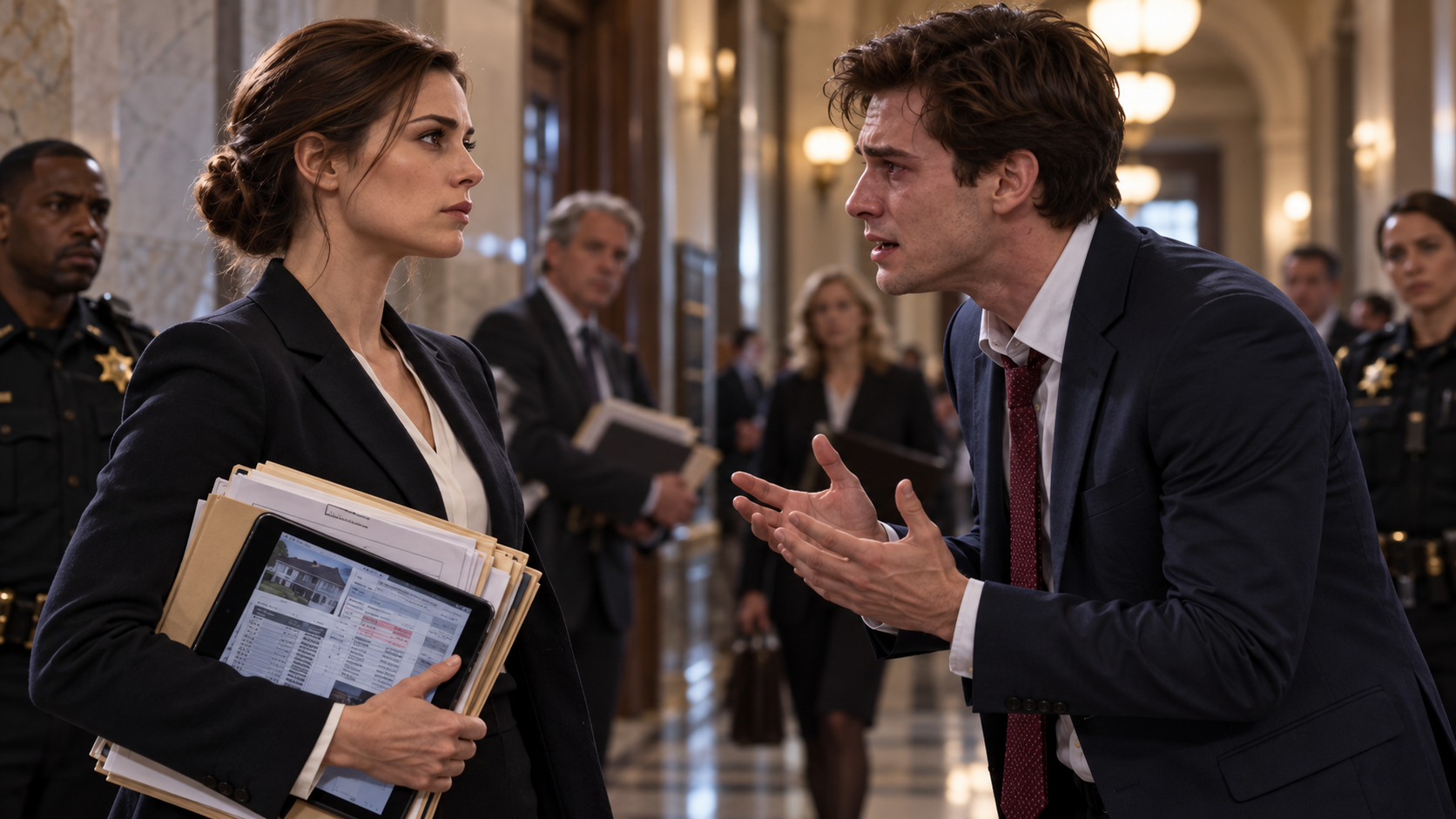
I pulled free.
“No.”
His expression hardened.
“You owe me.”
I stared at him.
“For what?”
“For Dad loving you more.”
There it was.
The wound he had carried for years.
And the justification he had built around it.
I stepped closer.
“Dad loved us both. He trusted us differently because we made different choices. You were not punished for being less loved, Ryan. You’re facing consequences for what you did.”
He looked at me with open hatred.
“You’ll regret this.”
“Maybe,” I said. “But I won’t regret telling the truth.”
Daniel guided me away.
As we entered the courtroom, my phone vibrated.
A message from Rebecca Shaw.
Claire, there is something you need to see before the hearing ends. It concerns your father’s final night.
My hand went cold.
I turned toward her.
She was standing near the rear entrance.
Her expression frightened me more than anything Ryan had said.
Because she looked like someone carrying a secret she had waited too long to reveal.
During the next recess, Rebecca showed us a copy of a digital access log recovered from the company’s archive.
It recorded a remote login to my father’s secure executive account at 2:14 a.m. on the night he died.
The login originated from a device assigned to Ryan.
Seventeen minutes later, a document titled Final Estate Instructions had been accessed.
A separate file had been copied.
Rebecca looked at me.
“There’s more.”
She opened a photograph.
It showed my father in his hospital bed.
Ryan stood beside him.
The timestamp was 2:38 a.m.
My father appeared unconscious.
A pen rested near his hand.
I looked at the date.
The same date listed on the revised will.
“Where did this come from?” Daniel asked.
“A backup from the hospital’s visitor documentation system. The photograph was attached to an internal complaint.”
“What complaint?”
Rebecca swallowed.
“A nurse reported that Ryan was asking staff to witness documents while Robert was heavily sedated.”
I stared at the photograph.
For months, I had imagined Ryan forging a signature in an office.
Now I understood something worse.
He had gone to Dad’s hospital room.
He had stood beside a dying man.
And he had tried to turn the final hours of his father’s life into an opportunity.
Daniel contacted the relevant parties to authenticate the hospital records and request permission to reopen the evidence on the will.
The court reconvened later that afternoon.
The nurse, Andrea Mitchell, was available to testify remotely.
She described entering the room and finding Ryan holding a document near my father’s hand.
“He asked whether I could sign as a witness,” she said.
“What did you observe about Mr. Cross’s condition?”
“He was sedated. He did not appear capable of understanding or signing legal documents at that time.”
“Did you sign?”
“No.”
“What happened afterward?”
“Mr. Ryan Cross became angry. He told me I was interfering in a family matter.”
Daniel asked whether she had documented the incident.
“Yes.”
“And did you notify hospital administration?”
“Yes.”
The testimony was devastating.
Not because it established every element of a criminal offense.
But because it destroyed the credibility of the revised will’s alleged execution.
Judge Whitmore announced that the document’s validity was now subject to overwhelming contradiction, and that the court would consider the full record before issuing its final ruling.
Ryan sat absolutely still.
My mother watched him.
Then, unexpectedly, she began speaking.
“Ryan.”
He didn’t turn.
“Ryan, tell me you didn’t do that.”
He stared ahead.
“Tell me you didn’t use your father that way.”
His lips moved.
“You told me we deserved the company.”
The words struck her visibly.
“I never told you to forge his signature.”
Ryan turned.
“You said Claire didn’t deserve anything!”
The courtroom fell silent.
My mother looked toward the judge.
Then toward me.
Her face crumpled.
“I wanted Ryan to have a chance.”
I felt my stomach turn.
A chance.
That was what she called it.
Not inheritance fraud.
Not dishonesty.
Not the deliberate destruction of my reputation.
A chance.
And then Ryan said something that made every person in the courtroom freeze.
“You helped me write the first draft, Mom.”
Her mouth opened.
No words came.
Grayson shot to his feet.
“Your Honor, I request an immediate recess so my client can consult counsel.”
Judge Whitmore granted it.
The courtroom erupted.
My mother collapsed into her chair.
Ryan was escorted into a private consultation room.
And I stood motionless, realizing that the betrayal had reached further than I had allowed myself to imagine.
They had not merely believed the worst about me.
They had planned to use it.
Together.
PART 5: THE INHERITANCE THAT WAS NEVER ABOUT MONEY
The court’s final ruling came three weeks later.
Those twenty-one days were among the longest of my life.
The media had transformed the hearing into a national story.
Headlines that had once called me a possible military impostor now described the release of my service records.
Some reporters apologized.
Others quietly edited their earlier articles.
A few tried to turn the reversal into entertainment.
They wanted interviews about my decorations.
They wanted photographs of my scars.
They wanted details about operations I still couldn’t discuss.
I declined.
My service was not a spectacle.
Neither was my father’s death.
While the reporters pursued headlines, the legal proceedings continued.
The authenticated records supported my military service and awards.
The forensic evidence undermined the supposed revised will.
The hospital documentation contradicted the claim that Dad had voluntarily signed new estate instructions.
And Rebecca’s financial records raised serious questions about Ryan’s management of company funds.
The Department of Justice separately confirmed that federal investigators were examining suspected financial misconduct and possible unauthorized disclosure of sensitive corporate information.
The investigation remained ongoing.
No one was entitled to assume that every accusation was proven simply because it had been made.
But Ryan’s attempt to take control of the company through the revised will was collapsing.
He resigned from his executive position.
The board suspended his access to corporate systems.
Independent auditors and security personnel reviewed the company’s records.
Victor Sloane’s relationship with Cross Meridian was terminated.
And the company’s employees were informed that operations would continue under independent oversight while the investigation proceeded.
On the morning of the final ruling, I arrived at the courthouse alone.
Ethan had offered to accompany me.
Daniel had suggested I bring someone for emotional support.
But I needed those last few minutes to myself.
I stood outside beneath a pale winter sky.
Traffic moved along the street.
A delivery driver unloaded boxes across the road.
Someone laughed at a nearby bus stop.
The world continued with an indifference I found strangely comforting.
My entire family had been falling apart.
And still, people needed coffee.
Buses ran late.
Children went to school.
Life didn’t stop for grief.
It simply asked you to keep moving through it.
Inside the courtroom, Judge Whitmore delivered his findings.
The purported revised will was rejected.
The court found that the document had not been validly executed and that the evidence strongly supported the conclusion that it had been fabricated.
My father’s authenticated estate plan remained controlling.
The transfer of the majority ownership interest to me was recognized.
My appointment as executor was upheld.
Certain financial questions were reserved for separate proceedings.
But the central dispute was over.
Cross Meridian remained under my lawful control.
Ryan had lost his attempt to seize it.
I should have felt victorious.
Instead, I felt exhausted.
For months, my life had been reduced to exhibits, sworn statements, legal arguments, and photographs of documents.
The truth had prevailed.
But it had cost me the illusion that my family would eventually become what I needed it to be.
After the ruling, I saw my mother standing beside the courthouse stairs.
Her hair looked grayer than I remembered.
She held her handbag with both hands.
For a moment, I considered walking past.
Then she said my name.
“Claire.”
I stopped.
She came closer.
“I know you don’t want to hear from me.”
I said nothing.
Her eyes filled with tears.
“I’ve been thinking about everything.”
I looked at her.
She seemed smaller without the certainty that had carried her through the trial.
“I was wrong,” she whispered.
Those three words had once been all I wanted.
Now they felt inadequate.
“What were you wrong about?” I asked.
She blinked.
“About you.”
“Be specific.”
Her mouth trembled.
“I knew you had served.”
The admission settled between us.
I waited.
“I knew,” she repeated. “Your father showed me the letters. He told me about the hospital. He begged me to visit you.”
I felt something inside my chest go still.
“Why didn’t you?”
She looked away.
“Because I was angry.”
“At what?”
“At your father. At how proud he was of you. At how everyone seemed to admire you while Ryan struggled to find his place.”
I stared at her.
“You were angry with Dad, so you punished me?”
“I didn’t think of it that way.”
“But that’s what you did.”
She nodded.
Tears slipped down her cheeks.
“When Ryan told me you were trying to take the company, I believed him because I wanted to.”
I took a slow breath.
That was the most truthful thing she had said.
Not that she had been confused.
Not that she had been manipulated.
She had wanted to believe the accusation.
Because it gave her permission to choose Ryan without confronting what he had done.
“I need you to understand something,” I said.
She looked up.
“You didn’t just lie about me. You lied about people who died. You dismissed injuries that nearly killed me. You stood in front of strangers and turned the worst days of my life into a joke.”
She covered her mouth.
“I know.”
“No, Mom. You know the words now. I don’t think you understand what they mean.”
“I can make it right.”
I shook my head.
“You can’t make it disappear.”
She began crying harder.
“What can I do?”
I thought about the hospital letters.
The empty chair beside my bed.
The birthday calls I made from overseas that went unanswered because she was celebrating Ryan.
The years spent trying to earn affection that should never have been conditional.
Then I answered.
“Tell the truth, even when it costs you something.”
She lowered her hands.
“I already told the investigators everything.”
“I know.”
“I’ve accepted responsibility for my part.”
“Then keep doing that.”
She stepped toward me.
“Can you forgive me?”
I looked at her for a long time.
There was a difference between forgiveness and pretending.
A difference between releasing hatred and restoring trust.
And a difference between loving someone and allowing them to keep hurting you.
“I don’t know yet,” I said.
Her face crumpled.
“But I don’t wish you harm.”
It was all I could honestly offer.
I walked away before either of us could turn the moment into another promise we weren’t ready to keep.
Outside, Ethan waited beside his truck.
He leaned against the driver’s door, holding two paper cups.
“Coffee,” he said.
I accepted one.
“Is this your solution to everything?”
“Not everything.”
“What else have you got?”
“Terrible jokes. Occasional useful advice. A spectacular inability to cook.”
I smiled.
“Sounds like a limited skill set.”
“It’s served me well.”
We stood together in silence.
Then he asked, “How do you feel?”
I considered giving him the practiced answer.
Fine.
Relieved.
Ready to move forward.
Instead, I told him the truth.
“I feel like I won something I never wanted to fight for.”
He nodded.
“That sounds about right.”
I looked at him.
“Does it get easier?”
“What?”
“Living with everything.”
Ethan watched a flock of birds settle along the courthouse roof.
“Sometimes.”
“That isn’t encouraging.”
“No,” he admitted. “But it’s true.”
Then he turned toward me.
“You remember what you told me during rehabilitation?”
I shook my head.
“You said you didn’t know who you were if you couldn’t go back to the person you’d been before.”
I remembered.
The hospital.
The endless physical therapy.
The frustration of ordinary movements becoming impossible.
“What did you say?” I asked.
“I said maybe you weren’t supposed to go back.”
I laughed softly.
“You were always annoying.”
“Consistently.”
He smiled.
Then his expression became serious.
“Claire, your father didn’t leave you the company because you were a soldier. He left it to you because he believed you would protect people when doing so was difficult.”
I stared into my coffee.
“And what if I fail?”
“Then you’ll learn. You’ll ask for help. You’ll fix what you can.”
He nudged my shoulder.
“You know. All those terrifying things that make a person human.”
For the first time in months, I felt the future open slightly.
Not as a battlefield.
Not as a courtroom.
But as something I could choose.
Over the following months, I began rebuilding Cross Meridian.
It wasn’t simple.
Several contracts required additional compliance reviews.
We suspended questionable vendor relationships.
We strengthened financial controls and restricted access to sensitive information.
An independent board committee was established to oversee governance and security.
Rebecca Shaw returned as chief financial officer.
When I offered her the position, she stared at me.
“Claire, I don’t know if I can do this.”
I smiled.
“You already did the hardest part.”
“What was that?”
“You told the truth when someone powerful wanted you to stay silent.”
She accepted.
Together, we reviewed every major department.
Some employees were frightened.
Others were angry.
Many had trusted Ryan.
A few had participated in questionable transactions without understanding the broader pattern.
We treated each situation according to the evidence.
I refused to turn the company into a place where fear determined guilt.
That wasn’t justice.
It was simply another form of abuse.
By summer, Cross Meridian had stabilized.
We retained our core workforce.
We established a scholarship for children of injured service members.
And we created a research initiative focused on safer evacuation and emergency communications technology.
I named it the Daniel Price Initiative.
His widow, Sarah, attended the dedication ceremony with their daughters.
The older girl was fourteen.
The younger was eleven.
They stood beside a photograph of their father.
For a moment, I couldn’t breathe.
Then Sarah approached me.
“He used to talk about you,” she said.
I stared at her.
“Daniel?”
She nodded.
“He said you were stubborn.”
I laughed through sudden tears.
“He wasn’t wrong.”
“He said you never left anyone behind.”
I looked toward the photograph.
“I couldn’t bring him home.”
Sarah reached for my hand.
“You brought him home in the way you could. And you never stopped remembering him.”
I had no answer.
So I held her hand.
Sometimes words were too small for the things they were expected to carry.
Later that afternoon, after the guests had left, I remained in the auditorium.
A large photograph of my father hung on the wall.
He was standing outside the company’s first workshop.
Young.
Tired.
Smiling proudly beside a sign he had painted himself.
Cross Meridian Systems.
I approached the photograph.
For years, I had believed he left me a burden.
Now I understood that he had left me an opportunity.
To build something better.
To protect people.
To prove that integrity was more than a word engraved on a corporate plaque.
“I’m trying, Dad,” I whispered.
The room remained quiet.
But for once, the silence didn’t feel empty.
It felt peaceful.
That evening, I drove to my father’s house.
The estate had been largely untouched since his death.
His books still occupied the living room shelves.
His reading glasses rested beside an armchair.
The old grandfather clock ticked in the hallway.
I walked into his study.
On the desk sat a small wooden box.
Daniel had arranged for the estate attorney to give it to me after the litigation ended.
Inside was a letter.
The envelope carried my father’s handwriting.
For Claire. When the fighting is over.
My hands trembled as I opened it.
The paper smelled faintly of cedar.
I sat in his chair and began to read.
My dear Claire,
If you’re reading this, I hope the difficult part is behind you.
I know your brother may fight you for what I’ve left. I know your mother may not understand my decision. I wish I could spare you that pain.
I want you to know something.
I did not choose you because you were the strongest.
I chose you because you understand that strength is a responsibility.
You have spent your life protecting people who could not always protect themselves. You did it when no one was watching. You did it when the cost was high. You did it without demanding recognition.
That is what this company needs.
But I need you to remember one more thing.
You are not responsible for saving everyone.
Not your brother from every bad decision.
Not your mother from every regret.
Not even me from the things I wish I had done differently.
You have already given more than enough.
Build a life that belongs to you, Claire.
Laugh again.
Let people love you.
Don’t spend every remaining year proving you deserved what I entrusted to you.
You deserved my love before you ever earned a medal.
And you will deserve it long after the world forgets your name.
Love, Dad.
I read the letter twice.
Then a third time.
By the fourth, the words had blurred.
I placed the paper against my chest and cried.
Not the restrained tears I had allowed myself in hospital rooms.
Not the silent grief I carried through the funeral.
I cried with the terrible, liberating force of someone who had spent years being strong because she believed no one would come if she fell apart.
For once, I let myself be weak.
And nothing terrible happened.
The next morning, I found Ethan waiting outside the house with coffee.
Again.
“You have a problem,” I told him.
He looked at the cups.
“Caffeine dependency?”
“Uninvited appearances.”
He smiled.
“Should I leave?”
I considered it.
Then shook my head.
“No.”
We sat on the front steps.
The air smelled of freshly cut grass.
A neighbor waved from across the street.
For a while, neither of us spoke.
Then Ethan said, “I’ve been offered a teaching assignment.”
“Where?”
“Virginia.”
“Congratulations.”
“It’s closer.”
I glanced at him.
“Closer to what?”
He smiled.
“People I want to spend more time with.”
I looked away before he could see my expression.
“You’re getting sentimental in your old age.”
“It’s a serious condition.”
“Terminal?”
“Possibly.”
He placed his hand beside mine.
Not touching.
Just close enough to offer a choice.
After a moment, I took it.
And something in me settled.
Not every story needed another battle.
Sometimes survival was learning that peace could feel unfamiliar without being dangerous.
Ryan eventually pleaded guilty to financial crimes arising from the misuse of company funds and the falsification of corporate records.
The unauthorized-access issues involving outside parties were addressed through separate proceedings and remedial security measures.
He received a custodial sentence and restitution obligations.
I attended his sentencing.
Not because I wanted revenge.
Because I needed to see the process reach an honest conclusion.
When the judge asked whether he wished to speak, Ryan stood.
He looked thinner.
Older.
His arrogance had worn away, leaving a man who seemed frightened by the consequences of his own choices.
“I blamed my sister for everything I didn’t have,” he said.
His voice shook.
“I told myself that if I had what she had, I’d be happy. Respected. Important.”
He swallowed.
“But when I started taking things, it never felt like enough.”
He looked toward me.
“Claire, I don’t expect you to forgive me.”
I remained still.
“I wanted to hurt you because I thought Dad loved you more.”
He lowered his head.
“And I ended up destroying the only things I had left.”
I listened.
I did not rescue him from the consequences.
I did not promise that everything would return to normal.
But when he finished, I nodded once.
It was acknowledgment.
Not absolution.
That distinction mattered.
My mother later sent me a letter.
She had entered counseling and begun cooperating fully with the investigations into her own conduct.
She wrote that she was learning to recognize the difference between loving her children and protecting one child from accountability at the expense of another.
I did not answer immediately.
Some wounds require distance before they can be touched without reopening.
Eventually, I sent a short response.
I hope you continue the work you’ve begun. I cannot promise what our relationship will become, but I am willing to see whether honesty can give us a different beginning.
It wasn’t reconciliation.
Not yet.
But it was a door I had chosen to leave slightly open.
And for the first time, leaving that door open didn’t mean standing beside it, waiting to be hurt.
A year after the trial, Cross Meridian held its annual employee gathering.
The company was financially stronger.
The compliance reforms had become part of our daily operations.
The Daniel Price Initiative had funded its first group of scholarships.
And our engineers had completed early testing on an emergency communications system designed to function when conventional infrastructure failed.
I stood behind the auditorium curtain, listening to the crowd.
Rebecca approached.
“Nervous?”
“A little.”
She laughed.
“You faced a courtroom full of people accusing you of being a fraud.”
“That was easier.”
“How?”
“I didn’t have to give a speech about quarterly performance.”
She handed me a folder.
“Your father would be proud.”
I smiled.
“I hope so.”
Then I walked onto the stage.
The applause surprised me.
I waited for it to settle.
Behind me, the screen displayed a photograph of my father standing outside his first workshop.
I began by thanking the employees.
The engineers.
The technicians.
The accountants.
The maintenance crews.
The people whose names never appeared in headlines but whose work kept the company alive.
Then I looked toward the photograph.
“My father built Cross Meridian because he believed technology should serve people,” I said. “Not the other way around.”
I paused.
“He also believed that trust was earned through responsibility.”
The room grew quiet.
“We have learned difficult lessons about what happens when that responsibility is forgotten. But we’ve also learned what happens when people choose to speak up, protect one another, and do the right thing despite the consequences.”
I glanced toward Rebecca.
She smiled.
“That’s the company we’re building.”
The applause rose again.
And this time, I didn’t feel as though I were standing in my father’s shadow.
I felt as though I were carrying something he had given me into a future he would have wanted to see.
Afterward, Ethan found me near the back of the auditorium.
He had arrived in civilian clothes, looking remarkably uncomfortable among a crowd of engineers asking him questions about military equipment.
“You survived,” he said.
“Barely.”
“Very heroic.”
“Don’t start.”
He grinned.
Then he reached into his jacket.
For one wild moment, I thought he was going to produce another coffee.
Instead, he handed me a small envelope.
Inside were two tickets.
To a quiet coastal town in Maine.
A place we had once talked about visiting during rehabilitation.
I stared at them.
“What’s this?”
“An invitation.”
“To what?”
“Four days without hearings, board meetings, classified briefings, or people trying to steal your company.”
I looked up.
“Sounds suspicious.”
“Highly.”
“And what do we do for four days?”
He considered the question.
“Walk. Eat. Watch the ocean. Argue about where to have breakfast.”
I smiled.
“That’s all?”
He took my hand.
“Claire, after everything we’ve been through, I think that’s enough.”
I leaned toward him.
And kissed him.
It wasn’t dramatic.
There were no cameras.
No applause.
No sudden revelation.
Just two people who had survived things that changed them, choosing to see what peace might look like together.
Months later, we returned to that same coastal town.
We walked along a quiet stretch of beach as the sun lowered over the water.
Ethan stopped beside a weathered wooden fence.
“Do you ever think about the courtroom?” he asked.
“Sometimes.”
“The clock?”
I nodded.
“I remember every second.”
He looked toward the waves.
“Thirteen minutes.”
I smiled faintly.
“Thirteen minutes changed everything.”
He shook his head.
“No.”
I turned toward him.
“What?”
He brushed a strand of hair away from my face.
“Those thirteen minutes didn’t make you who you are, Claire. They just gave everyone else a chance to see what had been true all along.”
I looked toward the horizon.
For twelve years, I had served in places most people would never know existed.
For years afterward, I had carried memories that couldn’t be explained in ordinary conversation.
I had survived fire.
Loss.
Betrayal.
And the strange loneliness of being disbelieved by the people who were supposed to know me best.
But I was no longer waiting for a courtroom to tell me who I was.
I was Claire Cross.
A daughter who had loved her father.
A sister who had learned that love did not require surrendering the truth.
A soldier who had served honorably.
A woman who had suffered and healed, and discovered that healing was not the same as forgetting.
And for the first time in longer than I could remember, I was simply happy.
Ethan squeezed my hand.
“Ready to go home?”
I looked at him.
Then at the distant lights along the shore.
Home.
Such a small word.
Such an enormous thing to find again.
“Yes,” I said.
And together, we walked toward the lights.
Behind us, the ocean continued its endless movement.
Ahead of us waited ordinary mornings, unfinished plans, unexpected challenges, and all the quiet possibilities I had once believed were lost to me.
My mother had sworn that my military service was a lie.
My brother had tried to steal my inheritance.
They had mistaken my silence for weakness.
They had mistaken classified records for nonexistent records.
And they had mistaken my willingness to protect others for an inability to defend myself.
At noon that day, the truth had finally become public.
But the greatest victory wasn’t watching their lies fall apart.
It wasn’t reclaiming the company.
It wasn’t even hearing an entire courtroom acknowledge what I had sacrificed.
The greatest victory was realizing I didn’t have to spend the rest of my life fighting to be believed.
I could finally live.
And somewhere in that quiet realization, I understood the final lesson my father had tried so hard to teach me.
Real strength isn’t measured by how many battles you win.
It’s measured by what you choose to protect, what you refuse to become, and whether you still have the courage to build a beautiful life after the fighting ends.
THE END.