Part 2- KICKED OUT AT 17, I DISAPPEARED INTO THE FROZEN HILLS — THEN THE TOWN FOUND SMOKE RISING FROM THE GROUND WHERE NO HOUSE EXISTED… 😱❄️
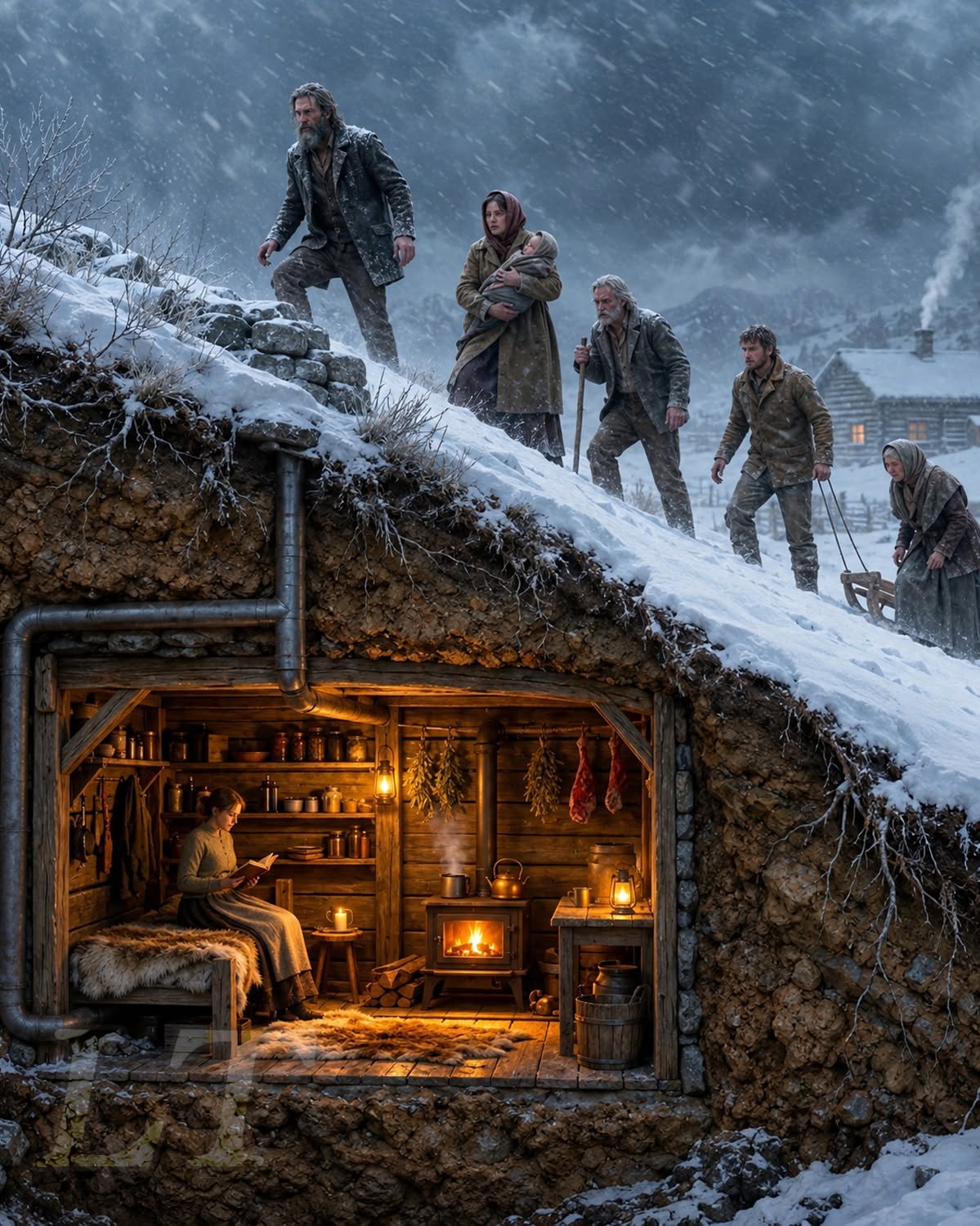
PART 2
The first snowflakes fell on a Tuesday morning.
They were enormous, soft flakes that drifted lazily across the prairie, settling on the rocks and turning the grass silver.
I was sitting beside my little iron stove, repairing a torn wool mitten, when I noticed something strange.
The birds had disappeared.
Not just a few.
Every last bird that usually gathered near the creek was gone.
Even the rabbits had vanished from the brush.
I stepped toward the concealed entrance and carefully pushed aside the wooden panel.
The air outside smelled different.
It was sharp, metallic, and strangely still.
My father had once told me that the prairie sometimes became quiet before it became dangerous.
I understood what he meant now.
The sky above the ridge was an unnatural shade of gray.
I returned inside and checked my supplies.
Twenty-three sacks of potatoes.
Dried beans.
Salted meat.
Flour.
A small barrel of preserved vegetables.
Firewood stacked almost to the ceiling.
I had enough to survive several weeks.
Perhaps longer if I rationed everything carefully.
But I couldn’t stop thinking about Niels.
He had gone into Havenwood the previous afternoon to purchase lamp oil and check on an elderly woman who lived alone near the church.
He had promised to return before sunset.
He hadn’t.
I looked toward the entrance again.
“Where are you, Niels?”
A gust of wind rattled the concealed wooden panel.
Then I heard the distant sound of a horse.
I hurried outside.
Niels emerged from the creek trail, leaning heavily over his saddle.
His gray beard was covered in ice.
One sleeve of his coat was torn, and his horse was breathing hard.
I ran toward him.
“You’re hurt!”
“It’s nothing.”
“Your arm is bleeding!”
He glanced down as though he hadn’t noticed.
“Fell against a fence.”
I helped him dismount and guided him inside.
As soon as he saw the stove, he sank into the chair beside it.
For several minutes, he said nothing.
Then he looked at me.
“Have you finished reinforcing the northern wall?”
“Yesterday.”
“The drainage channel?”
“Clear.”
“The emergency ventilation?”
“Working.”
He nodded slowly.
“Good.”
I placed a cup of hot water in his hands.
“What happened in town?”
His expression darkened.
“Nobody believes the storm is coming.”
I frowned.
“Nobody?”
“Not Cobb. Not the merchants. Not the sheriff.”
He took a sip.
“I told them the creek was behaving strangely. Told them the temperature shifts were wrong. Told them the western sky looked like the winter of 1864.”
“What did they say?”
Niels gave a bitter laugh.
“Cobb said old men see disasters everywhere because they have nothing better to do.”
I looked at his injured arm.
“Why didn’t you stay here?”
“Because I heard something else.”
He reached into his coat and removed a folded piece of paper.
It was a weather report from a telegraph station farther west.
The message was brief.
A massive winter system was moving toward the Dakota Territory.
Unusually strong winds.
Heavy snowfall.
Rapid temperature collapse.
Potentially catastrophic conditions.
My fingers tightened around the paper.
“How much time do we have?”
“Perhaps a day. Perhaps less.”
I looked toward the roof.
For months, I had imagined the storm arriving.
I had imagined myself sitting beside the stove, warm and safe, while the wind screamed overhead.
But suddenly, I wasn’t thinking about myself.
I was thinking about the families in Havenwood.
The children.
The elderly.
The people who had laughed when I walked out of town.
“How many people can we shelter?” I asked.
Niels looked at me.
“Sena, you cannot save an entire town.”
“I didn’t ask if I could save an entire town.”
He studied my face.
Then he sighed.
“Six comfortably. Perhaps eight if they don’t mind sleeping close together.”
I nodded.
“Then we need to prepare.”
He didn’t argue.
That evening, we cleared the storage chamber and moved some of the supplies to the far wall.
I placed extra blankets near the stove.
Niels inspected the ventilation shaft and reinforced the emergency supports.
Before going to bed, he gave me something I hadn’t seen before.
A small leather pouch.
Inside was a silver ring and a folded photograph of my father.
I stared at it.
“Why are you giving me this?”
“Because I should have given it to you months ago.”
I turned the photograph over.
On the back, my father’s handwriting was visible.
For my little sparrow. Wherever you go, remember that home is something you build, not something someone gives you.
My eyes filled with tears.
Niels watched me quietly.
“Your father believed you were stronger than you knew.”
I pressed the photograph against my chest.
“I wish he were here.”
“So do I.”
Then Niels said something that made me look up.
“There’s another reason I came back today.”
“What?”
He leaned forward.
“Vernon Cobb knows someone is living on this ridge.”
I felt my stomach tighten.
“He doesn’t know where the entrance is.”
“No. But he has begun searching for the source of the smoke.”
I looked at the little stove.
The chimney had been carefully concealed among the rocks, with its outlet positioned to disperse smoke against the hillside.
“How?”
“One of his men noticed that the snow melts in a narrow patch near the northern rocks.”
I felt the blood drain from my face.
“Can they find the entrance?”
“Not easily.”
“Not easily isn’t the same as no.”
Niels nodded.
“That’s why I want you to remember something. If anyone finds this place, don’t open the door simply because they ask.”
I frowned.
“What if they’re freezing?”
“Use your judgment. But never let Cobb inside without knowing why he’s there.”
I wanted to ask him what he meant.
But he was already looking toward the entrance.
And for the first time since I had known him, Niels looked genuinely frightened.
The storm arrived the following afternoon.
It didn’t begin gradually.
It attacked.
One moment, the prairie was covered in a thin blanket of snow.
The next, the wind struck the hillside with such force that I heard rocks tumbling down the slope.
Snow raced horizontally across the ground.
The sky disappeared.
I stood inside the shelter, listening to the terrifying roar above me.
The wooden supports creaked.
The earth trembled.
But the walls held.
I checked the ventilation.
Clear.
The drainage channel.
Clear.
The stove.
Burning steadily.
I breathed out.
My father had been right.
The land was protecting me.
For several hours, I believed we would be safe.
Then came the first knock.
Three sharp blows.
I froze.
They came from above the entrance.
Someone was outside.
I grabbed my father’s pocketknife and approached the concealed panel.
“Who’s there?”
A faint voice answered.
“Please!”
I recognized it immediately.
It was Thomas Reed, a farmhand from Havenwood.
“What are you doing out there?”
“Open the door!”
I hesitated.
Niels stepped beside me.
“Do you know him?”
“Yes. He works at the Miller farm.”
“How many people?”
“I don’t know.”
Another knock.
This time, it was weaker.
“Please! My little sister is with me!”
I looked at Niels.
He closed his eyes briefly.
Then he nodded.
I moved the concealed panel.
Thomas stumbled inside, carrying a little girl wrapped in a thin blanket.
She couldn’t have been more than seven.
Her lips were blue.
Her hands were shaking uncontrollably.
I pulled her toward the stove.
“Get her coat off. Quickly!”
Niels took the girl from Thomas and wrapped her in two thick blankets.
I warmed water and brought it over.
The child barely opened her eyes.
“What happened?” I asked.
Thomas was gasping.
“Our farmhouse roof collapsed. My mother sent us toward the church, but the wind pushed us off the trail.”
He looked around the shelter.
His eyes widened.
For a moment, he seemed unable to understand what he was seeing.
A bed.
A table.
Shelves.
A stove.
A real home.
Underground.
He stared at me.
“Sena?”
I nodded.
He looked horrified.
“You’re alive.”
I almost laughed.
“Apparently.”
He lowered his head.
“I heard what Cobb said about you. We all did.”
“That’s not important right now.”
He looked at the little girl.
“Thank you.”
I brought them food and dry clothing.
The girl eventually began to warm up.
Her name was Annie.
She had fallen asleep against Niels’s shoulder when another sound came from outside.
This time, it wasn’t knocking.
It was shouting.
“OPEN UP!”
Niels stood immediately.
I recognized that voice, too.
Vernon Cobb.
Cobb was outside with four men.
I could hear their boots scraping against the frozen ground.
“Thomas Reed!” he shouted. “I know you’re in there!”
Thomas went pale.
Niels gestured for him to stay quiet.
Then Cobb continued.
“We’re looking for a missing girl. A girl who has no right to occupy this land!”
I stared at the entrance.
He still didn’t know exactly where it was.
But he was close.
Very close.
“There’s no house here!” one of his men shouted.
“Then explain the smoke!”
Cobb struck something against the rocks.
I heard a sharp metallic sound.
“They’ve been hiding a stove,” he said. “Dig around the northern side!”
My heart began pounding.
He wasn’t searching for survivors.
He was searching for my home.
Niels moved toward the emergency support beam.
“He’s going to damage the hillside,” he whispered.
“What do we do?”
“Nothing. Not yet.”
The men began digging.
I heard shovels cutting into frozen soil.
Then a sudden crack echoed through the roof.
A heavy section of earth shifted.
Dust drifted from the ceiling.
Annie woke up screaming.
Niels rushed toward the northern wall.
“Everyone away from that side!”
Another crack.
Then another.
A wooden support groaned.
I grabbed Annie and pulled Thomas toward the center of the room.
The entire shelter seemed to shudder.
Above us, Cobb shouted.
“THERE! I FOUND SOMETHING!”
A terrible crash followed.
The northern support beam split.
A shower of dirt and broken timber poured into the room.
The concealed entrance was still intact, but part of the ventilation passage had collapsed.
Smoke began drifting toward the ceiling.
Niels grabbed a shovel.
“Sena! The emergency vent!”
I hurried toward the second ventilation opening.
My hands were shaking so badly that I could barely lift the wooden cover.
Thomas helped me.
Together, we cleared enough debris to restore the airflow.
But the shelter was damaged.
One more collapse could destroy the northern chamber.
Then I heard something that made my blood run cold.
A scream.
Not from inside.
From outside.
A man’s scream.
I rushed toward the entrance.
Through a narrow inspection opening, I saw one of Cobb’s men lying beneath a fallen section of the hillside.
His leg was trapped.
The other men were trying to pull him free.
Cobb stood nearby, shouting orders.
“Leave the equipment! Get him out!”
But the snow was already burying them.
Niels looked at me.
“We have to help.”
I stared at him.
“Those men came here to destroy our home.”
“They’re still people, Sena.”
I thought about every insult.
Every laugh.
Every time I had walked through Havenwood hoping someone would help me.
Nobody had.
But my father had taught me something different.
Never fear the land.
And never let cruelty turn your heart into something you don’t recognize.
I opened the emergency entrance.
The wind struck me so violently that I nearly fell backward.
Niels grabbed my coat.
Together, we crawled outside.
The injured man was barely conscious.
His name was Caleb Morris.
He was a young carpenter who had once helped my father repair the barn roof.
I remembered him.
He had been one of the men who laughed when Cobb called me a grave-digger.
Now his face was covered in blood.
“Please,” he whispered. “Don’t leave me.”
I grabbed his hand.
“We won’t.”
Thomas came out behind us.
Together, we managed to move the fallen timber.
Niels used a wooden lever to lift the heaviest section.
It took nearly twenty minutes.
By the time we dragged Caleb toward the entrance, my fingers were numb.
Cobb was standing a few feet away.
He stared at the opening.
Then at me.
His expression changed.
“Sena Lindall.”
I didn’t answer.
His eyes moved over the hidden doorway.
The wooden supports.
The stone chimney.
The warm air escaping from beneath the hillside.
For several seconds, he looked completely stunned.
Then his expression hardened.
“So it’s true.”
I helped Caleb inside.
Cobb stepped toward the entrance.
“What is this place?”
“My home.”
He laughed.
Even in the middle of a blizzard, he found the strength to laugh.
“Your home? You dug a hole in a public hillside and built yourself a furnace?”
“It’s private land.”
His smile disappeared.
“Who gave you permission?”
“My father.”
“Your father is dead.”
The words struck harder than the freezing wind.
I stepped closer.
“And that doesn’t give you permission to destroy what I built.”
Cobb stared at me.
Then he looked past my shoulder.
He saw the stove.
The shelves.
The beds.
The food.
And something changed in his eyes.
It wasn’t curiosity anymore.
It was calculation.
He realized that I had something the entire town desperately needed.
Warmth.
Shelter.
Food.
Safety.
He lowered his voice.
“Listen carefully, girl. This storm could last several days. People will die out here.”
“I know.”
“Then you’re going to open this place to the town.”
I looked at him.
“I already have.”
His face turned red.
“Don’t get clever with me.”
Niels stepped between us.
“Vernon, this is not the time.”
Cobb looked at the old man.
“Stay out of this, Bergman.”
“You’ve already done enough.”
Cobb’s eyes narrowed.
“What did you say?”
Niels didn’t answer.
For a moment, the two men stared at each other.
Then Cobb looked at the shelter again.
“I’ll be back.”
He turned and disappeared into the snow.
I watched him go.
“Do you think he’ll return?”
Niels looked at the entrance.
“Yes.”
“Why?”
He was silent for a long time.
Then he finally answered.
“Because he’s just discovered that you have something he wants.”
By nightfall, the storm had become a nightmare.
The wind howled continuously.
The temperature dropped so quickly that water froze inside exposed buckets.
The town’s church bell rang repeatedly, signaling distress.
I could hear it even from beneath the hillside.
Once.
Twice.
Then three times.
Niels listened carefully.
“That’s the emergency signal.”
“How many people are trapped?”
“Too many.”
I looked at the little girl sleeping beside the stove.
Thomas was sitting against the wall, holding his injured arm.
Caleb was unconscious on the narrow bed.
Our shelter was already crowded.
But outside, people were dying.
I stood up.
“We need to bring them here.”
Niels shook his head.
“Sena, the entrance is damaged. We can’t risk bringing dozens of people inside.”
“Then we’ll have to reinforce it.”
“With what?”
I looked at the wooden beams stacked beside the storage chamber.
“Everything we have.”
For the next two hours, we worked.
We reinforced the northern wall, moved the heaviest supplies away from the damaged section, and constructed an additional barrier near the entrance.
The shelter became cramped.
But it was holding.
Just before midnight, the first group arrived.
A woman carrying a baby.
An elderly farmer.
Two teenage boys.
Then another family.
And another.
Some had blankets.
Some had nothing.
Their faces were pale, their clothes frozen stiff.
I welcomed them one by one.
Nobody laughed.
Nobody called me an animal.
Nobody asked why a seventeen-year-old girl had chosen to live beneath the ground.
They simply came inside.
And I made room.
At one point, an elderly woman took my hands.
Her name was Mrs. Miller.
She was the wife of the farmer who employed Thomas.
I remembered seeing her standing behind the church when Greta threw me out.
She had watched me walk away.
Now she looked at me with tears in her eyes.
“Your father would be proud.”
I couldn’t speak.
She squeezed my hands.
“I should have helped you that day.”
I looked down.
“Yes. You should have.”
She began to cry.
I didn’t tell her it was all right.
Because it hadn’t been.
But I gave her a blanket.
And that was all I could offer.
By two in the morning, twenty-one people were sheltering beneath the hillside.
The air was warm but crowded.
The stove was burning constantly.
I rationed the food and assigned everyone a place to sleep.
Niels worked beside me.
For the first time, I began to believe we might survive the storm together.
Then the entrance shook.
Three heavy blows.
Everyone fell silent.
A voice came from outside.
“OPEN THE DOOR!”
It was Cobb again.
I moved toward the entrance.
Niels caught my arm.
“Wait.”
Cobb shouted again.
“YOU HAVE ROOM FOR ME!”
I looked through the inspection opening.
He was standing in the snow with two men.
His coat was torn.
His hat was missing.
His face was bleeding.
Behind him, a woman was carrying a small child.
I recognized the woman.
Greta.
My stepmother.
For a moment, I couldn’t breathe.
She was holding a little boy against her chest.
I remembered that child.
His name was Samuel.
He was only four years old.
Cobb struck the door again.
“Open it, Sena!”
I stared at Greta.
She looked directly at me.
Her lips moved.
“Please.”
I felt something twist inside my chest.
The woman who had thrown me out.
The woman who had watched me walk into the freezing night.
The woman who had told me to find somewhere warm.
Now she was standing outside my hidden home, begging to enter.
Niels moved beside me.
“Your choice.”
I looked at the child in her arms.
His face was almost the same pale color as Annie’s had been when Thomas first arrived.
I opened the door.
Cobb immediately pushed forward.
But I stood in his way.
“Greta and the child can come in.”
He glared at me.
“All of us are coming in.”
“No.”
His expression darkened.
“You don’t get to decide that.”
“I built this place. I decide who enters.”
For a moment, I thought he might strike me.
Then Greta stepped forward.
“Vernon, please. The boy is freezing.”
Cobb looked at her.
Something passed between them.
A silent warning.
Then he stepped back.
I allowed Greta and Samuel inside.
The little boy was barely conscious.
I wrapped him in blankets and placed him near the stove.
Greta knelt beside him, crying.
Then she looked up at me.
“Sena…”
I turned away.
“Don’t.”
She lowered her eyes.
“I know you hate me.”
I continued arranging blankets.
“That isn’t important right now.”
She looked around the shelter.
Her eyes moved over the shelves, the stove, the wooden furniture, and the carefully constructed walls.
Finally, she whispered:
“You built all this?”
“Yes.”
“Alone?”
“With Niels.”
She began crying harder.
Then she said something I hadn’t expected.
“Vernon told me you were dead.”
I stopped moving.
“What?”
“He said nobody had seen you for months. He told me there was no reason to worry.”
I stared at her.
“Why would he tell you that?”
Greta didn’t answer.
Instead, she looked toward Cobb.
He was standing near the entrance, speaking quietly with one of his men.
Then she leaned closer to me.
“Sena, you need to listen.”
Her voice was trembling.
“Your father didn’t die the way they told you.”
I felt the room disappear around me.
“What are you talking about?”
Greta glanced toward Niels.
He had gone completely still.
Then she reached into the pocket of her coat and pulled out a small envelope.
The paper was yellowed.
The edges were stained with something dark.
I recognized the handwriting immediately.
My father’s.
I reached for it.
Greta held on.
“Your father gave this to me two days before he died.”
My heart began racing.
“Why didn’t you give it to me?”
She looked at me with an expression I couldn’t understand.
“Because Vernon threatened me.”
I stared at her.
“What?”
“He said if I ever showed you this letter, he would make sure I lost everything.”
I grabbed the envelope.
My father’s name was written across the front.
Beneath it were three words.
For my little sparrow.
My hands began shaking.
I looked at Niels.
He was staring at the letter as though he had seen a ghost.
“You knew?” I whispered.
He didn’t answer.
I slowly opened the envelope.
Inside was a single folded sheet.
The first line made my knees weak.
My dearest Sena,
If you’re reading this, something has happened that I was afraid might happen.
I continued.
There are things about Vernon Cobb that I should have told you long ago. He has been trying to take our land for years. He knows about the old survey records, and he knows what lies beneath the eastern ridge.
My breathing became shallow.
I turned the page.
There was another paragraph.
If anything happens to me, don’t trust the official explanation. The horse did not simply become frightened. Someone had been near the stable that morning.
I looked up.
Niels had gone pale.
Greta covered her mouth.
Then I read the final sentence.
The person who helped Vernon was someone you have known your entire life.
I stopped.
The shelter was silent.
Even the children had stopped talking.
I looked at Niels.
Then at Greta.
“Who?”
Neither answered.
Suddenly, the entrance slammed open.
A violent gust of wind swept snow into the shelter.
Vernon Cobb stood in the doorway.
His face was no longer angry.
It was terrified.
Behind him, the storm swallowed the hillside.
He looked directly at the letter in my hands.
Then he shouted:
“GET THAT PAPER AWAY FROM HER!”
Two men rushed forward.
Niels grabbed a wooden support pole and blocked their path.
But Cobb wasn’t looking at him.
He was staring at Greta.
“You promised me you’d destroyed it!”
Greta began sobbing.
And then, for the first time since my father’s funeral, she spoke the truth.
“Your father didn’t die because of a frightened horse, Sena.”
I turned toward her.
She pointed at Vernon.
“He was murdered.”
The entire room erupted in shocked whispers.
Cobb stepped forward.
“She’s lying!”
But Greta shook her head.
“No. I’m finished lying for you.”
She turned toward me, tears streaming down her face.
“Vernon wasn’t alone that morning. Someone held your father’s horse while he loosened the bridle.”
I felt the blood drain from my face.
“Who?”
Greta looked toward the entrance.
Then she whispered a name.
A name I had never expected to hear.
“Niels.”
I stared at the old man.
My oldest friend.
The man who had saved me.
The man who had helped me build this shelter.
The man who had taught me how to survive.
He lowered the wooden pole.
His eyes filled with tears.
And when he finally spoke, his words shattered everything I thought I knew.
“Sena, there’s something your father made me promise.”
He took one slow step toward me.
“I was there the morning he died.”
I couldn’t move.
Outside, the blizzard continued to bury Havenwood.
Inside, twenty-one people waited in absolute silence.
Niels looked at the letter in my hands.
Then he whispered:
“But the man who caused your father’s death isn’t the only person hiding a secret.”
He glanced toward the northern wall.
“The real reason Vernon wants this hillside is buried beneath us.”
A sudden cracking sound echoed through the shelter.
The northern support beam began to bend.
Niels looked up in horror.
Then he shouted:
“EVERYONE GET AWAY FROM THE WALL!”
And from somewhere deep beneath the frozen earth, we heard a sound that none of us could explain.
Three slow knocks.
From below.
Someone—or something—was knocking from underneath my home.
And whatever was buried beneath that hillside had been there long before I ever started digging.