Ross Edgley’s 157-Day Swim Around Great Britain Left Him With a Rotting Tongue, Jellyfish Stings, and a Place in History
Ross Edgley’s 157-Day Swim Around Great Britain Left Him With a Rotting Tongue, Jellyfish Stings, and a Place in History
A Challenge No One Had Ever Completed
In June 2018, British endurance athlete Ross Edgley set out on a mission that many believed was impossible: to become the first person in history to swim around the entire coast of mainland Great Britain without ever setting foot on land.
Starting and finishing in Margate, Kent, Edgley spent 157 days at sea, covering approximately 1,792 miles (2,884 kilometers). His routine was relentless. He typically swam for six hours, rested on his support boat for six hours, and then returned to the water for another six-hour session. Day after day, week after week, he repeated the cycle until he had circumnavigated the entire island. The achievement was later verified by the World Open Water Swimming Association and recognized by Guinness World Records.
The Sea Began Destroying His Body
The physical punishment inflicted by the ocean was unlike anything Edgley had experienced before.
After only a few weeks, he developed what marathon swimmers call “salt mouth.” Constant exposure to seawater eroded the tissues inside his mouth and throat, making it difficult to eat, speak, and swallow. One morning, he woke to discover pieces of his tongue had detached during the night and were lying on his pillow.
The saltwater damage was so severe that parts of his tongue effectively disintegrated before eventually healing after the challenge ended. Edgley later described the experience as one of the most disturbing consequences of the entire expedition.
Jellyfish, Open Wounds, and “Rhino Neck”
The tongue injury was only one battle among many.
Months of wearing a wetsuit created deep abrasions around his neck, leaving him with a wound so severe that supporters nicknamed him “Rhino Neck.” He also suffered a suspected shoulder injury and endured repeated jellyfish attacks throughout the journey.
According to reports, Edgley was stung dozens of times during the swim. One particularly painful encounter involved a jellyfish attaching itself to his face and remaining there for an extended period as he continued swimming through cold northern waters.
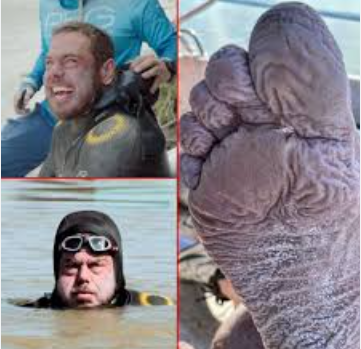
The constant immersion in seawater also damaged the skin on his hands and feet. His feet became swollen, discolored, and heavily deteriorated after spending months exposed to saltwater and harsh weather conditions. Team members treated him with creams, tape, and protective coverings just to keep him moving forward.
Fueling an Extraordinary Effort
To sustain the enormous energy demands of swimming up to 12 hours per day, Edgley consumed between 10,000 and 15,000 calories daily.
His diet included large quantities of carbohydrates and fruit, becoming famous for the hundreds of bananas he ate during the expedition. Reports estimate he consumed more than 600 bananas over the course of the swim, recording each one as a humorous reminder of the scale of the challenge.
Even with that staggering calorie intake, the swim burned hundreds of thousands of calories and pushed his body to its limits.
A Hero’s Welcome After Five Months at Sea
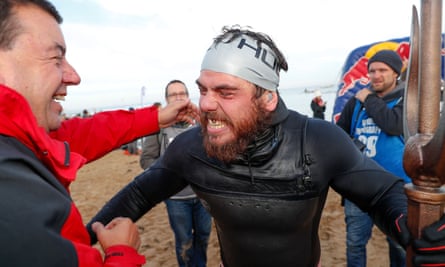
On November 4, 2018, after more than five months in the water, Edgley finally returned to Margate.
Hundreds of swimmers joined him for the final stretch, escorting him toward shore as crowds gathered to witness the conclusion of one of the most remarkable endurance feats ever attempted. After 157 days without setting foot on land, he emerged from the sea to cheers from supporters, friends, family, and fellow athletes.
The World Open Water Swimming Association later named the achievement the World Swim of the Year 2018, and it became officially recognized as the World’s Longest Staged Sea Swim.
A Testament to Human Endurance
Ross Edgley’s historic swim was more than a record-breaking athletic accomplishment. It became a powerful demonstration of resilience, determination, and the extraordinary limits of the human body and mind.
Despite a rotting tongue, severe skin damage, jellyfish stings, exhaustion, and months of relentless exposure to the elements, he refused to quit. His journey remains one of the most astonishing endurance achievements ever completed and continues to inspire athletes around the world years later.