Tom Cruise Became a Hollywood Punchline in 2005—Then Rebuilt His Stardom One Impossible Stunt at a Time
For a few seconds in May 2005, Tom Cruise stopped looking like the most controlled movie star in Hollywood.
Sitting across from Oprah Winfrey, he spoke excitedly about his new relationship with actress Katie Holmes. He dropped to one knee, gripped Winfrey’s hands and repeatedly rose from his seat. At the moment audiences would remember most, he planted both feet on her couch and threw his arms into the air.
The studio audience cheered.
Outside that room, the reaction became very different.
The brief display was replayed, exaggerated and mocked until “Tom Cruise jumping on Oprah’s couch” became shorthand for celebrity behavior that appeared excessive, strange or out of control.
The couch did not create Cruise’s crisis by itself. It arrived during a series of controversial public appearances involving his relationship, Scientology and statements about psychiatric treatment.
Together, those moments damaged an image he had spent two decades carefully maintaining.
Cruise eventually recovered, but not through a perfect apology or a carefully managed return to normality. He rebuilt the audience’s trust by making his body the proof of his commitment—climbing buildings, hanging from airplanes and continuing to run toward danger long after most stars would have allowed a stunt double to take over.
The Most Reliable Star in Hollywood
Before 2005, Cruise’s public identity rested on discipline.
From Top Gun and Rain Man to A Few Good Men, Jerry Maguire and Magnolia, he combined movie-star charisma with serious ambition. His films routinely attracted large audiences, while his performances earned three Academy Award nominations by the end of the 1990s.
The new century strengthened that position.
Mission: Impossible 2 became one of 2000’s biggest international hits. Steven Spielberg’s Minority Report placed Cruise inside an intelligent science-fiction thriller, while The Last Samurai gave him an epic historical drama.
In Michael Mann’s Collateral, he played against his heroic image as Vincent, a cold professional killer who forces a Los Angeles cabdriver to transport him between murders.
Cruise appeared nearly indestructible.
He was energetic in interviews, intensely promotional and famously protective of the movies built around him. Even when his characters became unstable or morally compromised, the star himself remained tightly controlled.
That control made the events of 2005 especially damaging.
The Couch Became Bigger Than the Interview
Cruise appeared on The Oprah Winfrey Show on May 23, 2005, while promoting Spielberg’s War of the Worlds.
He had recently begun dating Holmes, who had long described him as a childhood crush. Cruise’s excitement dominated the appearance. He declared his love, moved around the stage and brought Holmes before the audience.
The couch moment lasted only briefly. Cruise did not stand there delivering a speech, and the studio’s reaction was largely playful.
But the clip entered a changing media environment.
Online video was beginning to make short television moments easier to isolate and repeat. News programs no longer needed to show the entire conversation. Comedy shows could replay the most physical seconds without the surrounding laughter or context.
The image became more powerful than the event itself.
Cruise was no longer simply a man behaving exuberantly during a celebrity interview. He became the man who had “jumped on Oprah’s couch,” a phrase used as though he had suffered a public breakdown.
The mockery was intensified by questions surrounding the relationship. Cruise and Holmes had made their first major public appearance as a couple only weeks earlier, and their highly visible romance struck some observers as abrupt or promotional.
Cruise proposed at the Eiffel Tower the following month. They later married in Italy in November 2006 and had a daughter, Suri, before divorcing in 2012.
At the time, however, the couch became evidence for whatever viewers already suspected.
The Mental-Health Debate Changed the Stakes
The Oprah appearance might have faded as an embarrassing expression of romantic excitement if it had occurred alone.
It did not.
Cruise was also publicly criticizing psychiatry and the use of certain psychiatric medications, positions connected to Scientology’s opposition to the field.
He condemned Brooke Shields for discussing her use of an antidepressant while experiencing postpartum depression. Shields responded that Cruise should leave medical decisions to women and their doctors.
Then, during a June 2005 interview on NBC’s Today, Cruise argued with host Matt Lauer about psychiatry, medication and whether chemical imbalances existed.
The exchange became tense. Cruise accused Lauer of being “glib” and insisted that he understood the history of psychiatry.
Unlike the couch moment, this was not harmless spectacle.
Cruise was a powerful celebrity making broad claims about medical treatment while challenging the experience of people who said medication had helped them. Mental-health experts and advocates criticized his comments, warning that public stigma could discourage patients from seeking care.
Cruise later apologized privately to Shields. She accepted the apology, although she has since said it was not as complete as a public correction would have been.
By then, the public story had solidified.
The couch represented irrational enthusiasm. The Lauer interview represented combative certainty. His increased visibility as Scientology’s most famous member tied both moments to larger questions about the organization’s influence over him.
The calm professional had been replaced by a celebrity audiences believed they no longer understood.
Hollywood Begins Questioning His Value
War of the Worlds still became a major worldwide success in 2005.
Cruise’s films had not suddenly lost their audience. But studio executives began questioning whether his public behavior was making promotion more difficult.
The following year, Mission: Impossible III received generally favorable reviews but earned less worldwide than either of the first two films in the franchise.
In August 2006, Paramount Pictures chairman Sumner Redstone publicly announced that the studio was ending its long production relationship with Cruise and producing partner Paula Wagner. Redstone cited Cruise’s recent conduct and argued that it had become unacceptable to the company.
The separation was extraordinary.
Cruise had spent years as one of Paramount’s most profitable stars, and Mission: Impossible was closely identified with him. Now the studio appeared willing to risk that relationship because his public image had become a business concern.
Cruise and Wagner soon took control of United Artists, attempting to build a new production base.
The results were uneven. Lions for Lambs disappointed commercially, while Valkyrie performed respectably but did not immediately restore Cruise’s earlier dominance.
His funniest step toward rehabilitation came in 2008 with Tropic Thunder.
Hidden beneath heavy makeup and a bald cap, Cruise played vulgar studio executive Les Grossman. The performance was aggressive, ridiculous and unexpectedly self-mocking. Audiences saw a star willing to make himself grotesque rather than insist on being admired.
It helped, but the full recovery still required Ethan Hunt.
The Burj Khalifa Changes the Conversation
In 2011, Cruise returned for Mission: Impossible—Ghost Protocol.
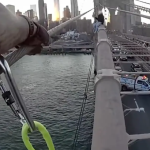
The movie included an image powerful enough to compete with the couch: Cruise clinging to the exterior of Dubai’s Burj Khalifa, more than 100 stories above the ground.
The sequence was not merely a visual effect built around a digital double. Cruise performed the climb while secured by safety equipment, turning behind-the-scenes footage into part of the film’s appeal.
That distinction became the foundation of his new public identity.
Cruise had once seemed desperate to control what audiences thought of his private life. Now he redirected attention toward what he was willing to do for the theatrical experience.
Each new Mission: Impossible film raised the stakes.
For Rogue Nation, he hung from the side of an airplane during takeoff. In Fallout, he performed a high-altitude parachute jump and broke his ankle while leaping between buildings, completing the take before stopping production.
The conversation surrounding him changed.
Journalists still asked about Scientology and his personal life, but audiences increasingly discussed the stunts, preparation and risk. Cruise became less available as an intimate celebrity while making his physical commitment more visible than ever.
He rebuilt trust without asking viewers to identify with the man offscreen.
He asked them to believe what they could see.
Top Gun: Maverick Completes the Return
The transformation reached its peak with Top Gun: Maverick in 2022.
Released 36 years after the original Top Gun, the sequel could easily have become a hollow exercise in nostalgia. Instead, Cruise and the filmmakers centered the aerial sequences on real aircraft, intensive cast training and practical photography.
The film became Cruise’s highest-grossing release, earning nearly $1.5 billion worldwide. It was also widely credited with helping restore confidence in theatrical moviegoing after the disruption of the COVID-19 pandemic.
The industry that had questioned his marketability now celebrated him as one of the last stars capable of turning a film into a global event.
Cruise continued the Mission: Impossible series through Dead Reckoning in 2023 and The Final Reckoning in 2025. Although the later installments faced enormous budgets and uneven box-office results, their promotion still revolved around a promise few other stars could make: Cruise would put himself inside the action.
That promise outlasted the jokes.
The Couch Was Never the Whole Story
The 2005 backlash cannot be reduced to a culture unfairly mocking a man for being in love.
The couch moment was distorted through repetition, but Cruise’s comments about psychiatry raised legitimate concerns. His confidence became troubling when it moved beyond movie promotion and into medical claims affecting vulnerable people.
The incident also showed how quickly celebrity narratives can flatten several events into one image.
A few seconds of television became the symbol for an entire year of controversy. Cruise’s romantic excitement, religious identity, aggressive interview style and mental-health statements were compressed into the sight of his shoes touching Oprah’s furniture.
He could not erase that image.
Instead, he replaced its meaning.
The same physical intensity that once made him look uncontrolled became the quality that restored his career. He turned movement into credibility: running across rooftops, gripping aircraft and returning to dangerous sets year after year.
Tom Cruise did not persuade audiences to forget 2005.
He gave them more powerful images to remember.
The couch showed a star losing control of his public persona. The action films that followed showed him taking control of the one thing audiences still trusted completely—what he could accomplish onscreen.