In 1937, a Wooden Crate on Old Wheels Gave Two Siblings a World of Their Own
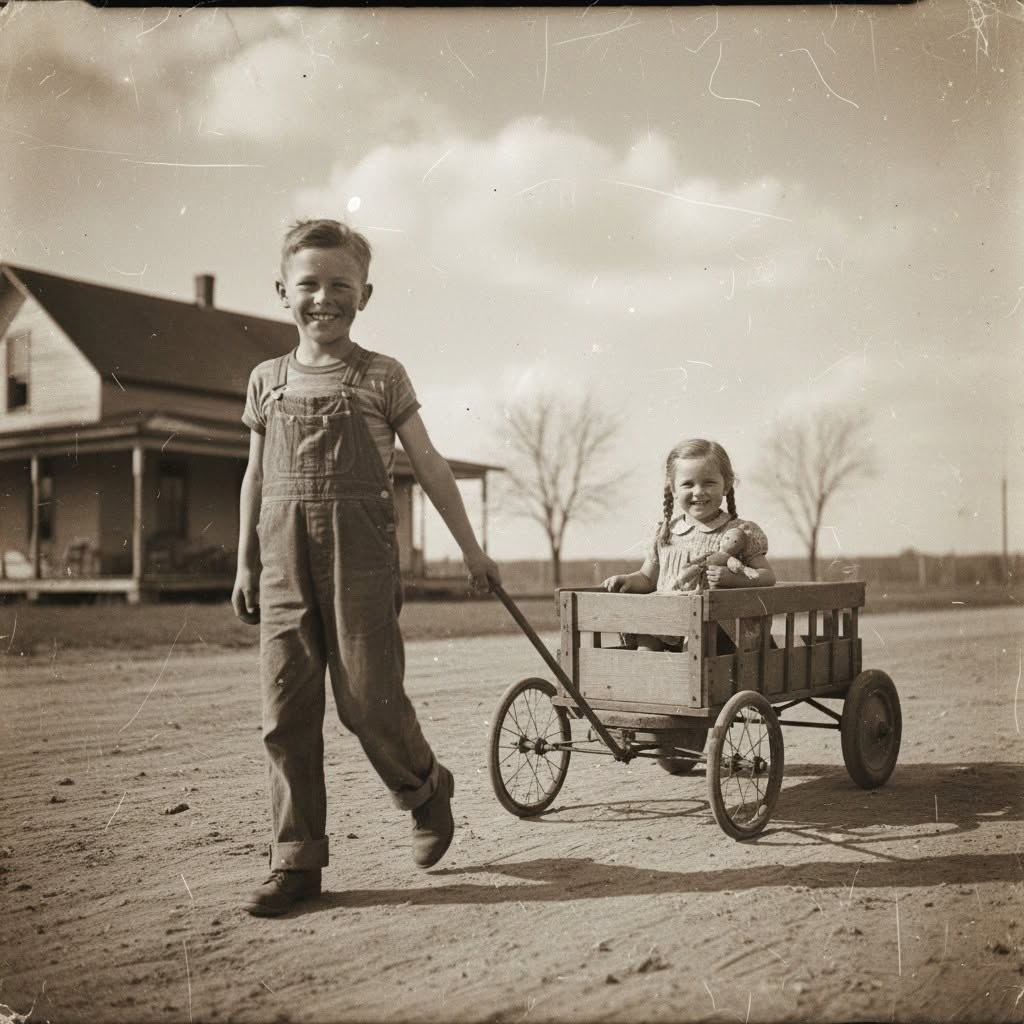
There was nothing luxurious about the little wagon.
Its body was an ordinary wooden crate. Its wheels were old and mismatched. A simple length of rope served as its handle. By almost any conventional measure, it was a toy made from leftovers.
But in a photograph from 1937, none of that seems to matter.
A young boy pulls his little sister along in the homemade wagon, turning a collection of discarded materials into something far more valuable. For the children, the rough wooden box could become whatever their imaginations allowed—a racing car, a grand chariot or simply their ticket to another afternoon of adventure.
Their small moment of happiness also captured something larger about childhood during one of the hardest periods in American life.
Growing Up When Almost Everything Was Precious
The photograph came from the era of the Great Depression, when financial hardship shaped everyday decisions for millions of American families.
Jobs had disappeared, household money was scarce, and people learned to stretch the usefulness of nearly everything they owned. Shoes were repaired rather than quickly replaced. Clothing was reused. Furniture and household items could be built or fixed with whatever materials were available.
Children lived within that same culture of necessity.
A brand-new toy from a store could be a rare luxury. Birthday presents might be homemade. Christmas gifts had to be carefully chosen or created from materials a family already possessed.
Yet the absence of expensive toys did not eliminate play.
Children simply became inventive.
A discarded piece of wood might become the beginning of a new game. An empty container could suddenly have an entirely different purpose. A yard or dirt path could become a world far larger than its physical boundaries.
That ability to transform ordinary objects is what makes the 1937 wagon so striking.
Scraps Became Something Worth Treasuring
The wagon had none of the features associated with a manufactured toy.
There were no bright factory colors, polished surfaces or carefully designed parts. Instead, someone had combined a wooden crate, used wheels and rope into a vehicle simple enough for one child to pull another.
Its imperfections would have been obvious to an adult.
To the children, they were irrelevant.
What mattered was that the wagon moved.
Once the little girl climbed inside and her brother took hold of the rope, the homemade creation became a source of freedom and excitement. A familiar path could feel like a highway. An ordinary neighborhood could become unexplored territory.
The value of the wagon did not come from what its materials cost. It came from what the children could do with it.
And perhaps even more importantly, it came from the experience they shared.
An Older Brother Giving More Than a Ride
There is another story inside the image.
The boy pulling the wagon was not playing alone. He was bringing his younger sister into the adventure with him.
For many families of that generation, older children learned responsibility at an early age. Brothers and sisters frequently helped watch over younger siblings, protected them and made sure they were included.
That relationship can be seen in something as uncomplicated as a wagon ride.
The boy supplied the effort. His sister received the thrill of being pulled along. Neither needed anything elaborate for the moment to work.
For the little girl, the important things were probably immediate: movement, laughter, excitement and the security of being cared for by someone she trusted.
She did not need to know whether another child owned a more expensive wagon. She did not need polished metal or a brightly painted body.
Her adventure was already underway.
What Homemade Toys Quietly Taught
Children growing up during the Depression absorbed lessons that extended far beyond recreation.
They watched adults repair and reuse objects because wasting useful materials was often not an option. They learned that an older possession could remain valuable and that something handmade could create just as much happiness as something new.
Building toys from available materials also encouraged creativity and problem-solving.
A child had to imagine what an object might become, work with what was available and accept imperfections along the way.
The finished result carried another kind of value, too.
There was effort behind it.
There might be memories of the person who helped construct it. There were afternoons spent using it and stories created around it. The toy became important not because it was expensive, but because life had happened around it.
Having Less Did Not Mean Feeling Less
Looking backward at Depression-era childhood, it is easy to focus entirely on deprivation.
Photographs show worn clothing, limited possessions and families living with financial uncertainty. Those hardships were real.
But hardship was not the only part of childhood.
Children still found reasons to laugh. They still made friends, explored, invented games and turned ordinary afternoons into memories.
The 1937 photograph preserves that contrast beautifully.
The wagon itself symbolizes scarcity: it was assembled from materials that were available rather than purchased as a finished product.
The expressions and actions of the children tell a different story.
They show abundance of another kind—imagination, companionship and the ability to enjoy something simple.
A child does not always measure happiness according to price. Sometimes happiness is simply having somebody willing to pull the rope while you climb into the box.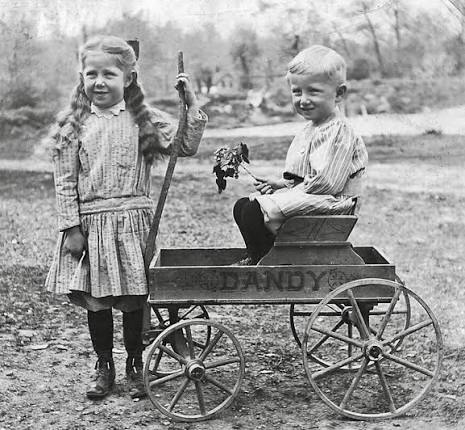
A Small Picture of a Resilient Generation
Children raised during those difficult years learned early how to adapt.
They understood that possessions had to last, resources should not be wasted and useful things could be created from unlikely materials. Many carried those habits of practicality and resilience into adulthood.
Yet the homemade wagon also reminds us that their childhood was not defined solely by hardship.
There was joy inside it.
The toy allowed two siblings to do what children in every generation have done: temporarily turn the world around them into somewhere more exciting.
Years later, the wooden crate itself would have had little chance of surviving. Wood breaks. Wheels wear down. Rope frays and is replaced.
The physical toy was always temporary.
The moment was not.
The photograph preserved the older brother pulling his sister, the handmade wagon beneath her and a kind of childhood happiness that required remarkably little to exist.
In the end, that may be why the scene remains so affecting.
The children had a box, some wheels and a rope.
What transformed those scraps into a treasure was everything that could not be purchased: a brother and sister together, an afternoon to explore, and enough imagination to make a wooden crate feel like the greatest ride in the world.