MY FATHER STOLE MY VIP GRADUATION TICKET AND LEFT ME IN THE RAIN—THEN THE ACADEMY COMMANDANT CALLED MY NAME IN FRONT OF EVERYONE
PART 1 — THE DAUGHTER NOBODY NOTICED
“Nobody’s going to notice you’re missing, Clara. You’re just another cadet.”
My father said those words before shoving me away from the entrance of one of America’s most prestigious military academies.
Rain poured down my face as I grabbed a railing to keep from falling.
My stepmother stood nearby.
My stepsister Haley was holding the golden VIP graduation ticket I’d given Dad the night before.
Then all three walked inside and left me standing in the storm.
They thought I was an ordinary cadet who had accomplished nothing worth celebrating.
They had no idea I was graduating first in my class.
They didn’t know I was the valedictorian.
And they certainly didn’t know I was about to receive one of the academy’s highest honors.
Minutes later, the Commandant stepped onto the auditorium stage.
My father was sitting comfortably in the VIP section, convinced I was still outside.
Then the general spoke.
“Ladies and gentlemen, please welcome our valedictorian, Cadet Clara Hensley.”
When I appeared in my full ceremonial uniform, hundreds of cadets and senior officers rose to applaud.
Haley dropped my invitation.
My father’s face went white.
But the greatest surprise came after my speech, when the Commandant returned with a sealed folder concerning my future assignment.
And even I wasn’t prepared for what it contained.
The evening before graduation, I returned home completely exhausted.
My name is Clara Hensley, and I’d spent the day moving between final rehearsals, administrative requirements, and preparations for the following morning’s ceremony.
There had also been one last review of my speech.
A speech I would deliver in front of thousands of people.
I should have been excited.
After years of relentless training and academic pressure, graduation was finally here.
Instead, I was tired enough to feel every muscle in my body.
I entered the house carrying my bag, hoping to find a quiet place to sit.
I hadn’t even put it down when my stepmother shouted from the kitchen.
“Clara! Those dishes aren’t going to wash themselves!”
I stopped in the hallway.
She continued.
“Haley has a photoshoot tomorrow morning. She needs her rest.”
I looked toward the living room.
Dad was sitting on the couch, scrolling through his tablet.
He didn’t look up.
Didn’t ask how rehearsals had gone.
Didn’t ask whether I was nervous about graduation.
He hadn’t asked about any of the preparations.
Throughout my years at the academy, he’d treated my military education as a strange hobby I would eventually abandon.
But that evening, I decided to try one final time.
I walked toward him.
“Dad, tomorrow is my graduation.”
He made a distracted sound without lifting his eyes.
I reached into my bag.
Then removed a golden invitation.
“The academy gave me one VIP ticket for a family member.”
I held it out.
For a moment, I imagined what he might say.
Perhaps he’d finally smile.
Perhaps he’d tell me he was proud.
Or perhaps he’d simply thank me for wanting him there.
I wasn’t expecting anything extraordinary.
Just one small acknowledgment that the years I’d spent working toward this day meant something.
Dad took the invitation.
He glanced at it.
Then turned toward my stepsister.
“Haley, here. You take this.”
He handed it to her.
My heart sank.
“Dad, that was supposed to be for my guest.”
He looked irritated.
“Haley is family, isn’t she?”
My stepmother appeared beside them.
Her eyes brightened when she saw the invitation.
“Oh, that’s perfect!”
She examined the gold lettering.
“I imagine there will be generals and influential military families attending.”
Then she smiled at Haley.
“You could make some very useful connections.”
Haley immediately pulled out her phone.
She photographed the invitation.
Within moments, she was preparing to share it on social media.
I stood there watching them treat my graduation ticket as an opportunity for Haley.
Not once did anyone ask why I’d received it.
Or why I’d wanted my father to have it.
“I wanted you to attend for me,” I told Dad quietly.
He finally looked directly at me.
Then laughed.
“Why?”
I stared at him.
He shrugged.
“You’re one cadet out of hundreds, Clara.”
His expression was dismissive.
“Nobody’s going to notice whether you’re there or not.”
The words hurt more than I wanted to admit.
Because the truth was that people would notice.
The academy had chosen me as valedictorian.
I was graduating at the top of my class.
And I was scheduled to receive one of its most prestigious distinctions.
But Dad knew none of that.
Not because the information had been impossible to share.
Because he’d stopped listening to me years earlier.
Eventually, I’d stopped trying to explain my achievements.
Whenever Haley gained more followers, my family celebrated.
When she reached another social-media milestone, champagne appeared.
Photographs were taken.
Relatives were notified.
But my accomplishments received silence.
Field exercises.
Leadership assessments.
Advanced research.
Sleepless nights spent studying.
The constant pressure of meeting demanding academic and military standards.
None of it interested them.
And now, on the night before my graduation, my father had given away my VIP ticket without even asking why it mattered.
The following morning, heavy rain swept across the academy grounds.
Water streamed from the roofs and gathered on the stone walkways.
The sky was dark.
The wind made the cold feel sharper.
I arrived early, wearing a dark coat over part of my uniform.
I still needed to collect the remaining pieces of my ceremonial uniform from a secured preparation room.
Everything had been carefully arranged.
There were final details to handle before the ceremony began.
I intended to go inside, finish dressing, and prepare for the speech I’d spent so much time rehearsing.
Then I saw my family’s black SUV approaching.
My stomach tightened.
The vehicle stopped near the entrance.
Haley climbed out first.
She was holding the golden VIP invitation in one hand.
She looked delighted with herself.
My stepmother followed.
Then Dad.
I hoped they would simply walk inside.
But as I approached the entrance, my father stepped directly into my path.
“What do you think you’re doing here?”
I stared at him.
“It’s my graduation.”
His eyes moved over my coat.
Then his expression darkened.
“You’re not going inside looking like that.”
I was too tired to argue.
“Dad, move.”
He didn’t.
Instead, he looked toward the entrance, clearly concerned about the people passing nearby.
“You’re embarrassing us.”
I felt my patience break.
“Get out of my way.”
Then he grabbed my arm.
His fingers tightened painfully around my upper arm.
I looked down at his hand.
“Let go.”
He didn’t release me.
I tried to step away.
Then he shoved me backward.
My shoes slid against the rain-soaked stone.
For a terrifying instant, I lost my balance.
I reached out.
My fingers caught the nearby railing just before I fell.
Cold rain struck my face.
I steadied myself and looked up.
Dad was already turning away.
My stepmother followed him.
Haley walked beside them with my VIP ticket still in her hand.
None of them looked back.
They disappeared through the heavy bronze doors.
And I was left standing outside.
Alone.
Drenched.
My arm aching where Dad had grabbed it.
For a moment, I couldn’t move.
I’d endured demanding military training.
I’d pushed through exhaustion, pressure, and difficult assignments.
But somehow, being rejected by my own father on graduation morning hurt in a way I hadn’t prepared for.
I looked toward the entrance.
Then down at my wet shoes.
And for one terrible moment, I considered leaving.
I could have walked away.
Gone back to my car.
Let the ceremony proceed without confronting my family again.
The thought lasted only a few seconds.
But it was real.
I had spent so many years wanting my father to recognize my achievements.
And even now, on the morning I was supposed to celebrate the greatest accomplishment of my academic career, he’d found a way to make me feel unwelcome.
Then something shifted above my head.
The rain stopped striking my face.
I looked up.
An umbrella had appeared over me.
“Cadet Hensley?”
I turned.
Standing beside me was Major General Jonathan Bradley.
The academy Commandant.
He looked directly at me.
Then frowned with concern.
“Good Lord, Clara. We’ve been searching everywhere for you.”
I straightened immediately.
“Sir.”
He continued.
“The Board is already seated. The superintendent and visiting officers are waiting.”
I felt embarrassed by my appearance.
Rain had soaked my coat.
My hair was damp.
And I was standing outside instead of preparing for the ceremony.
“My apologies, sir.”
General Bradley looked genuinely confused.
“Apologies?”
He shook his head.
“Clara, you’re the reason half those people came.”
I didn’t know what to say.
Then his attention moved toward my arm.
The red marks were still visible where Dad had gripped me.
General Bradley noticed them immediately.
His expression changed.
“What happened?”
I hesitated.
He followed my gaze toward the bronze doors.
Through the glass, I could see Haley posing for photographs.
My golden VIP invitation was still in her hand.
My parents stood nearby.
They looked completely comfortable.
As though nothing unusual had happened outside.
I swallowed.
“That’s my family, sir.”
The Commandant looked toward them.
Then back at me.
“They wouldn’t let you inside?”
I couldn’t answer.
My silence told him enough.
His jaw tightened.
For a moment, he said nothing.
Then he adjusted the umbrella so it covered me properly.
“Come with me.”
I looked toward the entrance.
He followed my gaze.
“You won’t be using the guest entrance.”
His voice left no room for discussion.
I nodded.
And walked beside him.
Only minutes later, the auditorium began filling with anticipation.
Graduating cadets prepared for the ceremony.
Senior officers took their seats.
Distinguished guests settled into the reserved sections.
And my family was sitting comfortably among the VIP attendees.
Dad apparently believed I was still outside.
Perhaps he imagined me standing in the rain, sulking because he hadn’t allowed me to enter.
Haley still had the ticket he’d given her.
My stepmother looked pleased with their seats.
Then the auditorium lights began to dim.
The conversations faded.
The ceremony was beginning.
Major General Jonathan Bradley stepped onto the stage.
He approached the microphone.
And addressed the audience.
“Today, I have the privilege of recognizing an extraordinary young leader.”
The room grew still.
He continued.
“A cadet whose achievements reflect exceptional discipline, academic excellence, and dedication.”
I knew my family was listening.
But I doubted they understood where his words were leading.
The Commandant paused.
Then announced:
“The cadet who graduates first in her class.”
He continued.
“Our valedictorian.”
Another pause.
“And the recipient of one of this academy’s highest distinctions.”
I imagined Dad beginning to pay closer attention.
Then General Bradley said the words that changed everything.
“Ladies and gentlemen, Cadet Clara Hensley.”
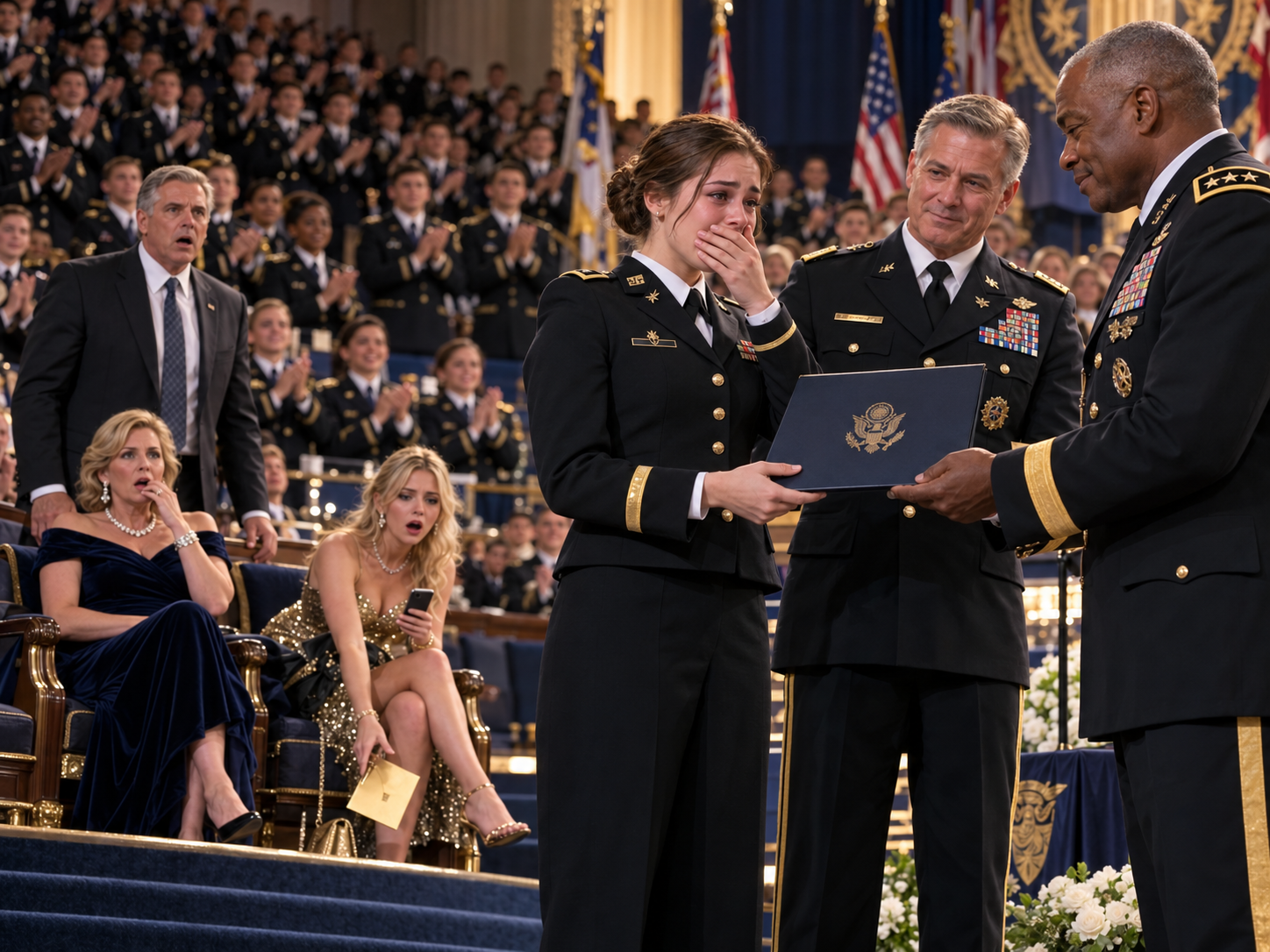
I walked onto the stage wearing my complete ceremonial uniform.
Every piece was in place.
The uniform I’d spent years working to earn the right to wear with pride.
The audience rose.
Hundreds of graduating cadets and senior officers stood applauding.
The sound filled the auditorium.
I kept my posture straight as I crossed the stage.
Then my eyes found the VIP section.
Haley was staring at me.
The golden invitation slipped from her fingers.
My stepmother looked stunned.
And Dad—
Dad was sitting motionless.
The same man who’d told me nobody would notice whether I attended.
The same man who’d shoved me away from the entrance.
The man who’d handed my VIP ticket to Haley because he couldn’t imagine my graduation being important.
Now he was watching an entire auditorium stand to recognize me.
For the first time that I could remember, he wasn’t looking through me.
He was looking directly at me.
And there was no laughter on his face.
I delivered my speech.
The words I’d rehearsed so carefully the previous evening came naturally as I stood before my fellow graduates, their families, and the officers who had guided us.
I spoke as the academy’s valedictorian.
Not as the daughter my father had dismissed.
Not as the stepsister whose achievements had been overshadowed for years.
But as a cadet who had completed an extraordinary journey through hard work and determination.
When I finished, the applause rose again.
For a moment, I allowed myself to feel proud.
I had earned that moment.
No one had handed it to me.
No one had arranged it through family influence.
I had done the work.
And whatever my father thought now, he couldn’t erase what the audience had witnessed.
I stepped back as the ceremony continued.
I believed the most difficult part of the morning was finally behind me.
But then General Bradley returned to the stage.
And he wasn’t empty-handed.
The Commandant carried a sealed folder.
I noticed it immediately.
He approached the microphone once more.
The auditorium quieted.
Then he spoke.
“We have one additional announcement concerning Cadet Hensley’s future assignment.”
My breath caught.
This hadn’t been part of the moment I’d just experienced.
I watched him carefully.
A high-ranking officer stepped onto the stage beside him.
The atmosphere seemed to change.
The audience waited.
In the VIP section, my father slowly rose from his chair.
His attention was fixed entirely on the stage.
Only a short time earlier, he’d treated me like an embarrassment.
Now he was watching two senior military leaders prepare to make an announcement about my future.
General Bradley looked down at the sealed folder.
Then opened it.
I watched him remove the document.
My eyes caught the words printed inside.
And suddenly, I forgot about the rain.
The stolen invitation.
My father’s cruel remarks.
Even the applause I’d received moments earlier.
Because whatever was written on that page wasn’t what I had expected.
Not even close.
I had arrived that morning expecting to graduate, deliver my speech, and receive the academic distinction I’d earned.
Instead, my father had shoved me away from the entrance while my stepsister carried the VIP ticket meant for him.
I’d nearly walked away from one of the most important days of my life.
Then General Bradley found me.
He brought me inside.
And in front of thousands, he recognized the achievements my family had ignored for years.
That alone would have been enough to make the day unforgettable.
But now he was standing onstage with another senior officer and a sealed document concerning my future assignment.
My father was on his feet.
Haley no longer looked pleased with herself.
My stepmother sat in stunned silence.
And I was staring at words I hadn’t expected to see attached to my name.
The morning had begun with my father telling me nobody would notice if I disappeared.
Now the academy’s Commandant was preparing to announce something about my future that even I hadn’t known was coming.
And as General Bradley held the open folder, I realized the biggest revelation of my graduation day was still ahead.
PART 2 — THE SEALED ORDERS
The first thing I noticed was the heading at the top of the document.
OFFICE OF THE SECRETARY OF DEFENSE
Beneath it were several lines of official language, followed by a designation I recognized immediately.
National Resilience Leadership Fellowship.
For three seconds, I couldn’t breathe.
I had applied for that fellowship six months earlier.
So had hundreds of outstanding candidates from military academies, universities, and officer-development programs across the country.
The program selected a small number of young officers with exceptional records in engineering, leadership, and infrastructure research. After completing their required initial officer training, those selected would work alongside experienced military and civilian specialists on projects designed to protect critical installations, transportation systems, and emergency-response networks.
I had been told the selection process was extraordinarily competitive.
I had also been told not to expect anything.
Apparently, I hadn’t listened to the second warning carefully enough.
General Bradley smiled.
“Cadet Hensley, would you please step forward?”
I obeyed.
The other officer approached. He was a distinguished-looking man with silver hair, four stars on his shoulders, and the calm expression of someone who had spent decades making difficult decisions.
“General Marcus Whitfield,” Bradley announced, “has joined us today to present a special recognition.”
General Whitfield extended his hand.
“Clara, congratulations.”
I shook it.
“Thank you, sir.”
He looked toward the audience.
“Every graduating class produces officers of talent and promise. Occasionally, however, we encounter someone whose work suggests a capacity for leadership far beyond the boundaries of a classroom.”
He glanced at me.
“Cadet Hensley’s research on military infrastructure resilience has attracted the attention of several senior review panels.”
My heart began pounding.
During my final year, I had spent nine months researching vulnerabilities in emergency evacuation systems at military installations.
It wasn’t glamorous work.
It involved old engineering reports, transportation maps, drainage systems, budget records, simulations, and more calculations than I cared to remember.
I had also examined how apparently minor maintenance decisions could compound into catastrophic failures during severe weather.
I knew why the subject mattered.
When I was fifteen, a violent storm had caused serious flooding in our hometown. Roads became impassable, emergency vehicles struggled to reach vulnerable neighborhoods, and several families were forced from their homes.
That disaster had changed the way I viewed engineering.
A failed drainage system wasn’t merely a technical problem.
It could be the reason an ambulance arrived too late.
An overlooked bridge inspection could determine whether children reached safety.
I had wanted my research to serve people whose names would never appear in an official report.
General Whitfield continued.
“Following a comprehensive review, Cadet Hensley has been selected for the National Resilience Leadership Fellowship. Upon completion of her required initial training, she will join a specialized team supporting the development of more reliable emergency infrastructure across Department of Defense installations.”
A murmur passed through the auditorium.
Then applause erupted.
My fellow cadets began cheering.
Someone shouted my name.
I barely heard them.
I was looking at the page General Bradley had placed in my hands.
My name was there.
My research title.
A formal selection notice.
And beneath the announcement was something else.
A personal letter from Dr. Eleanor Reeves, the program’s senior civilian director.
It contained a sentence that made my throat tighten.
Your work demonstrates an understanding that the true measure of infrastructure is not what it costs to build, but whom it protects when everything else fails.
I read those words twice.
Then a third time.
For years, my father had told me that studying engineering in the military was a waste of my potential.
He believed success meant expensive cars, attractive acquaintances, influential business partners, and photographs that made people jealous.
I had spent years trying to explain that I wanted to build things that mattered.
Someone, somewhere, had understood.
General Whitfield leaned toward me.
“You earned this, Lieutenant Hensley.”
Lieutenant.
It was the first time anyone had addressed me by the rank I was about to hold upon commissioning.
I straightened.
“Thank you, sir. I won’t disappoint you.”
He smiled.
“Don’t spend your career worrying about disappointing people. Spend it doing the work properly.”
Something about those words settled deep inside me.
I didn’t know it yet, but I would remember them long after the applause faded.
From the stage, I could see my father in the VIP section.
He was still standing.
His mouth hung slightly open.
For once, Haley wasn’t looking at her phone.
My stepmother had both hands clasped tightly in her lap.
I wondered what Dad was thinking.
Was he proud?
Embarrassed?
Angry that I’d kept my achievements from him?
Or was he already calculating what this announcement might mean for his business contacts?
I found out less than twenty minutes later.
The graduation ceremony concluded with music, the commissioning of our class, photographs, and the joyful chaos of families searching for newly commissioned officers.
I stepped outside into a courtyard washed clean by the morning storm.
The rain had stopped.
Sunlight appeared through breaks in the clouds.
My roommate and closest friend, Lieutenant Maya Torres, nearly knocked me off my feet when she hugged me.
“You absolute menace!” she shouted.
I laughed.
“What?”
“You got the fellowship!”
“I know.”
“You got the fellowship, and you didn’t even tell me you were being considered?”
“I wasn’t sure.”
Maya pulled back.
“You’re unbelievable.”
She was grinning so widely that I couldn’t help smiling.
Maya had spent four years listening to me worry over exams, leadership evaluations, and research deadlines.
She had seen me cry exactly twice.
Once after a grueling field exercise when I learned that a close family friend had died.
And once after my father forgot my twentieth birthday, despite promising to visit.
She knew what this day meant.
Then her expression changed.
“Clara.”
I followed her gaze.
My father was approaching.
Vivian, my stepmother, walked beside him.
Haley trailed behind, looking at something on her phone.
Dad was smiling.
Not the tight, irritated smile he’d given me when I arrived home the previous evening.
This one was broad.
Public.
Almost theatrical.
“There’s my girl!”
I froze.
Maya’s hand tightened around my shoulder.
Dad opened his arms.
“Clara! That was incredible!”
He tried to hug me.
I stepped back.
His arms remained suspended awkwardly for a moment.
Then he lowered them.
“What’s wrong?”
I stared at him.
There were so many things I could have said.
That he’d humiliated me.
That he’d hurt me.
That he’d left me outside in the rain.
That I had spent my entire childhood waiting for him to become the father he suddenly wanted to appear to be.
Instead, I asked one question.
“Why did you give Haley my invitation?”
He blinked.
“Clara, seriously? We’re doing this now?”
“Yes.”
Vivian made a small sound of disapproval.
“Don’t embarrass your father in front of all these people.”
I almost laughed.
There it was.
The same accusation.
The same expectation that I should swallow whatever happened so the family could look respectable.
Dad glanced around.
“Look, sweetheart, I didn’t realize the ticket was that important.”
“I told you it was for you.”
“Well, how was I supposed to know you were the valedictorian?”
I looked at him for a long moment.
“Because I told you.”
His expression tightened.
“No, you didn’t.”
“I called you when the academy announced it.”
He frowned.
“I don’t remember that.”
“You said you were busy.”
He looked away.
I continued.
“I sent you an email. And two messages.”
“Clara—”
“You didn’t respond.”
Vivian stepped forward.
“Your father has a company to run. He can’t keep track of every little school announcement.”
Maya inhaled sharply.
Every little school announcement.
I watched Dad’s face.
He didn’t correct his wife.
He never did.
Then Haley looked up from her phone.
“Can we stop arguing? People are staring.”
I glanced at her.
“You were holding my invitation this morning.”
She rolled her eyes.
“Dad gave it to me.”
“And you knew it belonged to me.”
“It’s just a ticket, Clara.”
I looked down at my uniform.
The silver insignia.
The ribbons.
The symbols representing years of training, study, responsibility, and service.
Then I looked back at my family.
“No,” I said quietly. “It wasn’t just a ticket.”
Dad’s smile disappeared.
He stepped closer and lowered his voice.
“Listen to me carefully. I won’t have you making a scene.”
I felt Maya shift beside me.
For the first time that morning, I didn’t lower my eyes.
“You don’t get to decide what I say anymore.”
His expression hardened.
“I’m still your father.”
“Yes,” I answered. “You are.”
Then I added the words I’d been afraid to say for years.
“But being my father doesn’t give you permission to hurt me.”
He stared at me.
Vivian’s mouth fell open.
Haley looked startled.
And Maya said, very softly, “Come on, Clara.”
I turned to leave.
Dad caught my sleeve.
Not hard enough to hurt me this time.
But enough to make me stop.
“We aren’t finished.”
I looked down at his hand.
He released me.
Then he said something that changed the entire conversation.
“Actually, there’s something important we need to discuss. It’s about your new assignment.”
I felt a cold sensation move through my stomach.
“What about it?”
Dad glanced at Vivian.
Then lowered his voice.
“My company has been trying to win a federal infrastructure contract for almost a year.”
I stared at him.
He continued.
“With your new position, you may be working with exactly the kind of people who could help us.”
I couldn’t believe what I was hearing.
Twenty minutes earlier, he’d been applauding the announcement of my future.
Now he was asking how he might profit from it.
“Dad,” I said, “that’s not how government contracting works.”
He waved one hand impatiently.
“Of course I know that. I’ve been in business longer than you’ve been alive.”
“Then you know I can’t use an official position to help a family business.”
His eyes narrowed.
“Don’t be dramatic. I’m talking about introductions.”
“No.”
One word.
That was all.
Dad stared.
“What?”
“No introductions. No influence. No access to information. Nothing.”
Vivian folded her arms.
“You are being incredibly selfish.”
I looked at her.
She continued.
“Your father has sacrificed so much for this family. The least you could do is help him.”
Maya moved closer.
“Sir, ma’am, perhaps this isn’t the place—”
Dad interrupted her.
“This is a family matter.”
Maya’s voice remained calm.
“Then maybe you should handle it like one.”
His face flushed.
Before he could answer, someone called my name.
“Lieutenant Hensley?”
We turned.
A uniformed officer stood several feet away.
It was Colonel Rebecca Shaw, the academy’s senior officer responsible for cadet professional development.
She had supervised part of my research program.
“General Bradley would like to see you before you leave.”
I nodded.
“Yes, ma’am.”
Colonel Shaw’s eyes moved from my father’s face to mine.
Her expression was unreadable.
“Privately,” she added.
Dad immediately straightened.
“Of course. I’m her father. I’d be happy to join.”
Colonel Shaw looked directly at him.
“That’s not necessary, Mr. Hensley.”
Something about her tone silenced him.
I followed her across the courtyard.
After several steps, she spoke quietly.
“Clara, we need to discuss what happened at the entrance this morning.”
My stomach tightened.
“Ma’am, I don’t want to cause trouble.”
She stopped walking.
“Lieutenant, reporting an incident is not the same thing as causing one.”
I looked at her.
She continued.
“General Bradley has asked our security office to preserve the relevant camera footage. You’re entitled to know that.”
I swallowed.
“Understood.”
Then she handed me a small sealed envelope.
“This was delivered to the academy’s administrative office yesterday. It was addressed to you personally.”
I examined the envelope.
There was no return address.
Only my name, written in dark blue ink.
I recognized the handwriting.
And every bit of happiness I’d felt that morning suddenly became tangled with something I hadn’t experienced in years.
Fear.
Because the handwriting belonged to my late mother.
My mother, Margaret Hensley, had died when I was twelve.
At least, that was the last time I’d seen her handwriting on a letter addressed to me.
I turned the envelope over.
The seal was intact.
“How did this get here?” I whispered.
Colonel Shaw looked concerned.
“The sender requested delivery on graduation day. Our office verified the arrangement with a local attorney.”
An attorney.
My fingers tightened around the envelope.
“Do you know who?”
She nodded.
“His name is Daniel Mercer.”
I knew that name.
Mr. Mercer had been my mother’s attorney and one of her oldest friends.
He’d attended her funeral.
Afterward, I’d seen him occasionally at memorial services and community events.
But over the years, contact had become less frequent.
Dad disliked him intensely.
I had never understood why.
Colonel Shaw watched my expression.
“Would you like somewhere private to open it?”
I nodded.
“Yes, ma’am.”
She led me toward a quiet office.
As I followed her, I glanced back through the courtyard.
My father was standing beside Vivian.
He was watching me.
And when he saw the envelope in my hand, something happened.
His expression changed.
Not to confusion.
Not to curiosity.
Recognition.
Then he took one hurried step toward us.
“Clara!”
I stopped.
Dad looked directly at the envelope.
“Where did you get that?”
I didn’t answer.
He came closer.
“Clara, give me that.”
Colonel Shaw moved slightly between us.
“Mr. Hensley, this conversation is over.”
Dad ignored her.
His eyes remained fixed on the blue handwriting.
“That’s family property.”
I looked down at the envelope.
Then back at him.
“My name is on it.”
“You don’t understand.”
His voice had changed.
The anger was gone.
For the first time in my life, my father looked genuinely frightened.
“Clara, please.”
I had never heard him say that word to me in that tone.
Please.
He reached for the envelope.
I stepped back.
And suddenly I knew something with terrifying certainty.
Whatever my mother had written, my father already knew it existed.
And he desperately didn’t want me to read it.
PART 3 — THE LETTER MY FATHER NEVER WANTED ME TO OPEN
Colonel Shaw closed the office door behind us.
The room was small and quiet, with a wooden desk, two chairs, and a window overlooking the parade grounds.
I sat down.
For several moments, I simply stared at the envelope.
My mother’s handwriting looked exactly as I remembered.
She had always formed the letter C with a little flourish.
When I was a child, she’d written notes for my lunchbox.
Be brave today, Clara.
Remember to eat something besides cookies.
Love you more than all the stars.
Sometimes I’d complained that the notes embarrassed me.
Now I would have given almost anything to receive one more.
Colonel Shaw stood near the door.
“Would you prefer to be alone?”
I shook my head.
“No, ma’am.”
I needed another person in that room.
My hands were trembling.
I carefully opened the envelope.
Inside was a folded letter and a photograph.
The photograph showed my mother and me sitting beside a lake.
I was eleven, missing a front tooth and wearing an oversized yellow raincoat.
My mother had her arm around me.
We were laughing.
I remembered that day.
We’d spent the morning trying to fly a kite.
The wind had been too strong, and the kite had landed in the water.
Mom had laughed so hard she could barely stand.
I placed the photograph on the desk.
Then unfolded the letter.
My dearest Clara,
If you are reading this, then you have reached a day I hoped with all my heart I would live to see.
I don’t know what your graduation will look like. Perhaps you will become an engineer, a teacher, a scientist, or something you haven’t even imagined yet.
But I know something about you already.
You will work harder than anyone expects.
You will worry that it isn’t enough.
And you will sometimes mistake other people’s inability to love you properly for evidence that you are difficult to love.
I stopped reading.
My eyes burned.
The letter continued.
I hope your father will be standing beside you on this day. I hope he learns to speak about you with the pride I have always felt.
But if he isn’t, promise me something.
Do not make your life smaller to fit inside someone else’s disappointment.
A tear fell onto the paper.
I quickly moved my hand to protect the ink.
You have never needed to earn the right to be loved, sweetheart.
That right was yours from the beginning.
I love you on ordinary days, when you haven’t won anything. I love you when you make mistakes. I love you when you’re afraid.
And I will love you on every important day I cannot attend.
When you stand at your graduation, imagine me somewhere in the crowd.
I’ll be the woman applauding before anyone else remembers to stand.
All my love,
Mom.
I covered my mouth.
For years, I’d believed that if I accomplished enough, my father would eventually love me the way my mother had.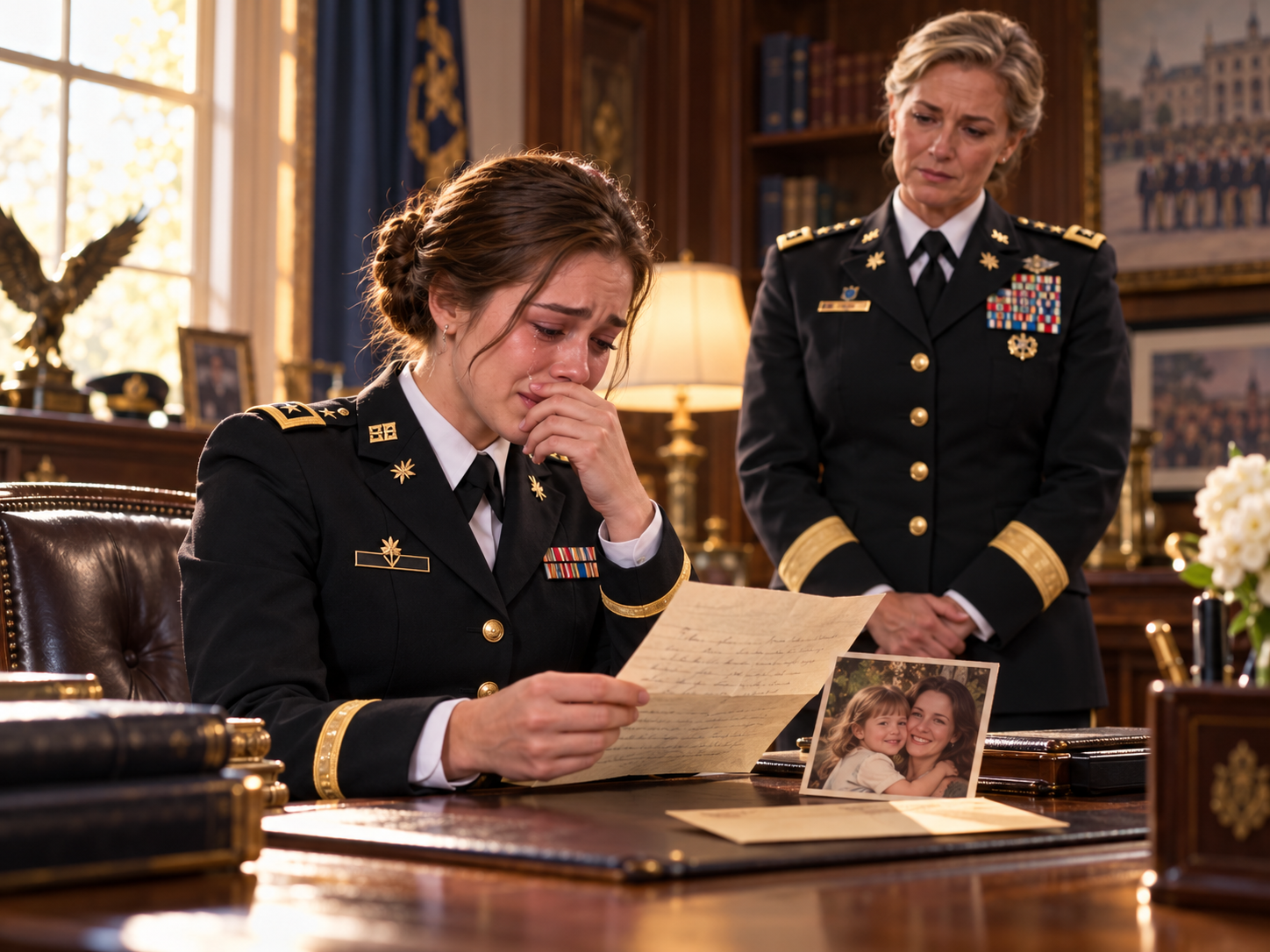
I’d chased perfect grades.
Awards.
Recognition.
Leadership positions.
I’d mistaken achievement for a bridge I could build across the distance between us.
And now, on the day I had finally reached the top of my class, my mother’s words told me what I had needed to hear all along.
There was never supposed to be a test.
I began crying.
Not the controlled tears I’d permitted myself during difficult moments at the academy.
I cried the way I hadn’t cried since childhood.
Colonel Shaw quietly placed a box of tissues on the desk.
She didn’t tell me to stop.
She didn’t ask whether I was all right.
She simply waited.
When I finally looked up, her eyes were wet too.
“She knew,” I whispered.
“Your mother?”
I nodded.
“She knew I would spend my life trying to be good enough for him.”
Colonel Shaw pulled out the chair opposite me.
“Clara, sometimes the hardest lesson for capable people is realizing they cannot solve every relationship through effort.”
I looked down at the photograph.
“What if I should have tried harder?”
She shook her head.
“Then you’d be asking the wrong question.”
I looked at her.
“The question isn’t whether you tried hard enough. It’s whether the other person was willing to meet you halfway.”
I folded the letter carefully.
For the first time in years, I allowed myself to consider that my father’s behavior might not be something I could fix.
There was another document in the envelope.
A short note from Daniel Mercer.
Clara, your mother instructed me to deliver the enclosed letter when you completed your first major professional or academic milestone as an adult. I understand today is that day. Please contact my office when you feel ready. There is an additional matter concerning your mother’s estate that should be discussed directly.
With warm congratulations,
Daniel Mercer.
I frowned.
My mother’s estate?
As far as I knew, Mom had left everything to Dad.
He’d told me that shortly after she died.
He said there had been medical bills, legal expenses, and a mortgage.
I was a child.
I’d believed him.
Colonel Shaw noticed my expression.
“Something wrong?”
“I don’t know.”
I showed her the note.
She read it, then returned it to me.
“Do you trust this attorney?”
“I think so. My mother did.”
“Then speak to him. And consider getting independent legal advice before making any decisions.”
I nodded.
Then my phone began vibrating.
Dad.
I let the call go unanswered.
It rang again.
Then a message appeared.
We need to talk immediately. Do not contact Mercer until you speak with me.
I stared at the screen.
A second message followed.
You have no idea what that man is trying to do to this family.
I felt my stomach tighten.
How did Dad know what the note said?
Unless he had already known about the estate matter.
I placed the phone facedown.
“Ma’am,” I said, “I think there’s more going on than I realized.”
Colonel Shaw studied me.
“Then take the time to learn the facts.”
That afternoon, I attended a reception for graduating officers and their families.
I hadn’t planned to stay.
After reading Mom’s letter, I wanted to disappear somewhere quiet.
But Maya insisted.
“You spent four years earning this day. Your father doesn’t get to steal the afternoon too.”
She was right.
So I stayed.
We ate miniature sandwiches, posed for photographs, and laughed about the most ridiculous moments of our academy careers.
My research adviser, Professor Samuel Bennett, gave me a small brass compass.
“Engineers tend to believe everything important can be measured,” he said. “Keep this as a reminder that sometimes you need to choose a direction before you know exactly where it leads.”
I promised to keep it.
General Bradley congratulated me again.
Several families I’d known for years came over to offer hugs.
Maya’s mother, Elena Torres, kissed my forehead.
“Your mother would have been so proud.”
Those words nearly broke me.
“Thank you, Mrs. Torres.”
She squeezed my hand.
“Call me Elena. You’ve been eating my cooking for four years. We’re well past formalities.”
I laughed.
And for a few wonderful minutes, I felt surrounded by people who were genuinely happy for me.
Then Haley appeared.
She walked toward me with her phone held against her chest.
“Clara, we need to talk.”
Maya looked suspicious.
“About what?”
Haley glanced at her.
“Privately.”
I considered refusing.
Then I noticed something unusual.
Haley’s eyes were red.
Her makeup had been carefully repaired, but the skin around her nose was swollen.
She’d been crying.
I followed her into a quiet hallway.
“What is it?”
She looked down.
“Dad is furious.”
“I noticed.”
“He thinks you’re trying to humiliate him.”
I stared at her.
“He shoved me outside in the rain.”
Haley shifted uncomfortably.
“Mom says you provoked him.”
“Did you see what happened?”
She hesitated.
“Yes.”
“Did I provoke him?”
She looked away.
I waited.
Finally, she whispered, “No.”
It was one word.
But it was the first time Haley had ever openly contradicted our parents to my face.
I folded my arms.
“Then why didn’t you help me?”
Her eyes filled.
“I don’t know.”
I didn’t answer.
She continued.
“Everything happened fast. Dad was angry, and Mom kept saying we needed to get inside. I thought you’d just use another entrance.”
I shook my head.
“You watched him push me.”
“I know.”
“You watched me almost fall.”
Her face crumpled.
“I know, Clara.”
For a moment, I saw something of the little girl I’d met when Vivian married Dad.
Haley had been nine.
I’d been fourteen.
Back then, she’d followed me around the house and asked me to braid her hair.
We’d played board games and built blanket forts.
Things changed gradually.
Every time Haley accomplished something, Vivian turned it into a family celebration.
Every time I accomplished something, Vivian explained why Haley needed more attention.
Eventually, Haley began repeating her mother’s words.
It had become easier for her to compete with me than to question the system that rewarded her.
But today, for the first time, she seemed ashamed.
“I didn’t know about the valedictorian thing,” she whispered.
“That’s because you never asked.”
“I know.”
“And when Dad gave you my invitation, you knew it was wrong.”
Her silence answered.
Then she said, “There’s something else.”
I waited.
“Mom posted a video.”
My stomach dropped.
“What video?”
Haley held out her phone.
I took it.
The video showed my father outside the academy entrance.
I recognized the location immediately.
Someone had recorded part of our confrontation.
The clip began just as I raised my voice.
“Get out of my way.”
Then it showed my father taking hold of my arm.
But the recording cut away before he shoved me.
Instead, it jumped to a shot of Dad walking inside with Vivian and Haley.
A caption appeared across the screen.
Even on graduation day, some children forget to respect the parents who sacrificed everything for them.
I stared at the screen.
Below the video were thousands of views.
Hundreds of comments.
Some criticized me for disrespecting my father.
Others asked why the footage appeared edited.
A few recognized the academy and wondered whether I was the same Clara Hensley who had received the major award.
I looked at Haley.
“Your mother posted this?”
She nodded.
“When?”
“About an hour ago.”
“Why?”
Haley wiped her cheek.
“She said people would believe Dad if they saw you being disrespectful first.”
I felt cold.
This wasn’t merely an argument anymore.
It was an attempt to rewrite what had happened.
“Did you record it?”
Haley lowered her eyes.
“Yes.”
I stared at her.
She began speaking quickly.
“I wasn’t trying to hurt you. I always film everything. Mom asked me to send her the clip, and I did. I didn’t know she was going to edit it.”
“Do you still have the original?”
She hesitated.
Then nodded.
“On my phone.”
I took a slow breath.
“Don’t delete it.”
“Clara—”
“Please, Haley.”
She looked frightened.
“What are you going to do?”
“I don’t know yet.”
And that was the truth.
I was an officer now.
I understood the importance of evidence, procedure, and accountability.
But I was also a daughter who had just discovered her family was willing to publicly distort an act of physical aggression.
The two parts of me were struggling to occupy the same body.
Haley reached for her phone.
Then stopped.
“Dad told Mom to post it,” she whispered.
I looked at her.
“What?”
She swallowed.
“He said nobody would believe you if they thought you’d started the fight.”
For a moment, I couldn’t speak.
Then she added something even worse.
“He said if you wouldn’t help with the government contract, he needed to make sure you understood how much trouble you could cause yourself.”
I stared at my stepsister.
My father wasn’t simply angry that I’d defied him.
He was trying to use my reputation as leverage.
That evening, I called Daniel Mercer.
He answered on the second ring.
“Clara?”
“Yes, sir.”
There was a pause.
Then his voice softened.
“Congratulations, Lieutenant.”
I closed my eyes.
“Thank you.”
“Your mother would have been overjoyed.”
I held the letter against my chest.
“I read what she wrote.”
“I’m glad.”
I swallowed.
“Mr. Mercer, I need to ask you something.”
“Of course.”
“Why did my father tell me Mom left everything to him?”
The line went silent.
For several seconds, I wondered whether the call had disconnected.
Then Daniel spoke.
“Clara, are you somewhere private?”
“Yes.”
“Good. I want you to listen carefully. Your mother established a trust for your benefit before she died.”
My heart began pounding.
“A trust?”
“Yes.”
“Dad never told me.”
“I was afraid of that.”
I stood up from the edge of my hotel bed.
“What do you mean?”
Daniel exhaled slowly.
“Your mother owned a minority interest in a small engineering consultancy founded by her father. She placed that interest and certain other assets into a trust for you. The trust documents provide for an independent trustee and specify conditions under which the assets are transferred to your control.”
I gripped the phone.
“Are you saying my father has been controlling money that belongs to me?”
“I’m saying there are records we need to review before drawing conclusions.”
“But why wait until graduation?”
“Your mother believed your first major adult milestone would be an appropriate time for you to receive her personal letter. The trust itself has separate age and distribution provisions.”
I sat down again.
“How much money are we talking about?”
Daniel paused.
“The value has changed considerably over the years.”
“Mr. Mercer.”
He sighed.
“Based on the most recent available valuation, the assets associated with your beneficial interest may be worth approximately two million dollars. But that figure is preliminary, and your actual rights will depend on the trust documents and a proper accounting.”
I stopped breathing for a moment.
Two million dollars.
My father had spent years telling me that I was an expensive burden.
That my education cost too much.
That I should be grateful he allowed me to live at home during breaks.
I’d worked summer jobs and saved nearly every dollar.
I had avoided asking him for anything.
And now I was hearing that my mother had left me assets of considerable value.
I managed to ask, “Does Dad know?”
Daniel’s voice became careful.
“Your father was not appointed trustee. But he has been aware of the trust since it was created.”
I felt sick.
“Why would he keep that from me?”
“I cannot answer that without speculation.”
I stared at the wall.
Then Daniel said, “Clara, there’s something else you should know.”
My fingers tightened around the phone.
“What?”
“Three months ago, your father contacted my office.”
I went still.
“What did he want?”
“He asked whether the trust’s ownership interest could be pledged as security for a business loan.”
I felt the floor shift beneath me.
“He tried to borrow against my mother’s trust?”
“He made an inquiry. No pledge was approved by my office, and I have seen no evidence that the trust was lawfully encumbered. But I believe the request warrants further investigation.”
I stood up.
My hands were shaking.
Dad’s company.
The federal contract.
The sudden interest in my fellowship.
The edited video.
All of it began fitting together in a way I didn’t want to believe.
I whispered, “Is his company in trouble?”
Daniel didn’t answer immediately.
Then he said, “Clara, I think you need to come to my office tomorrow.”
“Why?”
“Because I have reason to believe your father has been presenting your mother’s assets as part of his personal financial position.”
My mouth went dry.
Daniel continued.
“And yesterday, someone attempted to obtain information from the trust’s financial administrator while claiming to act on your behalf.”
I froze.
“Who?”
“We’re still verifying the identity.”
Then he asked a question that made my blood run cold.
“Clara, have you signed any financial documents for your father in the last six months?”
I was about to say no.
Then I remembered Christmas.
A folder.
Dad standing over the kitchen counter.
His impatient voice.
It’s just routine paperwork, Clara. Sign where I marked it.
And suddenly, I couldn’t remember exactly what I’d signed.
PART 4 — THE PRICE OF MY SILENCE
I didn’t sleep that night.
Every time I closed my eyes, I saw the kitchen counter at Christmas.
A stack of documents.
My father’s expensive fountain pen.
And the impatient expression he’d worn when he asked me to sign.
It had been December 23.
I’d arrived home after a demanding semester, exhausted and eager for a few quiet days.
Dad had called me into his study.
“Clara, I need your signature on some paperwork.”
“What paperwork?”
“Insurance and family financial records. Routine stuff.”
I’d asked whether I could read it later.
He’d sighed.
“Why do you always have to make things complicated?”
Then Vivian had appeared in the doorway.
“Your father is trying to take care of things, Clara. Just help him for once.”
I had signed two pages.
Maybe three.
I couldn’t remember.
At the time, it had seemed like a small concession that might prevent another family argument.
Now, sitting in my hotel room months later, I understood how dangerous that habit had become.
I’d spent years surrendering small pieces of independence to keep the peace.
And I had no idea what those signatures might have cost me.
Daniel Mercer’s office occupied the second floor of an old brick building overlooking a quiet town square.
I arrived at nine the following morning.
Maya came with me.
She had offered to wait outside, but Daniel invited her into the conference room after confirming I wanted her there.
He placed a thick folder on the table.
“Before we begin, Clara, I want to make one thing clear. We are going to distinguish what we know from what we suspect.”
I nodded.
He opened the folder.
Inside were copies of my mother’s trust documents, financial statements, correspondence, and a recent request for information submitted in my name.
He pushed one page toward me.
“Do you recognize this?”
My stomach dropped.
It was a photocopy of a document bearing my signature.
I recognized the handwriting.
But I didn’t recognize the document.
At the top were the words:
AUTHORIZATION FOR RELEASE OF BENEFICIARY FINANCIAL INFORMATION.
Daniel tapped the lower section.
“This appears to authorize a third party to request certain information concerning your beneficial interest.”
I looked at the name printed beneath the authorization.
Richard Hensley.
My father.
“I never knowingly agreed to this.”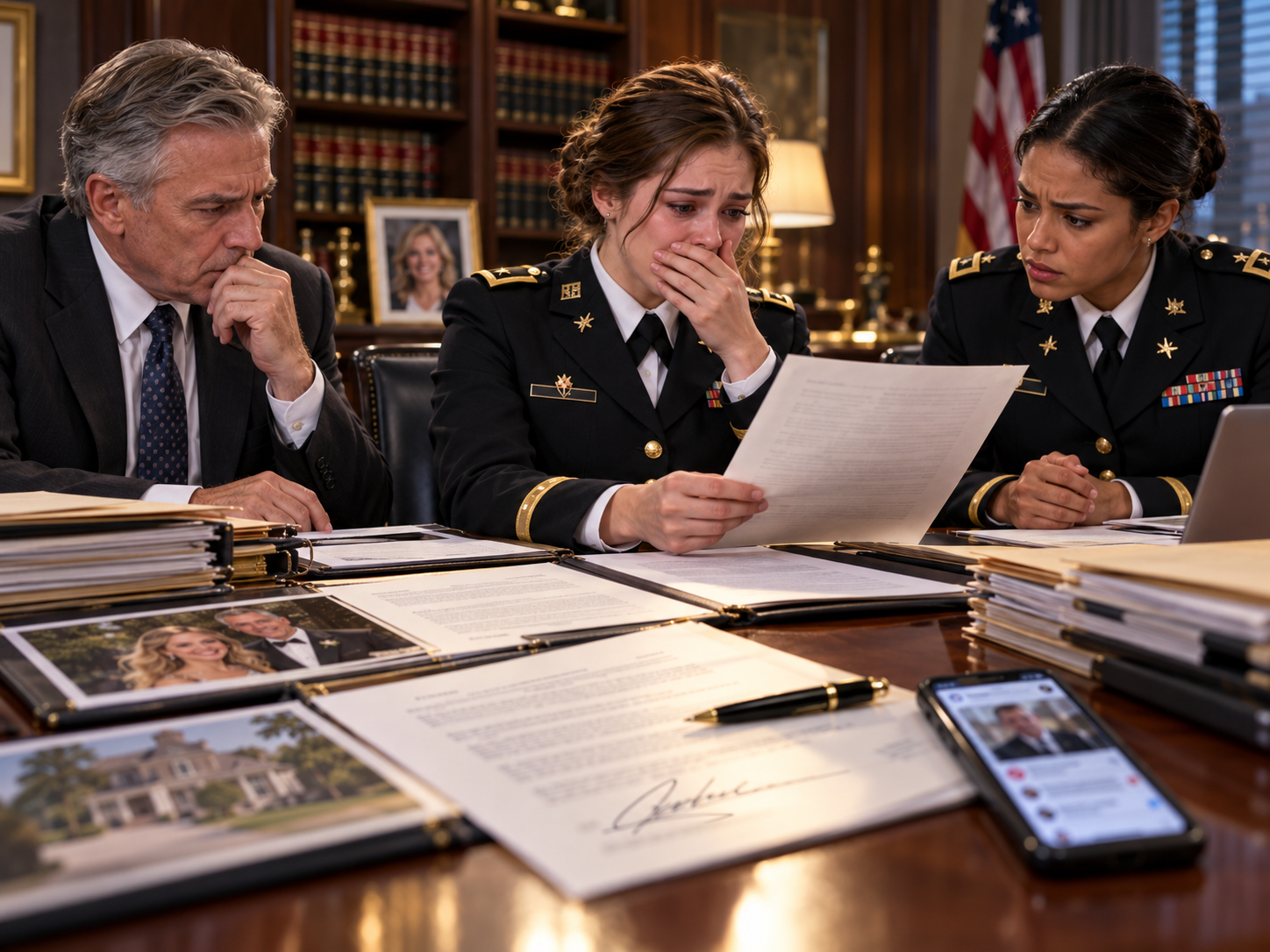
“Do you recognize the signature?”
“Yes. I think I signed it at Christmas. But I was told the papers concerned insurance.”
Daniel nodded slowly.
“Then we need to establish exactly what was presented to you and under what circumstances.”
Maya leaned forward.
“Was the authorization used?”
Daniel turned another page.
“An inquiry was made. The financial administrator declined to release substantive information because the paperwork did not satisfy its verification requirements.”
I exhaled.
For the first time that morning, I felt some relief.
But Daniel wasn’t finished.
“Your father also approached a lender about financing for Hensley Development Group.”
My father’s company.
For twenty years, Dad had built his identity around that business.
He drove expensive cars, wore tailored suits, and talked constantly about expansion.
Every family gathering eventually turned into a lecture about his success.
“What happened?” I asked.
Daniel studied me.
“According to the records available to us, the lender requested clarification about assets your father had included in a preliminary financial statement. Some appear to have been associated with your mother’s trust.”
I stared at him.
“Can he do that?”
“He cannot simply treat trust property as his own. But we need a full accounting and the lender’s records to determine precisely what representations were made.”
I looked down.
“Has he stolen money?”
“We do not have evidence establishing that,” Daniel answered firmly. “And I won’t tell you otherwise.”
I appreciated his honesty.
Some part of me wanted a simple villain.
A clear accusation.
A document that explained everything.
But reality was more complicated.
Dad might have misrepresented assets.
He might have misunderstood legal restrictions.
He might have deliberately tried to exploit property he didn’t own.
We didn’t yet know.
What I knew was that he’d kept important information from me.
And he had used my trust in him to obtain signatures on documents I didn’t understand.
That alone was enough.
Daniel slid another folder toward me.
“This is a proposed plan for obtaining the records and protecting your interests. Nothing will be filed or sent without your authorization.”
I read it carefully.
For the first time, I didn’t rush to sign.
We were halfway through the documents when my phone rang.
Dad.
I declined the call.
A message appeared immediately.
Where are you?
Then another.
Mercer is manipulating you.
Then a third.
Come home now. We need to handle this as a family.
I showed Daniel.
He read the messages without comment.
Then asked, “Do you feel safe returning home?”
The question surprised me.
I opened my mouth.
Closed it.
Until yesterday, I’d never seriously questioned whether my childhood home was safe.
It had been unpleasant.
Cold.
Full of criticism.
But safe?
I remembered Dad’s fingers digging into my arm.
The shove.
The railing.
The edited video.
“I don’t know,” I admitted.
Maya reached across the table.
“Then you don’t have to go.”
Her words were so simple.
I almost cried.
For years, I’d believed that being a good daughter meant returning whenever my father demanded it.
Now someone was telling me I had a choice.
I looked at Daniel.
“I want to protect the trust. But I also want to understand what happened.”
He nodded.
“Then we’ll proceed carefully.”
He prepared a formal request for records and recommended that I seek independent representation for any dispute concerning the documents I’d signed.
I authorized a written notice revoking any questionable permission to release my financial information, to the extent the law allowed.
We also arranged for future trust communications to be sent directly to me.
When Daniel finished, he looked at me.
“Your mother created this arrangement because she wanted you to have a measure of independence.”
I stared at the photograph I’d brought with me.
“She never trusted Dad?”
He paused.
“I think your mother loved your father. I also think she understood his weaknesses better than he understood them himself.”
That answer hurt.
Because it sounded true.
The next problem arrived before lunch.
Maya’s phone buzzed.
She looked at the screen.
Then at me.
“Clara, you need to see this.”
Vivian’s video had spread beyond her social-media followers.
A local online page had reposted it under a sensational headline suggesting that a newly commissioned officer had mistreated her family during graduation.
The comments were ugly.
Some people defended me.
Others accused me of arrogance.
A few insisted military officers should demonstrate respect toward their parents regardless of circumstances.
I watched the edited clip once.
Then turned it off.
“I want the truth out there.”
Maya nodded.
“Then use the truth.”
We contacted Colonel Shaw.
She explained that the academy’s security office had preserved the available entrance footage after the incident was reported. Any release would need to follow proper procedures, and the academy would not simply publish security recordings to settle a private social-media dispute.
I understood.
Instead, I prepared a factual statement.
I described the events in chronological order.
I acknowledged that I had raised my voice when Dad blocked my path.
I explained that he had grabbed and shoved me.
I said I had reported the incident and would cooperate with any appropriate review.
I did not mention my mother’s trust.
I did not accuse my father of financial crimes.
I did not insult Vivian or Haley.
I simply refused to accept a false version of what happened.
Before posting anything, I asked Colonel Shaw for guidance about the applicable public-communication rules for a newly commissioned officer.
With that guidance, I published a short personal statement that avoided implying any official military endorsement.
Within an hour, the response began changing.
People who had watched the original clip noticed where it had been cut.
Former cadets and classmates spoke about my character.
Several of my instructors sent private messages of support.
Then Haley called.
I almost didn’t answer.
“Clara?”
Her voice was shaking.
“What is it?”
“Mom wants me to delete the original recording.”
I sat upright.
“Don’t.”
“She says it’ll ruin Dad.”
“Haley, listen to me. Preserve the file exactly as it is.”
“She took my phone earlier.”
My heart raced.
“What?”
“She wanted to know if I’d sent it to you.”
“Did you?”
“No. But I made a copy.”
I exhaled.
“Good.”
Then Haley whispered, “I want to tell the truth.”
I closed my eyes.
“Are you sure?”
“No,” she admitted. “I’m scared.”
I waited.
She continued.
“But I saw what Dad did. And I helped Mom make people believe something else.”
Her voice broke.
“I don’t want to keep doing that.”
For the first time in years, I heard my stepsister speak without trying to impress anyone.
I told her to preserve the original recording and provide it through the proper channels.
She agreed.
Then she said something unexpected.
“Clara, Dad isn’t just angry about the video or the trust.”
My stomach tightened.
“What do you mean?”
“He had a meeting with two men from his company this morning. I heard them talking.”
“About what?”
“Some federal project. The one he kept asking you about.”
I went still.
Haley continued.
“He said your fellowship could make everything easier.”
My hand tightened around the phone.
“Did he say anything else?”
She hesitated.
“He said if you refused to cooperate, he’d tell everyone you weren’t mentally stable enough for your assignment.”
For a moment, the room seemed to tilt.
My father was willing to attack my professional reputation to pressure me into helping his business.
I looked toward Maya.
She saw my expression and immediately came closer.
“Clara?”
I held up one finger.
Then spoke into the phone.
“Haley, I need you to stay out of his business conversations. Don’t investigate anything for me.”
“But—”
“I mean it. You’re not responsible for fixing this.”
She was silent.
Then she whispered, “Okay.”
After the call ended, I contacted Colonel Shaw again.
This time, I reported the potential conflict of interest involving my father’s company and the concerns about threats to my reputation.
She listened carefully.
Then said, “Lieutenant Hensley, you did the right thing by disclosing this. We’ll make sure you receive guidance on the appropriate ethics procedures before your fellowship begins.”
I looked out the window.
The sun was shining.
Two days earlier, I’d believed graduation would end the most difficult chapter of my life.
Instead, it had opened a door into everything my family had kept hidden.
That evening, Dad came to my hotel.
I knew because the front desk called my room.
“Ms. Hensley, there’s a gentleman here claiming to be your father. He says he needs to speak with you urgently.”
I stood beside the window.
For a long time, I didn’t answer.
Then I said, “Please tell him I won’t be receiving visitors.”
A few minutes later, my phone rang.
I let it go to voicemail.
His message began angrily.
“You’ve humiliated this family enough.”
I almost deleted it.
Then his voice changed.
“You think you’re so important now? A few generals shake your hand and suddenly your father means nothing?”
I listened silently.
“You don’t know what I’ve done to keep this family afloat.”
There was a pause.
Then he said something that made my chest ache.
“Your mother would be ashamed of the way you’re treating me.”
I ended the recording.
For a moment, I couldn’t move.
Then I took Mom’s letter from my bag.
I read the final paragraph again.
You have never needed to earn the right to be loved.
I sat down.
And for the first time, I understood that my father had used my love for him as a bargaining chip for years.
If I obeyed, perhaps he’d be proud.
If I sacrificed, perhaps he’d be kind.
If I gave him what he wanted, perhaps he’d finally see me.
But love that arrived only after surrender wasn’t the love I’d been searching for.
I picked up my phone.
Then sent one message.
Dad, I will discuss the financial matters through legal counsel. I will not use my military position for your business. And I will not meet with you unless you can respect my boundaries.
He replied almost immediately.
After everything I’ve done for you, this is how you repay me?
I stared at those words.
Then switched off my phone.
Outside, the last sunlight fell across the rooftops.
For the first time in my life, I let my father be angry without trying to fix it.
And somewhere in the silence, I began to feel free.
PART 5 — THE FAMILY I CHOSE
Six weeks after graduation, my father stood across from me in a conference room and admitted something I never expected to hear.
“I thought if you became successful enough, you’d realize you didn’t need me.”
I stared at him.
Of all the explanations I’d imagined, that wasn’t one of them.
We were meeting at Daniel Mercer’s office.
Our attorneys were present.
The room was quiet.
And for the first time in my life, my father wasn’t the most powerful person at the table.
He looked different.
His expensive suit hung loosely around his shoulders.
There were dark circles beneath his eyes.
His confidence seemed to have drained away.
During the previous six weeks, several things had happened.
The trust administrator had completed a preliminary review of the disputed financial requests.
The available records showed that Dad had attempted to use information concerning my mother’s trust in discussions about his company’s financing.
No evidence established that he had succeeded in pledging the trust assets or withdrawing its money.
But he had made representations that required correction, and the documents I’d signed at Christmas had been used in ways I had never knowingly authorized.
Through his attorney, Dad withdrew the disputed authorization and agreed to provide the relevant records.
His company also had to clarify its financial disclosures to the lender.
Those steps didn’t erase what he’d done.
But they prevented the situation from becoming more damaging.
Meanwhile, the academy had documented the incident at the entrance.
Haley had provided her original recording.
It showed Dad grabbing my arm.
It showed him shoving me toward the railing.
And it showed my family walking away.
After receiving legal guidance, Haley withdrew her support for Vivian’s edited version and posted a public correction.
The original misleading post was eventually removed.
Vivian was furious.
She accused Haley of betraying the family.
Haley moved temporarily into an apartment with a friend.
For the first time, she’d chosen a difficult truth over an easy lie.
I knew how frightening that choice could be.
Dad shifted in his chair.
“I don’t expect you to understand,” he said.
I folded my hands.
“Then explain.”
He looked at Daniel, then back at me.
“When your mother died, everything changed.”
I waited.
He swallowed.
“She was the one who understood you. The science projects. The engineering drawings. The way you could spend hours taking something apart and putting it back together.”
My throat tightened.
Dad continued.
“I didn’t understand any of it.”
“That never stopped you from trying with Haley.”
He lowered his eyes.
“No.”
“Why?”
He rubbed his forehead.
“Haley wanted the things I understood. Business connections. Parties. Money. Social status.”
I watched him carefully.
“And I didn’t.”
“No.”
He took a breath.
“The older you got, the more you reminded me of your mother.”
My heart twisted.
“She was smarter than I was,” he said quietly. “She could look at a problem and see what mattered. I always worried about what everyone else thought.”
He gave a bitter laugh.
“And then you started doing the same things she did. You made your own decisions. You stopped asking me what I wanted.”
I stared at him.
“So you punished me for becoming independent?”
He closed his eyes.
For several seconds, he said nothing.
Then he nodded.
“Yes.”
The admission hurt more than another denial would have.
Because it confirmed that some part of him had understood what he was doing.
I leaned forward.
“Dad, I was twelve when Mom died.”
His face tightened.
“I know.”
“I was a little girl. I needed you.”
His eyes filled.
“I know.”
“No,” I whispered. “I don’t think you do.”
I felt tears gathering but continued.
“I needed someone to tell me it was okay to miss her. I needed someone to come to school events. I needed someone to ask whether I was happy.”
Dad lowered his head.
“I kept thinking if I worked harder, you’d notice me.”
My voice broke.
“I became first in my class, Dad. And the morning I graduated, you shoved me away because you thought I was embarrassing you.”
Tears slipped down his cheeks.
“I am sorry.”
I sat back.
For years, I’d imagined those words.
I’d pictured hearing them at birthdays, holidays, and quiet family dinners.
I’d imagined that an apology would immediately repair everything.
But sitting there, looking at him, I realized an apology could be sincere without being sufficient.
“I believe you’re sorry,” I said.
He looked up hopefully.
“But I don’t trust you.”
His expression crumpled.
I continued.
“Trust isn’t something you get back because you finally understand what you lost.”
He nodded slowly.
“I know.”
“If you want a relationship with me, things have to change. You need to accept responsibility without blaming Vivian, Haley, Mom, or me. You need to respect my decisions. And you can never use my career or reputation to pressure me again.”
He looked down.
“Can we try?”
I took a long breath.
“Maybe. Over time.”
His eyes closed.
It wasn’t the answer he wanted.
But it was the only honest answer I could give.
Vivian never apologized.
She sent one message accusing me of destroying the family’s reputation.
Then another claiming that I had manipulated Haley.
I didn’t respond.
Eventually, I blocked her.
I had spent enough of my life arguing with someone who treated kindness as weakness.
Haley, however, surprised me.
She called every Sunday.
At first, our conversations were awkward.
We discussed the weather, work, and books.
Then slowly, we began talking about our childhood.
One evening, she said, “I used to be jealous of you.”
I nearly laughed.
“Of me?”
“Yes.”
“Haley, Mom and Dad celebrated every achievement you had.”
“I know.”
She paused.
“But you could do things I couldn’t. You were smart. You had discipline. You knew what you wanted.”
I shook my head.
“You had plenty of strengths.”
“Maybe. But Mom always compared us. She said if I didn’t become successful, people would start asking why you were doing better.”
I was silent.
Haley sighed.
“I thought making you look small would make me feel bigger.”
There it was.
The truth beneath years of competition.
“I hated how you treated me,” I admitted.
“I know.”
“But I never hated you.”
She began crying.
For a few moments, neither of us spoke.
Then she said, “I don’t want to be that person anymore.”
I believed she meant it.
Whether she could sustain that change was something only time would show.
But for the first time, I wanted to give our relationship a chance.
My father’s company survived.
Not unchanged, but intact.
He sold several assets, reduced its borrowing, and stepped away from a proposed federal contracting opportunity that had raised concerns.
The trust matter was addressed through documentation, independent review, and a written settlement of the disputed authorization issues. Dad acknowledged in writing that he had no ownership rights over the trust property.
The assets remained protected under the trust’s terms.
I did not suddenly become a millionaire with unlimited cash.
The trust still had restrictions, investments, and administrative responsibilities.
But I finally understood what my mother had left me.
More importantly, I understood why.
She had wanted me to have choices.
Not leverage over other people.
Not status.
Not permission to live extravagantly.
Choices.
The ability to build a life without begging someone else to approve of it.
And I intended to honor that.
My first months after graduation were demanding.
I completed the next stage of my military training, learned from experienced officers, and worked harder than I had expected.
The fellowship remained a source of excitement and responsibility.
Because of the disclosed family connection to a company interested in federal infrastructure work, ethics officials reviewed the circumstances and established appropriate safeguards.
I would have no role involving my father’s company or any matter that could create a conflict of interest.
I welcomed those restrictions.
I wanted my work to stand on its own merits.
Eventually, I joined the fellowship team in Washington.
Our first major project examined emergency transportation vulnerabilities at installations exposed to increasingly severe storms.
It involved long days.
Complicated engineering questions.
Conflicting priorities.
And difficult conversations about budgets.
Sometimes I returned to my apartment so exhausted that I fell asleep in my uniform undershirt.
But I loved the work.
For the first time, I was doing exactly what I had dreamed about as a teenager.
I was helping turn research into practical decisions that could protect real people.
Four months later, I received a letter from General Bradley.
Inside was a photograph taken during graduation.
It showed me standing on the auditorium stage.
General Whitfield was shaking my hand.
The sealed fellowship folder was visible between us.
Behind us, hundreds of cadets and guests were applauding.
General Bradley had written a short note.
Clara,
I’ve presented many awards during my career, but I seldom see a young officer receive recognition with such humility after overcoming such a difficult morning.
Remember that your character was already evident long before you walked onto that stage.
Your responsibility now is not to prove your worth. It is to use your abilities wisely.
With pride,
Jonathan Bradley.
I placed the photograph on my desk.
Then I opened the small wooden box containing my mother’s letter.
Beside it lay the brass compass Professor Bennett had given me.
I looked at those three objects for a long time.
The photograph represented what I had earned.
The compass represented where I was going.
And my mother’s letter represented something I had always possessed, even when I’d forgotten it.
Love.
Not the conditional approval I’d spent years chasing.
The real kind.
The following spring, our research team organized a community demonstration in a town recovering from destructive flooding.
Engineers, emergency managers, local officials, and volunteers gathered to review improvements to evacuation planning and temporary transportation systems.
My role wasn’t glamorous.
I stood beside a display explaining how small infrastructure upgrades could significantly improve emergency access.
An elderly woman approached.
She wore a blue cardigan and carried a photograph of a house surrounded by floodwater.
“Are you one of the engineers?” she asked.
“Yes, ma’am.”
She pointed toward our project.
“Will this help ambulances get through when the roads flood?”
“That’s one of the goals.”
She nodded.
Then she showed me the photograph.
“My husband needed medical attention during the last big storm. The ambulance couldn’t reach our street for hours.”
My chest tightened.
“I’m sorry.”
She touched my arm.
“He’s all right now. But I hope the next family doesn’t have to go through what we did.”
I looked at the photograph.
Then at the woman.
And suddenly, I remembered why I’d started studying engineering.
Not for medals.
Not for applause.
Not to prove my father wrong.
For people like her.
I explained what our team was working on and what remained uncertain.
She listened patiently.
When I finished, she smiled.
“Your parents must be so proud of you.”
For a moment, the familiar ache returned.
Then I thought about Mom.
About Maya.
About Colonel Shaw.
About General Bradley and the classmates who had stood to applaud me.
And about the person I had become.
I smiled back.
“My mother would have been.”
The woman squeezed my hand.
“Then I think she’s the one who matters today.”
I watched her walk away.
And for the first time, those words didn’t make me sad.
They made me feel at peace.
A year after my graduation, the academy invited me back to speak with a group of cadets preparing for their final year.
The invitation surprised me.
I was still a young officer.
I had so much to learn.
But General Bradley believed my experiences could help cadets who were struggling to define success beyond grades and rankings.
I accepted.
The evening before the visit, my phone rang.
Dad.
We had been speaking occasionally.
He had begun attending counseling and had continued cooperating with the legal agreements concerning the trust.
Our relationship remained careful.
But he had stopped demanding immediate forgiveness.
When I answered, his voice sounded nervous.
“Clara?”
“Hi, Dad.”
“I heard you’re speaking at the academy tomorrow.”
“Yes.”
There was a pause.
“That’s wonderful.”
“Thank you.”
He cleared his throat.
“I wanted to ask something. And you can say no.”
I waited.
“Would it be all right if I came?”
My chest tightened.
For a moment, I was standing in the rain again.
Watching him disappear through the bronze doors.
Then I looked at the photograph on my desk.
A year had passed.
He had begun making changes.
And I had learned that setting boundaries didn’t always mean closing a door forever.
“It isn’t a public event,” I said. “But there’s a small reception afterward. I can ask whether guests are allowed.”
He exhaled.
“Only if you’re comfortable.”
I looked out the window.
“I’ll think about it.”
“Of course.”
Then he said something I had waited my entire childhood to hear.
“Clara, whether I come or not, I’m proud of you.”
My eyes filled.
I didn’t answer immediately.
For years, I’d believed hearing those words would transform my life.
Now I knew my life had already changed without them.
But that didn’t mean they were meaningless.
“Thank you, Dad.”
We ended the call.
And for the first time, I didn’t feel that my happiness depended on what happened next.
The following afternoon, I returned to the academy.
The weather was beautiful.
Sunlight shone across the stone buildings.
Cadets crossed the grounds in neat groups.
The bronze doors stood open.
I stopped outside the entrance where my father had shoved me one year earlier.
For a moment, I remembered everything.
The cold rain.
The pain in my arm.
The humiliation.
The terrible temptation to walk away.
Then I remembered the umbrella appearing above my head.
And a general’s voice.
Clara, you’re the reason half those people came.
I smiled.
I entered the building.
This time, I wasn’t searching for permission.
I knew exactly where I belonged.
The reception afterward was smaller than the graduation celebration.
Maya had come to surprise me.
She was wearing her uniform, grinning, and carrying two cups of coffee.
“You still give speeches like you’re trying to win another award,” she teased.
I laughed.
“And you still criticize everything I do.”
“It’s called maintaining standards.”
We hugged.
Across the room, General Bradley spoke with several instructors.
Professor Bennett stood near a display of student research projects.
Then I noticed a familiar figure standing quietly beside the doorway.
Dad.
He was alone.
No Vivian.
No expensive entourage.
No phone held out for photographs.
He wore a simple gray suit.
In his hands was a small bouquet of white flowers.
He looked uncertain.
For a moment, neither of us moved.
Then he approached.
“Hello, Clara.”
“Hi, Dad.”
He held out the flowers.
“These were your mother’s favorites.”
My throat tightened.
I accepted them.
“Thank you.”
He looked around the room.
“I listened to part of your talk from the back. General Bradley said it would be all right.”
I nodded.
“What did you think?”
Dad gave a small smile.
“I think you understand things I’m only beginning to learn.”
I looked at him.
He continued.
“I spent so much of my life believing success meant having people notice me.”
His eyes moved toward the cadets gathered near the displays.
“But you seem happiest when you’re helping someone else.”
I smiled faintly.
“Mom was like that.”
“Yes,” he whispered. “She was.”
For a few moments, we stood together in silence.
Then Dad reached into his jacket.
“I brought something else.”
He handed me a small envelope.
Inside was a photograph.
My mother stood in the backyard, smiling, with her arms around me.
I was about six.
We were both covered in mud.
Behind the photograph was a handwritten note.
Dad looked embarrassed.
“You built a little bridge across the drainage ditch behind the house. It was made from scrap wood.”
I remembered.
Mom had helped me.
We’d spent an entire Saturday arguing about how to keep the bridge from collapsing.
Dad continued.
“Your mother told me you were going to build real bridges someday.”
My eyes filled.
“I remember.”
He looked down.
“I should have listened.”
I held the photograph carefully.
“Yes,” I said.
He nodded.
“I know.”
Then, very slowly, I stepped forward and hugged him.
It wasn’t an embrace that erased the past.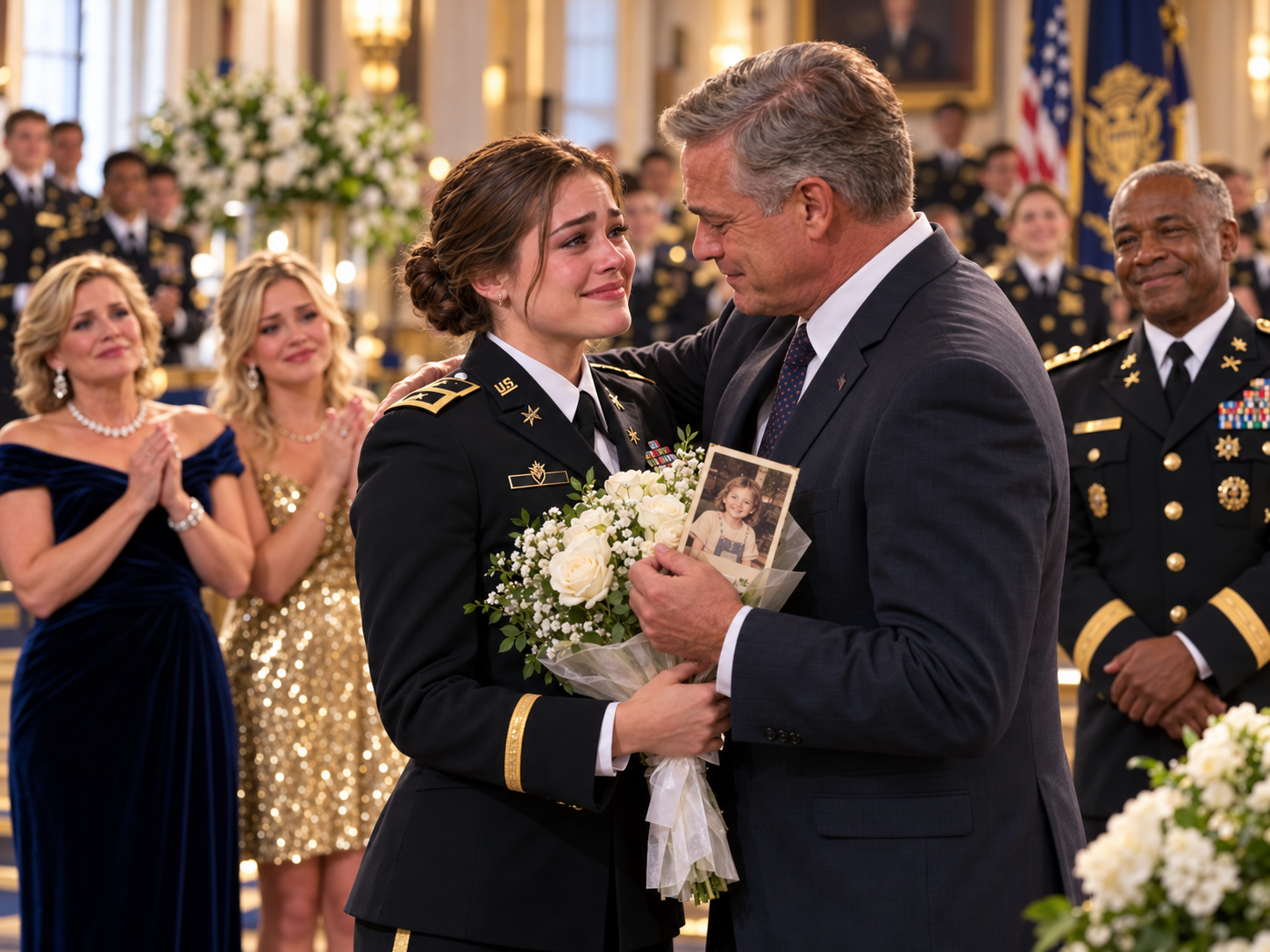
It wasn’t a promise that everything would return to normal.
It wasn’t forgiveness given because he finally knew the right words.
It was simply one moment.
A father trying to become better.
And a daughter strong enough to decide what closeness she could offer.
When we separated, he wiped his eyes.
“Can we have dinner sometime?”
I smiled.
“Maybe next week.”
His face softened.
“I’d like that.”
And this time, when he smiled, I believed he meant it.
That evening, after everyone had gone, I walked alone across the academy grounds.
The sky had turned a brilliant shade of orange.
The last sunlight touched the windows.
Somewhere in the distance, cadets were laughing.
I stopped beside the railing where I had nearly fallen one year earlier.
I placed my hand on the cool metal.
For a moment, I could almost see my younger self standing there.
Drenched.
Rejected.
Holding back tears.
Believing that the most important person in her life had just decided she wasn’t worth noticing.
I wished I could go back to that morning.
Not to confront my father.
Not to change the ceremony.
Not even to warn myself about the secrets waiting in my mother’s letter.
I wanted to place an umbrella over that frightened young woman’s head.
I wanted to tell her that she would survive.
That she would learn the truth.
That she would protect what her mother had left her.
That she would find people who celebrated her without demanding anything in return.
And that one day, she would no longer need to be chosen by her family to feel worthy of love.
I looked up at the clear evening sky.
“Thank you, Mom,” I whispered.
The wind moved gently through the trees.
I smiled.
Then I turned toward the academy gates.
Tomorrow there would be more work.
More difficult decisions.
More opportunities to fail and begin again.
My life wouldn’t always be easy.
My relationship with my father might never become the uncomplicated bond I’d once dreamed of.
But I had stopped measuring my future by the wounds of my past.
I had a career I believed in.
Friends who stood beside me.
A mother whose love had survived her absence.
A stepsister learning to choose honesty.
And the freedom to decide what kind of person I wanted to become.
One year earlier, my father had left me outside in the rain because he believed nobody would notice I was missing.
Now I understood something far more important than the applause that followed.
The most powerful moment of my life wasn’t when an entire auditorium stood to recognize me.
It was when I finally stopped waiting for my father to tell me I mattered.
I walked through the gates with my head held high.
Not because I had become famous.
Not because I had earned a prestigious fellowship.
Not because my father had finally apologized.
But because I had learned what my mother had known all along.
I was enough before the awards.
I was enough before the uniform.
I was enough before anyone stood to applaud.
And I would still be enough when the applause ended.
For the first time in my life, I wasn’t walking toward a future I hoped would make someone love me.
I was walking toward a future I had chosen for myself.
And that was the greatest honor of all.
THE END.