Christa Pike’s Attorneys Disappointed After Tennessee Supreme Court Declines to Halt Execution

Christa Pike’s Attorneys Disappointed After Tennessee Supreme Court Declines to Halt Execution
SEO Title
Christa Pike Attorneys Disappointed by Court Decision
Meta Description
Christa Pike’s attorneys say they are deeply disappointed after Tennessee’s Supreme Court declined to halt her Sept. 30 execution.
The attorneys representing Tennessee death-row inmate Christa Pike say they are deeply disappointed after the Tennessee Supreme Court declined to halt her scheduled execution.
The court ruled September 23 that Pike had not shown she was likely to succeed in her challenges to Tennessee’s lethal-injection protocol. Pike is scheduled to be executed on September 30 at Riverbend Maximum Security Institution in Nashville.
Her legal team has continued the fight in federal court and filed an application with the U.S. Supreme Court seeking a stay of execution. The Supreme Court docket shows that the stay application was submitted September 25 and remains pending.
Background
Pike was convicted of the 1995 killing of 19-year-old Colleen Slemmer in Knoxville. She was 18 when the crime occurred and was sentenced to death in 1996.
Pike’s attorneys have focused much of their recent legal and clemency efforts on circumstances surrounding her childhood, mental health and age at the time of the crime.
They have argued that Pike experienced severe abuse and trauma growing up and that significant mitigating evidence was not adequately presented during her original capital proceedings.
The legal team has also challenged Tennessee’s lethal-injection procedures, arguing that the state’s protocol could expose Pike to unconstitutional suffering.
Tennessee Supreme Court Decision
The Tennessee Supreme Court issued its decision on September 23, declining to stay Pike’s execution.
The court reviewed a special master’s determination concerning Pike’s challenge to Tennessee’s lethal-injection protocol. According to the court’s ruling, Pike was unlikely to succeed on her facial or as-applied challenges to the protocol.
The decision left the September 30 execution date in place.
Tennessee court records list the September 23 order as an order denying a stay of execution.
Pike’s Attorneys Respond
Pike’s attorneys Kelly Gleason and Stephen Ferrell described themselves as deeply disappointed by the decision.
In a statement reported by the Chattanooga Times Free Press, the attorneys said they remained focused on seeking relief from the U.S. Supreme Court and on asking Gov. Bill Lee to commute Pike’s death sentence to life without parole.
The attorneys argued that Pike’s age and background should be considered when evaluating her sentence.
“Christa was just 18 years old at the time of the crime,” the attorneys said, while also pointing to what they described as a history of severe abuse and serious undiagnosed mental illness.
Their statement also argued that developments in the scientific understanding of adolescent brain development and childhood trauma should be considered in Pike’s case.
Those statements represent the defense team’s position and are not findings by the Tennessee Supreme Court.
Appeal to the U.S. Supreme Court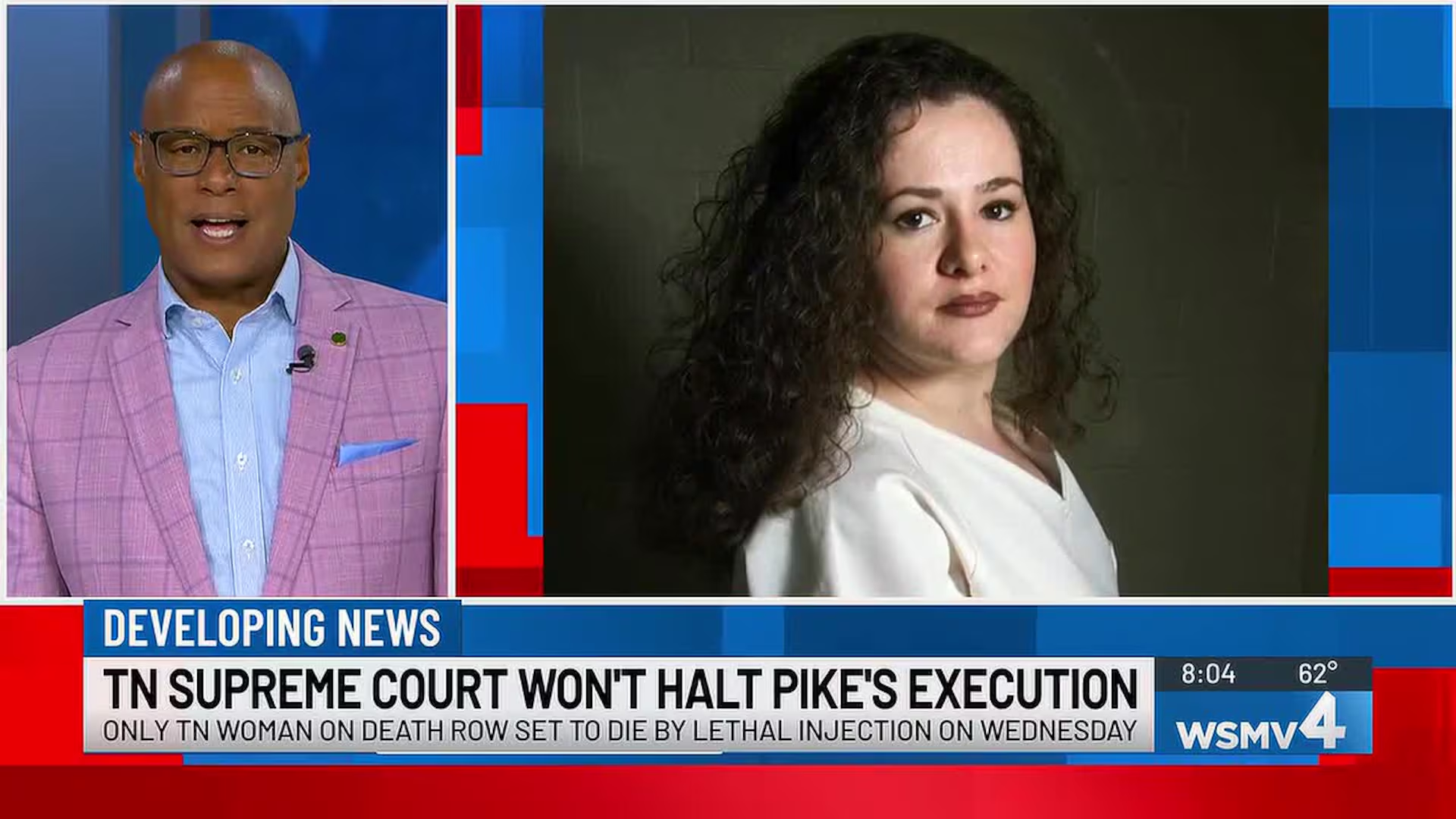
Following the Tennessee Supreme Court’s decision, Pike’s attorneys took the case to the U.S. Supreme Court.
The Supreme Court’s docket shows that Pike filed an application for a stay of execution on September 25. The application was submitted to Justice Brett Kavanaugh and remains listed as pending.
In the filing, Pike’s attorneys argue that the Tennessee litigation process imposed a heightened initial burden on her because of a state rule governing death-penalty challenges.
They also challenge the Tennessee Supreme Court’s conclusion that Pike was unlikely to succeed in her challenge to the lethal-injection protocol.
The filing is an argument from Pike’s legal team, not a ruling by the U.S. Supreme Court.
Clemency Request
Pike’s attorneys have also sought executive clemency from Gov. Bill Lee.
On September 28, Lee announced that he would not intervene in the case.
“After deliberate consideration of Christa Gail Pike’s request for clemency, and after a thorough review of the case, I am upholding the sentence of the State of Tennessee and do not plan to intervene,” Lee said.
That decision means Pike’s remaining major avenue for an immediate stay is through the courts, including her pending U.S. Supreme Court application.
What the Defense Is Arguing
Pike’s attorneys have emphasized several issues in their recent filings and clemency efforts.
Among them are:
- Pike was 18 when Slemmer was killed.
- Her attorneys say she experienced severe childhood abuse and trauma.
- They argue that significant mitigating evidence was not adequately presented at her original sentencing.
- They challenge Tennessee’s lethal-injection protocol.
- They argue that the procedures governing capital prisoners’ challenges create constitutional problems.
The defense does not argue that Pike was innocent of Slemmer’s killing. Recent reporting indicates that Pike has acknowledged responsibility and expressed remorse.
An International Human Rights Finding
The legal battle comes as the Inter-American Commission on Human Rights has separately issued findings concerning Pike’s case.
On September 24, the IACHR said it found violations involving Pike’s legal representation, due process and conditions of confinement. The commission also said that carrying out the death sentence following proceedings it determined violated Pike’s rights would constitute a serious violation of her rights.
The IACHR is an international human-rights body of the Organization of American States. Its findings are separate from the Tennessee and U.S. court proceedings.
The commission has requested that the United States take measures including reviewing and commuting Pike’s sentence and addressing her conditions of confinement.
What Is Confirmed
As of September 29, 2026:
- Pike’s execution remains scheduled for September 30.
- The Tennessee Supreme Court declined to stay the execution on September 23.
- The court found that Pike was unlikely to succeed in her challenges to Tennessee’s lethal-injection protocol.
- Pike’s attorneys have filed a stay application with the U.S. Supreme Court.
- The Supreme Court docket lists that application as pending.
- Gov. Bill Lee denied Pike’s clemency request on September 28.
- Pike’s attorneys continue to seek judicial relief.
- The IACHR has issued findings concerning Pike’s treatment, legal representation and death sentence.
What Remains Unclear
The most immediate unanswered question is whether the U.S. Supreme Court will issue a stay before the scheduled execution.
The public Supreme Court docket currently shows Pike’s application pending, but the docket alone does not establish what action the justices will ultimately take.
It also remains unclear whether any additional court action or other legal development will alter the September 30 execution schedule.
Why September 30 Matters
If the execution proceeds, Pike would become the first woman executed by Tennessee in more than 200 years.
She is also the first person scheduled for execution in Tennessee in the modern death-penalty era for a crime committed at age 18, according to reporting on the case.
The combination of Pike’s age at the time of the crime, her history of trauma, the lethal-injection challenge and the final appeals has made the case the subject of continuing legal debate.
For Pike’s attorneys, however, the immediate focus is narrower: whether a court will intervene before the scheduled execution.
Latest Update
As of September 29, 2026, the Tennessee Supreme Court’s decision remains in effect, Gov. Bill Lee has denied clemency, and Pike’s application for a stay remains before the U.S. Supreme Court.
Her attorneys have said they are deeply disappointed by the Tennessee court’s decision but intend to continue pursuing legal relief.
The next major development will be any action by the U.S. Supreme Court before Tennessee’s scheduled execution on September 30.
For now, the execution date remains in place.