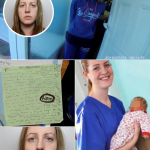
SHE WAS “VERY INVESTED” IN THE LINDSAY CLANCY CASE — THEN HER 2-YEAR-OLD SON WAS FOUND DEAD

SHE WAS “VERY INVESTED” IN THE LINDSAY CLANCY CASE — THEN HER 2-YEAR-OLD SON WAS FOUND DEAD
A new case in Illinois has drawn unexpected attention to the Lindsay Clancy trial — after prosecutors revealed that a mother accused of killing her 2-year-old son had been intensely following Clancy’s case in the hours before her own child’s death.
Corie A. Walsh, 40, of Frankfort, Illinois, is charged with three counts of first-degree murder in connection with the death of her son, Barrett “Bear” Walsh.
According to prosecutors and court records cited by multiple outlets, Walsh had been closely following the nationally watched Lindsay Clancy proceedings and discussing the case with friends shortly before Barrett was found in the family’s basement on Sept. 1.
But authorities have not alleged that Clancy’s case caused or directly influenced what happened in Illinois.
That distinction is critical.
What investigators have uncovered, however, has raised questions about just how closely Walsh had been following the Massachusetts case — and what was happening to her mental state at the time.
:max_bytes(150000):strip_icc():focal(764x405:766x407):format(webp)/Corie-Walsh-Barrett-Walsh-090926-b3100f536ddb4a2bb559910be08b5960.jpg) HOURS BEFORE THE TRAGEDY
HOURS BEFORE THE TRAGEDY
Prosecutors said Walsh had become “very invested” in the Lindsay Clancy case.
Clancy, a Massachusetts mother accused of killing her three young children in January 2023, had just gone through a highly publicized trial centered on whether she was criminally responsible for the deaths.
Her defense argued that she had been experiencing severe postpartum psychosis.
The trial ended in a mistrial on Sept. 4 after jurors failed to reach a unanimous verdict.
Walsh was reportedly discussing the Clancy case with friends until around 12:30 p.m. on Sept. 1.
Less than four hours later, authorities were called to her Frankfort home.
A neighbor had discovered Barrett in the basement and attempted CPR before emergency responders arrived.
The boy was taken to a hospital, where he was pronounced dead.
An autopsy determined that he died from asphyxia caused by ligature compression of the neck, according to prosecutors and court records cited by AP.
THE TEXT MESSAGES
The messages Walsh allegedly sent to a group chat have become another major piece of the investigation.
Witnesses described the messages as confusing and out of character.
At one point, Walsh allegedly wrote:
“It was manslaughter, please help I’m really freaking out.”
She also reportedly expressed a belief that Barrett’s father had been responsible for the deaths of Clancy’s three children — a claim for which authorities have said there is no evidence.
The messages were sent shortly before Barrett was found.
According to prosecutors, Walsh later told investigators that she believed her son was the “devil” and the “anti-Christ.” Prosecutors also said she allegedly made statements about poisoning her husband.
Those statements have become central to the question of Walsh’s mental state.
:max_bytes(150000):strip_icc():focal(742x224:744x226):format(webp)/Corie-Walsh-Barrett-Walsh-02-090926-ccc2876b69a14d94a8cb3b0047fa8e4c.jpg) HER LAWYER SAYS SHE WAS EXPERIENCING PSYCHOSIS
HER LAWYER SAYS SHE WAS EXPERIENCING PSYCHOSIS
Walsh’s attorney has argued that she was severely mentally ill when Barrett died.
During a Sept. 9 hearing, attorney Robert Kerr reportedly told a judge that Walsh had been experiencing a psychotic episode and had since been diagnosed with brief psychotic disorder.
Another attorney representing Walsh has described the situation as a tragedy involving a mother who was experiencing a severe psychiatric crisis.
Walsh was subsequently found in a bathtub with injuries authorities described as self-inflicted.
Her injuries were not considered life-threatening.
A neighbor who encountered her reportedly described her eyes as dilated and her behavior as highly unusual.
Friends also told investigators that her behavior before the incident had been out of character.
WHY LINDSAY CLANCY’S NAME IS NOW BACK IN THE HEADLINES
The timing is what has brought the two cases together in the public conversation.
In Massachusetts, Lindsay Clancy’s defense has spent years arguing that she was suffering from postpartum psychosis when her three children — Cora, 5, Dawson, 3, and Callan, 8 months — died in January 2023.
Clancy has admitted responsibility for the children’s deaths, but her defense has argued that she was not criminally responsible because of her mental state.
Prosecutors have maintained a different position, arguing that she understood her actions and should be held criminally responsible.
The trial ended in a mistrial after the jury became deadlocked.
Now, the revelation that Walsh had been intensely following that case shortly before Barrett’s death has created an uncomfortable parallel.
But investigators have not established a causal connection.
There is no public evidence showing that Clancy’s case caused Walsh to harm her son.
A DISTURBING COINCIDENCE — BUT NOT A PROVEN CONNECTION
The distinction matters because high-profile criminal cases can attract intense public attention without directly influencing another person’s actions.
In Walsh’s case, prosecutors are presenting evidence about her messages, statements and behavior as part of their own investigation.
Her defense, meanwhile, is focusing on her alleged psychiatric crisis.
And the fact that she was following the Clancy trial is only one part of a much larger investigation into what happened inside the Frankfort home.
Walsh remains charged with three counts of first-degree murder.
She is presumed innocent unless and until proven guilty in court.
TWO CASES, ONE UNANSWERED QUESTION
The Lindsay Clancy trial has already raised difficult questions about postpartum psychosis, criminal responsibility and whether a severe psychiatric illness can fundamentally alter a person’s perception of reality.
The Illinois case has now brought some of those same questions back into the spotlight.
But the cases remain legally and factually separate.
For Clancy, there is still no final verdict after the Massachusetts mistrial.
For Walsh, the criminal case is only beginning.
And for investigators in Illinois, the central question remains much simpler and much more painful:
What happened to Barrett Walsh — and what was happening inside his mother’s mind in the hours before his death?
Those answers will ultimately have to come from the evidence presented in court, not from the similarities that have emerged between two disturbing cases.